Review 1814: Temptation

From before his birth in a Hungarian village in 1912, Béla is unwanted. His mother, away working in Budapest, pays Rozi to care for him. But when his mother can’t pay, Rozi doesn’t feed him. So, at age seven, he begins stealing to feed himself.

Rozi also makes him work instead of going to school, that is until he, thirsting for knowledge, goes to the schoolteacher. At school, he begins finding success, until an incident results in him being shipped off to Budapest to live with his mother.

Béla must forget about schooling in Budapest, because his mother has found him a job in a fancy hotel. Unfortunately, as an apprentice he is not paid, and he and his mother are barely scraping by, scrambling to pay rent and eating seldom.

At work, Béla meets Elamér, who begins instructing him in Socialism. Although the Democratic Socialist party is legal, the right-wing government behaves as if it is not. Then Béla is distracted by his infatuation with Her Excellency, a beautiful member of the nobility who uses the boys in the hotel for sex.

Within a background of a country sliding toward chaos and Fascism, we follow Béla in his enthralling journey toward political self-awareness. This picaresque novel is vital and exciting. What a great story!

Jamrach’s Menagerie

American War

The Spoilt City

Review 1811: The Blue Sapphire

Julia Harburn is sitting on a bench in Kensington Gardens waiting for her fiancé when a young man sits down beside her and tells her he is on a business trip from South Africa and doesn’t know anyone in London. He is perfectly polite and friendly, but when the fiancé, Morland Beverley, arrives, Julia can tell Morland isn’t pleased.

Julia is taken aback, then, when she comes home one day to find the man, Stephen Brett, having tea with her stepmother. But this isn’t a tale of a stalker—it’s the story of how Julia finds herself.

Julia was close to her mother, who died when she was younger. She has never felt that her father paid attention to her. In fact, he’s always been quiet and depressed. Since he remarried, she has felt in the way, and her stepmother encourages her to move out and find a job. Julia finally finds a room with an eccentric but friendly landlady, who gets her a job in a hat shop. Morland isn’t very happy with her decision, but he has been delaying their wedding until he gets a partnership in his father’s firm, and anyway he is in Scotland golfing.

Julia’s parents are away in Greece when she gets a letter from Scotland from an uncle she didn’t know she had—her father’s brother. He says he is ill and wants to see her, so she goes, even though Morland is very much against her doing so. Thus begins an even greater adventure for her.

This novel is just what you expect from D. E. Stevenson: a heroine who didn’t know she had it in her, some light romance, some self-discovery, and some entertaining characters. Even though I could foresee the result of the romantic angle from the first pages, it didn’t make reading any less enjoyable.

I received a copy of this book from the publishers in exchange for a free and fair review.

Five Windows

Winter and Rough Weather

Vittoria Cottage

Review 1806: Harlequin House

When Mr. Partridge decides he needs a holiday, he just walks off from the Peters Lending Library, leaving it closed. He may be an older man with a shape like an egg, but he is lawless. Wandering around the seaside town of Dormouth Bay, he spots Lisbeth Campion and follows her. Lisbeth is the type of girl that men are always following. He not only follows her, he has tea with her and her aunt.

Later that night, he sees Lisbeth getting into a car with a man. He gets in the back. Finding they have landed in London at midnight, he learns that Lisbeth has been looking for her brother, Ronnie, who through a misunderstanding, of course, has been in prison for delivering cocaine and is just out. Ronnie claims he thought it was baking powder.

Although Lisbeth is engaged to a fine, upstanding captain in the army, Captain Brocard wants to ship Ronnie to Canada with a small pension, as he has never successfully kept a job. Lisbeth has other plans, though: to rehabilitate Ronnie so that the captain returns to find him an upstanding citizen with a job.

Using Mr. Partridge’s five pounds, the three find a modest lodging in Paddington and set out to find jobs. And they find very odd ones.

Harlequin House is a charming, silly comedy. It made me laugh.

Cluny Brown

The Stone of Chastity

Our Spoons Came from Woolworths

Review 1803: Five Windows

In Five Windows, D. E. Stevenson uses the metaphor of windows to reflect her main character’s growth, or change in mental outlook.

David Kirke (his last name again misspelled on the back cover of my Furrowed Middlebrow edition) begins his story as a young boy during World War II, the son of a rector of a small Scottish village. He comes from a happy home and loves rambling the countryside with his friend Malcolm, a shepherd, or Freda, a girl from a nearby farm.

David grows up a bit naïve, even after he goes to live with his uncle Matt in Edinburgh so that he can attend a better school. His eyes are opened to a less salubrious life when he moves to a London boarding house while he works as a clerk in a law office. That’s when he begins to learn that people aren’t always trustworthy or likable.

Five Windows follows David from childhood until just before he is married. It is pleasant, light reading about a likeable hero.

I received this book from the publishers in exchange for a free and fair review.

Winter and Rough Weather

Vittoria Cottage

The Baker’s Daughter

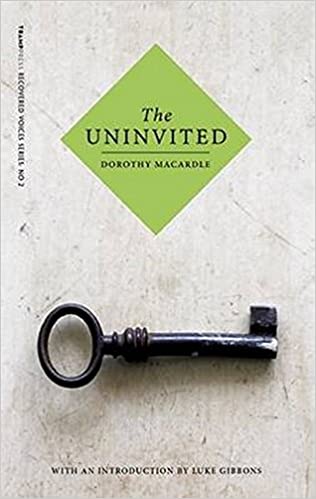
Review 1796: The Uninvited

The movie The Uninvited has long been the Halloween movie of choice for me and my husband. It is vintage 1930’s with Ray Milland and a great ghost story. However, I had not read the book until now.

Roderick Fitzgerald and his sister Pamela have been fruitlessly looking for a house in the west country that they can afford when they come across Cliff End. Although it needs work, it is so beautiful that they are sure they can’t afford it. However, it has not been occupied for 15 years, and Commander Brook reluctantly agrees to their price. He does say, though, that there have been “occurrences.”

All is well at first, and the Fitzgeralds are happy fixing up their house, but eventually the occurrences begin—a light in a room that had been the nursery, a sighing sound, the scent of mimosa, and more terrifying, an enervating cold in the studio and the attempt of an apparition to form. The Fitzgeralds begin to learn the story behind the home—that it belonged to the Commander’s daughter, Mary Meredith, and her artist husband, that an artists model died there after attempting to kill Mary, whom most people treat like a saint, and that Mary died soon afterwards.

The Fitzgeralds soon meet Stella Meredith, the Commander’s granddaughter, and befriend her. She has yearned to visit the house, but after she does, the manifestations grow stronger. Soon, the Fitzgeralds believe they have a choice between making the manifestations disappear by understanding what they want or giving up the house.

Although this novel didn’t really make my hair stand on end, it is a good ghost story. The characters are interesting, and the descriptions of the Devon coast are striking. I enjoyed the book very much.

Dark Enchantment

The Unforeseen

The Uninhabited House

Review 1792: #ThirkellBar! Before Lunch

Before Lunch is one of Thirkell’s Barsetshire Series that I have not read before. It possesses both the charm and slightly acid humor of the previous novels and a new sense of sadness.

In this novel we meet the Middletons. Jack is a trying man who often has to be soothed by his wife, Catherine. Jack’s sister Lilian Stoner, a young widow, is coming to stay in an adjacent house with her stepchildren, Denis and Daphne, who are almost as old as she is. The three have a loving relationship, all understanding that Lilian’s marriage was a difficult one.

The major focus of the plot in this novel is who will Daphne marry, for she meets two men she likes very much. Mr. Cameron is the partner of Lord Bond in their architectural firm. Although he is in his forties, Daphne thinks he’s the nicest man she knows. Cedric Bond, Lord Bond’s son and heir, also gets along with Daphne very well, but Daphne keeps hearing about another young lady named Betty in connection with him. Both men are smitten by Daphne.

Along with this plot, a lot is going on. The overbearing Lady Bond is leading a protest against the unwitting purchaser of a parcel of land called Pooker’s Piece (I love the place names in this series, particularly the oft-mentioned “Winter Overcotes”), where he plans to erect a tea shop and a garage (which rumor eventually converts to a road house). The countryside is outraged, as it is a favorite place for rambling.

The entire county is also preparing for the Agricultural Show, and Daphne talks cows with the best of them. She also takes a secretarial job with Lady Bond.

Denis takes a liking to Lord Bond, who is as kind as he is long-winded. Denis has been an invalid, but in the summer country air he begins to improve, and he is looking for backing for a ballet for which he is composing the music. He treats Lord Bond to Gilbert and Sullivan evenings when Lady Bond is away. He also has a secret of the heart.

Catherine and Lilian begin a friendship that is comforting for them both. We also briefly meet some of the characters from previous books, including Lord Pomfret, now a grieving widower, the Leslies, and Roddy Wicklow. And Thirkell does not fail to provide another irritating character (besides Lady Bond), Miss Starter, an ex-royal attendant who fusses constantly about her diet.

I think I liked this novel best so far, but I know one of my favorites, Cheerfulness Breaks In, is coming up.

The Brandons

Pomfret Towers

Summer Half

Review 1790: Mrs. Tim of the Regiment

I accidentally read Mrs. Tim Gets a Job first, but when I discovered it was third in a series, I decided to read the rest in order. Mrs. Tim of the Regiment is the first.

Hester Christie (Mrs. Tim—I didn’t discover her first name until I read this book) leads an active and happy life where her husband’s Scottish regiment is based in Southern England. However, her life is upended when her husband is temporarily transferred to Westburgh, Scotland. She must find a house, move, and then try to create a new social life. She feels especially close to her neighbor, Mrs. Loudon.

It isn’t long, though, before her husband gets his majority, which means they must move right back to where the regiment is stationed. Tim is sent back almost immediately, while Mrs. Tim prepares for the move. Before she leaves, though, she is invited to see the real Scotland by staying with Mrs. Loudon farther north.

At first, with its diary entry format, this novel was so full of little everyday events that, even though amusing, it began to seem too like the Provincial woman series. However, it eventually develops more of a plot, in particular, Hester’s attempts to help Mrs. Loudon, whose son Guthrie has fallen for an unsuitable young lady.

Although written in 1940, Mrs. Tim of the Regiment is set earlier. The exact year isn’t stated, but the soldiers all have relatively recent memories of World War I. This is a charming novel, although it does have some snobbery toward some wealthy acquaintances. However, Hester is a lively, likable heroine.

Mrs. Tim Gets a Job

Miss Buncle’s Book

Miss Buncle Married

Review 1788: Miss Plum and Miss Penny

At 40, Miss Penny leads a full life in the village. She has her village activities and her two close friends, Hubert, the vicar, a timid widower with a son, and Stanley, a self-pleasing fussy man. Miss Penny always receives a birthday letter from George, the suitor her parents disapproved of, but this year it doesn’t arrive. Miss Penny is hurt and begins to wonder what her life would be if she had left with George.

On her way to the movies, Miss Penny stops a woman from drowning herself in the duck pond. When she finds out the woman has no money and nowhere to go, she takes her home and is soon nursing her through an illness. Miss Plum turns out to be a whiny neurotic who bursts into tears and complains about her hard life. She also shows a tendency to hero-worship Miss Penny.

This darkish comedy shows an insight into human character, for you needn’t make the mistake of thinking Miss Penny’s efforts are rewarded with gratitude. In fact, she is soon consumed by only one thought—how to get Miss Plum out of her house.

This fun novel is filled with eccentric characters. I enjoyed it a lot and was happy to read it for my Classics Club list.

O, The Brave Music

The Stone of Chastity

All Done By Kindness

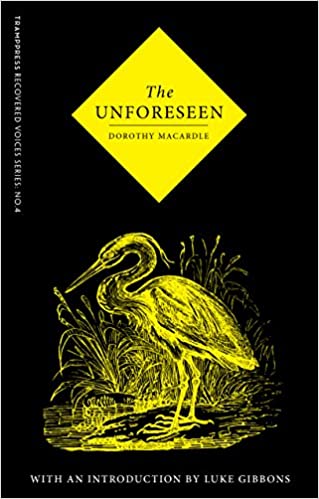
Review 1786: The Unforeseen

Although I haven’t yet read Dorothy Macardle’s The Uninvited, the movie based on it remains one of my favorites for Halloween. I didn’t realize that The Unforeseen is not a sequel to it but a follow-up and that a few of the characters make a reappearance. So, I’m reading and reviewing out of order.

Virgilia Wilde cannot afford to live in the city while she is sending her daughter Nan to art school in London, so she buys a cottage in the wilds of Wicklow. There she enjoys herself rambling the countryside and working on a children’s book about birds. However, she begins having strange experiences. First, she thinks she is seeing ghosts—a shadow in the doorway when no one is there, a telegram being delivered when one isn’t. She fears she is losing her mind so consults Dr. Franks, a psychiatrist. But he thinks there is nothing wrong with her. He consults his son Perry, who is a doctor with an interest in parapsychology, and eventually they realize that Virgilia is having visions of the future.

In the meantime, Nan has a frightening encounter with a sculptor and decides to come home for the summer while she works on illustrations for a book. Virgilia doesn’t want Nan to know about her visions, but soon she has some frightening ones.

This is a good little thriller with a supernatural angle to it. It has convincing characters and beautiful descriptions of the Irish countryside, reflecting the relative peace of Ireland during World War II.

Dark Enchantment

The Uninhabited House

The Victorian Chaise-Longue

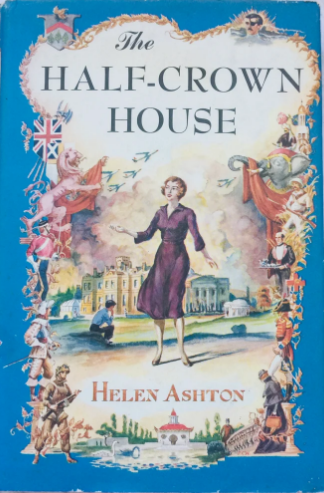
Review 1785: The Half-Crown House

The Half-Crown House is Fountain Court, a once-stately home that has fallen into disrepair after years of money and estate mismanagement and crippling death taxes. Its heir is Victor Hornbeam, a little boy who is coming to live there for the first time, his widowed mother preparing to marry. The property has been supported for years by Victor’s young aunt, Henrietta, who opens the house for viewing, and her cousin Charles, wounded during the war, who runs a market garden. They are struggling to support the estate so that they can hand over something to Victor when he comes of age. The only other family member living in the house is their grandmother, now bedridden, whose ferocious spending and mismanagement has bankrupted the family.

As the novel opens, Victor is arriving on one of the visitor’s days. Henrietta has a wealthy American suitor who wants to buy one of the valuable paintings, and she is hoping to sell it. However, that morning her grandmother tells her that it, along with many of the other paintings and jewels in the house, is a worthless copy that she had made when she needed to sell the original to pay her debts.

The household is wondering if Henrietta will marry the American, but it was apparent to me early on that her heart lay elsewhere. That only increases the little bit of suspense around this decision.

This novel is a meandering one. At times, it is much more concerned with the past elegance of the house and the events of the long-dead Hornbeams than with the living, for it goes off into little vignettes either through the memories of its inhabitants or during the descriptions of its current state. Thus, it particularizes the postwar state of the country, when many large homes were being dismantled or sold.

It’s an odd little book that reminded me a bit of Lady Rose and Mrs. Memmary and a couple of Rumer Godden novels that center around a house over the generations.

Lady Rose and Mrs. Memmary

China Court

A Harp in Lowndes Square