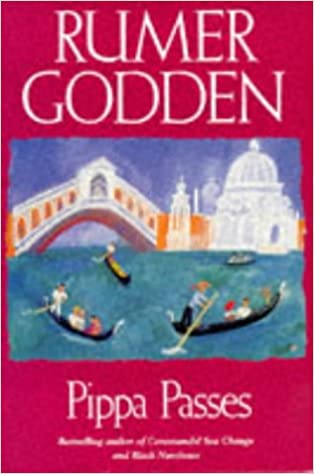
Review 1712: Pippa Passes

I have been reading the Indian novels of Rumer Godden, so I’m not quite sure how Pippa Passes got in there. It was published in the 1990’s and is set mostly in Venice. It doesn’t seem to have much to do with the Browning poem except by its being about a young, innocent girl. It does relate, however, to many of Godden’s novels that have a theme of the loss of innocence.

Pippa Fane is a 17-year-old ballet dancer who is new to the corps de ballet of an up-and-coming company from the English Midlands. The company is getting ready to tour Italy, and Pippa, as the newest member, doesn’t expect to be invited to come, but she is, at the insistence of Angharad Fullerton, the ballet mistress. Pippa’s friend, Juliette, warns her to beware of Angharad, but since the mistress has only been kind to Pippa, she pays no attention.

Pippa is enchanted at first sight of Venice and disappointed that Angharad expects the girls in the corps to do nothing but work and rest. When the other girls try to get her to go out the first night, she argues that Angharad told them to stay in and is left behind and taunted as Angharad’s pet. But instead, Angharad and the other company leaders take her out when they find she’s been abandoned.

Pippa’s star is beginning to rise with the company, but she has also met a gondolier named Niccolo who fascinates her. The company gives her a solo part after another dancer is injured, and at the same time Niccolo wants her to sing with his band.

I wasn’t as interested in this novel as I have been in the others by Godden that I have been reading. For one thing, it seems absurdly outdated for the 90’s, as Niccolo and his band make a splash dressed like gondoliers and singing such songs as “Santa Lucia” and “I Feel Pretty” from West Side Story. Yet, there’s no indication that the novel is set earlier. Also, although the information about the workings of the ballet company is interesting, I don’t think it was necessary to include pages describing the action of The Tales of Hoffman. And for the 1990’s, Pippa seems far too naïve about the intentions of both Angharad and Niccolo, and some readers may understand the novel as slightly homophobic. It’s possible that the novel was written many years earlier, but then there should have been some indication that it was set, say, in the 1950’s, if it was.


Related Posts

The Peacock Spring

The River

Death in Venice

Review 1710: Classics Club Spin Result! The Woods in Winter

I might have saved The Woods in Winter for a chillier time of year, but its number was chosen for me for the latest Classics Club spin. It’s a lovely tale.

Ivy Gover (not Gower, as it says on the back cover of my Furrowed Middlebrow edition), three times a widow and a charwoman, is living in a tidy but small North London flat when she receives a letter. Not being able to read well, she takes it to her employer, Miss Helen Green, who tells her she has inherited her great-uncle’s cottage out in Buckinghamshire for her lifetime.

Ivy abruptly moves to the country but not before stealing a neighbor’s dog that she has heard barking for months and finds living in its own dirt. Although the cottage is primitive and has a hole in its thatch, she moves right in and begins befriending the local animals. For she has a touch with wild things and for healing, as Lord Gowerville finds out when she magically cures his dying dog. The next day, he sends someone over to fix the thatch in her roof.

As Ivy befriends the birds, a fox, and eventually a boy, her neighbors also have their adventures. The vicar is suddenly taken with Pearl Cartaret, one of two sisters who open a tea shop. Helen is sometimes nearby pursuing an affair with an elusive young man. Angela Mordaunt, a “spinster” brought up by her mother more as a well-bred boy than a girl, catches the eye of Sam Lambert, a kind farm laborer.

This novel was the last one published (in 1970) during Stella Gibbons’ lifetime and displays a longing for the England of 40 years before, when most of it is set. I just loved it. It is funny yet astringent, has some engaging and other very lifelike characters, and contains lyrical descriptions of the countryside around Ivy’s cottage as well as a conservationist conclusion. Ivy herself is a spunky individualist. I liked her a lot.

Nightingale Wood

A Pink Front Door

Bramton Wick

Review 1706: Milton Place

Milton Place is sort of an update of King Lear—set in the 1950’s. It is partially drawn from de Waal’s experience and is one of two novels published posthumously.

Mr. Barlow, the elderly owner of Milton Place, receives a letter one morning from Anita Seiler. She is the daughter of a girl he fell in love with long ago in Austria, but unfortunately he was already engaged. Anita tells him that she no longer has ties in Austria and would like to come to England, asking him to recommend her to someone for work. He writes back inviting her to stay.

His daughter Emily is a busybody who thinks it’s time he sold Milton Place and moved somewhere smaller where he can be more comfortable. It’s true that the place is cold and shabby, but Mr. Barlow is comfortable in the few rooms he uses and loves his garden. However, Emily is already setting out on a plan to have the county request the house for a home for unwed mothers. When Emily hears about the new house guest, she is certain that Anita is after her father’s money.

Anita and Mr. Barlow get along beautifully, and he wants her to stay. She feels uncomfortable staying as a visitor, so she begins cleaning all the vacant rooms and making the house more cheerful.

Things change, though, with the arrival of Tony, Mr. Barlow’s beloved grandson, on break from university.

One plot line of this novel bothered me a bit. I want to be a little mysterious about it, but my difficulty hinges on how adult an 18-year-old boy is. I admit there is probably a difference of opinion on this, that clearly in the novel there is, and that this idea changes over time. That is, an 18-year-old of either sex is now considered less of an adult than they would have been then, and then less than 50 years before.

This caused a problem for me, but I found the novel beautifully written and affecting.

A Thousand Acres

King Lear

The Hare with Amber Eyes: A Hidden Inheritance

Review 1704: The Peacock Spring

Una, who shows promise for studying mathematics at university, has only two more years to prepare, having fallen behind because of all her moves between different schools with her diplomat father. Then, just as she’s feeling she will stay at Cerne, her father suddenly summons her and her sister Hal to India. They are to have a governess.

Una is sorely disappointed at this behavior that is so unlike Edward. Then she meets the governess, Alix, a beautiful Eurasian who orders around the servants and calls her father Edward. Soon she figures out that Alix is woefully uneducated. She does not know the difference between mathematics and arithmetic, and her idea of studying literature is to look at pictures of works cut from a magazine, not to read the works themselves. It becomes clear to Una that the girls are in India to hide from society that Edward and Alix are lovers.

Unbeknownst to anyone in the house, the second gardener, Ravi, is an ex-university student and poet on the run from the law after a demonstration. When he realizes Una is struggling to teach herself calculus, he offers help. He cannot help her, but his friend Hem can. So, Una begins sneaking out to meet Hem and Ravi.

This novel was another stunner from Godden. It overloads the senses with sights and smells as Alix tries to hide her past and Una strays from her goals.

Related Posts

The Lady and the Unicorn

Kingfishers Catch Fire

Coromandel Sea Change

Review 1702: The Two Mrs. Abbotts

The Two Mrs. Abbotts is the third Miss Buncle book. Barbara Buncle is, of course, one of the Mrs. Abbotts, and the other one is Jerry, the wife of Barbara’s husband’s nephew. It is 1942, and Sam, Jerry’s husband, is serving in Egypt. Jerry has allowed an army unit bivouacked on her property to use her kitchen.

The novel begins with a pleasant coincidence, for the dreaded Red Cross lecturer that Barbara is supposed to host turns out to be Sarah, an old friend. Sarah accompanies Barbara to a charity bazaar where the famous author Janetta Walters is appearing. Barbara’s husband is Walters’ publisher, but he doesn’t much like her books.

This novel has a rather meandering plot that checks in with old friends and introduces new ones. There are some funny scenes with Barbara’s children, Simon and Fay, and the novel spends some time with Markie, Jerry’s old governess turned housekeeper. However, much of the novel deals with what happens after a young man pressed into attending tea with Janetta Walters tells her he doesn’t like her books, but he’s sure she could write good ones.

The Buncle books are good fun, with appealing characters, humor, and a lot of fluff.

Miss Buncle’s Book

Miss Buncle Married

Mrs. Tim Gets a Job

Review 1700: #ThirkellBar! Wild Strawberries Recap

Cover for Wild Strawberries

It’s time for our reviews of the second Barsetshire novel, as we read Angela Thirkell’s Barsetshire series in order! In this case, I had already reviewed Wild Strawberries some time ago.

I looked at my original review of Wild Strawberries to see if I have anything to add for this reread. I don’t, except to point out how vividly Thirkell has depicted her characters. Lady Emily, for example, is equally adorable and frustrating. That first scene in church is a comic masterpiece, enough to make even the reader impatient with her, yet her family shows no sign of frustration, only affection. Most of Thirkell’s characters are funny, even our heroine Mary in her childish infatuation with David, and some of them, like managing Madame Boulle or finagling Mr. Holt, are hilarious. Or Agnes, so infatuated with her children that she heartily bores everyone else. Only John remains as the straight man.

I liked this book even more this time through but found the ridiculous errors in my Moyer Bell edition, which didn’t even employ a spell-checker, even more frustrating. Sadly, the Virago edition was not yet out in paperback when I reread this one (now it is).

Related Posts

Wild Strawberries

High Rising

Pomfret Towers

Review 1697: Black Narcissus

Best of Ten!

After reading Coromandel Sea Change, I decided to find more of Rumer Godden’s India novels and read them. Black Narcissus was the first (although I have already reviewed a few of the others), and I found it mysterious and haunting.

Sister Clodagh and a small group of Anglican nuns arrive at a palace above a remote Himalayan village to establish a convent, hospital, and school. The abandoned palace once was the home of the General’s father’s harem. He first gave it to religious brothers for a boys’ school, but after only five months, they left with no explanation.

From the first, the place seems to affect the sisters oddly. Sister Clodagh finds herself dreaming about Ireland and Con, whom she thought would marry her long ago. Sister Philippa, the gardener, becomes involved with the flower garden, to the neglect of the vegetables and the laundry. Sister Honey becomes too involved with the children. Sister Ruth, always difficult, becomes obsessed with Mr. Dean, the General’s agent. The sisters occasionally begin to forget their devotions.

Mr. Dean has warned the sisters about possible cultural misunderstandings with the villagers, but although they sometimes make an attempt to understand the natives, mostly the sisters heedlessly continue on their agendas. The sense of foreboding grows.

This is an absolutely terrific novel, very atmospheric, in which the brooding mountain across from the convent becomes almost godlike, certainly a character. I was so rivetted, I stayed up late into the night until I finished it.

Kingfishers Catch Fire

The River

Coromandel Sea Change

Review 1695: The Bridge of the Gods

A friend who knew I was writing a story set locally before the arrival of white men gave me The Bridge of the Gods, which was written in 1899 as a result of Balch’s years of collecting Native American folklore and customs in Oregon. The novel is based on a legend about a bridge of stone across the Columbia.

The novel begins in 17th century Massachusetts, where Reverend Cecil Grey feels the mission to preach Christianity to the indigenous people of the West and dreams of a huge stone bridge over a river. His wife having died, he sets off to do just that, accompanied by his Native American nurse.

Eight years later, Multnomah, chief of the Willamette tribe, decides to test his allies. His tribe is the leader of a confederation united against their enemies, the Spokanes and the Shoshoni. The ascendancy of the Willamettes is prophecied to last until the Bridge of the Gods, a massive stone arch over the Columbia River, is destroyed. However, Multnomah has been hearing that some tribes want to leave the confederation. He decides to summon all of the tribes for a great council on Wappatta Island (now Sauvie Island).

Multnomah has a beautiful daughter, Wallulah, whose mother was an Asiatic princess shipwrecked at the mouth of the Columbia. Multnomah wants to betroth her to Snohomish, chief of the Cayuses, to cement their alliance. Wallulah, having seen Snohomish once, is not averse—until Cecil Grey comes on the scene.

I didn’t expect much from the attitudes of this book, considering when it was written, and I didn’t get much. Despite the young Balch having been interested enough to travel around and interview indigenous people, they are referred to constantly as savages, their traditions are treated with abhorrence, their villages are described as degraded, they are shown as violent and cruel. Even Multnomah, who compared to Snohomish is a good guy, is depicted as obdurate and cruel. Grey’s faithful nurse doesn’t even have a name.

Only Wallulah escapes this treatment, but note that she is half “Asiatic” (and a confused half at that, for her mother is said to have taught the Willamettes something about Buddha but calls god Allah). Her mother is described as white. Wallulah is herself a typical late 19th century romantic heroine, fragile and weak and a completely unlikely indigenous woman.

Although this novel is billed as a romance, Grey’s struggle is between his mission and Wallulah (even though they do not seem mutually exclusive), and since Grey is a zealot, Wallulah doesn’t have much of a chance. This is actually a romance in the older sense of the word, an adventure novel.

Since Balch went to so much trouble to personally speak to indigenous peoples and collect stories, I was hoping this book would be a little more enlightened—say, perhaps, written by someone who actually liked the people. It wasn’t. If you’re interested in an older book based in the life of indigenous peoples, I recommend The Loon Feather.

Related Posts

The Loon Feather

Caleb’s Crossing

One Thousand White Women

Review 1694: The Lady and the Unicorn

The Anglo-Indian Lemarchant family lives in the annex of a crumbling mansion in Calcutta. Belle, the oldest daughter, is beautiful, fair, and charming, with the reputation of a saint but a character lacking in morals. She is determined to do whatever it takes to get rich, which, for her, means marrying the right man. Rosa, the second daughter, is fair and gentle. She tells lies when she is scared, so has a worse reputation than Belle even though she is much more moral. Blanche, the youngest, is dark in complexion and generally treated disdainfully because of it but is the most honest.

At a party, Rosa meets Stephen Bright, a British young man who treats her respectfully and seems different than the others. But he is new to India and doesn’t understand how he’s expected to behave in 1930’s India. While he is dating Rosa, he becomes interested in the old mansion, where they find evidence of French nobility having built it.

Out in the garden at times Rosa and then several other characters see a sobbing woman and a little dog. Others report seeing a carriage departing from the house. These appear to be ghosts.

This novel is an unusual case of a doomed romance and an ancient mystery. I liked it, but it seems more cynical than Godden’s other Indian novels, though they often have sad endings.

Related Posts

The River

Breakfast with the Nikolides

Kingfishers Catch Fire

Review 1690: Tension

When Sir Julian, who is on the board of the local commercial and technical college, mentions the name of the new Lady Superintendent to his wife, she recognizes it. She believes Miss Marchrose is the young woman who jilted her cousin.

Lady Rossiter’s belief in her own kindness conceals her meddlesome and ill-natured personality even from herself. She dislikes Miss Marchrose on sight. When she sees a friendship growing between Miss Marchrose and Mark Easter, the popular Superintendent, she makes it her business to spread insinuations about Miss Marchrose’s character.

Sir Julian likes Miss Marchrose and disapproves of his wife’s interference in the running of the college. I kept waiting for him to step in and stop her.

This novel, while it sparkles with wit and contains several comic characters, is about the serious subject of the damage of loose talk and gossip. Don’t look for a silly romantic novel here. I was rapt by this novel, as I found Miss Marchrose gallant and detested Lady Rossiter’s hypocrisy and self-deception.

That being said, the novel contains some very funny characters, for example, silly Iris Easter, the author of a novel entitled Why Ben! A Story of the Sexes, and her pseudo-Scottish lover, Douglas Garrett, or Mark Easter’s horrendously behaved children, Ruthie and Ambrose, alias Peekaboo. This is another excellent book from the British Library Women Writers series.

I received this book from the publisher in exchange for a free and fair review.

Related Posts

Consequences

Diary of a Provincial Lady

The Provincial Lady in London