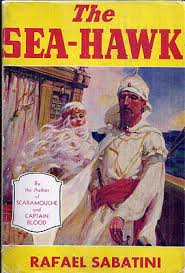
Review 1687: The Sea-Hawk

Sir Oliver Tressilian is in a good place. As one of Elizabeth I’s privateers, he has made a fortune and gained the Queen’s favor. He is also engaged to marry the woman he loves, Rosamund Godolphin, or at least she has promised herself to him. When he calls on her brother Peter to ask for her hand, though, Peter refuses it, determined to keep up the feud begun between their parents. Indeed, he is insulting to the proud Sir Tressilian, so much so that Oliver would have killed him had he not promised Rosamund he would not.

Peter’s refusal seems of little moment to Oliver, because Rosamund will soon be of age. When Oliver’s brother Lionel returns home, however, he has fought with Peter without witnesses and killed him. Oliver promises to protect him but later learns that the wounded Lionel left a trail of blood to his door and everyone thinks Oliver murdered Peter. When Oliver tries to speak to Rosamund, she refuses to hear him. He is able to prove he is innocent to a magistrate and a minister because he has no wounds, but Rosamund will not listen.

Lionel becomes frightened that Oliver will tell the truth, so he arranges with a shady sea captain, Jasper Leigh, to kidnap Oliver and sell him into slavery. Jasper Leigh actually intends to let Oliver buy himself back, but their ship is taken by Spain and both Oliver and Jasper end up as galley slaves.

When next we meet him, Oliver is named Sakr El-Bahr, the Sea-Hawk, for his famous acts of piracy. He has adopted Islam and is a chief of Asad-ed-Din, Basha of Algiers. He learns that his brother and Sir John Killigrew have had him declared dead and Lionel has taken over his property and his former fiancée. Upon hearing this, Sir Oliver sends a messenger to Rosamund with the proof of his innocence in her brother’s death, but she throws it unread into the fire. Oliver is overcome with anger against both Lionel and Rosamund. How will it end?

I thought this was a very interesting swashbuckler, mainly because both the hero and heroine have more dimensions than in the usual adventure tale. There are times when both of them behave very badly, and I especially disliked Rosamund for much of the book because she was so quick to distrust Oliver. However she is also more brave and self-possessed than the majority of adventure story heroines. They get into some seriously exciting situations.

This is my last book from my second Classics Club list, which I have finished a couple of weeks late, so I’ll be publishing another list tomorrow.

Related Posts

The Lovers of Yvonne

Blood & Sand

Treasure Island

Review 1684: #ThirkellBar! High Rising

I have long been saying I will read Angela Thirkell’s Barsetshire novels in order, but I just keep potting way at them as I encounter them. So finally, I decided to go back and read them all, in order, and I hope some others of you will join me at least part of the way. High Rising is the first one.

Mrs. Morland is a widow who has supported her three sons by writing what she calls “good bad books,” featuring skullduggery in the fashion industry. Her old friend, George Knox, is a widower and also an author, of serious historical works.

It is Laura Morland’s habit to work in London while her young son Tony is in school and come to High Rising when he is on holiday. When she and Tony arrive for the Christmas holidays, she learns there is a disturbing new resident at Low Rising. It is George’s new secretary, Una Grey, who is efficient and sweet to George but behaves officiously as if she were the mistress of the house even to George’s quiet adult daughter, Sybil. It is clear that Miss Grey is aiming at marriage with George, and she immediately treats Mrs. Morland as an enemy and rival.

The plot of High Rising is mostly concerned with this situation, but it also introduces more sympathetic characters. There is Miss Todd, who has been doing all the caretaking of her dying mother and works half-time as a secretary for Mrs. Morland. Dr. Ford is in love with her but thinks the difference in their ages makes him ineligible. Miss Todd herself believes she is the type of woman that men don’t marry.

Adrian Coates is Mrs. Morland’s editor. Although he is a good deal younger than she is, early in the novel he proposes. But Laura has no interest in marrying again and thinks he will make a much better match for Sybil Knox.

There are lots of characters, but one of the funniest is Tony, Laura’s single-minded young son. He is absolutely besotted with railways, and Thirkell does a great job of making him a believable motormouth of a boy.

Most of Thirkell’s books are notable for a subtle wit, but this one is a lot funnier than I remembered. I also felt really invested in the problems of these characters. This novel makes a nice start to the series.

So, who read High Rising along with me, and what did you think?

Related Posts

A Winter Away

Bramton Wick

The Native Heath

Review 1681: Mamma

Diana Tutton only wrote three books. All of them feature dysfunctional families, although Guard Your Daughters is a quirky but relatively traditional romantic novel. Mamma is more unusual.

Joanna has been a widow for 20 years, because her husband died unexpectedly in the early days of their marriage. Although only 41, she has a 20-year-old daughter, Libby, with whom she has a close and loving relationship.

Joanna has just moved when Libby comes for a visit and informs her that she is getting married—to an Army major named Steven. The marriage is to be soon, because Steven expects to be deployed overseas within a few months.

At first, Joanna is not sure what attracted Libby to Steven. She finds him unattractive, and at 36, he is closer to her age than Libby’s. However, circumstances throw them together to live with her, and she begins to understand that she and Steven have more in common than Steven and Libby. With her feelings for Steven growing, Joanna must figure out how to navigate this emotional situation.

Tutton depicts these relationships skillfully, in a way that makes you feel only sympathy for the characters. It is an empathetic and emotionally astute portrayal.

I received a copy of this novel from the publishers in exchange for a free and fair review.

Related Posts

Guard Your Daughters

Expiation

Mary Lavelle

Review 1679: Evelina

I haven’t read much 18th century fiction, but when I made my Classics Club list, I wanted to pick books from a variety of centuries. So, I picked Evelina.

Evelina’s heritage is unfortunate. Her grandfather married a vulgar woman much below his class and died without providing for his daughter, Caroline, leaving everything to his wife. When Caroline was old enough, her mother tried to force her to marry a cousin. Caroline instead eloped with Lord Belmont, but when her grandmother cut her off without a penny, Lord Belmont threw her off and denied they were legally married. After her mother’s death, Evelina was raised in isolation by the elderly Reverend Mr. Villars, who had been her grandfather’s tutor and had also raised her mother.

When Evelina gets an invitation from Lady Howard to visit London, Mr. Villars is reluctant to let her go because of her family history. But Mrs. Mirvan, Lady Howard’s daughter, offers to take great care of her. Evelina makes some social errors at her first appearances, for example, agreeing to dance with Lord Ormond when she has already turned down Lord Lovel.

Evelina is immediately attracted to Lord Ormond but she is barely able to speak to him at the dance and keeps making mistakes or having people impose upon her, so that she fears she creates a wrong impression. She herself is the typical 18th century heroine, virtuous, compliant, and innocent.

Later, her vulgar and coarse grandmother, Madame Duval, appears in London and demands her attendance. Evelina meets a series of ill-mannered and socially inferior cousins who keep putting her into embarrassing situations.

This novel is a social satire that pits the innocent, gentle Evelina against a number of snobbish or sexually aggressive members of the upper class and against the crassness of her relatives in the merchant classes. Some modern readers may struggle with the elaborate speech. That didn’t bother me, but my patience was a bit tried by the middle section of the book, in which Evelina is on a long visit to her grandmother and rude cousins. In that section as well as those featuring Captain Mirvan, I had a hard time believing anyone would behave so badly.

Related Posts

The Expedition of Humphry Clinker

Georgiana, Duchess of Devonshire

The Mermaid and Mrs. Hancock

Review 1675: Kingfishers Catch Fire

Best of Ten!

Before she is even eight years old, Teresa has learned to put her head down and cry when her mother has an idea. Sophie Barrington-Ward is feckless, naïve, doesn’t listen to anyone else, and only sees what she wants to see. Widowed and left relatively poor after paying off her husband’s debts, she has worked so hard at jobs she’s not qualified for that she gets sick. Recovering, she has an idea. The Kashmiri peasants are poor, but they are healthy and well-fed. Why not rent a house in the Kashmir countryside and live like a peasant?

Of course, she has no ability to live like a peasant and has no understanding of just how poor the villagers are. As she settles into her house in the high Himalayas, she doesn’t notice that the villagers are vying for opportunities to make money from her. She consistently overpays and doesn’t listen to the advice of her landlord or his caretaker, Nabir. More dangerously, she doesn’t realize that there are two feuding factions in the village, the Sheikhs and the Dārs.

Teresa knows that it is Nabir who keeps them safe, particularly herself and her little brother Moo. But Nabir has a pride and aloofness that makes him seem insolent. And he has people working against him, including Sultan, the incompetent house servant Sophie brought from the city. Over time, a dangerous situation evolves.

Like the other India-based novels by Godden I’ve been reading lately, Kingfishers Catch Fire is freighted with a love of this region that does not miss its cruelties. Its descriptions are lush. Its heroine is complex. At first frustrated by Sophie’s faults and her lack of understanding of her daughter, I eventually came to admire her. Although I thought Black Narcissus was wonderful (I haven’t reviewed it yet), I think this novel is even better.

The afterword notes that this novel is one of Godden’s mostly autobiographical, and it includes a short section of excerpts from Godden’s Kashmir diary.

The River

Breakfast with the Nikolides

Coromandel Sea Change

Review 1670: Classics Club Spin Result! The Brothers Karamazov

I selected The Brothers Karamazov for my Classics club list because I read it many years ago for Russian Literature and found it fascinating. I was curious how I would regard it now.

The plot of the novel is seemingly straightforward, but it is complicated by the characters’ relationships and several subplots, some of which are only tangentially related. Fyodor Karamazov has three sons whom as children he left to be raised by the servants. The oldest, Dmitri (or Mitya), is an ex-soldier whom Fyodor has cheated of part of his inheritance from his mother. Now, although Dmitri is engaged to Katarina, a girl of high moral values, he has fallen madly in love with Grushenka, a girl with an unsavory past, and Fyodor is trying to compete for her. The second oldest, Ivan, is a cold intellectual atheist. The third son, Alexei or Alyosha, is studying to be a monk.

In my old Penguin Classics edition, the novel is split into two volumes. It is not until the second volume that the action takes place that is the centerpiece of the novel. Fyodor is murdered. Mitya has been working himself into a frenzy and making threats so is immediately the prime suspect. Did Mitya kill his father or was it someone else? If so, who?

We readers know what Mitya did that night, so we can answer the first part of that question but not the second part, at least not right away. Dostoevsky (I’m going to use the spelling of his name that I’m accustomed to, and that indeed is on my old Penguin copy rather than the one shown on the title page above) isn’t interested so much in that but in what happens next. And ultimately he is engaged in pitting atheism against belief in God.

In my student days, I found the long philosophical passages in this novel fascinating. These days, I don’t have as much patience with them and I actually skipped a couple of chapters once I got their drift. The amount of time spent on Father Zossima, for example, a relatively minor character who dies in Book One, is a little inexplicable to me now. I can’t help feeling he might have been based on a real person whom Dostoevsky revered, but his presence in the novel doesn’t seem important enough to warrant several chapters being devoted to his life and sayings.

This is not to say that I didn’t find the novel compelling. Although it is long and sometimes difficult, there was something about it that made me want to keep reading it.

The novel is written with an unusual approach to point of view. The narrator is an unidentified person from “our town.” But the narrator is privy to scenes he could not possibly have witnessed. Yet, the point of view is not omniscient. For example, we see what Mitya does on the night of the murder even though there is no actual witness to that, but we don’t see the murder.

As usual with Dostoevsky, most of his characters are in a frenzy. Were 19th century Russians really this excited? Well, they’re not in Tolstoy, but most of Tolstoy’s characters are upper class, while Dostoevsky’s are not. So, I don’t know whether this is a class difference or a difference in the author’s perceptions or what. And speaking of class, the attitude toward peasants here is not great, and there are also other politically incorrect comments on occasion. Just a warning.

The Brothers Karamazov is considered Dostoevsky’s masterpiece, so if you are interested in Russian literature, you should definitely read it. Dostoevsky’s preoccupations are not mine, however, and I think even less so as I get older. I couldn’t help parsing some of the arguments and thinking about an implicit slant to them. The best example is an assumption—a sort of cognitive leap—that is very important to the plot and is stated several times by different characters. The cognitive leap is that if God doesn’t exist, “everything is permitted.” Only one character questions this assumption—that there is nothing within humans besides religion to stop them from doing horrendous things. But his suggestion is brushed aside because Dostoevsky wants you to conclude that there is a God and his arguments don’t work as well if you believe in inner goodness or inherently moral or ethical behavior. I guess.

Related Posts

The Idiot

The Kreutzer Sonata Variations

The Possessed: Adventures with Russian Books and the People Who Read Them

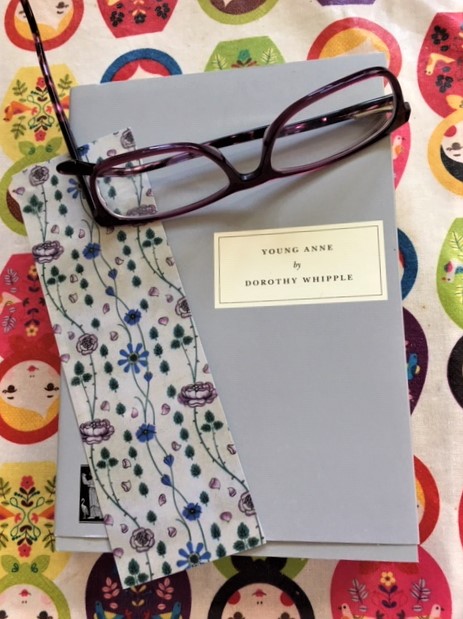
Review 1669: Young Anne

Young Anne is Dorothy Whipple’s first novel but unfortunately is the last one I’ll be reviewing, because I’ve read and reviewed them all. Like many first novels, it is at least somewhat autobiographical.

We meet Anne at age five and see her again at eleven and eighteen before the bulk of the novel when she is an adult, but these ages are enough to get to know her. At five, she is prone to misunderstand her parents. Her father is severely critical of her while he spoils his oldest son. He is a martinet, and Anne becomes defiant of him as she grows older. Her mother doesn’t care about anything happening in the household.

As Anne gets older, she becomes quite naughty, but she is sent away to school because she laughs at her father while he is singing. This is shortly after she destroys her father’s copy of Boswell and knocks all the berries off a holly bush while getting carried away playing schoolteacher.

As a young woman, Anne loses her father, and the household is broken up. She is sent to live with her Aunt Orchard, who constantly complains about her ingratitude. Her only comfort is the maid, Emily, who has always been her staunch supporter and follows her to work in Aunt Orchard’s house. That and her friendships with Mildred and Mildred’s cousin George.

I found the character of Anne very appealing as she, in her straightforward way, has trouble navigating in society. Some of the scenes, especially with Mildred’s kind but social-climbing mother or the one where Aunt Orchard reveals her true self to the rector, are quite funny. This novel seemed true to life and was sometimes very touching. I liked it a lot.

Related Posts

Greenbanks

High Wages

Because of the Lockwoods

Review 1666: The Winged Horse

It’s going to be hard to describe this novel without either giving too much away or being too vague. The description on the Virago back cover focuses too much on the role of business tycoon J. G. Baron, when really he is more the catalyst of the action.

Harry Levitt is an American on his way to England for a job with J. G. Baron. He and Baron’s entourage are on shipboard along with Baron’s oldest daughter, Celia, who has been living in the States but is now separated from her husband and moving home.

J. G. is an unlikable person. He surrounds himself with yes men and is hypocritical and self-deceptive. He dislikes two of his three children and terrifies the third. Celia is the only one who doesn’t try to please him, as she dislikes him back.

When we meet Harry, he is a practiced dissembler who feels insecure about his Midwest background so has invented Californian origins. Despite a bad start with Celia, while living in England, Harry develops a close relationship with her siblings Tobias and Liz and with their friend Anthony Carey, a mediocre sculptor known to the family as Thank-God-for-Anthony. Anthony seems perfectly assured and the only person who is not afraid of J. G. The Barons consider him the epitome of probity.

Harry, as he grows to love England and feel accepted, becomes calmer and more assured. However, there is a family tragedy, and subsequent events allow Frankau to explore themes of power, truth, and dishonesty.

At first I had trouble being interested in these characters, but eventually I became involved in this story. I did find irritating the way Frankau handled the characters’ inner thoughts, just as if they were dialogue, which seemed artificial. But this is a minor criticism.

I read this book for my Classics Club list.

Related Posts

They Knew Mr. Knight

Because of the Lockwoods

Consequences

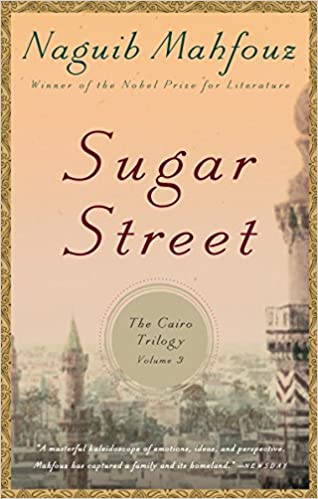
Review 1665: Sugar Street

Sugar Street is the third book in Naguib Mahfouz’s Cairo Trilogy and in many ways the weakest. Although it spends some time with Kamal, it goes on to the next generation and deals mostly with Kamal’s nephews.

The patriarch of the family, Ahmad Abdal-Jawad, although only in his early 60’s in 1935, has let his intemperate habits get the best of him and becomes more and more decrepit as the book goes on. We don’t see much of him or his wife, Amina.

Kamal has come to believe in nothing. He is an English teacher who writes difficult philosophical articles for a journal for no pay. His family urges him to marry, but he does not. He is not happy except in a few friendships with men he can exchange ideas with.

Aisha is a faded shadow of herself after the death of her husband and sons, so it is Khadiya’s and Yasin’s sons we follow for most of the novel as they get involved in politics. Abdal-Muni’m becomes a Muslim Nationalist, Ahmad a socialist, and Ridwan becomes involved with an important political sheikh in a way that seemed vaguely homosexual to me but perhaps wasn’t.

In any case, although you might think these different political alliances would provide more insight into the state of the country, the strangely formal and didactic conversations I mentioned in a review of the previous book assume too much knowledge for me and throw too many names around. On the other hand, what was missing from this novel were the intimate family relationships and strong individual characterizations. We never really get to know any of these nephews like we did the original brothers and sisters.

Finally, Kamal’s character is so mired in inaction that he brings every scene to a halt with his inner observations. When he finally sees the little sister of his boyhood love, Aïda, and fancies himself in love with her, first he creepily stalks her and then, finally, having won her attention, he backs off. Oh! I thought at first, something is going to happen! Not!

Related Posts

Palace Walk

Palace of Desire

The Map of Love

Review 1660: Breakfast with the Nikolides

Because of the war, Louise and her children are forced to return to her husband Charles in India for the first time in many years. There, they take up what is apparently a toxic relationship.

Louise is a fearful, sometimes hysterical woman who seems to dislike Emily, her 12-year-old daughter. Louise considers her sly and deceptive when in actuality Emily is very truthful but seems unable to behave naturally with Louise. Emily loves India, but Louise only sees its dirty and ugly sides, not its charm.

The situation between husband and wife and between mother and child comes to a head over Emily’s dog, Don. In a crucial moment, Louise chooses to lie to Emily rather than tell her the truth as Charles advises.

In general, I liked this colorful novel, which, as always with Godden’s India novels, is luminous in its descriptions and sympathetic to its characters. However, for modern audiences there is a recounting of a rape scene that is handled in a very problematic way. For me, it detracted a good deal from my enjoyment of the novel.

Related Posts

Coromandel Sea Change

The River

The Lives of Others