Review 1666: The Winged Horse

It’s going to be hard to describe this novel without either giving too much away or being too vague. The description on the Virago back cover focuses too much on the role of business tycoon J. G. Baron, when really he is more the catalyst of the action.

Harry Levitt is an American on his way to England for a job with J. G. Baron. He and Baron’s entourage are on shipboard along with Baron’s oldest daughter, Celia, who has been living in the States but is now separated from her husband and moving home.

J. G. is an unlikable person. He surrounds himself with yes men and is hypocritical and self-deceptive. He dislikes two of his three children and terrifies the third. Celia is the only one who doesn’t try to please him, as she dislikes him back.

When we meet Harry, he is a practiced dissembler who feels insecure about his Midwest background so has invented Californian origins. Despite a bad start with Celia, while living in England, Harry develops a close relationship with her siblings Tobias and Liz and with their friend Anthony Carey, a mediocre sculptor known to the family as Thank-God-for-Anthony. Anthony seems perfectly assured and the only person who is not afraid of J. G. The Barons consider him the epitome of probity.

Harry, as he grows to love England and feel accepted, becomes calmer and more assured. However, there is a family tragedy, and subsequent events allow Frankau to explore themes of power, truth, and dishonesty.

At first I had trouble being interested in these characters, but eventually I became involved in this story. I did find irritating the way Frankau handled the characters’ inner thoughts, just as if they were dialogue, which seemed artificial. But this is a minor criticism.

I read this book for my Classics Club list.

Related Posts

They Knew Mr. Knight

Because of the Lockwoods

Consequences

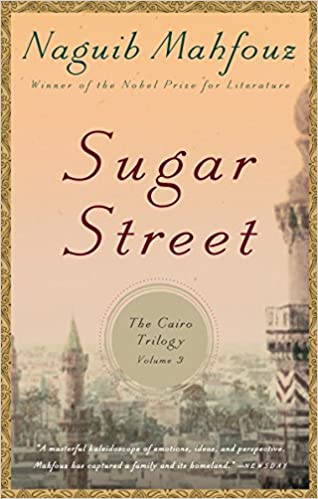
Review 1665: Sugar Street

Sugar Street is the third book in Naguib Mahfouz’s Cairo Trilogy and in many ways the weakest. Although it spends some time with Kamal, it goes on to the next generation and deals mostly with Kamal’s nephews.

The patriarch of the family, Ahmad Abdal-Jawad, although only in his early 60’s in 1935, has let his intemperate habits get the best of him and becomes more and more decrepit as the book goes on. We don’t see much of him or his wife, Amina.

Kamal has come to believe in nothing. He is an English teacher who writes difficult philosophical articles for a journal for no pay. His family urges him to marry, but he does not. He is not happy except in a few friendships with men he can exchange ideas with.

Aisha is a faded shadow of herself after the death of her husband and sons, so it is Khadiya’s and Yasin’s sons we follow for most of the novel as they get involved in politics. Abdal-Muni’m becomes a Muslim Nationalist, Ahmad a socialist, and Ridwan becomes involved with an important political sheikh in a way that seemed vaguely homosexual to me but perhaps wasn’t.

In any case, although you might think these different political alliances would provide more insight into the state of the country, the strangely formal and didactic conversations I mentioned in a review of the previous book assume too much knowledge for me and throw too many names around. On the other hand, what was missing from this novel were the intimate family relationships and strong individual characterizations. We never really get to know any of these nephews like we did the original brothers and sisters.

Finally, Kamal’s character is so mired in inaction that he brings every scene to a halt with his inner observations. When he finally sees the little sister of his boyhood love, Aïda, and fancies himself in love with her, first he creepily stalks her and then, finally, having won her attention, he backs off. Oh! I thought at first, something is going to happen! Not!

Related Posts

Palace Walk

Palace of Desire

The Map of Love

Review 1660: Breakfast with the Nikolides

Because of the war, Louise and her children are forced to return to her husband Charles in India for the first time in many years. There, they take up what is apparently a toxic relationship.

Louise is a fearful, sometimes hysterical woman who seems to dislike Emily, her 12-year-old daughter. Louise considers her sly and deceptive when in actuality Emily is very truthful but seems unable to behave naturally with Louise. Emily loves India, but Louise only sees its dirty and ugly sides, not its charm.

The situation between husband and wife and between mother and child comes to a head over Emily’s dog, Don. In a crucial moment, Louise chooses to lie to Emily rather than tell her the truth as Charles advises.

In general, I liked this colorful novel, which, as always with Godden’s India novels, is luminous in its descriptions and sympathetic to its characters. However, for modern audiences there is a recounting of a rape scene that is handled in a very problematic way. For me, it detracted a good deal from my enjoyment of the novel.

Related Posts

Coromandel Sea Change

The River

The Lives of Others

Review 1651: Three Weeks

I realized earlier this month that the deadline I set myself for finishing my Classics Club list is coming up this summer, with about a dozen books left. I’ve been reading lots of classic novels, just not necessarily the ones on my list. I have also read many of the ones on my list but just haven’t posted my reviews yet. So, I decided I was going to have to accelerate my schedule of reviewing and reading them in hopes of getting all my reviews posted on time. Here is one of them.

Elinor Glyn was a romance novelist at the turn of the 20th century whose works were considered scandalous at the time. Three Weeks is the story of a young English man who has an affair with an older Russian queen.

Naïve young Paul Verdayne fancies he is in love with the parson’s daughter, so his mother ships him off for a tour of the continent. He is young and sulky and hates Paris but, being a sportsman, enjoys Switzerland. While in Geneva, he becomes fascinated with a striking woman who is traveling only with her servants.

This mysterious woman, about ten years older than Paul, takes him in hand and begins opening his mind to art and ideas. Soon, they begin a torrid affair. But this affair must remain secret, because there is danger.

First, I found it difficult to buy that this sophisticated, cultured woman would fall madly in love with a gauche, uncultured young man whose only interest is his dog and horses and whose only attraction is his good looks.

Next, Glyn’s writing is florid and overwrought. It is often cloying and downright silly. The style resembles that of writers from the Romantic movement, which was well over by the time Glyn was writing. I have an idea that Glyn may be the type of writer Forster was mocking in A Room with a View.

Finally, the idea that Paul could become informed and educated just by spending three weeks with his mistress is ridiculous. The novel doesn’t say that he is interested in being more informed but that he comes back from his experience poised and culturally literate, enough so as to impress people with his elegance. Right.

In short, this is a really silly book.

Related Posts

Chéri

The Last of Chéri

Dolly: A Love Story

Review 1650: The River

Harriet and her family live along the river in a town in India. Harriet is dismayed at the changes in her sister Bea, who is becoming a young lady and is no longer fun to play with. Her brother Bogey spends his time looking at insects and animals in the garden. Victoria is just a baby. Harriet spends some time each day writing in her book that she keeps hidden away, and she also is fascinated by her parents’ guest, Captain John, who was injured in WWI. Captain John, however, likes Bea best.

This little novel has a plot, but it is mostly atmospheric and descriptive, of the garden and house, of life on the river. I was just a short way in when I realized that I had seen the movie based on it by Jean Renoir. I said, “If there’s a snake, I’ve seen this.” There was a snake.

The semi-autobiographical novel is about Harriet waking up from childhood and complete self-involvement and learning to become a writer. It is beautiful and touching.

My Virago Modern Classics version also included two short stories, “Red Doe,” about Ibrahim, a bakriwar nomad who is on the way to another encampment to claim a wife, and “The Little Black Ram,” about Jassouf, a bad boy who is tamed by being give a black ram to care for.

Related Posts

Coromandel Sea Change

A God in Every Stone

Sea of Poppies

Review 1648: Joanna Godden

At first, I wasn’t sure I was going to like Joanna very much, in this novel that is essentially a character study. She is large and brash. She likes to wear bright colors and to impress people. She is a fine figure of a woman.

As a young woman, she inherits her father’s sheep farm on Walland Marsh in far southeastern Kent. From the first, she will take no advice. She’ll run her farm the way she wants, and she scandalizes the neighborhood for firing her father’s shepherd of 28 years, for painting her wagons and her house yellow, and for other such offences against tradition.

At first, she makes some costly mistakes in her willingness to experiment. She hires a shepherd just because she likes his looks, but he is too docile and inexperienced to warn her when she’s about to make a big mistake in breeding. She sends her little sister Ellen away to a posh boarding school and gets back a sulky, discontented young woman who thinks she is too good for the farm.

I couldn’t help growing to love this heroine, though. She is bumptious but well-intentioned, pushy but kind. By the end of the novel, I was touched and sorry it was coming to a close. I read it for my Classics Club list and hope to find more by the author.

Related Posts

Far From the Madding Crowd

Miss Marjoribanks

Chatterton Square

Review 1645: The 1936 Club! Nightwood

When I looked for books to read for the 1936 Club, I picked a couple of rereads, as I usually do, but also tried to find one I hadn’t read before. That novel was Nightwood, which I had heard of for years.

T. S. Eliot, who wrote the original Introduction and had a great deal to do with its publication, said that it would “appeal primarily to readers of poetry.” That comment struck dread into my heart, because I am not a big poetry reader. And indeed this is a difficult novel.

The plot is relatively slight. Felix, an Austrian Jew and pseudo-baron, marries Robin Vote because he wants a son to pass his heritage to. Robin is an enigma whom we only see through the eyes of those infatuated with her. She is boyish, and the Doctor, an intersex character who is also an enigma, implies that she is also intersex. Robin seems to view motherhood with horror, so she leaves Felix with his son and takes up with Nora, who is madly in love with her and spends most of her time dragging her, dead drunk, out of sleazy Parisian nightclubs. Then Robin dumps Nora for Jenny, a woman who always wants what other people have.

All the characters are distraught.

The novel is most known for its style and language. It is crammed with images and metaphor, but it is difficult to understand what the characters are talking about, especially the Doctor. I felt like I understood him less than half the time.

The novel seems filled with dread, as it might well in pre-World War II Europe, even though its characters’ preoccupations are not political. I found it disturbing, thought-provoking, and astonishing.

Related Posts

The True Heart

Fidelity

My Husband Simon

Review 1644: The 1936 Club! August Folly

This week it’s time for the 1936 Club, hosted by Stuck in a Book. For my first book published in 1936, I am delighted to review August Folly by Angela Thirkell. As usual with my first posting for the club, I am also listing the links for the books published in 1936 that I have reviewed previously:

__________________________________

Louise Palmer, who likes to manage things, has decided to put on a Greek play. This endeavor will involve the participation of most of the young people around the village of Worsted, including her summer guests, the Deans. Richard Tebbins, just up from Oxford with a poor third, is at the age when everything his parents do irritates him (although that’s usually earlier, in my experience). However, when he sets eyes on Mrs. Dean, his parents’ contemporary, he falls into puppy love. Mr. Fanshawe, the Deans’ guest, seems to be a confirmed bachelor, but he has always only loved young Helen Dean. However, he fears he is too old for her. These are just a few of the characters and subplots of Angela Thirkell’s fourth Barsetshire novel.

Sometime, I would like to read these novels in order, because although each one concentrates on different characters, they have characters that reappear in different books—presumably also plot lines. However, I used to randomly encounter the novels in bookstores and just picked up whatever I found.

August Folly is one of the more fun books, featuring eccentric academics, delightful children, realistic but absurd romances, and a cat, a donkey, and a bull. It is froth at its best. I was happy to revisit it for the 1936 Club and my Classics Club list.

Related Posts

Pomfret Towers

Wild Strawberries

Northbridge Rectory

Review 1642: The Tenant of Wildfell Hall

Gilbert Markham is a young man running a family farm when a new, mysterious person moves into the neighborhood, taking up residence in an old, half-derelict house named Wildfell Hall. She is Mrs. Graham, a beautiful young widow with a five-year-old son, Arthur. She tends to be reclusive, which makes the neighborhood more interested in her. Finally, Gilbert goes with his sister to call and finds that Helen Graham is supporting herself working as an artist.

Gilbert falls in love with Helen, but she will not allow him to express any of his feelings. Then, he hears an ugly rumor about Helen and his friend Mr. Lawrence, Helen’s landlord. Helen has secrets, but they’re not the ones being repeated about her. She finally decides to confide in Gilbert by giving him her diary.

I hadn’t read this novel for many years, so I put it on my Classics Club list. I found the structure of the novel—epistological first because Gilbert is writing a very long letter to a friend, and then the diary—to be cumbersome. It seems as though a straightforward first-person narration would be less artificial for the first part, which must be the longest letter ever written. For the middle, diary portion, I understand why Brontë chose that method of telling her story, which makes up the bulk of the novel, but it seemed a little clumsy and too long.

Finally, there were times when I tired of the self-righteous Helen. It seemed to me that her attitude might have driven a better husband than the one she chose away from her. Of course, he is a scoundrel, so there was probably no attitude she could adopt that would reform him, which makes the ending kind of absurd. I don’t know how to explain it without spoilers, but I thought it might be a sop to the critics of Brontë’s time who would have thought Helen should not have deserted her husband. Either that or she is destined for sainthood.

I am probably being overcritical of this book, which would have been quite shocking for its time because of making a woman who has fled her home with her child its heroine. Although I’ve read a gothic novel or two with the same premise, I’m sure this one was more groundbreaking through the husband’s faults being those of cruelty and dissipation rather than, say, robbery and murder. Here, we see Brontë taking up a feminist viewpoint, and I guess I’m just saying that I found Helen a little too rigidly moral. She spends an awful lot of time being outraged. Jane Eyre is also moral, but somehow from her it doesn’t seem as irritating.

Related Posts

The Castle of Wolfenbach

Aurora Floyd

The Grey Woman

Review 1634: Palace of Desire

The three books of Naguib Mafouz’s Cairo Trilogy are all named after streets in Cairo. The home of al-Sayyid Ahmad Abd al-Jawad is located on Palace Walk, the name of the previous book. His oldest son Yasid’s home is on the Palace of Desire, and desire is certainly a theme for this novel.

The novel is set five years after the last one, beginning in 1924. Since his middle son Fahmy’s death, Ahmad has stopped his nightly drinking and womanizing, but fairly soon in the novel he decides to go out with his friends again. Now a middle-aged man, he finds he has lost his confidence. Instead of flitting from woman to woman, he is soon spending a lot of money setting up his mistress, Zanuba, in a house boat.

Kamal, definitely a portrait of the writer himself, as I suspected in the last book, is now 17 and in love. He is entranced by Aïda, the sister of one of his school friends, who was raised in Paris. This girl belongs to a relatively aristocratic family, and Kamal seems to have no hope but just wants to worship her.

Yasid, having been divorced by his wife in the first book, now decides to marry Maryam, the girl from next door that his brother Fahmy wanted to marry. Also a terrible womanizer, Yasid only decides to marry her because she won’t sleep with him. His choice causes some family problems. His mother Amina and his sisters have broken with her because they think she slighted Fahmy by becoming acquainted with an English officer after Fahmy’s father refused to let him marry her. They also think Yasin should leave alone the girl Fahmy loved. His father cannot admit that he doesn’t approve because he himself had an affair with Maryam’s mother, Bahija.

So, Yasin must go to ask for Maryam’s hand himself instead of sending a relative. When he does, he complicates matters more by starting an affair with Bahija. At this point, I almost wondered if I was reading a farce except that Mahfouz is so deadpan serious.

I wasn’t sure how much I liked Palace Walk, but I liked Palace of Desire less. For one thing, Mahfouz doesn’t spend much time with Kamal’s sisters, Aisha and Adijah. But frankly, I found Kemal’s obsessions and long internal dialogues tedious. Either he’s rhapsodizing about Aïda, whom he seriously doesn’t want to be a real girl, or he’s philosophizing about some other subject. In Mahfouz’s attempts at realism, he frequently interjects a character’s thoughts into the middle of a conversation to show what the character is really thinking. When overused, this technique slows things down too much. Finally, Kamal’s conversations with his friends seem terribly formal and artificial, and the other characters’ flirtacious and joking comments seem clumsy and crude, but this just might be a cultural difference. I was most bothered by Kamal’s interactions with Aïda. Without saying too much about what happens, I’ll just say that he comes off as a bit of an idiot and a prig.

I still plan to read the third novel, Sugar Street, but I hope to like it better.

The New York Times reviewer comments that Mafouz essentially invented the Egyptian novel form with reference to Arabic poetry. I can see that in some of Kamal’s musings, but I don’t have much patience for it.

Related Posts

Palace Walk

The Map of Love

The Danger Tree