At first, I wasn’t sure I was going to like Joanna very much, in this novel that is essentially a character study. She is large and brash. She likes to wear bright colors and to impress people. She is a fine figure of a woman.
As a young woman, she inherits her father’s sheep farm on Walland Marsh in far southeastern Kent. From the first, she will take no advice. She’ll run her farm the way she wants, and she scandalizes the neighborhood for firing her father’s shepherd of 28 years, for painting her wagons and her house yellow, and for other such offences against tradition.
At first, she makes some costly mistakes in her willingness to experiment. She hires a shepherd just because she likes his looks, but he is too docile and inexperienced to warn her when she’s about to make a big mistake in breeding. She sends her little sister Ellen away to a posh boarding school and gets back a sulky, discontented young woman who thinks she is too good for the farm.
I couldn’t help growing to love this heroine, though. She is bumptious but well-intentioned, pushy but kind. By the end of the novel, I was touched and sorry it was coming to a close. I read it for my Classics Club list and hope to find more by the author.
When I looked for books to read for the 1936 Club, I picked a couple of rereads, as I usually do, but also tried to find one I hadn’t read before. That novel was Nightwood, which I had heard of for years.
T. S. Eliot, who wrote the original Introduction and had a great deal to do with its publication, said that it would “appeal primarily to readers of poetry.” That comment struck dread into my heart, because I am not a big poetry reader. And indeed this is a difficult novel.
The plot is relatively slight. Felix, an Austrian Jew and pseudo-baron, marries Robin Vote because he wants a son to pass his heritage to. Robin is an enigma whom we only see through the eyes of those infatuated with her. She is boyish, and the Doctor, an intersex character who is also an enigma, implies that she is also intersex. Robin seems to view motherhood with horror, so she leaves Felix with his son and takes up with Nora, who is madly in love with her and spends most of her time dragging her, dead drunk, out of sleazy Parisian nightclubs. Then Robin dumps Nora for Jenny, a woman who always wants what other people have.
All the characters are distraught.
The novel is most known for its style and language. It is crammed with images and metaphor, but it is difficult to understand what the characters are talking about, especially the Doctor. I felt like I understood him less than half the time.
The novel seems filled with dread, as it might well in pre-World War II Europe, even though its characters’ preoccupations are not political. I found it disturbing, thought-provoking, and astonishing.
This week it’s time for the 1936 Club, hosted by Stuck in a Book. For my first book published in 1936, I am delighted to review August Folly by Angela Thirkell. As usual with my first posting for the club, I am also listing the links for the books published in 1936 that I have reviewed previously:
Louise Palmer, who likes to manage things, has decided to put on a Greek play. This endeavor will involve the participation of most of the young people around the village of Worsted, including her summer guests, the Deans. Richard Tebbins, just up from Oxford with a poor third, is at the age when everything his parents do irritates him (although that’s usually earlier, in my experience). However, when he sets eyes on Mrs. Dean, his parents’ contemporary, he falls into puppy love. Mr. Fanshawe, the Deans’ guest, seems to be a confirmed bachelor, but he has always only loved young Helen Dean. However, he fears he is too old for her. These are just a few of the characters and subplots of Angela Thirkell’s fourth Barsetshire novel.
Sometime, I would like to read these novels in order, because although each one concentrates on different characters, they have characters that reappear in different books—presumably also plot lines. However, I used to randomly encounter the novels in bookstores and just picked up whatever I found.
August Folly is one of the more fun books, featuring eccentric academics, delightful children, realistic but absurd romances, and a cat, a donkey, and a bull. It is froth at its best. I was happy to revisit it for the 1936 Club and my Classics Club list.
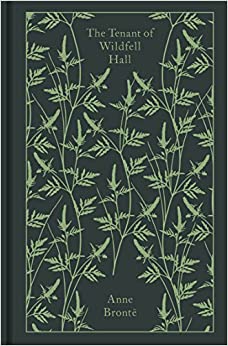
Gilbert Markham is a young man running a family farm when a new, mysterious person moves into the neighborhood, taking up residence in an old, half-derelict house named Wildfell Hall. She is Mrs. Graham, a beautiful young widow with a five-year-old son, Arthur. She tends to be reclusive, which makes the neighborhood more interested in her. Finally, Gilbert goes with his sister to call and finds that Helen Graham is supporting herself working as an artist.
Gilbert falls in love with Helen, but she will not allow him to express any of his feelings. Then, he hears an ugly rumor about Helen and his friend Mr. Lawrence, Helen’s landlord. Helen has secrets, but they’re not the ones being repeated about her. She finally decides to confide in Gilbert by giving him her diary.
I hadn’t read this novel for many years, so I put it on my Classics Club list. I found the structure of the novel—epistological first because Gilbert is writing a very long letter to a friend, and then the diary—to be cumbersome. It seems as though a straightforward first-person narration would be less artificial for the first part, which must be the longest letter ever written. For the middle, diary portion, I understand why Brontë chose that method of telling her story, which makes up the bulk of the novel, but it seemed a little clumsy and too long.
Finally, there were times when I tired of the self-righteous Helen. It seemed to me that her attitude might have driven a better husband than the one she chose away from her. Of course, he is a scoundrel, so there was probably no attitude she could adopt that would reform him, which makes the ending kind of absurd. I don’t know how to explain it without spoilers, but I thought it might be a sop to the critics of Brontë’s time who would have thought Helen should not have deserted her husband. Either that or she is destined for sainthood.
I am probably being overcritical of this book, which would have been quite shocking for its time because of making a woman who has fled her home with her child its heroine. Although I’ve read a gothic novel or two with the same premise, I’m sure this one was more groundbreaking through the husband’s faults being those of cruelty and dissipation rather than, say, robbery and murder. Here, we see Brontë taking up a feminist viewpoint, and I guess I’m just saying that I found Helen a little too rigidly moral. She spends an awful lot of time being outraged. Jane Eyre is also moral, but somehow from her it doesn’t seem as irritating.
The three books of Naguib Mafouz’s Cairo Trilogy are all named after streets in Cairo. The home of al-Sayyid Ahmad Abd al-Jawad is located on Palace Walk, the name of the previous book. His oldest son Yasid’s home is on the Palace of Desire, and desire is certainly a theme for this novel.
The novel is set five years after the last one, beginning in 1924. Since his middle son Fahmy’s death, Ahmad has stopped his nightly drinking and womanizing, but fairly soon in the novel he decides to go out with his friends again. Now a middle-aged man, he finds he has lost his confidence. Instead of flitting from woman to woman, he is soon spending a lot of money setting up his mistress, Zanuba, in a house boat.
Kamal, definitely a portrait of the writer himself, as I suspected in the last book, is now 17 and in love. He is entranced by Aïda, the sister of one of his school friends, who was raised in Paris. This girl belongs to a relatively aristocratic family, and Kamal seems to have no hope but just wants to worship her.
Yasid, having been divorced by his wife in the first book, now decides to marry Maryam, the girl from next door that his brother Fahmy wanted to marry. Also a terrible womanizer, Yasid only decides to marry her because she won’t sleep with him. His choice causes some family problems. His mother Amina and his sisters have broken with her because they think she slighted Fahmy by becoming acquainted with an English officer after Fahmy’s father refused to let him marry her. They also think Yasin should leave alone the girl Fahmy loved. His father cannot admit that he doesn’t approve because he himself had an affair with Maryam’s mother, Bahija.
So, Yasin must go to ask for Maryam’s hand himself instead of sending a relative. When he does, he complicates matters more by starting an affair with Bahija. At this point, I almost wondered if I was reading a farce except that Mahfouz is so deadpan serious.
I wasn’t sure how much I liked Palace Walk, but I liked Palace of Desire less. For one thing, Mahfouz doesn’t spend much time with Kamal’s sisters, Aisha and Adijah. But frankly, I found Kemal’s obsessions and long internal dialogues tedious. Either he’s rhapsodizing about Aïda, whom he seriously doesn’t want to be a real girl, or he’s philosophizing about some other subject. In Mahfouz’s attempts at realism, he frequently interjects a character’s thoughts into the middle of a conversation to show what the character is really thinking. When overused, this technique slows things down too much. Finally, Kamal’s conversations with his friends seem terribly formal and artificial, and the other characters’ flirtacious and joking comments seem clumsy and crude, but this just might be a cultural difference. I was most bothered by Kamal’s interactions with Aïda. Without saying too much about what happens, I’ll just say that he comes off as a bit of an idiot and a prig.
I still plan to read the third novel, Sugar Street, but I hope to like it better.
The New York Times reviewer comments that Mafouz essentially invented the Egyptian novel form with reference to Arabic poetry. I can see that in some of Kamal’s musings, but I don’t have much patience for it.
It turns out that Mrs. Tim Gets a Job is part of a series. Unfortunately, because I’d rather read series books in order, I never find this out until I mark that I’m reading it in Goodreads. Luckily, the novel seems to stand perfectly well on its own.
The Second World War is over, but Mrs. Tim’s husband is still stationed in Cairo and won’t be getting home anytime soon. Mrs. Tim’s two children are off at school, and she finds herself at loose ends. So, without really consulting her, a friend arranges a job for her at a hotel in Scotland. At first, Mrs. Tim is inclined to turn down the job, but then she gets a letter from her landlord giving her notice to move out.
With trepidation, she sets out to work for Miss Clutterbuck, who she understands is a difficult person. Miss Clutterbuck has been forced to open her family home to the public, and she has a rude manner. Mrs. Tim finds that part of her duties is to talk to the guests, because Miss Clutterbuck can’t bear them.
This novel is written in a light style as a diary, reminding me very much of the Provincial Lady series except gentler and with less overt humor. We follow Mrs. Tim’s progress as she grows to appreciate Miss Clutterbuck, learns how to deal with a housemaid who hates her, and straightens out a guest’s love life. I enjoyed this book very much.
My Brilliant Career is the very singular story of the life of an Australian teenage girl in the bush in 1901. It isn’t so much singular in its plot as in the personality of Sybilla, the main character.
Sybilla’s childhood was spent in comfort, as her father was a prosperous horse breeder. However, well before this novel starts, her father decided his talents were wasted, so he sold his property and began a career selling livestock. He was unsuccessful, and he drank heavily in entertaining prospective clients. When the novel opens, the family is struggling to run a dairy with their father drinking away the money he makes selling butter.
Sybilla at 15 is admittedly a difficult person. Her mother never gives her a kind word, and her mother and brother twit her about her lack of good looks. She angrily resents their life of endless labor for no good result. In fact, she is ambitious to become more but doesn’t know how to go about it. She is an unusual mixture of self-confidence and self-hatred and is angry and rebellious.
Sybilla’s mother becomes so angry with her that she arranges for her to go live with her grandmother farther into the bush. There, Sybilla blossoms under the kind treatment of her grandmother, her uncle, and her Aunt Helen. Her aunt helps her look more attractive, but she never gets over believing she is ugly. Romance even seems to be on the horizon.
I thought that the view this novel gives of Australian frontier life is really interesting, and I was particularly struck by the amount of traffic going by the grandmother’s house and the number of homeless, wandering men. However, I was unsatisfied with this novel, and to explain why, I have to include spoilers, so be warned.
A feminist interpretation of this novel might be that the heroine chooses to write a novel instead of getting married, but that would be ignoring Sybilla’s difficult personality. Continually, she seems to bite off her nose to spite her face, and in the case of marriage, really declines out of a sense of inferiority rather than anything else. She decides not to marry Harold and stays in a life she hates because she can’t believe he loves her and she thinks she is not good enough for him. I find that really frustrating. It’s not that I wanted a romantic ending so much as it bothered me how she never really sees herself or is able to get past being told how worthless she is by her mother.
How delighted I was to find out there are actually three Miss Buncle books, since I so enjoyed the first one. This second book continues in the first one’s gently comic, frothy tradition.
Barbara Buncle, now Mrs. Abbott, and her husband Arthur discover that neither of them has been enjoying their active social life. There seems to be no way to get out of it, however, because they’re such a popular couple. So, they decide to move.
It takes Barbara quite a long time to find a house she likes. When she visits a solicitor’s office in Wandlebury to view a house, Mr. Tupper, mistaking her for another client, has her read a will in which Lady Chevis Cobbe leaves her estate to her niece, Jeronina Cobbe, on the condition that she isn’t married before Lady Chevis Cobbe’s death. When Mr. Tupper discovers his mistake, he is horrified and asks Barbara to tell no one.
Of course, Barbara discovers the perfect house in Wandlebury, and after extensive renovations, it makes a comfortable home. Shortly after moving there, Barbara meets Jeronina Cobbe, who goes by Jerry. She is an industrious young woman who has been running her own stables to keep afloat financially and is worried about her brother Archie. Archie has been living beyond his means because he thinks he is Lady Chevis Cobbe’s heir.
Barbara and Arthur have been enjoying their new home immensely when Barbara discovers that Arthur’s nephew Sam has fallen in love with Jerry. So, without telling anyone about the will, Barbara feels she must keep the two apart until ailing Lady Chevis Cobbe dies, so as not to deprive Jerry of her inheritance.
If anything, I enjoyed this novel more than I did Miss Buncle’s Book. It’s a lot of fun.
Camilla Lacely has been asked by a friend to tell her more about her life in a letter, so she decides to keep a diary for a week. Aside from daily entries, though, this diary reads more like a first-person narrative.
Camilla is the wife of a vicar running a household on very little money, attempting to attend numerous meetings every day, and trying to help parishioners so they don’t all bother her husband with concerns as silly as what the railroad schedule is. Her cares range from how to afford a new hat to how to provide dinner for an unexpected visit by the archdeacon to how to be more attentive to her religious thoughts and prayers.
This novel is touching and amusing, although I occasionally found it bewildering. As an unreligious American from another time, I didn’t always understand the references or jokes. Because of its focus on religion, I had more difficulty with it than with other novels from this period.
The novel does have a plot. It concerns the furor of the village residents when the unbending, self-righteous curate gives a sermon preaching pacifism. Since this novel takes place in the early days of World War II and many villagers have relatives in the war, this sermon causes an uproar.
Stella Gibbons’s books always start out seeming to be froth, but there is an edge to them, I’ve found. Still, she handles her characters’ foibles with compassion.
In A Pink Front Door, her heroine, Daisy Muir, is engaging, but she has one big flaw. She tends to make the problems of a set of misfits her own, much to the discomfort of her husband, James. At the beginning of the novel, she’s trying to keep one silly friend, Molly, from running after men, in particular an Eastern European refugee named Tibbs, who keeps losing both jobs and his lodging. Lodging is difficult to find in post-war London, and the next thing Daisy knows, she has Don, a man she barely remembers from Oxford, at her front door. Don and Katie and their three young children have just lost their lodgings, and Don hopes Daisy can help.
Daisy remembers “little Katie” from university, the most promising student of her year. Later, Katie reflects that she became stupid with love and made only a poor third. Don, however, is only a few months from finally taking his exams to qualify as a chemist, and Katie hopes to find a quiet place where he can work. If he passes, he can take a good job and they can begin a better life, but until now, they have been living in cramped, noisy, unpleasant quarters.
Daisy thinks of a former neighbor and friend of her father, Mrs. Cavendish, a horrible snob who has an entire upper floor free. Mrs. Cavendish, like many of the upper classes, has fallen on comparatively hard times and has lost her last servant. She agrees that the family can move in but insists that the hard-pressed Katie spend some time every day cleaning in exchange for the low rent that is all they can afford. The house is inconvenient. Katie must haul all their water and coal upstairs. It is also not laid out for children. But it is quiet, and Don is finally able to work.
While Daisy is embroiled in the difficulties of her friends’ lives, Molly has homed in on James and has begun dropping by Daisy’s house especially when Daisy isn’t there, making tea for James and babysitting James Too. James himself, usually tolerant of Daisy’s projects, has begun to lose his patience.
Gibbons has an eye for social follies and foibles, and she employs it here with effect. I enjoyed this novel and was touched by its conclusion.
I received this book from the publisher in exchange for a free and fair review.








 What? Me Read?