Day 335: A Time of Gifts: On Foot to Constantinople: From the Hook of Holland to the Middle Danube

Cover for A Time of GiftsIn December 1933, nineteen-year-old Patrick Leigh Fermor set out alone on a great adventure, a walking trip from Amsterdam to Istanbul, or as Fermor still called it, Constantinople. (It was renamed in 1930.) He had no idea when he left that he would not return until 1937. In 1977, he collected his notebooks from the trip and wrote A Time of Gifts and its sequel Between the Woods and the Water.

Although Leigh Fermor had one notebook stolen from him with all the rest of his gear, he otherwise must have kept careful account and his memories of the trip must still have been vivid, for the result is an entrancing account of scenery and architecture, tales of chance encounters, glimpses of foreign customs and celebrations, and so on. Jan Morris, who wrote the introduction, calls him “one of the great prose stylists of our time,” and Wikipedia, quoting an unnamed British journalist, “a cross between Indiana Jones, James Bond and Graham Greene,” presumably for his work with the Cretan resistance in World War II as well as his writing. (He was also a friend of Ian Fleming.)

From his drinking bouts with Dutch barge men to his extended stays in various German, Austrian, and Czech castles, Leigh Fermor plunges enthusiastically into every experience on offer. At one moment he is sleeping in a barn, in the next hanging out with fashionable youth in Vienna. Along the banks of the Danube he is mistaken for a 50-year-old smuggler. All of these adventures as well as his observations of nature are described in beautiful, evocative prose. To add interest to the modern reader, he is describing a Europe that no longer exists.

If I have any complaint, it is one of my own education, for Leigh Fermor’s writing assumes for his audience a familiarity with classical culture that is no longer common. The book often alludes to mythology and refers to obscure historical events that I do not fully understand. Finally, in the footnotes, which are Leigh Fermor’s original ones, all utterances in modern languages (some of which I could have taken a stab at) are translated, but the quotations in Latin are not. They are not integral to comprehension, but it is a little frustrating to be unable to understand them. (Of course, I could have googled them, but I was almost always reading this on the bus.) That being said, I look forward to reading the sequel.

Day 328: Hamlet

Cover for HamletMy husband likes his jokes. When I told him I was re-reading Hamlet, he said, “It’s full of clichés, you know.” But it was amazing to see how many lines from this play are so familiar to all of us, have almost entered our societal DNA.

Everyone is familiar with the plot. Hamlet’s father, the King of Denmark, has died, and Hamlet’s mother Gertrude has married his uncle Claudius, his father’s brother, who is now king. Hamlet is in grief and dismay at his father’s death and his mother’s quick remarriage. In the first act of the play, Hamlet meets the ghost of his father, who tells him that Claudius murdered him by pouring poison in his ear as he slept. The ghost orders Hamlet to avenge his death.

One of the puzzlers for me about this play is the reason why Hamlet then chooses to fake insanity. It allows Hamlet to continually bait Claudius and Gertrude without consequences, but otherwise does not make sense to me.

An interesting point raised in the introduction of my version of the Collected Works is that Polonius, in appearance and behavior, is meant to be William Cecil, Lord Burghley, Queen Elizabeth I’s chief minister. The claustrophobic feeling in the play of not being able to trust anyone, of being spied on (depicted marvelously in the 2009 Royal Shakespeare Company production, starring David Tennant and Patrick Stewart), reflects the paranoid nature of Tudor society because of the prevalence of espionage at that time.

Of course, Hamlet’s musings on suicide, death, and the nature of revenge are a major focus of the play. An undoubted message seems to be of the unintended consequences of actions, particularly of revenge. Hamlet and Laertes are bent on revenge, but in obtaining it, they manage to wipe out both their families.

I have seen Hamlet played as a drooping figure of indecision, but I don’t think this is a correct interpretation. Hamlet is caught on the crux of a dilemma. He wants to do what is right but knows that whatever action he chooses, the results will not be pretty. Hence, the inaction.

Day 323: Oliver Twist

Cover for Oliver TwistOliver Twist was one of the first adult books I read as a child, although I believe that David Copperfield was the very first one. This book is, of course, Dickens’ famous indictment of the British treatment of and attitudes toward the poor, as followed through the adventures of Oliver Twist, an innocent and hapless young orphan.

Oliver is born in the workhouse after his mother dies in childbirth without identifying herself. He is named by the beadle and brought up at a baby farm, the intent of which seems to be to starve as many babies to death as possible. The story really begins when Oliver is 10 years old and is moved to the workhouse to begin an illustrious career picking oakum, which is unraveling and picking apart old ropes. There he is voted by the boys to be their representative in asking for another bowl of thin gruel at mealtime (or rather is the only one naive enough to agree to do it).

This act brands Oliver as a malcontent, and he is apprenticed out to a coffin maker with dispatch. His employer seems disposed to be kind, but he is bullied by a “charity boy,” Noah Claypole, as well as by the housemaid and the coffin maker’s wife. Finally, after being unjustly punished for standing up for himself, he runs away.

Oliver’s adventures lead him to London, where he innocently falls in with a gang of thieves lead by the infamous Fagin. Oliver’s struggles to make his way in life without becoming a criminal and the mystery of his identity are the focuses of the rest of the book.

Although this novel has a few amusing and lovable characters, it is fairly grim compared to some of Dickens’ later efforts. It is merciless in its satire of institutions such as the workhouse and the law courts. Oliver himself is more of a symbol for goodness than a fully developed character, yet we are touched by his plight.

It is a long time since I read this novel, and I found I had forgotten just how complex the plot is. Although I do not feel that it is as good as some of Dickens’ later works, as his first serious novel, it is compelling reading.

Day 319: Murder on the Orient Express

Cover for Murder on the Orient ExpressMurder on the Orient Express is Agatha Christie’s classic mystery featuring Hercule Poirot. Everyone has of course seen the lush 1974 movie featuring a flock of movie stars and Albert Finney as Poirot.

Hercule Poirot is visiting Istanbul when he unexpectedly receives a telegram prompting him to cancel his plans and book a seat on the Orient Express leaving that night. He is able to book a compartment in first class, but only after some difficulty.

Poirot’s fellow passengers include a Russian princess, a Hungarian count and countess, a Swedish missionary, a British colonel, an annoying American widow, and other unusual characters. As always with Christie, her characters are expertly and colorfully drawn.

On board the train, Poirot is approached by the repellent Mr. Ratchett, an American businessman who believes his life is being threatened, asking for protection. Poirot dislikes Ratchett and declines his offer.

After a disturbed night, during which Poirot is awakened by a cry and spies a woman in a lurid silk kimono walking down the hall, Ratchett’s body is found dead in his compartment. He has been stabbed 12 times. The railroad executive traveling on the train begs Poirot to attempt to solve the crime before the train reaches Yugoslavia.

It begins to look as if an intruder disguised in a railway uniform broke into Ratchett’s compartment and murdered him then escaped out into the snow. Poirot’s investigation turns up a suggestion that Ratchett was the leader of a gang who kidnapped and killed the child Daisy Armstrong (a crime based upon that of the Lindbergh kidnapping), resulting in much tragedy for the family. He also begins finding links between some of the passengers and the Armstrongs.

This particular mystery is famous not only for its exotic locales but also for the unusual solution to the murder. Despite my familiarity with the plot, it made enjoyable reading.

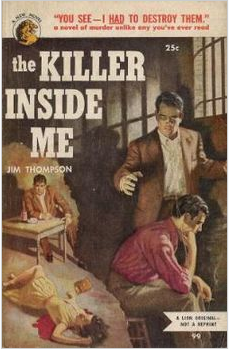
Day 310: The Killer Inside Me

Cover for The Killer Inside MeJim Thompson’s classic noir thriller The Killer Inside Me was one I had never read, so I picked it up out of curiosity. Normally, I am not drawn to classic noir, even though I like a crime novel that is dark. This brief novel easily kept my attention, though.

Lou Ford is a deputy sheriff in a small Texas town. He projects the image of a jovial good guy, maybe even a little stupid, who continually spouts clichés. But he has actually been hiding his sociopathic tendencies for years.

Ford begins a sadomasochistic relationship with Joyce Lakeland, a prostitute. He sees a way to use his relationship with Joyce to get revenge for his brother’s death. As a teenager Ford sexually abused a little girl, and his foster brother Mike took the blame. After he got out of jail, Mike died in a construction accident, and Ford has blamed the local owner of the construction company for Mike’s death.

Ford and Joyce begin blackmailing the owner of the construction company in return for keeping his son’s affair with Joyce secret. Then Ford sees a way to take it all one step further. Of course, things don’t always go as planned.

As in reading Patricia Highsmith’s Ripley novels, a large part of the fascination of this disturbing book lies in wondering how Ford is going to get out of one fix after another. Thompson’s writing is deft and tight. You will be glued to the page, even if you don’t like noir.

Day 308: Love in a Cold Climate

Cover for Love in a Cold ClimateLove in a Cold Climate is more of a companion novel to Nancy Mitford’s The Pursuit of Love than a sequel, because it focuses on a different group of characters. Fanny is still the narrator, and she returns to tell a little more of her own story but mostly that of her beautiful friend and distant relation Polly Hampton.

When Fanny receives an invitation to stay with the family upon their return from India, she is happy to renew her friendship with Polly. Polly’s demanding mother, Lady Montdore, has been pushing her toward marriage, but Polly resists. Polly has always been difficult to read, unlike Fanny’s Radlett cousins from The Pursuit of Love, who “told everything.” Although Polly is so beautiful that she could have her pick of the eligible bachelors, she tells Fanny that she finds the whole life of the social season boring.

Lady Montdore is a rapacious, snobbish manipulator with social ambitions, although not without charm. Another family member who is important to the novel is also a snob, “Boy” Dougdale, the husband of Polly’s aunt, Lady Patricia. Fanny and her cousins have always called Boy “the Lecherous Lecturer” because of his tendency to furtively grope very young girls. Much to everyone’s surprise, Polly’s secret comes out when, shortly after Lady Patricia’s death, she marries a reluctant Boy, for she has been in love with him for years.

Polly is ostracized from her family and cut out of her father’s will as a result. But the plot thickens upon the arrival of Lord Montdore’s heir, the effeminate and hilarious Cedric Hampton.

As usual with Mitford, we have a strong suspicion that all her ghastly and funny characters strongly resemble real-life society members of her time. Her novels are full of vivid characterizations and incisive dialogue. Even in today’s world, so removed from her own, her novels are extremely funny.

As a side comment about the cover art, I find the covers of the most recent editions of Mitford’s novels to be too romantic and to do nothing to convey the spirit of her novels. I was able to find a better cover for The Pursuit of Love, but this was all I could find for Love in a Cold Climate.

Day 300: The Land of Green Ginger

Cover for The Land of Green GingerJoanna Burton is a naive girl with a huge sense of adventure who has always wanted to travel the world in this most touching of Winifred Holtby’s books. Born in Africa but brought to England as a small child, Joanna has never felt like she quite fit in and has always wanted to return to the “land of green ginger.” During World War I she meets a young officer, Teddy Leigh, who tells her he is going to give her the world as a golden ball, and she believes him.

Several years later, however, she is living on a Yorkshire farm with two little girls and an ailing husband. Not only was Teddy gassed during the war, but he hid from her his history of tuberculosis.

As Joanna struggles to deal ineptly with the farm, her husband, and her children, a nearby landowner asks if they could take a Hungarian man in as a roomer. Joanna is so preoccupied with her troubles that she doesn’t notice her husband’s irrational jealousy or the rumors starting up in the village about her relationship with the Hungarian.

This novel is beautifully written and painful to read at times, as the readers see Joanna unconsciously make misstep after misstep and the neighborhood gossips become vicious indeed. Holtby only wrote a few books before she died at the age of 37, but she was a master at depicting life in the Yorkshire countryside and small towns.

Day 297: Persuasion

Cover for PersuasionMost people have probably read Pride and Prejudice, which is a wonderful book, but if I had to pick my favorite Jane Austen heroine, it would be hard to decide between Elinor Dashwood of Sense and Sensibility and Anne Elliot of Persuasion. Probably fewer people are familiar with Persuasion.

Anne is no longer in the bloom of youth. Seven years ago she fell in love with a young naval officer named Frederick Wentworth, but Sir Walter, her superficial, supercilious father, did not approve. Perhaps the gentle Anne would not have been dissuaded from marriage, but her older friend and mentor, Lady Russell, talked her out of the engagement because of Wentworth’s lack of wealth and social position. Anne listened because she viewed Lady Russell as a surrogate mother, and she hasn’t heard from Wentworth since.

Now the family has fallen upon hard times, and Sir Walter is forced by his profligacy to lease their house and take rooms in Bath. He and Anne’s fashionable sister Elizabeth care very little for Anne, and they leave her to close up the house and make all the arrangements for its occupation by an Admiral Croft. Much harassed, she readies the house and tends to her hypochondriac, selfish sister Mary Musgrove. At least she enjoys the company of the children and Mary’s genial in-laws, with their two daughters Henrietta and Louisa and Anne’s brother-in-law Charles.

Anne meets the friendly Admiral and Mrs. Croft, and between their society and that of the Musgroves, begins to find a little pleasant enjoyment. However, she is soon dismayed to learn that Frederick Wentworth is Mrs. Croft’s brother, and he will be arriving soon. Wentworth is now wealthy and has retired from the service.

When he arrives, Wentworth pays little attention to Anne; in fact, she overhears him saying that she has changed so much he would not have recognized her. This remark distresses her very much, as her feelings have not altered. Soon he appears to be courting Louisa Musgrove. Anne finds it easiest to send Mary off into company while she stays home with her nephews.

After Louisa has a fateful accident on an outing in Lyme Regis, Anne finds herself taking charge and summoning help. Then she returns with Wentworth to notify Louisa’s parents. Feeling superfluous after the Musgroves leave with Wentworth for Lyme Regis, Anne decides she has no choice but to join her unpleasant father and sister in Bath.

What I love about Anne is her understated good will. Despite the insults by her family members and their general bad treatment of her, she tries to help them and to be a true sister and daughter to them. Despite Wentworth’s slights and attention to Louisa, she hides her feelings and remains faithful in her heart. Anne has much in common with Elinor Dashwood, except that Elinor is well regarded by her family and Anne is not. There is something delicate and understated in this novel, and in all of Austen’s work, that I appreciate in this more tempestuous modern world.

Day 291: Brat Farrar

Cover for Brat FarrarI have only read a few mysteries by Josephine Tey and have had mixed reactions to them. I really enjoyed The Daughter of Time, but disliked The Franchise Affair. Brat Farrar is completely different from either of those novels, and I enjoyed reading it.

Patrick Ashby, the 13-year-old heir to the Ashby fortune, disappeared three years go. This novel isn’t a mystery about whether Brat Farrar is an imposter–we know that from the beginning–but about what actually happened to Patrick.

Brat, an orphan who bears a surprising resemblance to the Ashbys, is talked into impersonating Patrick, despite his better instincts, by a ne’er-do-well cousin of the Ashby’s. This cousin has carefully coached him for his part, with the understanding that after Brat inherits, he will pay the cousin a pension. Once Brat arrives at the house, he feels surprisingly at home with the place and the family, except for Simon, his supposed twin brother.

The characters are likeable, and the story keeps your attention, even though I figured out the solution to the mystery fairly early on.

Day 272: Moby Dick or, The Whale

Cover for Moby DickThose who know me well will be surprised to see me reviewing this book, because one of my stories is of my horror, when first trying to read it, to find an entire chapter about one rope. At that point, Moby Dick became the first book I ever stopped reading. However, I got interested in trying it again by listening to the Moby Dick Big Read. I listened to the beginning chapters and finally picked up a copy to finish it.

The plot, of course, is about the sailor Ishmael, who decides to go whaling for the first time, the people he meets, and his experiences–and about the obsession of his captain, Ahab, to kill the whale that took his leg.

Moby Dick is not for everyone. The novel is not simply an adventure tale about whaling but also a dissertation on whaling history, a series of philosophical essays, an explication on types of whales, on the different parts of a whale, on pieces of whaling equipment (hence, the chapter on the rope), even a musing on the color white.

The novel also has a sort of schizophrenic narration, starting out as first-person limited from the point of view of Ishmael, but then at other times taking the point of view of Ahab. The writing style rips back and forth from simple story telling to a kind of heightened, bombastic oratory. Characters do not so much speak as give speeches.

The novel is immense, but it is meant to be immense–the way Melville saw America and its possibilities. I have over the years read different interpretations of this work (the whale as a symbol of evil, etc.), but one that strikes a chord with me is that it is a reflection on some of the American political ideas of the time, particularly Manifest Destiny. While seeming to admire the grandiosity of such ideas, Melville is, with one whaling story, also warning of their possible effects and ramifications.

I can see why some academics have devoted their careers to this work, because it can be endlessly examined and interpreted. I finished reading it this time, but I can frankly admit that it is still a bit too much for me and is probably better suited for someone who is more contemplative in his or her reading.