Day 126: Dombey and Son

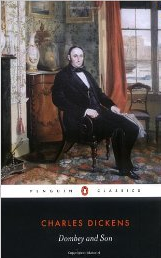
Cover for Dombey and SonI recently re-read Dombey and Son after not having read it in so long that I could not remember its plot. The novel is Charles Dickens’s tale about Paul Dombey, a wealthy, cold, self-important man who cares only about his son, not about his wife or his gentle, loving daughter Florence. His wife dies in childbirth, and his son Paul is weak and often ill, but Paul and Florence have a loving relationship. When Florence is kidnapped as a child, she is rescued by Walter Gay, a young employee of Dombey. Dombey ships him off to Barbados to get him away from Florence, but Walter’s ship is lost and he is presumed drowned.

With Walter gone, Florence has only her brother Paul for her friend. Then Paul dies, and her father even resents Florence for the love his son had for her, which he did not give to his father.

Dombey meets a beautiful widow, Edith Granger. She is a cold, haughty but impoverished woman, and Dombey essentially “buys” her by marrying her. She despises Dombey for his pride and herself for having married him for his money. The only person she is kind to is Florence, which provides more fuel for Dombey’s dislike of his own daughter. His attempts to subdue his wife end in her disgracing him as best she is able by running away to Dijon with Mr. Carker, one of Dombey’s rivals. When Florence attempts to offer sympathy, Dombey strikes her and she leaves the house, friendless and destitute.

Although the novel is not critically accepted as one of Dickens’s major works, it is still enjoyable. It is full of vibrant characters–mostly those of good will but also some villains–and it is gripping to the end. Some critics have noticed a change in the novel that takes place with the death of the young Paul, believing that having the colorless Florence and the unlikable Dombey as the main characters is not enough to carry the story forward. The absence of Walter and his uncle through much of the book is also thought to be a problem. However, the novel has all of the Dickens hallmarks–social commentary, comic absurdity, realism, pathos, and transformation. Dombey and Sons was written before most of Dickens’s real masterpieces like Bleak House or David Copperfield, but it certainly shows the movement from his lighter, shorter works toward the qualities of his more major works.

Day 111: The Black Tulip

Cover for The Black TulipThe Black Tulip does not feature the swashbuckling we have come to expect from the historical novels of Alexandre Dumas. Even though it begins with two innocent men being torn limb from limb by a mob, it is actually a romantic comedy about the mania for tulips in the 17th Century.

The two men are the uncles of an obsessed tulip grower, Cornelius van Baerle. Just before their deaths, they send him a message telling him to destroy some papers they’ve left with him, but he is too occupied with cultivating his black tulip bulbs to read it.

These bulbs are worth a lot of money, as the Horticultural Society is offering a huge prize for a black tulip. Cornelius himself is not interested in the money as much as the achievement of growing the tulip. However, a neighbor who covets the prize, Isaac Boxtel, betrays him to the authorities hoping to get a chance to steal his tulip when he is arrested.

Cornelius bequeathes his tulip to Rosa, the jailer’s daughter, when he thinks he will be executed. Although completely innocent of treason, he is sentenced to life in prison. The story continues with the attempts of Boxtel to steal his tulip, which Cornelius and Rosa are trying to grow in jail so that it can be delivered to the Horticultural Society. At the same time it is about the love that grows between Cornelius and Rosa.

The novel is funny, romantic, and well written. Although some historians currently believe that reports of tulip mania are exaggerated, this novel seems to accurately reflect what was earlier reported of this odd period of history. If you are interested in another look, try reading Deborah Moggach’s historical novel Tulip Fever or the Wikipedia entry on “tulip mania.” For a nonfiction account reflecting current ideas, try Anne Goldgar’s Tulipmania: Money, Knowledge, and Honor in the Dutch Golden Age, which I have not read, but is cited in the Wikipedia article.

Day 51: With Fire and Sword

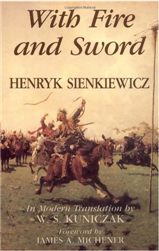
Cover for With Fire and SwordBest Book of Week 11!

Two years ago I read an exciting trilogy of Polish novels written in the 19th Century by Henryk Sienkiewicz, a Nobel prize winner for lifetime achievement in writing epic literature. The books were wildly popular for about 50 years, and Polish friends of mine tell me that they were their childhood reading. My review of the trilogy was published on Nancy Pearl’s blog (the librarian who has her own action figure), and I wrote to her awhile back asking if I could republish it here. She did not respond, so without further ado, I am going to write another review of the first book, With Fire and Sword. I will of course crib from my original review. The three books are stand-alone but with recurring characters, so you can read just one without missing important plot points.

It is 1647, and the Polish-Lithuanian Commonwealth is having some trouble—there are rumblings of rebellion among the Cossacks, who are a major force in the Polish army. Yan Skshetuski is a young Polish officer in the hussars of the Ukrainian Prince Yeremi Vishnovyetski. Prince Yeremi sends him on a mission as an emissary to Bohdan Hmyelnitzki, the leader of the Cossack rebellion. Yan has just become engaged to the beautiful Helen, but duty calls, so he makes his way through down the river to where the Cossacks are gathering.

Yan has been sent too late, though, for the rebellion has already started when he arrives, and he is made a prisoner. He escapes with difficulty and makes his way through the war-torn landscape, all the time worrying about Helen.

The political situation in Poland is very unstable, so no one comes to Prince Yeremi’s aid as he is attacked by hoards of Cossacks from the southeast. Even though Helen has been kidnapped by the wild Cossack Bohun, Yan cannot take time to look for her because he is embroiled in another mission for the Prince. So, his friends, the fat buffoon Pan Zagloba, the lovelorn knight and master swordsman Michal Volodyovski, and the gentle Lithuanian giant Longinus Podbipyenta decide to help Yan by rescuing Helen themselves.

This novel is all adventure and romance, and it is truly exciting. Along the way, you learn something about 17th century Polish history.

If you are interested in reading the book, you may have  a hard time finding it (although I see it is available in a print-on-demand basis). It is also available in several translations, about which there is some debate. The original translation by Curtin is said to be truer to the book, but I took a look at it, and it is also fairly badly written. The translation that I read by Kuniczak takes some liberties with the structure of the novel, but is eminently readable, if you can find it. The cover picture at the beginning of the article is from the edition that I read.

Day 45: The Possessed: Adventures with Russian Books and the People Who Read Them

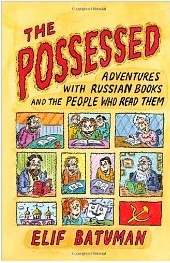
Cover for The PossessedMaybe not many of you would be interested in a book like The Possessed: Adventures with Russian Books and the People Who Read Them by Elif Batuman, but as a previous student of Russian and also a previous literature graduate student, I found it very funny.

Batuman has written a book about her years as a graduate student of Russian language and literature that skewers many things, but particularly academic conferences with their absurd presentation topics and academic thinking, with the oblique reasoning process that sometimes accompanies it. For example, on the way to a conference on Tolstoy’s estate, Batuman loses her luggage and is forced to dress in flip-flops, sweatpants, and a flannel shirt. Some of the scholars attending the conference assume she is a Tolstoyan and that she has taken a vow to walk around in sandals and a peasant shirt for days. When she calls a Russian clerk to find out about her luggage, the clerk replies, “Are you familiar with our Russian phrase resignation of the soul?”

While relating her adventures in studying, travelling in Russia, and living in Turkey, where she went because her grant was too small for her to afford a stay in Russia, Batuman muses on ideas from literature and compares the lives of the people she meets with the adventures of characters in Tolstoy, Dostoevsky, and Chekhov. Her observations are colored with her own peculiar view of life, which poses that “the riddle of human behavior and the nature of love appear bound up with Russian.” In Turkey, when she is challenged by scholars to study Turkish literature, particularly because of her Turkish heritage, she concludes that no one reads it, even the Turks.

Batuman expanded articles she wrote for Harper’s and The New Yorker into this book, which is named after one of Doestoevsky’s more enigmatic novels. Although her musings are occasionally a trifle too erudite for me to follow (and perhaps my memories of Russian literature too rusty), I found the book amusing and couldn’t put it down.

Day Six: Waverley

Cover for WaverlyI have been trying to offer a mix here, not just mystery mystery mystery, and so far I have just reviewed books I’ve liked. But I plan to also review books I didn’t like. This book isn’t one of them; I’m just warning you.

I had a hard time even getting interested in reading anything by Sir Walter Scott after having been forced to plow through the dreaded and deadly dull Ivanhoe in high school. I tried rereading it again some years ago because sometimes things you find dull in high school are more interesting when you’re older, but it wasn’t. I have often wondered what criteria high schools use when picking the English curriculum, when there are much more vibrant classics available. I can only suppose that they thought a tale of knights, derring-do (whatever that is), and Richard the Lionheart would interest high school students. When you read Ivanhoe, it’s hard to imagine that at one time Scott’s books were waited for with bated breath by the whole family.

But most of us probably haven’t tried to read his Scottish novels, or the Waverley novels, as they are called. This review is about the novel called Waverley, presumably the one the others are named after. It was written in 1814 but is set in 1745. Scott’s Scots dialects are a little difficult—a glossary would be nice—and he can occasionally be a bit long-winded, but his Scottish novels are much more interesting and amusing than Ivanhoe.

Waverley is a dreamy, wealthy youth brought up in England who has been neglected by his father and raised by his uncle, a man of Jacobite sympathies. A romantic man of undetermined principles, he cannot decide what to do with himself, so he is sent off by his uncle to join the army.

On leave from a regiment stationed in Lowland Scotland, he goes to visit an old friend of his uncle. He makes a visit to the Highlands out of curiosity and ends up embroiled in the Jacobite conspiracy. He is charged with desertion and treason, mostly because he’s in the wrong place at the wrong time.

Part of Scott’s intent, I believe, was to show the British of the times that the Highland Scots were not just a bunch of savages and to depict them realistically.

The book is entertaining and humorous at times, and also occasionally a little ponderous. Waverley is a hapless hero who finds himself drawn into one fix after another, which perhaps makes him a more modern protagonist than you would expect.