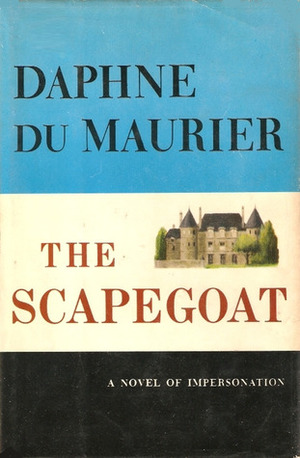
Review 2542: The Scapegoat

It’s been some years since I read du Maurier’s The Scapegoat, so when I saw it filled a hole in my A Century of Books project, I took it down from the case and placed it on my project pile. I find I remembered the plot fairly accurately.

John, an English lecturer in French history, is finishing his yearly vacation in France. This year, he feels dissatisfied with his life. He has no close connections and lives alone. He suddenly feels a lack of purpose in life and decides to drive to a monastery. But first he stops for the night in LeMans.

There, he bumps into a stranger who looks exactly like him. This man introduces himself as Jean and invites him for a drink and then to spend the night at his hotel. When John awakens, he is in the other man’s room with his things. The man is gone and so are all John’s own things, including his car. John finds a chauffeur has arrived to collect him in the new identity of Jean, Comte de Gué. He realizes that he has no proof of his own identity to convince the police, so he goes along.

At the Comte’s home, no one suspects a thing. He must guess who all these people are, but when he makes mistakes, he finds that no one expects him to behave nicely. His counterpart is apparently prone to cruel jokes.

John finds himself slowly becoming involved in the lives of the Comte’s family, who have secrets and problems from events during World War II. In addition, the family fortunes depend upon the Comte’s pregnant wife bearing a boy—or dying.

As usual with du Maurier, there aren’t very many unshadowed characters in this novel. It’s quite dark despite John’s intentions to do good for the family. The plot is interesting and involving, though.

Related Posts

Jamaica Inn

Rebecca

Daphne Du Maurier: The Secret Life of a Renowned Storyteller
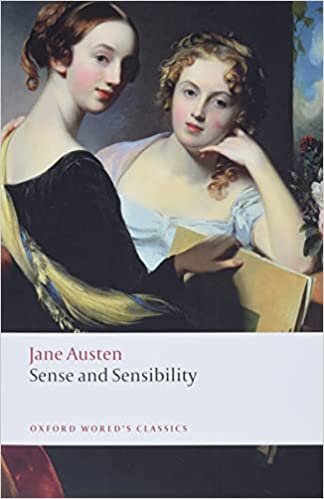
Review 2534: #ReadingAusten25! Sense and Sensibility

My original intention for ReadingAusten25 was to reread only the books I hadn’t reviewed yet. But I can’t resist Austen, so here I am reviewing Sense and Sensibility. I am not going to repeat my review of 2022, though, so you can find it here. Instead, I thought I’d look at whether the book struck me differently this time and a little at Claire Tomalin’s point of view (the wobble), as cited by Brona.

It did strike me differently. Although Elinor is still my favorite of the two sisters, they both struck me more extremely this time. Marianne seemed like a true modern teenager, not as much for her reactions to Willoughby but more in her sulking (call it what it is), her rudeness to various kind characters whom she thinks ill-bred, and so on. But the thing is, 16 in the early 19th century meant she was supposed to be an adult, or almost. (Of course, she is also under the influence of the Romantic movement in art, literature, and music.)

As for Elinor, sometimes I felt she carried her comments a little too far, into preachiness. I got a little tired of her dissections of other people’s behavior.

I also appreciate the wit of the novel more. Although I always find Austen witty, she has drawn us some priceless characters and written quite a few zingers.

I am not so sure about Tomalin’s “wobble.” I looked for it but didn’t find much evidence for it unless you count Elinor’s dash out of the room after she finds out Edward isn’t married. I’d like to hear if anyone was struck differently. I remember not agreeing with some of Tomalin’s interpretations when I read her biography of Austen.

Related Posts

Jane Austen: A Life

Jane Austen at Home

Persuasion

Review 2533: The Stone Angel

When I was looking for books to fill a hole in my A Century of Books project, I found this one. I thought I had read a book by Laurence before, but apparently not. The Stone Angel is the first in her Manawaka series.

Hagar Shipley is 90 years old. She is a proud, tough woman who has never expressed any of her gentler feelings. Now she finds that her son Marvin and his wife Doris are thinking she needs to move to a senior home. She understands this idea as greed for her home and possessions, although that is not the case. She is fighting the idea as best she can.

Hagar, though, is prone to falling and has memory lapses. In between the scenes from her current life, she returns in her memory to important events and tragedies in her life.

Hagar is not a pleasant person, but Laurence makes us interested in her and manages to make us understand and even sympathize sometimes with this complex character.

Related Posts

The Night Stages

Fifth Business

The Northern Lights

Review 2531: The Bell Jar

I’ve meant to read The Bell Jar for years, so when I saw it would fill a hole in my A Century of Books project, I got it from the library. I was also interested in it after reading the biographical fiction Euphoria, about Sylvia Plath and her husband, Ted Hughes.

In 1953, Esther Greenwood has earned an opportunity from a major fashion magazine, an internship with a group of other girls in New York. At first, she studiously applies herself to her assignments, but she becomes distracted by her fascination with Doreen, who seems more worldly than the other girls. She is tempted out by endless partying until Doreen gets a boyfriend and Esther has several unfortunate encounters with men.

She returns home from her internship suddenly adrift. She has not been accepted into a writing program, she doesn’t want to live with her mother, and none of the careers she can think of are appealing. Everything seems gray and uninteresting.

Of course, this is the story of Esther’s fall into mental illness, wrapped up in her inability to see a path for herself aside from marriage, which she clearly fears.

The novel is clearly based on Plath’s own experiences. It is clearly and vividly written and looks deep into the psyche.

Related Posts

Euphoria

Song of a Captive Bird

My Brilliant Career

Review 2528: The Home

Eleanor is moving. She’s doing this because after 26 years of marriage, her husband is leaving her. Their marriage had been an open one, which translated to her husband Graham being serially unfaithful while she had two affairs that ended in friendship because she loved Graham. The last few years have not been happy, but still it’s hard for her to accept that he has left her—without really talking about it—for a woman who is younger than her oldest daughter.

Now she is trying to make a home for children who, all but one, are adults living on their own. Nevertheless, they return in ones and groups to stay with her.

Eleanor struggles in this novel with the idea of what home is, with loneliness, with her desire to mother children who don’t really need it anymore, with desire and love for Graham, and with the need for someone to take care of her. The novel looks unflinchingly at the situation that many middle-aged women found themselves in beginning in the 1970’s, when divorce rates began to rise. For example, Graham (who in my opinion is an unrelenting jerk) supposes Eleanor can get a job when she has been trained for nothing and has no work experience for the last 26 years except being a wife and mother.

This is sometimes a rough read but always an insightful one. Mortimer has an unfailingly observant eye.

Related Posts

The Pumpkin Eater

A Separation

The Women’s Room

Review 2525: The Camomile

As Simon Thomas points out in the Afterword, The Camomile is a novel that “sets out to be distinct from the ‘marriage plot’.” This although its heroine, who says she strains for Reality, thinks sometimes that marriage is a way to achieve it.

That heroine is Ellen Carstairs, who has just returned to Glasgow after four years in Germany studying music. She knows herself not to be a prodigy, but she begins giving music lessons to contribute to the household, that of her religious Aunt Henry and her brother Ronald, an architecture student.

Apparently, Ellen’s mother wasted a lot of money publishing her writings, to the point where it seems to be considered a mental disease, so Aunt Henry dreads the possibility that Ellen may be writing. Yet, that’s exactly what she begins doing. She gets herself a room where she can practice the piano undisturbed, but she also spends a lot of time at a library, where she meets an impoverished scholar she calls Don John, who helps her with her writing.

The novel, which is related in letters to her friend Ruby and in diary entries, deals with fairly innocuous social engagements, but Ellen spends a lot of time pondering ideas and trying to understand people’s relationships with each other. First, there is the marriage of Laura, one of Ellen’s friends, who doesn’t seem to love her fiancé at all, while being determined that people think she does. Ellen herself doesn’t mind not being married but on the other hand seems to accept that it is a goal of a kind, a way to achieve Reality.

Ellen pretty much dissects every idea she comes across, and after a while, I felt it was too much, especially after she herself (spoiler!) becomes engaged. However, over all I found the novel engaging with Ellen a lively heroine.

Related Posts

The Fountain Overflows

The Pumpkin Eater

O, The Brave Music

Review 2524: I Capture the Castle

It was with delight that I noticed I Capture the Castle would help me with my Century of Books project, because I liked it so much when I read it years ago. It had an ending that was completely different from what I remembered, though, my memory having possibly been polluted by seeing a couple of TV versions of it.

Cassandra lives with her family in a house attached to a ruined castle. The house, which was purchased during the heights of her father’s success as a writer, is now woefully decrepit. Her father has not produced anything since his initial success, and the money ran out long ago. Now their clothes are shabby, and they can barely afford to eat. Rent hasn’t been paid for months, and they’ve sold all the good furniture.

There is exciting news, though. Their landlord having died, new occupants of the estate, which includes their home, have arrived. They are American brothers, Simon and Neil Cotton.

The brothers arrive when Cassandra is taking a bath in the kitchen. She keeps quiet and they go away, but they return so she has to announce herself. They take her for a child. Her sister Rose, who is beautiful, decides that she will marry Simon, the heir, no matter what, even though she hates his beard.

Cassandra likes both men at first but then overhears them talking about Rose, who has been behaving affectedly. With a little advice, Rose begins to act naturally, though, and soon she has accomplished her goal. She is engaged to Simon, although Neil seems to hate her. The only trouble is, Cassandra is in love with Simon.

This sounds like a straight love story, but it isn’t. There are lots of terrifically eccentric characters and subplots to go with them. There is the issue of whether their father will write again. And will Topaz, their stepmother, who sees herself as an artist’s muse, leave him for someone who is working? What can Cassandra do about Stephen Colley, a devastatingly handsome young man who lives with and basically supports the family and copies out poems to give to her?

This novel is charming. Its narrator mixes wit with naiveté and wisdom, and the novel is written in a sprightly, entertaining manner. It’s a lovely light read.

Related Posts

It Ends with Revelations

A Pink Front Door

The Weather at Tregulla

Review 2518: Dean Street December! The Fledgling

Here’s another book for Dean Street December!

I have read two memoirs by Frances Faviell, but The Fledgling is the third of her three novels and the first of her novels I’ve read. For me, It wasn’t as successful as her memoirs.

One reason is the main character. He is not very appealing. I’ll explain why later.

Neil Collins is serving his compulsory military service in 1950s England. This service was apparently controversial because the country was not at war.

Neil is a fragile, small young man who gets so nervous when ordered around or bullied—which he frequently is—that he gets stupid and can’t remember how to do things. He has already gone AWOL twice and has promised his grandmother he won’t do it again.

Everyone in his unit picks on him. He thinks he has one friend, Mike, but when Mike bullies him to desert, planning to follow him and use Neil’s contacts to get to Ireland, he realizes Mike has just been using him. So Mike bullies him more until he goes. Sexual abuse is implied.

Neil shows up in his grandmother’s rooms hoping to get his twin Nonnie’s husband, Charlie, to take him to Southampton before the arrival of Mike, who was supposed to leave the next day. However, his grandmother wants to turn him in, like she did last time, and Charlie doesn’t want to help him. To make matters worse, the walls of the rooms are very thin and people keep dropping by and trying to come in. Meanwhile, unbeknownst to the family, Mike is across the street all day watching the house.

I found Neil unlikable not so much because of what he is doing but how he acts. He is like the most timid heroine in a Gothic novel. He gasps loudly when he’s hiding, he keeps raising his voice despite many warnings about the nosy neighbors. He actually falls through the door when he is eavesdropping on his grandmother and her social worker. Basically, he’s an idiot with no control over himself. He acts more like a five-year-old than a twenty-year-old.

Of course, the book is about how he gets some stuffing to brace him up, but some of the book’s values are very dated. For example, Nonnie is supposed to tolerate Charlie’s infidelity because he’s jealous of her connection with her twin. And Neil has to get in a physical fight to gain some confidence. I also didn’t really find any of the characters to be that likable.

Related Posts

A Chelsea Concerto

The Dancing Bear

The World My Wilderness

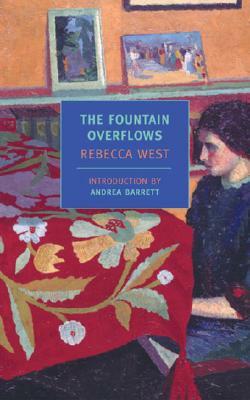
Review 2516: The Fountain Overflows

Rebecca West based The Fountain Overflows on her chaotic family life when she was a girl. I understand it is the first of an unfinished trilogy. If so, I’m interested in reading all of it.

Rose Aubrey is a daughter of an unusual couple. Her father Piers is a writer and editor whom many consider a genius, but he is a gambler who continually impoverishes his family. He has a pattern of collecting followers or benefactors who at first seem to worship him, but eventually they break with him, usually after lending him money. However, his family adores him. Her mother is a gifted pianist, formerly a famous concert performer, who is teaching Rose and her sister Mary with the expectation that they will become concert pianists, too. Their oldest sister, Cordelia, has no talent for music but doesn’t know it. She takes up the violin. Their younger brother Richard Quin is adored by all, a toddler at the beginning of the novel.

The novel covers about ten years of the family’s life. There is plenty of incident, from Mrs. Aubrey’s struggles to keep the family financially afloat to the girls’ struggles at school because they’re considered peculiar but also because they hate wasting time at school when they could be playing piano. Cordelia finds a mentor in one of her schoolteachers who encourages her in the idea that she is talented, which Mrs. Aubrey and the other girls deplore. Rose and Mary meet poltergeist activity at a friend’s house, and the family gets involved in a murder case. Also of importance is the girls’ cousin Rosamund.

It’s difficult to summarize this novel, but this family is so interesting, brilliant, chaotic, well-intended, and right behaving. I found the novel delightful.

Related Posts

Little Women

Apricot Sky

The Pursuit of Love

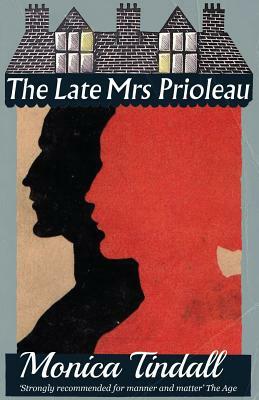
Review 2515: Dean Street December! The Late Mrs. Prioleau

Here’s another one for Dean Street December!

Because of the war, Susan Prioleau never meets her mother-in-law before she dies. Mrs. Prioleau seems to have kept an unhappy home, with children who left it as soon as they could, excepting Austin, her oldest son. She adored him but convinced him he is an invalid with a bad heart, which his doctor says is not true. He is immensely fat and makes his heart an excuse for doing nothing.

Susan hears stories about Mrs. Prioleau that don’t agree. She was adored by her servants of long ago, but she has written people cruel, vindictive letters. Both her daughters say she never gave them any attention, although the oldest, Nonnie, remembers a time when things were different. Her daughter Melissa disliked her, and she was estranged from her sister, Catherine, for years.

As Susan gets to know the family and helps Austin clear the house (although he won’t let her remove much), she begins to learn more about her mother-in-law’s life. Eventually, she learns about events that turned her from a selfish but warm-hearted girl to a spiteful old woman.

It’s a pity Monica Tindall only wrote one novel, because this is a good one. Although some of its secrets are easy to guess, the journey was absorbing.

Related Posts

Expiation

Which Way?

The Awakening