Review 1358: Literary Wives! A Separation

Today is another review for the Literary Wives blogging club, in which we discuss the depiction of wives in fiction. If you have read the book, please participate by leaving comments on any of our blogs. Be sure to read the reviews and comments of the other wives!

Emily of The Bookshelf of Emily J.
Eva of Paperback Princess
Lynn of Smoke and Mirrors
Naomi of Consumed By Ink

* * *

The unnamed narrator of A Separation receives a call from her mother-in-law, Isabella. Isabella has been trying to contact her son Christopher, the narrator’s husband, and demands to know where he is. What Isabella doesn’t know is that the narrator has been separated from Christopher for six months because of his infidelities. She has promised him to tell no one, which has become awkward because for three months she has been living with another man, Yvan.

Isabella can’t believe the narrator doesn’t know where Christopher is. His mother has traced him to a hotel in rural southern Greece and demands that the narrator go there to find out what is going on. For some reason, Isabella is alarmed.

The narrator makes some inexplicable decisions during this novel, almost as though she is obeying instinct rather than thinking. The first one is in not telling Isabella that she and Christopher are separated. The second is in actually doing what Isabella asks.

When she arrives at the hotel, she finds that Christopher is indeed staying there, researching a book on death rituals. However, he has been away for a few days. The narrator decides to wait for his return. Soon, something happens that forces her to re-evaluate her relationship with Christopher.

This novel is a carefully observed work about the complexities of marriage, love, betrayal, and loss. As the narrator, with her secret, is forced more and more back into the role of wife, she uncovers feelings about her husband that she didn’t know she had. Although a fairly simple story plotwise, the novel delves into the layers beneath the facades of marriage. This is a much more intelligent, sophisticated look at marriage than we have yet read in this club.

What does this book say about wives or about the experience of being a wife?

This novel is one of the most complex and true-to-life that we have read for this club, while not really looking at what the marriage was like while the couple were still together. Even though the narrator considers her marriage over, and in fact, goes to Greece planning to ask for a divorce, she finds that the bonds of marriage affect her more strongly than she would have guessed. She finds herself forced back into the role of wife, for example, experiencing the dichotomy of having to make decisions she doesn’t feel she has the right to. The situation forces her to re-evaluate her relation to Christopher and his family. She is bound in ways she didn’t expect.
Literary Wives logoEven though Christopher was the one who strayed and her relationship with Yvan didn’t begin until after they separated., she feels she has betrayed him in some way through that relationship.

I wonder about Kitamura’s decision to make the narrator the only unnamed character in the novel. I have only seen this device used a couple of times, and I can only put a name to one of them now, Daphne du Maurier’s shy, self-effacing narrator in Rebecca. Surely the reason that Kitamura used this device is not the same. Of course, the novel is narrated in first person, and we don’t think of ourselves by our names. Still, no one calls her by her name, either. Perhaps Kitamura uses the device because in some ways the narrator seems to be functioning blindly and is at times an unreliable narrator because she is unaware of her own motivation. I wonder if anyone else has an insight into this.

Related Posts

Stay With Me

After You’d Gone

First Love


Review 1353: There There

Cover for There ThereThere There is about the life of urban Native Americans. Set in Oakland, it follows numerous characters who plan to attend a powwow. However, we know from the beginning of the novel that some men are planning to rob the powwow.

The novel begins with a Prologue about depictions of Native Americans in popular culture. Then we meet Tony Loneman, a low-level drug dealer who is being compelled by his contacts to help them rob the powwow. Tony was born with fetal alcohol syndrome, so his thinking processes are not great, but when he puts on his regalia to attend the powwow, he sees a dancer in the mirror.

Dene Oxendene makes a presentation to a grant committee to get funding for a project to record the stories of Oakland Native Americans. The powwow is a good place to find them, and it’s not hard to image that Dene is Orange himself.

Next, we meet Opal Viola Victoria Bear Shield as a child in the late sixties, taken by her mother to occupy Alcatraz. With her is her sister Jacquie Red Feather, who is raped by a boy named Harvey. In the present day, Opal doesn’t plan to attend the powwow until she learns that her great nephew, Orvil Red Feather, plans to dance. Ultimately, Opal’s entire family, including Jacquie and Jacquie’s children, ends up at the powwow.

Another important character is Edwin Black, a young man who has spent his time since college trolling the internet and gaining weight. When he finds out that his father, Harvey, is a powwow emcee, he gets a job helping organize the powwow.

Although this novel is an angry one, it at least has a hopeful ending. However, it was marred for me by the promise of violence. Of course, that was the way to lend it suspense, but I had the same reaction to it as I did as soon as I saw the gun in Thelma and Louise. Although these people have a tough life, there isn’t any gun violence in it (although there is domestic violence) except for this plot device. I wish Orange had found a different way to hold his stories together.

Related Posts

A Brief History of Seven Killings

Telegraph Avenue

LaRose

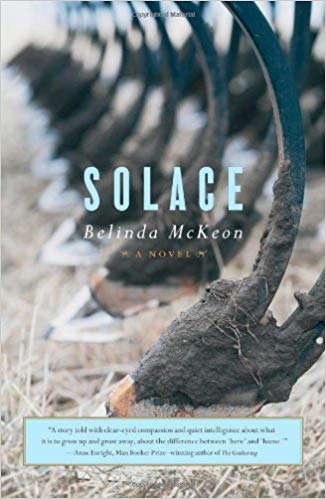
Review 1352: Solace

Cover for SolaceSolace examines with intelligence and compassion a difficult relationship between father and son. This relationship is eventually made more complex by grief.

Mark Casey is a graduate student writing his Ph.D. dissertation in English literature at Trinity. He feels as if his father, Tom, expects his help on the farm too often. His presence at the farm is brokered by his mother, who barely lets a day go by after he has left before she is asking when he’ll be back. Mark has no interest in running the farm, however, even though his work on his dissertation is faltering.

Tom Casey thinks Mark was born to work the farm. Although Mark was interested in helping as a youngster, his interests began changing when he became a young man. Tom does not understand Mark’s choice of a profession and makes it clear that he thinks Mark will eventually choose to return to the farm. When they are together, they are soon arguing.

Then Mark meets Joanne Lynch at a party, and they begin dating. By rights, he should already know her, because she grew up not ten minutes down the road from home. However, since they were both young, his father has had a feud with Joanne’s, which has not ended with Brian Lynch’s death. The situation between Mark and Tom becomes more complicated when Joanne finds she is pregnant after they’ve only been dating a few weeks.

This novel shows insight into a difficult relationship, how both father and son say things they don’t mean while being unable to say what they do mean. Then their relationship is tested further through tragedy.

This is an interesting, empathetic novel about ordinary lives that I read for my James Tait Black project. It is touching and true to life and provides no easy answers for its characters.

Related Posts

& Sons

The Sea

Gilead

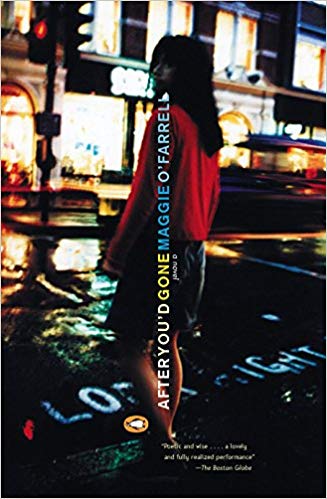
Review 1346: After You’d Gone

Cover for After You'd GoneAlice Raike takes an unplanned trip from London to North Berwick to see her family. After she arrives, she sees something horrible that makes her return immediately to London. Later that evening, her mind in an uproar, she steps off a curb into oncoming traffic and ends up in the hospital in a coma.

In vignettes shifting in time and point of view, After You’d Gone tells the story of Alice’s life and of her family’s secrets. This novel is powerful, and it had me in tears by the end. O’Farrell slowly peels off layer after layer to reveal the truths of Alice’s life.

I don’t know what else I can say about this novel except I loved it.

Related Posts

Autumn

The Rehearsal

Atonement

Review 1338: Eligible

Cover for EligibleSo far, the Austen Project, for which current writers rework Jane Austen’s novels within a modern framework, hasn’t worked for me. I have a theory that the readers who like them are reading mostly for plot, whereas I read Austen for her quick but subtle wit and her precision. Let’s face it, although humor is always in style, these days subtlety is not. Still, I thought I’d give Eligible, Curtis Sittenfeld’s reworking of Pride and Prejudice, a try.

Obviously, some of the dilemmas in the original novel are just not workable in today’s society, a problem that foundered Joanna Trollope’s reworking of Sense and Sensibility. Sittenfeld is wise enough to realize this and has made significant changes to the characters and plot.

Liz Bennett is a magazine writer who lives in New York. She and her sister, Jane, a yoga instructor, have returned to their home town, Cincinnati, to help out after Mr. Bennett’s heart attack. Their help is needed even though their three younger sisters, suffering from failure to launch, are still living at home, because they are doing nothing. Mrs. Bennett, a social climber, is too involved in running a charitable event to take her husband to his doctor’s appointments.

Jane is pushing forty, so she started in vitro fertilization before returning home. Then she meets Chip Bingley at a charity event. Jane and Chip immediately become involved, but Liz has formed a negative impression of Chip’s friend, Fitzwilliam Darcy, because of remarks she overhears at a party.

Liz has been involved for years with Jasper, a man she fell in love with in her early 20’s. Jasper claims he has an open marriage, and he has been seeing Liz on the side. When Jasper hears Liz has met Darcy, he hints at some misbehavior of Darcy’s when the two attended Stanford together.

Of the Austen Project novels I’ve read, this is the most successful rewrite, but the bar is fairly low. Although the dialogue is humorous, it’s not the sparkling dialogue of the original. Kitty and Lydia, for example, are almost unbelievably vulgar and poorly behaved. It’s also hard for me to believe that these days a mother would be pushing marriage after Jane and Chip have only had a few dates.

I was fairly well entertained, though, until the emphasis went to the Eligible reality show. Although I’m sure Sittenfeld had fun with her parody, that’s where I felt the novel lost steam.

Related Posts

Persuasion

Sense & Sensibility

Northanger Abbey

Review 1333: Literary Wives! Wait for Me, Jack

Cover for Wait for Me, JackToday is another review for the Literary Wives blogging club, in which we discuss the depiction of wives in fiction. If you have read the book, please participate by leaving comments on any of our blogs. Be sure to read the reviews and comments of the other wives!

Emily of The Bookshelf of Emily J.
Eva of Paperback Princess
Lynn of Smoke and Mirrors
Naomi of Consumed By Ink

* * *

Wait for Me, Jack is the story of a marriage, told backwards. I remember this technique being used for the movie Betrayal, giving the final scenes of the enraptured beginning to an affair a certain poignancy. That’s not really the effect of this novel, however.

The novel begins with a few scenes before the death of 80-something Jack. His wife Milly can hardly walk, increasingly more debilitated since her injury in a car accident in her 40’s. Jack has had a couple of heart attacks. Both have been suffering from the indignities of old age.

The novel works its way backwards, showing them at two- or three-year intervals, until they meet at work in their 20’s in 1950. This backwards approach may have worked better if it was not so regular, if we saw them at less frequent but more significant times of their lives. Instead, it visits them at purposefully mundane times—not when they split up but when they are separated, not when their son dies but before and after.

A more significant issue, though, is that their problems are trite and not very interesting. Jack is a philanderer. Milly is dreamy and a  neglectful housewife. Their personalities are ill-defined. Sure, we see their thoughts over a period, but we still don’t have much of a sense of them as people. I started out mildly interested in them but eventually bored, especially when I found that the last four or five pages echo the first four or five almost verbatim. Really? Why not end with their first sight of one another? Wouldn’t that have been more poignant?

And by the way, what did they see in one another? We’re told that Jack first thinks he’s meeting a classier lady than Milly proves to be. He has upward ambitions. But he must find out that is not so fairly early on. In any case, their reasons for staying together are not clear. I disliked Jack and found Milly to be silly, and the other characters are just ciphers, there for the plot to continue.

I have commented on this before for other novels, but I also disliked Jones’s technique of having her characters think words  like “Gee” and “Jiminy.” These might be words that people say, and she obviously thinks these expressions are cute, but we don’t ever think these sort of interjections.

What does this book say about wives or about the experience of being a wife?

Despite her occasional insights, I found Milly to be much more enigmatic than Jack. For a girl who at the beginning of the book seems to want adventure and a change from her lower-class roots, she settles pretty quickly into a standard 50’s housewife at first not much better off then her parents were.

She actually reminded me of my mom, a dreamy person not really suited to her role, at one point imitating Jackie Kennedy. She accepts her role better than my mother did, though, and stays devoted to her husband even when he strays. Why is that? Is that just because it is what you did in her generation? But that’s clearly not true, as it is just at this time that divorce increased so much in the U. S.

Jack has the typical 50’s view of his wife and never really advances out of it. He considers their money his and discounts the effort she spends caring for the kids or keeping the house. “What do you do all day?” he asks, even though anyone who has done both roles knows that keeping a house and caring for children is a lot harder than working in an office. These were accepted views of the time, though. Still, Jones herself seems to have the same view, having Milly watch soap operas and read magazines and daydream more than showing her engaged in her daily tasks.

So, how to answer this question? I see Milly as a woman who accepts her traditional role as defined in the 50’s and doesn’t really advance much with the times. Jones shows her, for example, puzzled about feminism in the 60’s and 70’s but not really getting it. She inexplicably puts up with Jack’s dalliances and accepts his illegitimate son into her family. Most of the time, she doesn’t really seem to love Jack (although I think she loves him more than he loves her), just as he doesn’t seem to love her but criticizes her all the time. However, she stays devoted to him in other ways.

Maybe this describes most marriages. I don’t know. But I think the biggest problem with this book is that it takes a surfacy look at marriage.

Related Posts

The Headmaster’s Wife

American Housewife

The World’s Wife

Review 1330: The Ministry of Utmost Happiness

Cover for The Ministry of Utmost HappinessTwenty years after Arundhati Roy’s transcendent The God of Small Things, she has written another work of fiction. The Ministry of Utmost Happiness deals with varied characters and sources of unrest in India, though, rather than the unhappiness of a single family.

The novel begins in roughly the 1950’s Delhi with Aftab, the only son of his Muslim family. Aftab was born a hermaphrodite, and his parents decided he would be a boy. Aftab, however, feels he is a girl, so in his teens he joins the hijras of Shahjahanabad, a group of transexuals and transvestites who are mostly sex workers. Aftab becomes Anjum.

Roy follows Anjum’s adventures for nearly half the book, during which time India is rocked by several eras of attacks on its Muslim communities. Eventually, as an older woman who feels that the affections of her adopted daughter have been lured away from her, Anjum moves away from the hijras to live in a graveyard and befriend a host of misfits.

With the appearance of a second unwanted baby, Roy’s narrative goes off in an entirely different direction, which does not seem to tie up with the previous story for some time. Instead we have the story of the friendship between Tilo, Naga, and Musa, a Christian-raised girl and two boys. Musa eventually becomes a revolutionary fighting for the freedom of Kashmir. Roy’s book is angry as she documents abuses of power by the Indian government on relatively innocent citizens who are not Hindu.

Frankly, it’s hard to know what to make of this novel, which seems to be all in pieces and has too easy of an ending. One key to it is a poem written by Tilo at the end of the novel. “How to tell a shattered story? By slowly becoming everybody. No. By slowly becoming everything.” Well, this novel feels like Roy tried to cover everything, with many characters, many forms of narration, many stories.

Related Posts

An Atlas of Impossible Longing

The Lives of Others

The Lowland

Review 1328: What Belongs to You

Cover for What Belongs to YouAt first, I really didn’t think I would enjoy What Belongs to You, which I read for my James Tait Black Fiction Prize project. One reason was its explicit sexuality, which I didn’t really find interesting.

As I read further, I didn’t like it because it is about the unnamed main character’s affair with a Bulgarian male prostitute named Mitka. I have never understood why some people believe that they can have a meaningful relationship with someone they’re paying for sex, or even more pertinently, why that is such a common theme for fiction. The novel is divided into three parts, with the first and last devoted to this relationship.

Still, it is very well written, with clean, crisp prose. I also found the second section, which is about the narrator’s relationship with his father, more interesting. I felt it explained a lot about the relationship with Mitka.

Ultimately, I was touched by this novel, even though its sexuality was so explicit that it occasionally made me uncomfortable.

Related Posts

In a Strange Room

All That Man Is

Arctic Summer

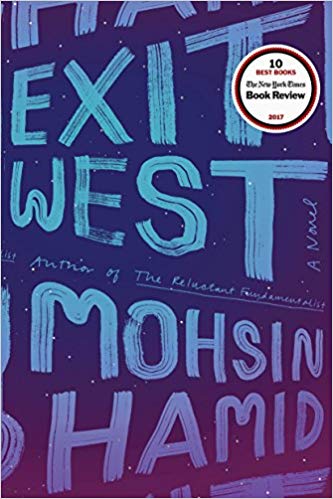
Review 1325: Exit West

Cover for Exit WestIt’s difficult to describe Exit West. Part embedded in a slightly futurist reality, a small part speculative, part romantic, the novel is mostly a parable. Those of you who know me, know I don’t really like parables and I seldom appreciate magical realism, so this probably wasn’t the best choice for me, but I read it for my Man Booker Prize project.

Saeed meets Nadia in class as their unnamed city succumbs to war. They secretly see each other while a war goes on between religious fundamentalists and the government. As the situation deteriorates, Saeed’s mother is killed.

Saeed and Nadia hear rumors about doorways that can take refugees to other parts of the world, and we take a few side trips from their stories to witness people emerging in other countries. In some countries, the doors are guarded to keep the refugees safe. In others, the governments are trying to keep refugees out.

Saeed and Nadia decide to leave, but they cannot convince Saeed’s father to go with them. They eventually go, emerging first in Mykonos, where they live in a refugee camp, then in London, and finally in Marin County. Everywhere they go, they join swarms of refugees.

Hamid isn’t as interested in the grueling journeys of refugees as he is in the psychological effects of their journeys. Quiet, reflective Saeed has more difficulty adjusting than does the more adventurous Nadia.

Because this is more of a parable, though, the two main characters are mostly ciphers. We don’t really get to know them or care that much about them. Hamid’s lightning glimpses of other people’s lives open up the novel a little bit. It’s a technique similar to that used by David Mitchell, but in this novel it doesn’t work as well. Sometimes these glimpses seem to have little point, although most of them are linked to the doorways.

Aside from the timeliness of this novel (which I’m guessing is what has made it so popular especially with predictions about climate refugees to add to our current economic refugees and those fleeing violence), this novel was interesting but not altogether successful.

Related Posts

The Alchemist

The Parable of the Sower

The Forty Days of Musa Dagh


Review 1320: The Hypnotist’s Love Story

Cover for The Hypnotist's Love StoryEllen O’Farrell makes a charming, slightly ditzy heroine. As a professional hypnotherapist, she is experienced in helping her clients detangle their own relationships, but she’s not so good about her own. She hopes to find someone with whom to build a life, and she may have found him in Patrick, a surveyor and single father. Things seem to be going well except for two issues—he still seems to be madly in love with his deceased first wife, Colleen, and he has a stalker, his ex-girlfriend, Saskia.

Oddly, Ellen seems much more concerned about the dead wife than the live ex-girlfriend. Saskia seems rather harmless, even after Ellen discovers she already has her as a client under an assumed name. On the other hand, Patrick mentions Colleen several times a day. Ellen, who has a tendency to over-analyze things, begins wondering if she’s making a mistake.

The Hypnotist’s Love Story is unpredictable. For one thing, it is a long time before you figure out which genre it falls in. Is it a thriller, a comedy, a romance, or chick lit?

I always find Moriarty eminently readable. Her approach is empathetic and her characters usually likable, even the stalkers. This book is lots of fun, and I recommend it for witty light reading.

Related Posts

Big Little Lies

Truly Madly Guilty

What Alice Forgot