Review 1319: The Lesser Bohemians

Cover for The Lesser BohemiansI found The Lesser Bohemians a difficult book to read, in more ways than one. Still, if you are willing to give it a try, you may find it rewarding. It won Britain’s oldest literary prize, the James Tait Black fiction prize, in 2017.

The narrator of the novel, whose name we don’t learn until the end, is an 18-year-old Irish girl who comes to London to attend drama school. She is naive and inexperienced, but she plunges right into a life of partying. Still, she has not yet accomplished what she wants to, losing her virginity.

Then she meets an older man in a pub. He is 38 and a well-known actor. They begin an affair that he makes clear is a casual one. Soon, however, she realizes she is in love with him. Darker times await.

One of the difficulties (but also joys) of this book is the writing style. Although the story is told chronologically, McBride writes in sentence fragments, smashes sentences together, shifts pronouns and verb tense, and plays with typography, leaving gaps between words and placing innermost thoughts in smaller type. Here, for example, is a paragraph about her first friendship.

Vaudeville she, drawing all around. Funniest. And good to found a friendship. At least she’s a side to go side by with to class. Vault a day then with its procession of self. What’s your name? Whereabouts are you from? Live close? I hate the announcing but new futures demand new reckonings so I shuffle around what I have. Not much, not much, only me. Far from exotic when there’s Spaniards and Greeks. And here the first Dane I’ve ever met. Australian girls. Not white or Irish. You mean English up North? I only crossed a sea. Speak French then? Amazing. Fluently? I’d love to slip my homogeneity but. On to the next class. Go.

Like the narrator, none of the characters have names until, toward the end of the novel, the narrator and her lover use their names in the text. This can make it difficult at times to tell which characters are speaking or being referred to. The shift to actual names signals a shift in clarity for the main character.

Another problem for some readers may be the rawness and explicitness of its sexuality and of some other subject matter. For we are dealing with two really damaged individuals. I had to laugh when I realized my library was shelving this novel with the romances. Trust me, this is not a romantic novel.

So, why do I say it is worth reading? For one thing, it has a great deal of energy that carries you along. Also, you come to know these characters, with all their flaws, and care what happens to them.

The novel shifts about 2/3 of the way through, when the man starts being honest about himself. One reviewer thought the novel sags a little here. Certainly, it shifts in style, and perhaps loses some energy, but I was interested in the story.

Perhaps I don’t believe the ending of the novel and what it promises after all the characters’ volatility. Still, I was touched by this book and thought it was well worth reading.

Related Posts

First Love

Dear Thief

All the Birds, Singing

Review 1318: All That Man Is

Cover for All That Man IsIf David Szalay’s new novel shows all that man is, then we’re in a sorry state. A collection of nine barely linked short stories that is being marketed as a novel, the book depicts nine men at different life stages travelling or living in a different European country than their native countries.

The book starts with young men and works its way through middle age to old men. Seventeen-year-old Simon is travelling with his friend Ferdinand through Europe. They seem to be incompatible travelers. Simon is interested in art and music, while Ferdinand wants to party. Simon has mixed feelings when Ferdinand has sex with their middle-aged landlady in Prague.

Bernard is an aimless 20 when he quits his job to go to Cyprus with a friend. He ends up going alone, where he finds himself involved in a sexual relationship with both a hefty young woman and her mother.

Baláz is hired by Gábor to come with him and his girlfriend Emma to London. The details of this job are murky, but Baláz needs the money. It turns out that he is to provide the muscle while Gábor and his friend Zoli pimp Emma out to wealthy men.

Karel is an academic who begins the story believing his relationship with a lover who meets him periodically for a few days is perfect. But she has news for him. She has just discovered she is pregnant. To this news he answers, “This is shit!”

Kristian is a talented journalist with a friendly connection to a politician, Dahlig. The tabloid he works for decides to expose Dahlig’s affair with a married woman. Even though Kristian and Dahlig have a cordial and political relationship, Kristian thinks nothing of interrupting Dahlig’s vacation in Spain to break the news and try to force an admission from him.

I think you get the idea. These are not likable men. At best, they are feckless and inert. At worst, they are ruthless and amoral. Szalay affords each of them a moment of insight, clarity, or immersion of the senses, but these moments are fleeting. Sordid is a good adjective to describe these lives. This was not one of my favorite pieces of fiction. I read it for my Man Booker Prize project.

Related Posts

The Finkler Question

Hot Milk

Eileen

Review 1312: Autumn

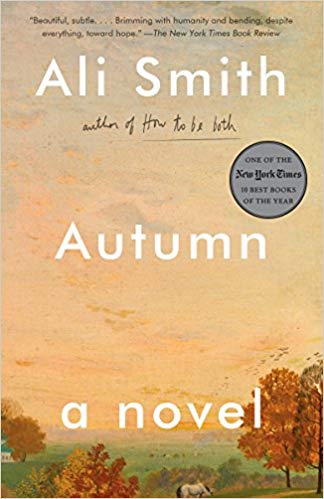
Cover for AutumnAutumn is the first of Ali Smith’s planned Seasonal Quartet. I believe Winter is already out. The first is about, among many other things, Brexit.

Daniel Gluck may be dying. He is an elderly man, over 100, and he dreams, among other things, that he has become his younger self and that he is turning into a tree. At his side reading to him is Elisabeth Demand, a thirty-two-year-old lecturer who has known him since she was eight. He taught her how to invent stories, approach the world creatively, and think critically. He always greets her with, “What are you reading?”

As Elisabeth walks around the village where her mother lives, she observes the various attitudes about Brexit. Some people are exultant while others are horrified. Her mind goes to A Tale of Two Cities, which she is reading to Daniel: “It was the best of times; it was the worst of times.”

It’s beyond my powers to provide much more than a suggestion of this novel, which touches on so many subjects, among them British pop artist Pauline Boty, Christine Keeler of the Profumo scandal, our experience of time, the relationship between mothers and daughters and brothers and sisters. I’ll just say that I found the novel both intellectually challenging and touching. I read it for my Man Booker project.

Related Posts

How to Be Both

In the Light of What We Know

Submergence

Review 1302: Crow Lake

Cover for Crow LakeBest of Ten!
Kate Morrison grew up in a farming community in far northern Ontario. She is reticent about her personal life, which frustrates the man in her life, Daniel Crane. Both are zoologists, and Kate can track her interest all the way back to the times she spent as a young girl watching insects and other wildlife in the ponds near her home with her older brother, Matt.

Kate finds it difficult to discuss her family, mostly because of her estrangement from that beloved brother. Crow Lake relates the events that led up to that estrangement from the time her parents died.

When Kate is seven, both her parents are killed in a tragic car accident. When their relatives plan to split up the four children, Luke, at 18 the oldest, decides to give up his scholarship to a teaching college to raise the two girls, Kate and Bo, aged one. He intends that Matt, the real intellect in the family, will go to the college the next year.

This sacrifice on Luke’s part makes Matt angry. Still, the biggest struggle is that the family get by at all, despite the help of the neighbors. Although their father had a good income, he gave most of his money away to struggling family members.

Aside from the troubles in the Morrison household, there are hints of tragic events at the neighboring Pye farm. These events will eventually affect the Morrisons in unexpected ways.

A visit back to the family to celebrate the birthday of Matt’s son, Simon, sends Kate’s thoughts repeatedly back to the events of her seventh and eighth years. In some ways, she is forced to face facts that she’s been avoiding.

Crow Lake is truly the kind of book that creates a world for its readers to explore. It is loaded with atmosphere and tension as Lawson explores the origins of family resentments and feelings pushed firmly below ground. This is a powerful book, completely absorbing. I was sorry for it to end.

Related Posts

Family Furnishings

Suzanne

The Death of Bees

Day 1293: Fourth of July Creek

Cover for Fourth of July CreekBest Book of Five!
Pete Snow is a social worker living in a remote region of Montana in the early 1980’s. His life is slowly falling apart. He has left his wife because of her infidelity, and she soon decides to move to Texas, taking their thirteen-year-old daughter, Rachel, with her.

Pete is called to school because a ragged boy is found there. The boy is Benjamin Pearl, the son of a religious fundamentalist who thinks the feds are after him. In trying to help the boy, Pete slowly begins to learn the forces that have made Jeremiah Pearl so distrustful.

The world Henderson depicts is a rough one and it seemed at times to be filled with lowlifes. Nevertheless, Henderson draws you into his universe and makes you understand these people. Although this novel is at times harrowing, it is also touching and compassionate. I read it for my James Tait Black project and really enjoyed it.

Related Posts

Dear Thief

We Are Not Ourselves

All the Birds, Singing

Day 1287: In the Light of What We Know

Cover for In the Light of What We KnowIn the Light of What We Know is a novel teeming with ideas and stories. It is filled with conversations about mathematics, politics, religion, philosophy, which makes it sound intimidating. Instead, it is thought-provoking and absorbing.

The nameless narrator is an American of Pakistani descent and privileged upbringing. When the novel opens in 2008, he has been fired from his position as an investment banker and is separated from his wife. At his door appears an old friend from his school days, a man he hasn’t heard from in years. Zafar was born in Bangladesh and raised in poverty in London. But he made his way to a degree in mathematics at Oxford, becoming first an investment banker and then a human rights lawyer. Zafar has been adrift, though, and the narrator barely recognizes him when he arrives.

Although the narrator has occasional remarks to make, most of the novel is Zafar telling about his life in anecdotes and ideas that wander and are loosely connected. Gradually, then, we understand the events that trouble and particularly anger him. All along there are hints of a massive disclosure.

Occasionally, when involved in the many circumlocutions and digressions in this novel, I felt myself on the verge of irritation, but I never actually entered into it. Instead, I found it fascinating. This novel is about exile, the feeling of not belonging, and so much more. It pins itself on the story of an unhappy love affair and on deception in the wake of 9/11. It also has something to say about the financial collapse, the war between Pakistan and Bangladesh (which I didn’t know about), Afghanistan, and many other subjects.

The title is ironic, because Zafar has a fascination with Gödel’s Theorum, which says that there are things in mathematics that are true but cannot be proven to be true. The novel is about truth, knowledge, and belief. What are they, and how do they interact?

This is a novel I read for my James Tait Black Fiction Prize project.

Related Posts

A Tale for the Time Being

Extremely Loud and Incredibly Close

The Shadow of the Crescent Moon

Day 1284: Hot Milk

Cover for Hot MilkSofia is an anthropology graduate student who has given up her job and her room in a storage cupboard to care for her mother, Rose, as she seeks medical help at a clinic in Spain. Rose has a myriad of symptoms, but no one has been able to diagnose a problem. Mostly, she is concerned about her legs. She can’t walk, at least when she doesn’t want to. She can’t feel anything, except when she does. She complains constantly, and nothing is ever right.

Sofia is unhappy with her life—her unfinished dissertation, her job as a barrista, the cubbyhole she lives in, her subservience to her mother. Her father left them when she was five and despite being wealthy, seems to feel no responsibility for them, even in the days when they could barely afford to eat. He has made a religious conversion and now has a young wife and baby daughter.

Sofia is dabbling in an affair with a German girl, Ingrid, from Berlin, but they seem to be at cross purposes.

This novel is intelligent and sometimes almost hallucinogenic as it explores Sofia’s attempts to wake up and take responsibility for herself. At times, I found it a little confusing and its incidents unlikely but mostly I was engaged in Sofia’s journey.

This is another book I read for my Man Booker Prize project.

Related Posts

History of Wolves

A Spool of Blue Thread

A Tale for the Time Being

Day 1283: The Husband’s Secret

Cover for The Husband's SecretCecilia Fitzpatrick is a super organized woman who volunteers for things and executes them perfectly all the while keeping an immaculate house, running a Tupperware business, and caring for her husband and children. One day, she accidentally finds an envelope addressed to herself from her husband, John Paul, to be opened in the event of his death. She asks her husband about it, and he gives her an unsatisfying answer and asks her not to open it.

Tess O’Leary thinks her marriage to Will is a happy one. She does, that is, until Will and her best friend and cousin, Felicity, come to tell her they are in love.

Rachel Crowley has been depressed ever since the death of her daughter, Janey, as a teenager. Only since the birth of her grandson has Rachel been happy. But now, her son and daughter-in-law are planning to move away to New York.

The lives of all these people are going to change with the revelation of John Paul’s secret.

I just gave this novel three stars on Goodreads but not because I wasn’t deeply involved in it. Rather, Moriarty presents us with some situations that aren’t easily resolved, but some of the choices she makes to resolve them make me uncomfortable. There is sort of a cruel quid pro quo that feels like it minimizes the acts of some of the characters. Further, it is put across in a jarringly flippant tone.

Related Posts

What Alice Forgot

Truly Madly Guilty

Big Little Lies

Day 1268: Literary Wives! An American Marriage

Cover for An American MarriageToday is another review for the Literary Wives blogging club, in which we discuss the depiction of wives in fiction. If you have read the book, please participate by leaving comments on any of our blogs. Be sure to read the reviews and comments of the other wives!

Emily of The Bookshelf of Emily J.
Eva of Paperback Princess
Lynn of Smoke and Mirrors
Naomi of Consumed By Ink

Celestial and Roy are a young African-American couple on their way up to a life of success. Married only a year and a half, they have traveled from Atlanta to Roy’s childhood home in small-town Louisiana to visit Roy’s parents. After an argument earlier in the evening, they are yanked out of bed in their motel room, and Roy is accused of raping a woman whom he earlier assisted with her things.

Although innocent, Roy is found guilty and sentenced to 12 years in jail. The jail sentence is more of a MacGuffin in this novel, though. The bulk of the novel is about what happens to their marriage after his incarceration.

It’s hard for me to evaluate this novel. On the one hand, it’s certainly topical and about an important issue, but this novel is really not about the injustice.

So, to look at it as I would any other novel, I have to say that I didn’t buy these characters or their interactions. I didn’t like Roy, and although I felt sorry for him, I liked him less as the novel went on. At first, he’s too much of an operator, and I’m not sure what Celestial sees in him.

The other two important characters, Celestial and Andre, are more enigmatic. Although Celestial has some narrative sections, we don’t really know how she feels about things. She is an artist who makes dolls and gets more involved in her career as the novel progresses. At first, she seems to be a woman who doesn’t take any guff from men, but she takes plenty from Roy in terms of his philandering. Andre has a few sections as narrator, but he seems to have no discernible personality.

I found the letters section particularly annoying. I didn’t ring true for me at all. I didn’t think the characters would write to each other like that or say the things they did.

Most of the way through the novel I felt as if the characters were just being put through their paces for the sake of the plot. This particularly applies to the end, when Roy suddenly gets released from jail for no reason that makes sense or is adequately explained. Again, the MacGuffin. Although I did get involved in the novel, it was almost against my will.

What does this book say about wives or the experience of being a wife?

Since the characters spend most of the novel apart, this is a difficult question to answer. Certainly, their marriage does not seem to have a firm foundation. Although Roy claims they are happy at the beginning of the novel, we don’t really know this from Celestial. We do know that Roy has cheated on her and is minimizing this behavior to himself, but we don’t know how she feels about it.

Spoilers ahead . . .

Literary Wives logoWhen Roy gets out of jail, his behavior is beyond belief. First, he has sex with the first woman he sees, but then he returns to Atlanta expecting to resume his marriage even though he hasn’t heard from Celestial in two years. The climactic scene where he demands another chance and her reaction to it just seems ridiculously over the top, and I couldn’t believe it when she agrees. The characters’ whole relationship just doesn’t ring true. One thing I can say is that for Roy, being a wife seems to be more like being a possession.  For Celestial, again, I’m not sure what she gets out of marriage.

Related Posts

First Love

The Headmaster’s Wife

On Beauty

Day 1260: The Finkler Question

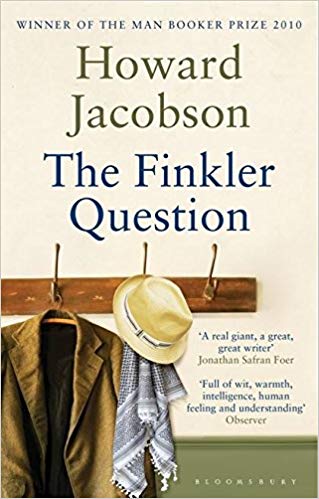
Cover for The Finkler QuestionHaving read Howard Jacobson’s J for my Booker Prize project, I was not looking forward to reading The Finkler Question for the same project. Since it won the award in 2010, I was hoping to like it better. I found it, however, very difficult to stay interested in.

Julian Treslove, the main character, is always expecting loss. He imagines himself holding the women he loves as they lie dying. I found him unbelievable and cartoonish.

Treslove has a long friendship with Libor, his former professor, and Finkler, an old school friend. Both of them are Jewish and recent widowers. Treslove, naturally lugubrious, has been hanging out with them while they grieve and argue endlessly about Jewishness and Israel.

I mean endlessly.

Treslove tends to make generalizations about Jewish traits and calls Jews “Finklers.” I ask you, who would do that?

Then one night on the way home from Libor’s house, Treslove gets mugged by a woman who says something to him that might be “You Jew.” After Treslove endlessly examines this event, I mean endlessly, he decides maybe he’s actually Jewish. He hopes he’s Jewish.

It doesn’t help that Jacobson tells this story using the same jokey, ironic tone that drove me crazy in J. I know that there are people who convert, but Treslove is such a ridiculous person I feel he’s there to be ridiculed.

Yet, I briefly became interested in him after he buckles down to become Jewish and meets a woman who seems suited to him. I could not say the same for Finkler, who belongs to ASHamed, Jews who are ashamed of the behavior of Israel.

I assume Jacobson is mocking the different characters and their ideas about Judaism, but no one in this book feels like a real person but Treslove’s girlfriend, Hephzibah. This novel really bugged me. I see it as the type of literary novel honored by the male publishing elite that no one actually likes.

Related Posts

J

The Fixer

The New Sweet Style