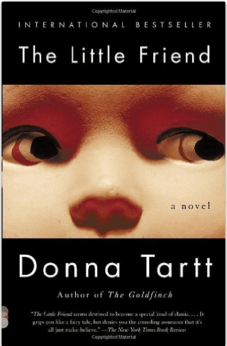
Day 853: The Little Friend

Cover for The Little FriendI didn’t decide to read The Little Friend until recently. That was because I was one of the few people who didn’t like Donna Tartt’s first book, The Secret History. I thought The Goldfinch was wonderful, however, so I decided to give The Little Friend a try.

This novel shows influences from practically every modern southern novel I’ve ever read, a bit of the Comptons from Faulkner, a touch of To Kill a Mockingbird, and lashings of Southern Gothic. The novel’s world is a harsh one, although not as twisted as that of Flannery O’Connor.

The main character is 12-year-old Harriet Dufresnes, a bookworm and misfit in 1970’s Alexandria, Mississippi. She is from a once-wealthy family whose rotting mansion, no longer in the family’s possession, is out in the countryside. Harriet lives in town with her mother Charlotte and sister Allison. But whatever future they might have had was prematurely blighted by the death of Harriet’s brother Robin, at the age of nine, 12 years earlier. Robin was found hanging from the tree at the edge of the yard, and his murder has never been solved. Their household has been made miserable by the ceaseless mourning and lassitude of Harriet’s mother.

Harriet is facing a long, lonely summer when she decides to avenge the death of her brother. She understands from the family’s maid Ida that Robin and Danny Ratliff were bitter enemies, so she decides that Danny, who is now a small-time criminal and meth addict, must be the murderer. She begins stalking him with the help of her best friend, Hely.

The Ratliff family embodies almost cartoonish O’Connor Southern Gothic. Farish, the oldest brother, is a half-crazed and hyperactive meth cooker and dealer. Although he talks about fighting in the Vietnam War, he spent it in a mental institution and is said to have calmed down since he had a head injury. Eugene is a street corner preacher who is inept at preaching. Curtis is a sweet-natured boy of limited mental capacity, and Gam, the boys’ grandmother, relentlessly favors Farish and does her best to undermine the other brothers’ efforts to leave their lives of crime.

Danny is rather a more tragic figure than anything else, but I was more interested in Harriet’s life than in her interactions with the Ratliffs. That situation provides the tension and danger of the plot, but I was sometimes bored by it and other times found it grotesquely funny.

Harriet’s family is the essence of dysfunction. Her mother is almost completely self-obsessed, spending all her time mourning Robin. She neglects her two daughters and stays in her bedroom. Harriet is dependent on Ida for any attention or care in a house that is only held from chaos by Ida’s efforts. Allison, although 16, is timid and milky and almost doesn’t exist as a character.

The other influences on Harriet are her grandmother Edie and her great-aunts. They are really the only points of stability in her life, especially her great-aunt Libby.

By and large, I was impressed by the energetic writing and the imagination of The Little Friend. The parts I don’t admire as much are the forays into an almost clichéd Southern Gothic of the Ratliff brothers. Still, I found it hard to put down this novel.

Related Posts

The Goldfinch

The Optimists’s Daughter

Wise Blood

Day 852: The Lake House

Cover for The Lake HouseThe Lake House is another of Kate Morton’s enthralling novels about family secrets. It is set in two time periods, 1933 and 2003.

In 1933 Cornwall, Alice Edevane is 16. She loves her life in the woods and gardens of the family estate, Loeanneth, and she spends her time writing stories of romance and mystery. She reads her stories to Ben Munro, an itinerant gardener whom she loves. Her newest one is about a kidnapping, set in her own home.

In 2003, Sadie Sparrow is a police officer on an enforced holiday. She got over-involved in a case, in her partner’s opinion, and went to the media when she thought it was mishandled. Her partner is trying to keep her name out of the subsequent investigation, but he wants her on vacation for a month.

Sadie chooses to visit her grandfather Bertie in Cornwall, where he recently moved after her grandmother’s death. In traipsing around the woods with the dogs, she comes upon the abandoned house at Loeanneth. When she tries to find out about the house, she learns that it was deserted after the disappearance of a little boy, Theo Edevane, who was never found.

Sadie decides she would like to look into the cold case with the help of retired officer Clive Robinson. She tracks down Alice Edevane, now a famous novelist, and writes asking for permission to enter the house. But she hears nothing back.

Alice has always believed she knew what happened to Theo and thinks it is her fault. She has no desire to reopen the investigation, however unofficial. But a frank conversation with her sister Deborah reveals something she didn’t know, which leads her to re-evaluate her belief in what happened long ago. When the persistent Sadie writes again, she agrees to see her.

The story alternates between the investigation in the present and the events leading up to Theo’s disappearance. We see the past events from the points of view of several different characters but mostly from that of Eleanor, Alice’s mother.

I absolutely loved this novel, with one caveat. It is intricately plotted and beautifully written, as are Morton’s other novels. I also found it completely absorbing.

However, the coincidence of what happened to Theo I found a bit much. I can’t explain more, but read it yourself and tell me what you think.

Related Posts

The Distant Hours

The Forgotten Garden

The Secret Keeper

Day 849: Our Souls at Night

Cover for Our Souls at NightBest Book of the Week!
Since this is my post before Valentine’s Day, I’m trying to observe the day with a book about love. Kent Haruf, who passed away in 2014, was a great stylist. His prose is unbelievably spare, his tales about ordinary small-town people in eastern Colorado. When it was my turn to make a book club selection for the anniversary of his death, I picked Our Souls at Night, his last book.

Louis Waters is a lonely widower in Holt, the town where most of Haruf’s books are set. One day his neighbor Addie Moore stops by with a proposal. She would like Louis to come over and sleep with her at night, sleep and talk. She misses this intimacy since her husband died. He decides to agree.

Although Louis and Addie are not having a romantic relationship, at least not at first, that’s what the town thinks. Instead, they are simply lying together and talking over their lives. We learn, for example, that once Louis fell in love with another woman and briefly left his wife for her. Everyone in the town knows this, but Louis explains to Addie how he felt and why he returned to his wife.

Addie’s son Gene is having marital problems, so he asks Addie to take his young son Jamie for the summer. Soon Jamie grows to care for Louis, who adopts a dog for the boy to play with.

This is a quiet novel about loneliness, friendship, and love. Haruf said it has its roots in the conversations he had at night with his wife. Our Souls at Night is a lovely novel.

Related Posts

Black River

Major Pettigrew’s Last Stand

Beautiful Ruins

Day 845: The Brief Wondrous Life of Oscar Wao

Cover for The Brief Wondrous Life of Oscar WaoEven after thinking about the novel for some time, I can’t decide whether I liked The Brief Wondrous Life of Oscar Wao. On the one hand, there’s the energy with which it is written and its inventiveness, wedging a portion of the narrative into footnotes that convey some of the most interesting information (a technique used also in The Sunken Cathedral and by such writers as David Foster Wallace). On the other hand, there’s the unrelenting sexism and objectification of women expressed by the principal narrator as well as by other characters. Okay, that’s an important part of the character’s personality rather than an attitude of the author, but I found it disturbing.

Oscar is a misfit. He is a fat, nerdy boy from the Dominican Republic, highly intelligent and well read but unable to interact normally with people, especially girls. He is interested in Star Trek and Tolkien, but even his other geeky friends eventually get girlfriends while he remains alone and still preoccupied with his obsessions. He dreams of being a science fiction writer.

In college at Rutgers he has one reluctant friend. Because Yunior (Díaz’s persona for much of his fiction) is in love with Oscar’s sister Lola, he agrees to be Oscar’s roommate. He tries to get Oscar to exercise and invites him out with friends. But his efforts aren’t sincere, or perhaps it’s more accurate to say that his intentions are mixed, so he eventually gives up on trying to make Oscar more normal.

Of course, Yunior’s perceptions are all colored by his own preoccupation, sex. Although he loves Lola, they break up several times because of his unfaithfulness. Yunior sees Oscar as a young man wanting to get laid. Well, of course he does, but what he really wants is love.

Oscar has grown up with the romance of his sci-fi and fantasy epics. Yes, they are also full of action, but they are in a sense the continuation of the chivalric romances that obsessed another famous character, Don Quixote, and that’s the book this novel reminds me of. Of course, we know from the title that Oscar will die, and we can guess he will die for love. Also like Don Quixote, although the story is ultimately tragic, its tone is comic.

What I found most interesting in this novel was the story of Oscar’s family, for this is an inter-generational saga about the fortunes of his family in the Dominican Republic. In a combination of narrative and footnotes, the novel tells the recent history of the Dominican Republic and especially of the Trujillo regime, where Oscar’s family ran aground.

This time period was also the focus of another book I’ve reviewed, In the Time of Butterflies, which this novel references, along with a lot of other pop culture. I complained of that book that it assumed its readers already understood all about the Trujillo dictatorship. The Brief Wondrous Life of Oscar Wao does a much better job of explaining Dominican history and exposing us to its culture.

Related Posts

In the Time of the Butterflies

Don Quixote

The Sunken Cathedral

Day 840: Juggling

Cover for JugglingI am usually a huge fan of Barbara Trapido, but I have to admit to being slightly disappointed by Juggling. I think my problem is in the depiction of its characters.

Christina is the youngest of two sisters. Her parents, Alice and Joe, decided to get married after Alice’s best friend died and Alice decided to adopt her baby, Pam. They all moved to the U.S. from England, and Christina came along seven months later.

Christina is a pushy, lippy, verbally active child, and from early on she doesn’t get along with her father. She finds him too controlling and manipulative, even though he seems to encourage her sauciness.

When Alice met Joe, she was dating Roland. Later, Roland met and married Gentille, Peter’s French mother. Although Peter gets along with Roland, the move from his quiet Paris apartment to England and boarding school is hard on Peter until he comes under the protection of Jago.

Jago is a popular boy in school, but like many popular boys, he tends to be a bully and hangs with a thuggish crowd. Still, he is good friends with Peter until adolescence, when Peter’s lack of coolness becomes too obvious.

Fatefully, Christina and her gentle sister Pam enroll at the same school as Jago and Peter. Christina is fascinated by Jago, but she and her sister are too clean cut in their American fashions for him to be bothered. Still, Jago finds himself drawn to Pam. Pam is oblivious and begins a friendship with Peter based on a mutual love of music. Then a terrible event occurs that changes everything.

This Trapido novel is all over the place, with a boy who floats in the air, another boy who is a mean bully, a Cambridge don who cheats his student by stealing her paper, reshuffling of partners into too many combinations, a woman who purposefully tries to cause problems between a woman and her daughter. And we’re supposed to like all the characters, I think.

I usually like Trapido characters despite their flaws, but in this case I didn’t. I found it hard to like Christina, who takes everything so personally that she splits from her family about something that happened to someone else, even splitting from that person, who was not at fault. I didn’t buy her antipathy to her father. In fact, if anyone is manipulative, it is she. The more likable characters, such as Peter and Pam and Alice, are neglected for the loudmouths and bullies. About the only one of the more forceful characters I liked was Dulcie, who is loud and exuberant, not a bully.

Trapido seems to have made a thing about people pairing up with the wrong partners. In this case, there are just too many of them and too many coincidences. Hence the title of the book, I suppose.

Related Posts

Sex and Stravinsky

Brother of the More Famous Jack

The Travelling Hornplayer

Day 836: My Name Is Lucy Barton

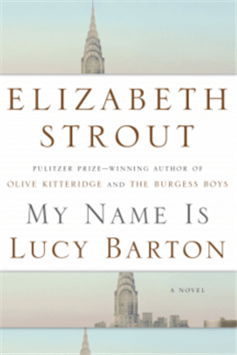
Cover for My Name Is Lucy BartonBest Book of the Week!
Lucy Barton grew up very poor in rural Illinois. She looks back to a time as a young married woman, living in New York City with her husband and two daughters and learning to write. At the time, she had not returned to her parents’ house since she went to college. Something horrible associated with her father is hinted at.

Much of Lucy’s story centers around a stay in the hospital, where for some weeks she has an undiagnosed illness. Her husband can’t bear hospitals, so he asks her mother to come. Her mother stays with her, never leaving her room and refusing to use the cot the nurses provide. During this visit, her mother tells her stories about people they both know.

For much of their lives, Lucy’s family has been outcasts. At school other children complained that they smelled funny. For many years, they lived in a garage with exposure to extreme cold and no access to running water. When she was a little girl and both her parents were at work, her older siblings at school, her parents would lock her into her father’s truck. One time a snake was in there with her. These are some of the horrors of Lucy’s childhood.

link to NetgalleyWe can see that Lucy loves other people for the slightest show of kindness. We can understand why.

My Name Is Lucy Barton is an affecting story about a woman learning to deal with her own past and loving people despite it. The novel is also about becoming a writer.

Strout’s prose is wonderful as usual, picking out the little details of life that make her prose so convincing. I delight in Strout’s depictions of ordinary life and people.

Related Posts

The Burgess Boys

Olive Kitteridge

Amy and Isabelle

Day 832: Sweetland

Cover for SweetlandBest book of the week!
At the beginning of this novel, Moses Sweetland is an old man living in a small community on an island off the coast of Newfoundland. Although the island thrived at one time, now it is occupied by just a few families, including Sweetland’s niece Clara and her autistic boy Jesse.

All his life, Sweetland has lived on the island, which is called Sweetland after his family. Now, the Canadian government wants to buy out the remaining residents, move them off the island, and decommission it. The lighthouse where Sweetland worked for years is now a battery-driven beacon that gets serviced a couple of times a year.

At the opening of the novel, Sweetland is among only a few people who have refused to take the deal. If they don’t all take it, no one gets it, so someone has been leaving Sweetland threatening notes.

This is a powerful novel that covers most of the major events of Sweetland’s life in flashbacks. We see that events have left him very little except the life on the island, where he traps animals and catches fish, and his relationship with Clara and Jesse.

To tell much more would be to tell too much. Suffice it to say that Crummey gets us to care very much for this crusty old man and also for his community. As in Galore, which I really loved, Crummey brings back even the ghosts of the little island.

Related Posts

Galore

River Thieves

We, The Drowned

Day 828: Sex and Stravinsky

Cover for Sex and StravinskySex and Stravinsky is about two families that live far apart from each other but eventually meet. Caroline and Josh live in England with their daughter Zoe, while Hattie and Herman live in South Africa with their daughter Cat.

Caroline is Australian, tall, beautiful, and vastly capable. All her life she has been striving to please her mother, who continues to favor her other daughter Janet. Caroline leaves Australia to study in England and eventually marries Josh, a small, mild-mannered theatre academic. They struggle financially for their first few years. They are just able to afford their own house when Caroline’s mother moves to England without warning. She demands that they buy her a house and give her an allowance, and they seem unable to resist her commands. So, they continue struggling, living in a bus even though they have two professional salaries.

Hattie was Josh’s girlfriend until she met Herman. She was a ballerina despite the lack of support from her family. But when she married Herman, she started teaching and began writing a series of children’s books about a girl who wants to dance. Herman, a wealthy businessman, is away on business most of the time, and Hattie’s teenage daughter Cat treats her with contempt.

Caroline and Josh’s daughter Zoe has always wanted to learn ballet, and she adores the ballet series written by Hattie, who was Josh’s first love. But Caroline thinks Zoe is being silly about wanting to dance, even though Josh’s career deals heavily with ballet. Caroline says that in any case they can’t afford ballet lessons.

When Josh goes to a conference in South Africa, he reconnects with Hattie. Caroline finds out something shocking about her mother that sends her flying to South Africa to find Josh; Hattie finds out her lodger has a secret identity.

Trapido’s novels are witty and engaging. I always love them. They are sparkling with amusing dialogue, they have likable and not so likable characters, but ones that seem to be real people. Trapido continues to be one of my favorite writers.

Related Posts

Brother of the More Famous Jack

The Travelling Hornplayer

The Weird Sisters

Day 826: The Unlikely Pilgrimage of Harold Fry

Cover for The Unlikely Pilgrimage of Harold FryI know that many people enjoyed reading The Unlikely Pilgrimage of Harold Fry. Unfortunately, I’m not one of them. The reason? I think that this novel is manipulative, pulling out all the stops to make you feel for its characters. What it didn’t do is make them convincing.

Harold Fry is retired, but since his retirement he’s done virtually nothing. He and his wife are estranged over a series of misunderstandings followed by a tragedy. He is an ineffective person who blames himself for lack of action at important times during his life.

One morning Harold receives a letter from a former coworker, Queenie Hennessy. Harold feels guilty about Queenie because he wronged her in some way, but we don’t find out why for some time. Queenie tells him she is in a hospice in Berwick-upon-Tweed, dying of cancer.

Harold, who is not good at self-expression, writes her a stiff letter and sets off to the post office to mail it. But he feels reluctant to return home and makes an excuse to walk to the next post office. Soon, Harold finds himself walking from Kingsbridge in far southern England to Berwick-upon-Tweed on the Scottish border.

This novel is about Harold’s self-redemption through the accomplishment of a difficult goal. It is a feel-good novel that uses all kinds of tricks, including a dead child, to make us feel sorry for Harold and sympathetic to his wife Maureen. But I did not find Harold’s journey very involving, and all along I felt manipulated, probably because, as I said before, the characters in the novel don’t seem to be real. They are instead types. This novel just doesn’t have much depth. It seems to be catering to the audience for “quirky,” saccharine, feel-good stories, which I am not a part of, and I didn’t find it very interesting.

Related Posts

My Wish List

Pastoral

This Is Your Life, Harriet Chance!

Day 823: Black River

Cover for Black RiverWes and Claire Carver have been living in Spokane since they left Black River, Montana, 30 years before. But when Claire realizes she is dying from cancer, she asks Wes to take her home to Black River. She also asks him to play to her, which he cannot do, because his fingers were broken years before.

Although Wes plans to take her the day after Claire’s request, she dies during the night. So, Wes prepares to return her ashes to Black River.

Wes has not been there nor seen his stepson Dennis since he and Claire left, although Claire has been back to see her son. Their leaving was after a horrendous series of events. First, there was a riot in the prison where Wes worked. He was held prisoner by a convict, Bobby Williams, for more than a day, and tortured, his fingers ruined. Later, in an argument with teenage Dennis, Dennis pulled a gun on him. That was when he demanded that Claire choose between him and Dennis.

Added to his grief and the difficulties of seeing Dennis again, Wes has heard that Bobby Williams is up for parole. Williams claims to have found God and to be a different person than he was when he held Wes captive. Wes doesn’t believe that people can change. In fact, his beliefs go farther than that, the source of the problems between him and his stepson. Dennis’ father was a criminal, and Wes has always watched for criminal tendencies in Dennis. Finally, Williams robbed Wes of one thing, his gift as a talented fiddler, that made him believe true faith was possible.

Like the modern Western novels of Kent Haruf, which inspired this one, Black River is a quiet story about ordinary people. Although Hulse is not Haruf’s equal as a stylist, she shows herself as an accomplished storyteller.

Related Posts

The Hour I First Believed

Empire Falls

The Burgess Boys