Day 764: Sweet Caress

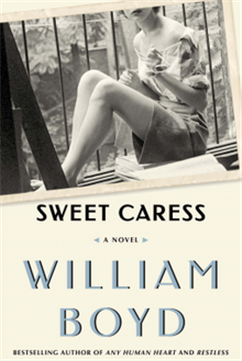
Cover for Sweet CaressAlthough I have by no means read everything by William Boyd, Sweet Caress reminds me most of his Any Human Heart, perhaps because it’s the story of one person’s life. This novel is about Amory Clay, a photographer born in 1908. Boyd creates the impression that Amory is a real person (so much so that I googled her twice) by interjecting photos of her life into the novel.

Amory leads an unusual life almost from the start of the novel. Although her father suffers from depression and other problems as a result of World War I, she is so content with her home life that she is upset when her parents send her away to school. Her parents are not well off, but Amory learns later that a legacy from an aunt is dedicated to her education.

Her mother wants her to attend university, but she decides early that she doesn’t want to go. Her favorite uncle, Greville, gave her a camera on her 10th birthday, and she wants to be a professional photographer.

Then a violent incident brings her home. Her father arrives at school unexpectedly to take her to tea. But his intention is to commit suicide, and he doesn’t want to go alone. Amory survives the drive into the lake and even saves her father, who is committed to an institution for a long time.

Soon after, Amory becomes Uncle Greville’s assistant. He is a society photographer, and although Amory does not enjoy this type of work, she must start somewhere. But she takes a risk with an unusual betrothal photo, and its reception ruins her chances. Soon Amory is off to capture the decadent night life of Berlin.

Amory leads an extraordinary life that contains many sorrows and triumphs. She is a war correspondent for both World War II and the Vietnam War, she is attacked by fascists rioting in London, she travels with lesbians to Mexico, she encounters a Charles Manson-like figure in 1960’s California. She almost unwittingly marries a lord and has a family. These are just some of the events of her life, its story punctuated with paragraphs from the “present time” of 1978, when Amory is an old woman.

link to NetgalleyI found this novel involving, although not as much as I did Any Human Heart. For one thing, I wasn’t always convinced I was hearing a woman’s voice, and in no way was this because of Amory’s adventurous life. Also, Amory’s voice is a reserved one, with certain exceptions. Still, it is a fascinating story that manages to cover a great deal of modern history.

Related Posts

The All-True Travels and Adventures of Lidie Newton

The Signature of All Things

The Lacuna

Day 759: We Are Not Ourselves

Cover for We Are Not OurselvesBest Book of the Week!
Eileen Tumulty has had a tough youth and adolescence with her Irish immigrant family struggling with alcoholism. For most of her school years she’s had to keep the house and take care of her drunken mother. So, when she meets Ed Leary, a young scientist who holds the promise of getting out of her neighborhood in Queens, she marries him.

In some ways, they are a mismatch even though they love each other. Eileen is a practical woman, ambitious for a well-to-do life. Ed cares about integrity, his teaching, and his research. When Eileen buys him an expensive gold watch for a wedding present, one she cannot return, he refuses to wear it even after she replaces the gold wristband with a leather one. He teaches and has a lab at Bronx College. Several times he is offered jobs at more prestigious schools that he turns down. He also turns down an offer to be head of his department.

After a while, Eileen becomes exasperated at their lack of upward mobility. They have bought the three-family house in which they rented an apartment, but they still live in the same Queens neighborhood they moved to when they were married. However, after their son Connell is born, Eileen settles her attention on him for awhile and also continues her nursing career.

Eventually, a shadow falls over the lives of the Learys. I don’t want to tell what it is, because it happens well into the novel. Until it happens, I sometimes wondered where the novel was going but eventually realized it is an honest, unflinching look at the pressures on a small family of a tremendous burden.

The novel is told mostly from the point of view of Eileen, a strong, independent woman with a will to succeed. Because of her upbringing, she has problems with showing affection and being open. Ed is warmer and more affectionate to Connell. Connell is slow to mature but eventually learns to accept responsibility for his actions.

I felt for a long time some distance from these characters, but the sheer weight of everything we learn about them eventually breaks through this barrier. The result is a touching and affecting story about love’s power over adversity.

Related Posts

I Know This Much Is True

The Fault in Our Stars

The House We Grew Up In

Day 738: The House Gun

Cover for The House GunWhen Nadine Gordimer died last year, I thought it was about time I read something by her. I’ll say right up front that I did not find The House Gun easy to get into.

Almost the only characters of any depth are Claudia and Harald Lindgard, an older upper-middle-class liberal white couple living, I assume, in Johannesburg, although the city is never mentioned by name. The novel is set in the 1990’s, just after De Clerc has left office and the nation is stumbling to find its way in a new order.

Claudia and Harald are disturbed in their gated complex one night by a friend of their son Duncan who comes to report a horrible event. Duncan has been living in a compound in a separate house from three gay men. One of them has been murdered, and Duncan has been arrested for it.

The story is mostly about the effect this event has on the couple’s marriage. At first very close, they are driven apart almost immediately. They know nothing about what happened, and Duncan isn’t talking. Eventually they learn from Duncan’s advocate, Hamilton Motsamai, that Duncan did indeed shoot Carl Jesperson after finding him having sex with Duncan’s girlfriend Natalie.

There is much more to the story, but it comes out slowly. And Gordimer’s writing style is so abrupt and choppy, her viewpoint so removed and analytical, that the novel seems chilling. This impression is heightened by the tendency to use pronouns or other nouns instead of names for the other characters, especially for Natalie, who is referred to as “the girl,” and the victim, who is referred to as “he” or “him.” Obviously, since the novel is from the point of view of the couple, this naming is a distancing technique to separate the parents from the victim and the person they consider the instigator, but the overall effect is to also distance the reader. I have no frame of reference to know if this writing style is typical of Gordimer or not.

Of course, there are other, more political points to the novel. Although viewing themselves as liberals, Claudia and Harald are shaken to find how biased they are. For example, they wonder at first about the competency of Duncan’s advocate just because of Motsamai’s color. Racial and stereotypical comments permeate the book. It is clearly an issue that is on everyone’s mind.

Then again, the presence of the gun is an important issue. In an article about the novel in The New York Times, a statistic was quoted that after the violent and abusive regime of De Clerc ended and Mandela came into power, official statistics of violence in South Africa increased tenfold. The young men in the compound had bought the gun to protect themselves in case someone broke in. If it hadn’t been sitting there on the table, no one would have been killed. That’s a point that we in the states, with our own issues, should pay attention to.

Related Posts

The Sun is God

Conversations with Myself

I Know Why the Caged Bird Sings


Day 732: The Blazing World

Cover for The Blazing WorldBest Book of the Week!
Every once in awhile I read a book that is so remarkable that I doubt my powers to convey it. Such a book is The Blazing World. This novel was long-listed for the Booker Prize in 2014, but frankly, I think it is better than the novel that won. It is stunningly filled with ideas about such varying subjects as perception and misogyny in the art world, but it is ultimately the touching story of a flawed but compelling human being.

Harriet Burden is already dead when this novel begins. It is purportedly a book about her life, assembled through interviews, excerpts from her diaries, and art reviews and journal articles.

Our examination of Harriet’s life really starts with the death of her husband Felix. Harriet realizes that she has spent her entire life submerging her identity to please first her father and then Felix. She is a ferociously intelligent, well-read woman who has sat by and let Felix take credit for her ideas. Even more importantly, she is an artist. Although Felix was an art dealer, he never helped her find a market for her art. She has become convinced that no one pays attention to her work because she is an older woman.

Harriet, or Harry, as her friends call her, concocts a project she calls Maskings. She will convince a series of young male artists to present her work as his. Once the work gains the recognition it deserves, she will reveal it to be her own.

This novel is remarkable for the character Hustvedt creates in Harry—intelligent, articulate, caring, and extremely angry. Other characters are also complex and insightfully depicted—her grown children Maisie and Ethan, her lover Bruno, her second mask Phinny who becomes her friend, and even the Thermometer, a mentally ill man whom Harry gives a place to stay.

The novel is also remarkable for its ability to describe Harry’s art so that you can imagine it and understand its power. Some of Harry’s ideas are too abstruse for me—she is much smarter than I am and I couldn’t follow all of them even with Hustvedt’s footnotes. Still, this novel is an accomplished feat of storytelling, intellectual and dazzling.

Related Posts

The Enchantment of Lily Dahl

The Life and Death of Sophie Stark

The Fountain of St. James Court or, Portrait of the Artist as an Old Woman

Day 727: I Know This Much Is True

Cover for I Know This Much Is TrueI have only read one other book by Wally Lamb, the more recent The Hour I First Believed, and when I began reading I Know This Much Is True, it was like deja vu all over again. In a very long novel, crass, belligerent, macho protagonist with anger issues ignores his own problems in attempting to cope with a family member with serious mental health difficulties.

In this case, Dominick Tempesta has a twin brother Thomas who is a paranoid schizophreniac. Thomas has seemed to do very well lately, so Dominick is shattered when Thomas goes to the public library one day and chops off his own hand in an effort to halt Operation Desert Storm. When Thomas is sent to Hatch, the high-security facility for the most dangerous patients, instead of Settle, where he usually goes, Dominick is convinced there is some mistake. His misgivings are confirmed when Dominick himself is severely beaten by one of Hatch’s security guards while he’s trying to get someone to call Thomas’ doctor. He begins trying to get Thomas out of there.

In his efforts, he meets with Thomas’ social worker Ms. Scheffer and with Dr. Patel, one of the therapists who is supposed to evaluate Thomas. Dr. Patel asks Dominick to discuss his and Thomas’ past with her so that she can gain more insight about Thomas. But eventually she begins treating Dominick.

So, the present-day chapters of the novel, set in the early 90s, are interspersed with chapters describing incidents from Dominick’s childhood and adolescence. These incidents include upbringing by a mild-mannered mother and abusive stepfather Ray, Dominick’s constant curiosity about the identity of his real father, Dominick’s jealousy at their mother’s favoritism for Thomas.

In the end, you get to understand and feel for Dominick, if not actively like him. His insight about himself is helped along by finding a manuscript written by his grandfather, another similarity with his other novel. This novel explores issues such as bullying and abuse, mental illness, the way Americans raise boys, the closeness of twins, the way our own history flows from the history of our parents.

As with the other book, I liked it well enough but perhaps not well enough to subject myself to another 1000 pages of Wally Lamb.

Related Topics

The Hour I First Believed

The Gathering

In the Lake of the Woods


Day 724: & Sons

Cover for & Sons& Sons is a novel about fathers and sons, but it is really most about sons and the effect on them of their father’s actions. It is also about the fate of a lifelong friendship.

The friendship seems to be the catalyst for events. Charles Topping has died, and his funeral is packed with people waiting to see his best friend, the reclusive novelist A. N. Dyer, give the eulogy. Dyer is noted for several excellent books, but Ampersand has become a classic about prep school life.

At the funeral, though, it becomes clear that Andrew Dyer himself isn’t quite all there. During the eulogy, he becomes upset about the whereabouts of his young son Andy and has to be removed from the podium.

The story is told by a narrator who is not at all trustworthy, Charles Toppings’ son Philip. When Andrew Dyer meets him at the funeral and finds he has split from his wife, he kindly invites him to stay.

This suits Philip, who grows more malevolent as we get to know him. He is on hand a few weeks later when the Dyers reunite at their father’s request to discuss something important. He can be there to eavesdrop and look through old papers, but generally he cannot possibly be privy to all the details of the story he tells.

Andrew Dyer has been estranged from his ex-wife and two sons since the family learned about the existence of his third son, Andy. Andy is now seventeen. Andrew has tried to avoid neglecting him, as he did his two other sons, and do a better job of bringing him up. But Andrew knows he is nearing the end and is afraid Andy will be alone. He fears Andy is just as messed up as the other sons, only in a different way. Andrew has formed another preoccupation about Andy that shows how divorced he is from reality.

Andrew’s oldest son Richard is an ex-drug addict who has stabilized his life with great difficulty. He is now a drug counselor and has a wife and two teen children. The other son Jamie is a documentary filmmaker whose films for years have dwelt on the darkest of subjects. Philip Topping has a grudge against both of them for the teasing he received as a child.

The novel is told using letters between Andrew and Charlie, passages from Ampersand, and other artifacts from Andrew’s life, as well as Philip’s testimony. We find Andrew feverishly manufacturing an “original draft” of Ampersand because he burned up the original manuscript in disgust at what he did to his old friend Charles in fiction. Now he needs one to leave with his papers.

I waited to write my review for a few days after I finished the book, and I’m still not sure how much I enjoyed the novel. It is well written and absorbing, and it provides a lot to think about.

Related Posts

The Art of Fielding

The Sense of an Ending

The Child in Time

Day 719: To Rise Again at a Decent Hour

Cover for To Rise Again at a Decent HourThe descriptions I’ve read of this book in reviews and on the cover don’t really do a good job of conveying what it is like, and I’m afraid mine won’t be any better. Still, I’ll give it a try.

Paul O’Rourke is a rather neurotic New Yorker, a middle-aged dentist who loves the Red Sox. He wants to belong to something so badly that his desire has messed up his two most significant relationships. Each time, he has fallen madly for his girlfriend’s family—the first a close-knit Catholic family whom he offended by announcing he was an atheist, the second a close-knit Jewish family he tried to impress by his research into the Holocaust.

Paul feels he needs to engage more with life but instead engages less. He records and watches baseball games and eats take-out and does little else except worry about how little his patients floss. At least, that’s all he’s done since he and Connie, his office manager, broke up.

Although Paul texts, he does not use other Internet technology, so he is surprised when someone puts up a web site for his dental practice. He immediately contacts the designers of the site and asks them to take it down. Soon, someone is posting odd messages about a group called Ulm on the site and has also started a Facebook page and Twitter feed in his name.

Rather than simply working through a lawyer, Paul engages with this other “Paul” in long philosophical arguments by text. Soon Paul’s other self is trying to get him to visit his “homeland” in the Negev desert.

This novel creates a distinct personality in Paul as well as a fair amount of humor. I enjoyed it even though I thought many of the discussions were gratuitous and the plot a bit whacky.

Related Posts

Straight Man

Wife 22

Await Your Reply

Day 712: Literary Wives: My Father’s Wives

Cover for My Father's WivesToday is another Literary Wives discussion about the book My Father’s Wives by Mike Greenburg.

Be sure to read the reviews and comments of the other wives! If you have read the book, please participate by leaving comments on any of our blogs.

* * *

If there is such at thing as a male equivalent for chick lit, My Father’s Wives fits in the genre. Take a similar focus on romance and family, keep the background of wealth and focus on expensive brand names, replace shopping with basketball and witty dialogue with earnestness. Mix in a bunch of underdeveloped characters that readers don’t care about. Make it light as a feather despite themes that could be heavy and also make it thoroughly predictable. There you have it. This genre can even have a similarly rhyming name, but it would be rude to say it.

Jonathan Sweetwater has led a privileged existence. He is the son of a U.S. senator. He has a job as a banker that he enjoys, and he has been taken under the wing of the CEO because of a mutual love of basketball. He is happily married with two kids that he loves.

One day before he is due to leave for a business trip, he decides to come home early from work and sees what he thinks is evidence that his wife Claire is having an affair. I’m not giving away anything here. This happens almost at the beginning of the book.

Instead of simply walking into the room or, failing that, asking his wife about what he saw, Jonathan hires a private detective. This is what movie reviewers call the lame-brained plot, the plot that continues when the problem could be cleared up with a few sentences. If he had behaved at all rationally, there would be no story, however. By the way, this detective’s shenaningans, supposedly an effort to protect his client’s anonymity, are ridiculous.

Then for some reason, Jonathan decides he really needs to find out about his father, from whom he and his mother have been estranged since he was 9. I would call this the McGuffin if it had any other purpose than making the book a little longer. To do this, he tracks down all six of his father’s wives, doing so while pretending to be on business trips.

I felt the premise behind this novel, although not unlikely, didn’t really relate well to its trigger. That is, why would thinking his wife was having an affair make him run out to find out about his father? The people in the novel are very thinly characterized, even Jonathan. We know, for example, that he’s supposed to be destroyed by his discovery, but we don’t feel it. In any case, I think we all know that there will be some explanation for Claire’s apparent infidelity.

I would also like to mention the choices in this novel and the lack of a sense that some of the choices are not ethical or moral. Jonathan sees nothing wrong with hunting up his father’s wives while he’s pretending to work. His boss behaves more like a mafia don than a CEO, and if he was really spending his nights with cocaine-sniffing models, he wouldn’t take an employee along. In any case, that relationship is inexplicable and unlikely. Claire does one questionable thing that is unexplained, and I cannot say more about it.

What does the book say about wives or the experience of being a wife? In what way does the woman define “wife”—or in what way is she defined by “wife”?

Although there are a lot of wives in this book, I don’t think we learn much about them. We don’t even see that much of Claire. Her role seems to be very conventional—to be a good suburban wife and mother. She is warm and someone Jonathan feels comfortable with.

Literary Wives logoOf Percy Sweetwater’s six wives, we learn that he left each one for not being perfect. Jonathan’s mother is intelligent, educated, and cultured, but she doesn’t worship Percy, so he leaves her for Christine, who does. But he soon tires of Christine for her lack of the qualities he admires in his first wife. Next, he marries Elizabeth, a doctor, for her intelligence. He continues on, always marrying his current wife’s opposite. But we barely learn anything about them except their jobs. I don’t think we can gain much of a coherent view from this novel of how the author views wives. Clearly Percy views a wife as someone who has to meet all his needs for admiration, intelligence, charm, and beauty, but just as clearly, that is not Jonathan’s view of a wife. What is his view? That’s not clear. Maybe a companion.

Related Posts

Wife 22

Where’d You Go, Bernadette?

The Interestings

Day 711: Mother of Pearl

Cover for Mother of PearlSet in the 1960’s but seeming more appropriate to decades before that, Mother of Pearl is a sort of Southern Gothic mashup. It features a love affair between near relations, a half-Indian seeress, the town slut, a self-educated African-American man, and some other stereotypes. It is energetically written but sometimes so floridly that I wanted to put it down. Still, it captured my attention enough to give it a mild recommendation. For a novel that starts out dark and unusual, it ends up being surprisingly sentimental and unlikely.

Even Grade is an African-American factory worker. He recently helped his older neighbor Canaan after a teenage white boy hit him in the head with a bottle. His deepest sadness comes from the knowledge that his mother abandoned him as a baby and he was raised in an orphanage.

Valuable Korner, a white teenager, was also left by her mother, the town slut. Her mother disappeared after her birth and left her to be raised by her grandmother Luvenia, returning just before Luvenia died. Since then, Valuable has shared the house with her mother and whichever man she is with.

Barely in puberty, Valuable is about to turn her life-long friendship with neighbor Jackson into a full-blown love affair. What neither of them knows is that they are half brother and sister. The adults who are aware of this seem criminally oblivious, except one.

That one is Joody Two Sun, a half-Indian healer and seeress who lives in a hut by the creek. She and Even are lovers. When Valuable and Jackson come to consult her, she can immediately see their relationship and fate but chooses to say nothing.

Joleb, a friend of Jackson, lives with his father, who is as dumb as a post, and his older brother Burris, who tries to see God by standing on a railway trestle as the train approaches. Their mother also lives with them, but she has been in a vegetative state since Joleb was born. He feels closer to Grace, an African-American woman who cares for his mother and nursed him when he was a baby, than he does to his own family.

I had some problems with this novel, mostly involving the unlikelihood that Valuable, with her attitude toward her mother’s affairs, would plunge into her own love affair as soon as she hits puberty, especially as naive as she is. But then again, if she didn’t, there would be no novel. In addition, I can say no more, but the ending of the novel is very unlikely, ignoring legalities, for one.

Still, I enjoyed this book, especially liking the African-American characters, who seem better defined than the white ones. Valuable’s Aunt Bea, who with her lesbian lover Neva takes her in when her mother finally leaves town, seems to have no personality at all. Neva definitely has one but it is mostly destructive. Joleb, although he gets more interesting, seems like a cartoon character at times. And frankly, the two star-crossed lovers are pretty much cardboard figures.

I was interested particularly in Even and Grace. Joody is too much over the top at times, and Canaan only seems to be there to anchor Grace.

Readers commented that they were not taken with the book until about 100 pages in. That was my experience as well. In fact, if I hadn’t read those comments, I may not have kept reading the book.

Related Posts

This Side of the Sky

Queen Sugar

A Good Hard Look

Day 705: The Spinning Heart

Cover for The Spinning HeartDonal Ryan achieves a remarkable feat in The Spinning Heart. In this very short novel, he manages to depict the effects of the recent Irish financial collapse from the viewpoints of 21 different small town residents. (My caveat: I didn’t actually count them. I am relying for the number on an article about the novel.)

First we hear from Bobby Mahon, who is absorbed in his contempt for his father Frank and his betrayal by his employer. Frank drank away his own inheritance, his father’s farm, and as soon as it was gone, stopped drinking. This all because Bobby’s grandfather said that at least Frank, at that time a teetotaler, wouldn’t drink away the farm. Frank himself was so verbally abusive that Bobby and his beloved mother stopped talking to each other to avert his wrath. That pretense eventually grew into an actual estrangement.

Bobby was the foreman of a crew for a successful construction company until the downturn, when the company folded and the boss, Pokey, disappeared. Now, Bobby and the other men have found out that Pokey did not pay in for their government benefits, instead pocketing the money, so none of them will get unemployment or their pensions.

Josie, Pokey’s father, laments his decision to turn his company over to Pokey and feels sorry for the men left without an income. He blames himself for loving Pokey’s other brother more than Pokey.

Vasya, a contract construction worker from the Caucasus, has even fewer options than Bobby and his men. He relates how Pokey gave him a ride and lied to him about work the last time he saw him, on Pokey’s way out of town.

And so the novel goes, written in many different voices in Irish slang. As the novel moves forward, tensions rise, finally ending in violence. A well-regarded young man is accused of murder. A small child is kidnapped.

Using an unusual technique, this novel conveys the perspective of an entire small community and the impact the economic calamity has had on all their lives. Surprisingly, considering the subject matter, the book is rough and funny, as well as poignant.

Related Posts

Broken Harbor

We, the Drowned

The Gathering