Day 712: Literary Wives: My Father’s Wives

Cover for My Father's WivesToday is another Literary Wives discussion about the book My Father’s Wives by Mike Greenburg.

Be sure to read the reviews and comments of the other wives! If you have read the book, please participate by leaving comments on any of our blogs.

* * *

If there is such at thing as a male equivalent for chick lit, My Father’s Wives fits in the genre. Take a similar focus on romance and family, keep the background of wealth and focus on expensive brand names, replace shopping with basketball and witty dialogue with earnestness. Mix in a bunch of underdeveloped characters that readers don’t care about. Make it light as a feather despite themes that could be heavy and also make it thoroughly predictable. There you have it. This genre can even have a similarly rhyming name, but it would be rude to say it.

Jonathan Sweetwater has led a privileged existence. He is the son of a U.S. senator. He has a job as a banker that he enjoys, and he has been taken under the wing of the CEO because of a mutual love of basketball. He is happily married with two kids that he loves.

One day before he is due to leave for a business trip, he decides to come home early from work and sees what he thinks is evidence that his wife Claire is having an affair. I’m not giving away anything here. This happens almost at the beginning of the book.

Instead of simply walking into the room or, failing that, asking his wife about what he saw, Jonathan hires a private detective. This is what movie reviewers call the lame-brained plot, the plot that continues when the problem could be cleared up with a few sentences. If he had behaved at all rationally, there would be no story, however. By the way, this detective’s shenaningans, supposedly an effort to protect his client’s anonymity, are ridiculous.

Then for some reason, Jonathan decides he really needs to find out about his father, from whom he and his mother have been estranged since he was 9. I would call this the McGuffin if it had any other purpose than making the book a little longer. To do this, he tracks down all six of his father’s wives, doing so while pretending to be on business trips.

I felt the premise behind this novel, although not unlikely, didn’t really relate well to its trigger. That is, why would thinking his wife was having an affair make him run out to find out about his father? The people in the novel are very thinly characterized, even Jonathan. We know, for example, that he’s supposed to be destroyed by his discovery, but we don’t feel it. In any case, I think we all know that there will be some explanation for Claire’s apparent infidelity.

I would also like to mention the choices in this novel and the lack of a sense that some of the choices are not ethical or moral. Jonathan sees nothing wrong with hunting up his father’s wives while he’s pretending to work. His boss behaves more like a mafia don than a CEO, and if he was really spending his nights with cocaine-sniffing models, he wouldn’t take an employee along. In any case, that relationship is inexplicable and unlikely. Claire does one questionable thing that is unexplained, and I cannot say more about it.

What does the book say about wives or the experience of being a wife? In what way does the woman define “wife”—or in what way is she defined by “wife”?

Although there are a lot of wives in this book, I don’t think we learn much about them. We don’t even see that much of Claire. Her role seems to be very conventional—to be a good suburban wife and mother. She is warm and someone Jonathan feels comfortable with.

Literary Wives logoOf Percy Sweetwater’s six wives, we learn that he left each one for not being perfect. Jonathan’s mother is intelligent, educated, and cultured, but she doesn’t worship Percy, so he leaves her for Christine, who does. But he soon tires of Christine for her lack of the qualities he admires in his first wife. Next, he marries Elizabeth, a doctor, for her intelligence. He continues on, always marrying his current wife’s opposite. But we barely learn anything about them except their jobs. I don’t think we can gain much of a coherent view from this novel of how the author views wives. Clearly Percy views a wife as someone who has to meet all his needs for admiration, intelligence, charm, and beauty, but just as clearly, that is not Jonathan’s view of a wife. What is his view? That’s not clear. Maybe a companion.

Related Posts

Wife 22

Where’d You Go, Bernadette?

The Interestings

Day 711: Mother of Pearl

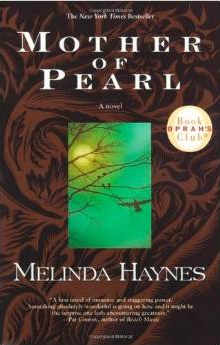
Cover for Mother of PearlSet in the 1960’s but seeming more appropriate to decades before that, Mother of Pearl is a sort of Southern Gothic mashup. It features a love affair between near relations, a half-Indian seeress, the town slut, a self-educated African-American man, and some other stereotypes. It is energetically written but sometimes so floridly that I wanted to put it down. Still, it captured my attention enough to give it a mild recommendation. For a novel that starts out dark and unusual, it ends up being surprisingly sentimental and unlikely.

Even Grade is an African-American factory worker. He recently helped his older neighbor Canaan after a teenage white boy hit him in the head with a bottle. His deepest sadness comes from the knowledge that his mother abandoned him as a baby and he was raised in an orphanage.

Valuable Korner, a white teenager, was also left by her mother, the town slut. Her mother disappeared after her birth and left her to be raised by her grandmother Luvenia, returning just before Luvenia died. Since then, Valuable has shared the house with her mother and whichever man she is with.

Barely in puberty, Valuable is about to turn her life-long friendship with neighbor Jackson into a full-blown love affair. What neither of them knows is that they are half brother and sister. The adults who are aware of this seem criminally oblivious, except one.

That one is Joody Two Sun, a half-Indian healer and seeress who lives in a hut by the creek. She and Even are lovers. When Valuable and Jackson come to consult her, she can immediately see their relationship and fate but chooses to say nothing.

Joleb, a friend of Jackson, lives with his father, who is as dumb as a post, and his older brother Burris, who tries to see God by standing on a railway trestle as the train approaches. Their mother also lives with them, but she has been in a vegetative state since Joleb was born. He feels closer to Grace, an African-American woman who cares for his mother and nursed him when he was a baby, than he does to his own family.

I had some problems with this novel, mostly involving the unlikelihood that Valuable, with her attitude toward her mother’s affairs, would plunge into her own love affair as soon as she hits puberty, especially as naive as she is. But then again, if she didn’t, there would be no novel. In addition, I can say no more, but the ending of the novel is very unlikely, ignoring legalities, for one.

Still, I enjoyed this book, especially liking the African-American characters, who seem better defined than the white ones. Valuable’s Aunt Bea, who with her lesbian lover Neva takes her in when her mother finally leaves town, seems to have no personality at all. Neva definitely has one but it is mostly destructive. Joleb, although he gets more interesting, seems like a cartoon character at times. And frankly, the two star-crossed lovers are pretty much cardboard figures.

I was interested particularly in Even and Grace. Joody is too much over the top at times, and Canaan only seems to be there to anchor Grace.

Readers commented that they were not taken with the book until about 100 pages in. That was my experience as well. In fact, if I hadn’t read those comments, I may not have kept reading the book.

Related Posts

This Side of the Sky

Queen Sugar

A Good Hard Look

Day 705: The Spinning Heart

Cover for The Spinning HeartDonal Ryan achieves a remarkable feat in The Spinning Heart. In this very short novel, he manages to depict the effects of the recent Irish financial collapse from the viewpoints of 21 different small town residents. (My caveat: I didn’t actually count them. I am relying for the number on an article about the novel.)

First we hear from Bobby Mahon, who is absorbed in his contempt for his father Frank and his betrayal by his employer. Frank drank away his own inheritance, his father’s farm, and as soon as it was gone, stopped drinking. This all because Bobby’s grandfather said that at least Frank, at that time a teetotaler, wouldn’t drink away the farm. Frank himself was so verbally abusive that Bobby and his beloved mother stopped talking to each other to avert his wrath. That pretense eventually grew into an actual estrangement.

Bobby was the foreman of a crew for a successful construction company until the downturn, when the company folded and the boss, Pokey, disappeared. Now, Bobby and the other men have found out that Pokey did not pay in for their government benefits, instead pocketing the money, so none of them will get unemployment or their pensions.

Josie, Pokey’s father, laments his decision to turn his company over to Pokey and feels sorry for the men left without an income. He blames himself for loving Pokey’s other brother more than Pokey.

Vasya, a contract construction worker from the Caucasus, has even fewer options than Bobby and his men. He relates how Pokey gave him a ride and lied to him about work the last time he saw him, on Pokey’s way out of town.

And so the novel goes, written in many different voices in Irish slang. As the novel moves forward, tensions rise, finally ending in violence. A well-regarded young man is accused of murder. A small child is kidnapped.

Using an unusual technique, this novel conveys the perspective of an entire small community and the impact the economic calamity has had on all their lives. Surprisingly, considering the subject matter, the book is rough and funny, as well as poignant.

Related Posts

Broken Harbor

We, the Drowned

The Gathering

Day 698: The Namesake

Cover for The NamesakeIn 1968, Ashima Ganguli gives birth to her first child. She has travelled from Calcutta to Cambridge, Massachusetts, to live with her husband, whom she barely knows, and is missing her family in India. When she has a boy, she and her husband Ashoke run into difficulty because they are waiting for a name to arrive from her grandmother. But the American hospital needs to put a name on the birth certificate. Finally, Ashoke picks Gogol, after Nikolai Gogol, a favorite author whom he credits with saving his life after a horrendous train accident when he was a young man.

Gogol grows up embarrassed by his name and rejecting the traditions of his Bengali parents. He is bored through the endless Saturdays spent with his parents’ Bengali friends and the biennial trips to India where they do almost nothing but visit family. His mother, on the other hand, has never stopped missing India. His parents want him to observe the customs of his homeland, while he just wants to be American.

This novel insightfully explores the stresses for Indian immigrants adjusting to American ways and the tensions between the traditional and the present for their first-generation American children. Lahiri’s prose is full of minutely observed details as well as empathy for both generations.

Related Posts

The Lowland

Unaccustomed Earth

Under the Lemon Trees


Day 697: The Life and Death of Sophie Stark

Cover for Sophie StarkThe Life and Death of Sophie Stark is the striking portrait of an unusual person, a young filmmaker, from the viewpoints of various lovers, acquaintances, relatives, and movie reviewers. The various chapters are possibly interviews for the documentary about her.

The first story about Sophie is one of betrayal. Allison meets Sophie at a storytelling event where Allison decides to tell a story. She makes up a tale about a murder, but later Sophie is able to get her to tell the real story, about how the boy who she’d made the murderer in her story actually raped her. Sophie is a beginning film maker, and she asks Allison to be in her movie. They also begin a torrid affair.

But Sophie uses her knowledge of the rape to manipulate Allison into giving a better performance in the horror movie. The movie, Marianne, becomes a cult classic as explained in the humorously egotistical review by R. Martin.

Gradually, we see how Sophie was mistreated or ignored in school. But Robbie, Sophie’s brother, understands her a little better than others do. He tells about Sophie’s beginning as a filmmaker, when she started following a popular basketball player named Daniel around her college campus with a camera. This episode ends with Cece, Daniel’s girlfriend, getting friends to shave off all of Sophie’s hair. Sophie uses that event to interesting effect in her movie, too.

link to NetgalleyGradually, a picture builds of a woman struggling to express herself. She doesn’t understand people, she says, but she knows how she wants things to look. She can’t explain her feelings even to her brother. She does what she must, destroying relationships in the process. I imagine someone on some part of the autism spectrum.

We never hear from Sophie herself, but her story is oddly powerful. This is the second book for North, whose America Pacifica is a young adult dystopian novel.

Related Posts

Tell the Wolves I’m Home

Mountains of the Moon

Black & White


Day 695: The Assassination of Margaret Thatcher

Cover for The Assassination of Margaret ThatcherThe Assassination of Margaret Thatcher is a collection of short stories that reveal an unusual sensibility. Some of the stories echo other of Hilary Mantel’s writings.

For example, the first story, “Sorry to Disturb,” seems as if it could be a chapter from Mantel’s Eight Months on Ghazzah Street. It is about an English woman living in Saudi Arabia who has troubles with a Pakistani man she befriends. Several other stories refer to physical ailments that she talks about in her memoir Giving Up the Ghost. Another story, “Terminus,” is about seeing the ghost of her father on the subway. But of course, many writers’ fiction has an element of the autobiographical.

The title story has more than a hint of the absurd. In the story, an apartment owner is held hostage by a sniper who is waiting for Margaret Thatcher to emerge from the hospital below her window. The hostage, who doesn’t like Thatcher either, begins helping with the planned attack and escape.

All of these stories are impeccably written, some are haunting, and all reflect the workings of an unusual mind.

Related Posts

Giving Up the Ghost

Beyond Black

The Stone Mattress

Day 693: Fallout

Cover for FalloutMost of Fallout is told as a flashback, but the opening section is very short, so we can say we really encounter Luke Kanowski in 1961, when he is 14. He has busted his mother out of the mental asylum where she’s lived since he was five to take her to visit the art museum in London. The expedition is not a success, but while they are being questioned by a security guard, Nina Hollings notices them.

Nina is with her mother Marianne, a selfish woman who hands her off to her sister Mat when Nina is in her way but reclaims her before she can gain any stability. Later, she does other things to sabotage Nina’s self-confidence. Marianne works sporadically as an actress.

Luke is a young adult when he meets Paul Driscoll and Leigh Radley. He has been working at a mill, but shortly after he meets the two, he decides his life is harmful to him. Luke feels immediate friendship for Leigh and Paul and has soon moved to London. There the three of them work together with a few others to open a new theater.

Leigh has fallen immediately in love with Luke, but Luke is busy seducing practically every woman he meets, so Leigh becomes Paul’s girlfriend. Leigh’s father was unfaithful to her mother, so Leigh decides to stick with the man she feels is safe.

Then Luke meets Nina, who her mother has essentially pimped out to Tony Moore, a theatrical producer. Tony and Nina are soon married, Nina naively not realizing that Tony is using her as his beard. That is, she doesn’t realize until she finds him with two waiters during a party.

Luke’s first play is being produced as he and Nina begin an affair. This affair and the things Luke is willing to do to try to “save” Nina have repercussions for several people.

This novel is completely different from Jones’ The Uninvited Guests, which I enjoyed more. Although I was compelled to read the novel, I really don’t enjoy fiction where men betray themselves for a woman, or vice versa. Usually, the woman in these novels is bad. Nina isn’t, but she is weak and selfish and eventually asks Luke to betray his friends and his art.

Finally, I feel as if the ending of the novel is unrealistically hopeful and pat, when I think of the wreckage that has gone before. The background of the theater and play production with a bit about the politics of theatre is very interesting, though.

Related Posts

The Uninvited Guests

A Visit from the Goon Squad

The Cuckoo’s Calling

Day 691: The Shadow of the Crescent Moon

Cover for The Shadow of the Crescent MoonI have to admit right away that I found this novel about modern-day Pakistan confusing. I think it’s because I don’t understand enough about the history of the area.

The Shadow of the Crescent Moon is set in Mir Ali in northern Pakistan. To help figure out what was going on, I did a little googling and found out that this area is known for jihadist insurgency. but it wasn’t clear to me that this is what the novel is about, exactly, although it certainly is about the complexities of life in an unstable area.

Set in one morning during Eid, the novel is about three brothers. The oldest, Aman Erum, has just returned from studying and starting a business in America. All his life, he has only wanted to leave Mir Ali and become a successful businessman. His tie to Mir Ali has been Samarra, the woman he has loved since they were children. But his price for leaving Mir Ali was a betrayal, even of her.

The youngest brother Hayat was the one who listened to his father’s stories of the past, when the region was free. Here is one source of my confusion, because Hayat has joined the insurgents working for the region’s freedom from Pakistan. It was not until late in the novel that I discovered they wanted to belong to Afghanistan instead, and it was not clear to me whether these insurgents were also jihadists. I think not, because the family is Shia and the jihadists seem to be Sunni. The actual term is never used in the novel. In any case, Hayat is plotting with Samarra an event to take place that day. In fact, Samarra, whose father disappeared years ago on a mission for the separatists, is in charge of their group.

Sikander, the middle brother, is a doctor whose son has recently been killed when a different group, apparently the Taliban, blew up the hospital where the boy was waiting for his father. Sikander’s wife Mina has taken to attending funerals of other children and behaving in a way that is slightly deranged. Sikander is taking Mina home from yet another funeral when he is summoned for a medical emergency so he brings her along. On their way, they are stopped at a Taliban roadblock. Sikander cravenly pretends that Mina is the doctor and he is simply her driver.

link to NetgalleyI don’t think we get to know any of these people well enough to become very involved in this novel. Further, more complete background on the history of the area, as opposed to allusions that assume we already know about it, would have helped me understand better what the issues are and who is who. It is clear that the residents of the area feel that Pakistan’s leaders have pilfered it and left them with little hope. The novel held a certain amount of drama but could have been more effective.

Related Posts

The Great Game: On Secret Service in High Asia

And the Mountains Echoed

A Thousand Splendid Suns


Day 686: Everything I Never Told You

Cover for Everything I Never Told YouI just applied a new look to my site! Let me know how you like it.

* * *

From the beginning of Everything I Never Told You, we know that Lydia Lee is dead, but her family doesn’t, and it is awhile before we understand what happened. Lydia’s story has its roots in her family history.

In 1970’s small-town Ohio, the Lees are outsiders, the only mixed race family in town. James Lee is of Chinese heritage, a history professor at the local college. Marilyn Lee is white, a former Harvard medical student who gave up her dreams of becoming a doctor when she became pregnant with Nath, their son.

Once the police begin looking into Lydia’s disappearance, it soon becomes clear that she was leading a double life. Her parents believe her to be a popular girl and a good student with a brilliant future. But when police begin questioning her supposed friends after she is reported missing, the teens claim to hardly know her. She is close to failing some of her classes, and Nath is aware that she has been spending time with their neighbor, Jack, a boy with a bad reputation.

This novel is extremely sad, about the effect on young people of their parents’ insecurities and expectations, about misunderstandings and lack of communication, and about how an event in the family’s past affected Lydia’s behavior.

The novel is moving and well written, exploring the tensions between maintaining individuality and fitting in and the stresses caused by parents only wanting the best for their child. After being almost unremittingly sad for the entire novel, it ends on a more hopeful note, perhaps unrealistically.

Related Posts

We Are All Completely Beside Ourselves

Tell the Wolves I’m Home

The Possibilities

Day 685: A Thousand Acres

Cover of A Thousand AcresBest Book of the Week!
A Thousand Acres is a powerful novel set mostly in 1979 rural Iowa. It evokes a completely realized world that is complex and secret.

Ginny Smith has lived on the family farm all her life. Her husband Ty farms alongside her father, Larry Cook, and she and Ty live on what used to be their neighbor’s property, which Larry has bought to make his thousand acres of land. Ginny’s sister Rose also lives on the farm, and her husband Pete works with Larry as well, a bit less comfortably. The women’s youngest sister Caroline is a lawyer in Des Moines.

Ginny is proud of her family’s accomplishment in creating a fine, well-run farm out of the swampland her great-grandparents bought sight unseen. It soon becomes clear that the farm and the relationship to the land is the most important thing to her family—to all of the families in the area.

At a local barbecue, Larry makes an unexpected announcement. He will create a corporation of the farm and hand it over to his three daughters. Ginny, who is mild-mannered, is taken aback and has doubts, but she does not say anything. Rose seems to be enthusiastic. Caroline simply says “I don’t know,” at which point, Larry petulantly cuts her out. When she tries to approach him later, he slams the door in her face.

Harold Clark, another older farmer, has his prodigal son Jess return after an absence of many years. Almost immediately, he begins to favor Jess over his more loyal and hard-working son Loren.

If this all is beginning to sound familiar, it should, for A Thousand Acres is a modern re-imagining of King Lear. This novel, however, turns the original on its head, for we see it from the point of view of the two “greedy” sisters. In fact, Smiley accomplishes a rather clever trick, because while the neighbors and townspeople see events occur that, from their points of view, seem parallel to those of the play, the readers of the novel are conscious of a whole new layer of information, about how two old men lie and exaggerate when they don’t get their way, and how family secrets fuel Ginny’s timidity and Rose’s rage.

This novel presents complicated, flawed characters in a fully realized setting. It is really excellent and thought-provoking.

Related Posts

The All-True Travels and Adventures of Lidie Newton

King Lear

Home