Day 682: The Sea House

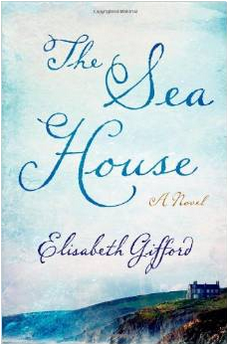
Cover for The Sea HouseAn atmospheric novel set on the Scottish isle of Harris, The Sea House offers a fascinating story split between two times, the 1990’s and the early 19th century.

In 1992, Ruth and Michael have purchased a ramshackle Georgian house on the island, intending to fix it up and open a bed and breakfast. The house used to be the manse long before a new modern house was built. In tearing up the floorboards in the study, Michael finds the small corpse of a baby, although its legs are unfinished, looking more like a fish tail.

The body is at least 100 years old and its death is found to be of natural causes, but Ruth becomes interested in finding out more about the long-ago occupants of the house, hoping to identify the baby. She begins looking into the house’s history.

Ruth also knows very little about her own history. When she was 10, her mother’s death by drowning was found to be suicide, and she grew up in a series of foster homes. She knows nothing about her father, and all her mother told her was that they came from the islands and were descended from selkies. Her last name was Macleod, which she finds is a very common name there, but when she consults a genealogist, the woman can find no trace of a woman of her mother’s name and age born on the islands, leading them to guess that she was using a false name.

In 1860, Alexander Ferguson is the new curate at the manse. He is serious and eager to serve god and his parishioners. He is also interested in the new discoveries about evolution and studies fossils looking for new species. His family legend also holds that he is descended from selkies, and he is fascinated when he hears that a mermaid was discovered on the beach after a storm. He would like to examine her, but she has already been buried and the authorities won’t dig her up. He becomes interested in the idea that selkies might actually exist and could be a cross-species between man and fish.

Alexander has also taken in a new maid, a girl found running wild. Moira’s family was moved off their island along with all the other families so that Lord Marston could put sheep on it. The families were allocated the worst piece of land and all of them except Moira got sick and died. Moira was away from the house when Lord Marston’s men came and burned it down, and she was living wild until the reverend took her in. She loves the reverend but has vowed to kill Lord Marston.

This novel is well written and interesting. I was engrossed in both the modern and historical stories. The novel is particularly interesting for those who like Celtic legends and folk tales.

Related Posts

Galore

Remarkable Creatures

The Forgotten Garden

Day 677: The History of Love

Cover of The History of LoveBest Book of the Week!
At times I wasn’t sure that I would be able to figure out what was going on in The History of Love. This feeling may not be unfamiliar to readers of Nicole Krauss. My book club was so frustrated by Great House a few years back that I had to draw a diagram to help figure out the series of owners of a desk. However, The History of Love eventually becomes clear, with an eminently satisfying ending.

For most of the novel, we follow two main characters. Leo Gursky is an old Jewish immigrant in New York, a survivor of the holocaust from Poland. Years ago he fell in love with Alma Mereminski but was separated from her just before World War II when she went to America. When he tracked her down after the war, she had married. Her oldest son, though, was 6.

Leo has led a lonely life, during which he yearned for Alma and for his unacknowledged son, Isaac Moritz, who became a famous writer. As an old man, he spends part of each day trying to draw attention to himself in some small way, so that if he dies that day, someone will have seen and remembered him.

Alma Singer is a lonely 14-year-old. Years ago her father died, and her mother has ever since lived a life of quasi-mourning, seldom coming out of her room and only doing some occasional translation work. Alma’s brother Bird is a strange boy who believes he is blessed by god. He is preparing an ark for the coming flood.

Alma has been trying to find a boyfriend for her mother so she won’t be sad. One project that interests her mother is a request to translate a book called The History of Love by Zvi Litvinoff that had a small publication run in Chile. This book was very important to Alma’s parents, and Alma was named after a character in the book. Alma thinks she perhaps can strike up a relationship between her mother and the man who requested the translation. But then she notices that the only character in the book who doesn’t have a Spanish name is Alma Mereminski. Reasoning that it may be a real person’s name, she decides to find Alma.

It is Leo who actually wrote The History of Love, we understand, inspired by his love for Alma. But then what happened?

This novel is intricate and vividly imagined. Ultimately, it is emotionally involving. I did not really enjoy the excerpts from the novel within the novel, which seem to be trying too hard to be profound, but those make up only a very small part of the book.

Related Posts

Great House

Beautiful Ruins

Tomorrow There Will Be Apricots


Day 675: Amsterdam

Cover for AmsterdamThe Booker Prize people liked Amsterdam a bit more than I did. Although the shattering last page of McEwan’s Atonement absolutely upended that novel, the same technique did not work as well for this one. Perhaps the problem lies with my having seen McEwan do this several times already.

The novel begins with the death of Molly Lane. Two old friends, both former lovers of Molly, meet at the funeral. Clive Linley is a world-famous composer, and Vernon Halliday is an editor trying to save a floundering newspaper. At the funeral is another of Molly’s former lovers, foreign secretary Julian Garmony, a right-wing bigot whom both men dislike. They all pay stiff respects to Molly’s possessive husband George.

The brush with mortality makes both Clive and Vernon a tad hypochondriac, and they end up exchanging a pledge. But various stresses will soon interfere with their friendship. Clive is struggling to complete what he thinks will be his masterpiece in time for a performance in Amsterdam. And George has offered to sell Vernon some compromising photos of Julian that he found in Molly’s papers. Vernon has to decide whether publication of these photos will result in increased sales or backlash.

This novel is darkly humorous. None of these men is a sterling individual. In fact, they are all morally bankrupt. Clive seems the least at fault for quite some time, but then he does something unforgivable and justifies it as being for his art.

It’s difficult to explain my main criticism without revealing the ending. I can only say that the implications of the final page do not make sense, that there is no way that the character could have known how things would work out. So, I do not think the surprise ending works as well in this case as in other McEwan novels.

Related Posts

Sweet Tooth

The Sense of an Ending

The Child in Time

Day 668: The Sea

Cover for The SeaIn this contemplative novel, recently widowed Max Morden returns to the small Irish seaside resort where his family used to live when he was a boy. It was there he met and became fascinated by the Grace family, much above his own in social strata.

Max’s memories are assisted by his residence as a boarder at The Cedars, the house where the Graces stayed that summer. The Cedars has become a boarding house that is now managed by Miss Vavasour.

The young Max became the companion of the Grace’s oddly feral twins, Chloe and Myles. They are two very unpleasant children who torment their teenage nanny Rose. At first infatuated with the voluptuous Mrs. Grace, Max eventually turns his attentions to the spiky Chloe.

Through his memories of the extraordinary events of that summer and his feelings about his wife’s death, Max eventually gains some self-knowledge. Looking back, he also gains some understanding of the dynamics between people that he did not grasp as a child.

The Sea is stylistically exquisite, with its sussurating and rhythmic prose a striking meditation on death, grief, and memory. Although I guessed one of its revelations much earlier than intended, that did not take away from the power of the prose.

Related Posts

The Sense of an Ending

Bridge of Sighs

Nora Webster


Day 663: Pastoral

Cover for PastoralAndré Alexis states that his intention for this novel was to write a modern pastoral. If you’re not familiar with this term, it’s not surprising, for pastoral literature hasn’t been popular for hundreds of years. A pastoral is a work about life in the country, sometimes comparing it to life in the city, showing the pleasures of a simpler existence.

Alexis tells us explicitly, though, that his protagonist, Father Christopher Pennant, expects the rural town of Barrow, Ontario, to be simple but finds it is not. Indeed, events force him through a crisis of faith.

Father Pennant is a little disappointed by his posting to his first parish of Barrow but is determined to do a good job. There he meets a young woman, Liz Denny, who has just discovered her fiancé is sleeping with another woman. Another parishioner with a problem is Father Pennant’s caretaker, Lowther Williams, 62 and certain he will die at 63. He has set Father Pennant a test to determine if he is the proper person to attend to his affairs after his death.

This is an unusual novel and I’m not quite sure what I think of it. Although I enjoyed Father Pennant’s journey, his conclusions about faith are not definitive and we’re not sure where he will end up. I was also interested in whether Liz would decide to marry Rob after all.

The novel takes place in an indefinite time period that could be any time from the 50’s on. If it is in the present, the town seems old-fashioned. A detail that struck me as odd is that at least three characters keep prayer books with them, and these characters are not religious. Now, things could be different in rural Canada, but as far as I know, I have never even seen a prayer book outside church and don’t know anyone who has one. So, I had to wonder whether something was meant by it.

The descriptions of nature are truly gorgeous. Father Pennant spends more and more of his time exploring it and wonders during his struggles if the study of nature may not be enough for anyone. The novel is written with a gentle humor and sense of irony, and the language is truly lyrical at times.

By the way, my copy is an expensively produced paperback, very nicely printed on thick, high-quality paper. Unfortunately, the last 8 or 10 pages are out of order, which was momentarily confusing.

Related Posts

The Hour I First Believed

Gilead

Religion and the Decline of Magic

Day 660: Straight Man

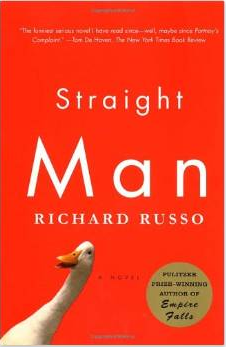
Cover for Straight ManSo far, I have enjoyed Empire Falls the most of Richard Russo’s novels, and Straight Man is at least also set in the rust belt, which he depicts so well. However, rather than being a depiction of small-town life, it is a rich spoof of academia. My husband, formerly the spouse of an academic, tells a joke, probably an old one, that the reason politics in academia is so vicious is that the stakes are so low. That these battles are being fought not on the campus of a great university but of an obscure college in a small Pennsylvania industrial town makes it more ironic.

William Henry Devereux, Jr., (Hank) sees himself as a bit of a rebel, although his rebelliousness mostly confines itself to snarky comments in faculty meetings and satiric opinion pieces on academic life in the local paper. He was once the author of a decently reviewed novel, but now he finds himself the interim head of the English department at a small Pennsylvania college.

Hank has been ignoring rumors that the college is to undergo stringent cuts on the grounds that the same rumors make the rounds every April. The faculty members in his department are constantly embattled, most recently over the job search for a new department head. Hank is better at enraging them than smoothing things over, and at the beginning of the novel suffers a wound to his nose when a professor hits him with her spiral notebook.

Maybe Hank wouldn’t have gotten himself into quite so much trouble, but his wife Lily is out of town on a job interview, and he is preoccupied by a possible kidney stone when he begins taking the rumors seriously. One of the reasons he has discounted them is that the college is breaking ground on an expensive new technology center and he can hardly believe they could claim financial problems requiring layoffs at the same time.

Such is the case, he finds, and with his department members all worried about their jobs, he chooses the groundbreaking ceremony to stage a protest, claiming he will kill a duck (which is in reality a goose) from the campus pond for every day he doesn’t get his budget. Soon he finds himself a minor media celebrity and a suspect of campus security when someone actually does kill a goose. In the meantime, his daughter’s marriage is imploding, he keeps imagining his wife is having an affair with the dean, his scholar father who years before deserted him and his mother for a graduate student is returning, and an attractive daughter of a colleague might be trying to seduce him. The events of this week force him to examine his relationship to his own life.

I found this novel both a bit over the top and amusing, as well as true. If I have a criticism, it is to wonder about some modern male authors’ fascination with bodily functions, and why they seem to think they’re funny. But I guess I can’t constrain this complaint to just novelists, because I’ve been staying away from comic movies for years for the same reason.

Related Posts

That Old Cape Cod Magic

Lucky Jim

The Bridge of Sighs

Day 652: Amy and Isabelle

Cover for Amy and IsabelleIn 60’s small-town New England, Isabelle Goodrow and her 16-year-old daughter Amy are having a tough summer. They are together all the time because Amy has a job in the mill office where Isabelle has worked for years, but they are presently resentful of each other and barely speak.

Although Amy has been harboring typical teenage feelings toward her mother, their problems go back a lot farther. Some of them have roots in how Isabelle has represented herself in town since she moved there. She has some social ambitions and thinks she is more refined than the other women who work in the office. Quietly in love with her married boss for years, she is concerned about how she and her daughter are perceived. She also has secrets.

But their immediate problems begin earlier that school year, when insecure Amy thinks she is in love.

This is my third Strout novel, and I like how observant she is of life in these small, conservative New England towns. She presents us with situations that are dramatic but common and has us examine the lives of ordinary people. Amy and Isabelle are hard on each other, as mothers and daughters can be, but they are also able to learn from their mistakes, even if the lessons are painful.

Related Posts

Olive Kitteridge

Giving Up the Ghost

Empire Falls

Day 650: Nora Webster

Cover for Nora WebsterIt took me awhile to place Nora Webster in time. Irish readers may be quicker to identify its setting from some events, but I am not familiar enough with recent Irish history. Finally, I identified the novel as set in the late 60’s and early 70’s. It wasn’t long after gaining that knowledge that I began to wonder how autobiographical the novel is. Since then, I have read that it is indeed autobiographical, as details about Nora’s husband match those of Toíbín’s father.

Nora Webster is in her 40’s a recent widow. She is finding it difficult. Not only does she miss her husband Maurice, but she finds the attention paid to her as a widow painful. She feels comfortable only with a few people, those who stayed with her and Maurice during his painful death.

Making things more difficult is the fact that she is left with little money. One of the first things she is forced to do is sell the holiday cottage where the family stayed every summer. She finds it hard to return there, especially under those circumstances.

She also has her children to worry about, particularly her two young sons. Donal has begun stammering since his father’s death, and when her Aunt Josie comes to call, it is immediately clear to Nora that all did not go well when the boys stayed with Josie while their father was dying.

Soon Nora is forced to return to her old job at Gibney’s, where she has not worked since she married 20 years before. She must report to Mrs. Kavanaugh, a woman she disliked when they were girls at work there together and who bullies the office staff.

There are no big events in this novel, which is more of a character study. It is about grief and the act of making a new life after a major event.

Nora is an interesting character. She doesn’t say much of what she thinks, so is sometimes misunderstood. She does not listen to other people’s opinions of who she should like or what she should do. She is intensely private and does not discuss things with her family, even things that she should perhaps discuss. She is also fiercely protective of her family.

This is a quiet, contemplative book and is not for those who read only for plot.

Related Posts

The Master

The Year of Magical Thinking

The Gathering

Day 649: The Death of Bees

Cover for The Death of BeesBest Book of the Week!
It may take some fortitude for readers to get past the foul language and bad behavior at the beginning of this novel. But I think most readers will feel it is worth it to have read this dark, funny, and ultimately touching little modern gothic novel.

Marnie and her younger sister Nelly find themselves with a problem. Their parents are dead, and they have already once experienced the joys of the foster care system. So, the two girls bury their mother Izzy in the back garden and hide their father Gene in the shed.

Izzy hung herself, but it is not altogether clear for quite some time what happened to Gene. The couple were terrible parents in any case, Izzy a self-obsessed, neglectful addict and Gene also an addict and molester of his own daughters. The two girls will do their best to take care of themselves until 15-year-old Marnie can do it legally.

Lennie, the old man next door, is a social outcast. After the death of his long-time partner, the lonely Lennie was once tempted by a male prostitute, only to be arrested and charged because the prostitute was a minor. Lennie doesn’t see that well anymore, so although he knew the man was young, he didn’t know how young and feels thoroughly ashamed. Despite his poor eyesight, Lennie is the only person who notices that the two girls are on their own. Soon, he is inviting them over and feeding them, happy to have someone to cook for.

The meat of the novel is the characters of these three. Marnie is brash, foul-mouthed, and smart. She is determined to protect her unworldly sister. But she is more vulnerable than she seems.

Nelly speaks like someone out of a Jane Austen novel and seems strangely clueless for a girl growing up in a tough Glaswegian neighborhood. She has a tendency to see only what she wants to.

Lennie misses his partner. He is meticulous but still ready to open his house to the two teenage girls.

Marnie’s world is populated with drug dealers, butch girlfriends and unreliable boyfriends, a best friend who was ready to run off with her father, and other difficult personalities. As Lennie’s dog Bobbie insists on digging up the bones in the garden and the girls evade questions about their parents, they both learn who they can love and depend upon.

Related Posts

NW

All the Birds, Singing

Mercy Snow

Day 648: The Snow Queen

Cover for The Snow QueenAlthough The Snow Queen is marketed as Michael Cunningham’s reworking of the classic fairy tale, the novel actually alludes to it more than rewrites it. Tyler Meek gets an ice crystal in his eye as does the main character of the fairy tale, so we know he will not be able to see clearly. The Snow Queen herself is the drugs Tyler takes.

The novel begins with Tyler’s younger brother Barrett walking home through a snowstorm. He has just been dumped by his lover by means of an abrupt text and is wondering what he did wrong. In his mid-40’s, Barrett, although a Yale graduate who had a seemingly bright future before him, has been unable to settle to any one thing. He has lost his apartment and now lives with Tyler and his girlfriend Beth and works as a clerk in a store.

Barrett notices an odd light above him in the sky and feels that it is looking back at him. This experience seems so extraordinary to him that he half fears he imagined it and doesn’t at first tell anyone about it.

At home, Tyler awakes to find the room full of snow because he and Beth left the window open. Tyler, Beth, and Barrett live in an ugly apartment in a shabby neighborhood in New York City. Tyler’s dreams of being a musician have ended with him working as a bartender and being allowed to play a couple of nights a week.

Tyler is trying to write a song for Beth for their wedding. Beth has liver cancer, and she presently is getting no better or worse. Tyler obsesses with the song and with the impending 2004 re-election of George Bush rather than trying to get himself off drugs, as he promised Beth. Now, he has begun lying about the drugs.

For a few months, Beth gets better. Barrett attributes her recovery in some part to his exchange with the light and begins attending church. Tyler, who has been good at taking care of Beth, feels a bit like he has lost his purpose.

Cunningham has written an intimate portrait of the two brothers in his masterly style. He forces us to examine our notions about success and failure and insightfully depicts Tyler’s growing dependence on the drugs. However, the story about the brothers and their friends isn’t really compelling, and the female characters are deficient. Beth is a palely drawn angel, and the only other important female character, Liz, looks too much like her opposite. Other characters seem to be there just to populate the novel. After the stunning The Hours, I found The Snow Queen disappointing.

Related Posts

The Hours

The Goldfinch

Boy, Snow, Bird