Day 652: Amy and Isabelle

Cover for Amy and IsabelleIn 60’s small-town New England, Isabelle Goodrow and her 16-year-old daughter Amy are having a tough summer. They are together all the time because Amy has a job in the mill office where Isabelle has worked for years, but they are presently resentful of each other and barely speak.

Although Amy has been harboring typical teenage feelings toward her mother, their problems go back a lot farther. Some of them have roots in how Isabelle has represented herself in town since she moved there. She has some social ambitions and thinks she is more refined than the other women who work in the office. Quietly in love with her married boss for years, she is concerned about how she and her daughter are perceived. She also has secrets.

But their immediate problems begin earlier that school year, when insecure Amy thinks she is in love.

This is my third Strout novel, and I like how observant she is of life in these small, conservative New England towns. She presents us with situations that are dramatic but common and has us examine the lives of ordinary people. Amy and Isabelle are hard on each other, as mothers and daughters can be, but they are also able to learn from their mistakes, even if the lessons are painful.

Related Posts

Olive Kitteridge

Giving Up the Ghost

Empire Falls

Day 650: Nora Webster

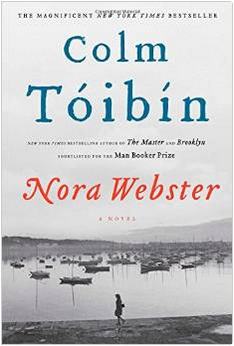
Cover for Nora WebsterIt took me awhile to place Nora Webster in time. Irish readers may be quicker to identify its setting from some events, but I am not familiar enough with recent Irish history. Finally, I identified the novel as set in the late 60’s and early 70’s. It wasn’t long after gaining that knowledge that I began to wonder how autobiographical the novel is. Since then, I have read that it is indeed autobiographical, as details about Nora’s husband match those of Toíbín’s father.

Nora Webster is in her 40’s a recent widow. She is finding it difficult. Not only does she miss her husband Maurice, but she finds the attention paid to her as a widow painful. She feels comfortable only with a few people, those who stayed with her and Maurice during his painful death.

Making things more difficult is the fact that she is left with little money. One of the first things she is forced to do is sell the holiday cottage where the family stayed every summer. She finds it hard to return there, especially under those circumstances.

She also has her children to worry about, particularly her two young sons. Donal has begun stammering since his father’s death, and when her Aunt Josie comes to call, it is immediately clear to Nora that all did not go well when the boys stayed with Josie while their father was dying.

Soon Nora is forced to return to her old job at Gibney’s, where she has not worked since she married 20 years before. She must report to Mrs. Kavanaugh, a woman she disliked when they were girls at work there together and who bullies the office staff.

There are no big events in this novel, which is more of a character study. It is about grief and the act of making a new life after a major event.

Nora is an interesting character. She doesn’t say much of what she thinks, so is sometimes misunderstood. She does not listen to other people’s opinions of who she should like or what she should do. She is intensely private and does not discuss things with her family, even things that she should perhaps discuss. She is also fiercely protective of her family.

This is a quiet, contemplative book and is not for those who read only for plot.

Related Posts

The Master

The Year of Magical Thinking

The Gathering

Day 649: The Death of Bees

Cover for The Death of BeesBest Book of the Week!
It may take some fortitude for readers to get past the foul language and bad behavior at the beginning of this novel. But I think most readers will feel it is worth it to have read this dark, funny, and ultimately touching little modern gothic novel.

Marnie and her younger sister Nelly find themselves with a problem. Their parents are dead, and they have already once experienced the joys of the foster care system. So, the two girls bury their mother Izzy in the back garden and hide their father Gene in the shed.

Izzy hung herself, but it is not altogether clear for quite some time what happened to Gene. The couple were terrible parents in any case, Izzy a self-obsessed, neglectful addict and Gene also an addict and molester of his own daughters. The two girls will do their best to take care of themselves until 15-year-old Marnie can do it legally.

Lennie, the old man next door, is a social outcast. After the death of his long-time partner, the lonely Lennie was once tempted by a male prostitute, only to be arrested and charged because the prostitute was a minor. Lennie doesn’t see that well anymore, so although he knew the man was young, he didn’t know how young and feels thoroughly ashamed. Despite his poor eyesight, Lennie is the only person who notices that the two girls are on their own. Soon, he is inviting them over and feeding them, happy to have someone to cook for.

The meat of the novel is the characters of these three. Marnie is brash, foul-mouthed, and smart. She is determined to protect her unworldly sister. But she is more vulnerable than she seems.

Nelly speaks like someone out of a Jane Austen novel and seems strangely clueless for a girl growing up in a tough Glaswegian neighborhood. She has a tendency to see only what she wants to.

Lennie misses his partner. He is meticulous but still ready to open his house to the two teenage girls.

Marnie’s world is populated with drug dealers, butch girlfriends and unreliable boyfriends, a best friend who was ready to run off with her father, and other difficult personalities. As Lennie’s dog Bobbie insists on digging up the bones in the garden and the girls evade questions about their parents, they both learn who they can love and depend upon.

Related Posts

NW

All the Birds, Singing

Mercy Snow

Day 648: The Snow Queen

Cover for The Snow QueenAlthough The Snow Queen is marketed as Michael Cunningham’s reworking of the classic fairy tale, the novel actually alludes to it more than rewrites it. Tyler Meek gets an ice crystal in his eye as does the main character of the fairy tale, so we know he will not be able to see clearly. The Snow Queen herself is the drugs Tyler takes.

The novel begins with Tyler’s younger brother Barrett walking home through a snowstorm. He has just been dumped by his lover by means of an abrupt text and is wondering what he did wrong. In his mid-40’s, Barrett, although a Yale graduate who had a seemingly bright future before him, has been unable to settle to any one thing. He has lost his apartment and now lives with Tyler and his girlfriend Beth and works as a clerk in a store.

Barrett notices an odd light above him in the sky and feels that it is looking back at him. This experience seems so extraordinary to him that he half fears he imagined it and doesn’t at first tell anyone about it.

At home, Tyler awakes to find the room full of snow because he and Beth left the window open. Tyler, Beth, and Barrett live in an ugly apartment in a shabby neighborhood in New York City. Tyler’s dreams of being a musician have ended with him working as a bartender and being allowed to play a couple of nights a week.

Tyler is trying to write a song for Beth for their wedding. Beth has liver cancer, and she presently is getting no better or worse. Tyler obsesses with the song and with the impending 2004 re-election of George Bush rather than trying to get himself off drugs, as he promised Beth. Now, he has begun lying about the drugs.

For a few months, Beth gets better. Barrett attributes her recovery in some part to his exchange with the light and begins attending church. Tyler, who has been good at taking care of Beth, feels a bit like he has lost his purpose.

Cunningham has written an intimate portrait of the two brothers in his masterly style. He forces us to examine our notions about success and failure and insightfully depicts Tyler’s growing dependence on the drugs. However, the story about the brothers and their friends isn’t really compelling, and the female characters are deficient. Beth is a palely drawn angel, and the only other important female character, Liz, looks too much like her opposite. Other characters seem to be there just to populate the novel. After the stunning The Hours, I found The Snow Queen disappointing.

Related Posts

The Hours

The Goldfinch

Boy, Snow, Bird

Day 640: The Enchantment of Lily Dahl

Cover for The Enchantment of Lily DahlBest Book of the Week!
Lily Dahl is a 19-year-old making a living as a waitress in a small-town cafe and living in an apartment above it. Although she is saving for college, what she really wants to be is an actress.

Lately she has been fascinated by Ed Shapiro, an artist living in a room across the street. He is in his thirties, recently deserted by his wife. At night she can’t keep herself from watching as he paints in his underwear.

Lily’s next-door neighbor, an old lady named Mabel, is helping Lily with her part of Hermia in a local production of A Midsummer Night’s Dream. Lily has also made friendly overtures to Martin Petersen, even though he seems very odd, because she remembers they used to play together as children. Martin stares at her and stutters, but he becomes a different person when acting his part of Cobweb in the play.

As Lily gets to know Ed Shapiro, she becomes aware that someone is watching her apartment and has even entered it when she wasn’t home. She suspects Hank, the boyfriend she broke up with when she realized she liked Ed.

Odd things begin to happen around town. Martin has left her some bewildering gifts and told her things that don’t make sense. She has heard rumors of someone seen near the river carrying a body and people seeing something that looks like an angel. Lily begins to fear that someone may have been killed.

This novel is an eerie one, and Lily, although at times naive, makes a strong and daring heroine. Occasionally, the novel seem almost dreamlike as it explores the differences between appearance and reality. You may find it hard to put down the novel, which in its look at the underbelly of a small town in Minnesota, reminded me a bit of the movie Blue Velvet, although the novel is gentler.

Day 639: The Children’s Crusade

Cover for The Children's CrusadeIt took me awhile to figure out the focus of The Children’s Crusade, which for some time just seems to wander backward and forward in time telling the story of a family. This is not really a criticism, though, as I was interested in the story.

It begins when Bill Blair discovers a piece of land outside San Francisco after his time serving in the Korean War. He envisions children playing there, so he buys the property, and eventually he marries and builds a house. He is a pediatrician, and he and his wife Penny have four children: Robert, Rebecca, Ryan, and James.

By the time the older children are nearing their teens, all of the children begin planning a Children’s Crusade. The purpose of the crusade is to try to think of activities that their mother will want to do with them. Although their father is warm and nurturing, their mother is distant and passive-aggressive, wanting, for example, her family to explicitly invite her on outings even though she knows they want her to come and will be disappointed if she doesn’t. When they don’t think to ask her, she stays home. She begins spending more and more time in a shed on the property working on art projects.

It is a usually unacknowledged fact within the family that the addition of James, large, obstreperous, and destructive, proved overwhelming for their mother. He feels this deeply, and it makes him more unruly. Affectionate and caring Ryan, closest to him in age, tries to make up for their mother’s neglect, but he is only three years older than James. Robert and Rebecca spend a lot of time keeping James out of their mother’s hair.

http://www.netgalley.comAs adults after their father’s death, the four siblings are forced to consider selling the house. No one originally wanted to sell, so they have it rented out, but then James forces the issue when he needs the money to make a home for his married girlfriend and her children. Even though Bill and Penny Blair were separated for years before Bill died, Penny must agree to the sale of the house. This arrangement forces James to talk to his mother for the first time in years after one of her art projects proved difficult to forgive.

The novel moves between the points of view of each of the siblings, only briefly touching on that of the parents. It is absorbing and well written and struck some chords with me. Its examination of the complexities of human relationships is thought-provoking.

Day 634: The Never List

Cover for The Never ListThe Never List is one of several books that were published last year to capitalize on the huge popularity of Gone Girl. Unfortunately, The Never List never comes close to reaching the tension and suspense of Gillian Flynn’s work.

Caroline has managed to arrange her life so that she has not left her New York apartment for years. She was once Sarah, held captive with three other women for years and subjected to torture by a crazed psychology professor named Jack Derber. Derber’s parole hearing is coming up, and Agent McCordy is trying to prepare her to testify. That would mean she would have to leave her apartment.

Of course, Sarah doesn’t want Derber out of jail, but she is more concerned about whatever happened to her best friend Jennifer, with whom she was kidnapped. After a car accident in their teens in which Jennifer’s mother was killed, Sarah and Jennifer constructed the Never List, things they would not do that would put them in danger. One of those things was to never walk back to their college dormitory at night after a party. It was after they got into the car they thought was their cab that they were kidnapped. The last time Sarah saw Jennifer alive was in that car. After that, Jennifer was kept in a box in Derber’s basement.

Sarah begins to believe that letters she receives from Derber hold coded clues for her fellow victims Tracy and Christine, and that theirs may hold clues for her. In hopes of finding Jennifer’s body, she tries to get them to help. She believes that Jack’s wife Amelia, the member of a religious cult, might know something. But when she travels to Oregon to see her, she can’t find her.

Eventually, Sarah begins traipsing all over the country looking for clues, later helped by Tracy.

The first thing that struck me was the novel’s narrative style, a certain flavor of first person that reminds me of the style adopted for many young adult novels. I find it irritating, used to provoke a false intimacy.

I also found it completely unlikely that an agoraphobic who hasn’t left her apartment in years and is full of terror could put it aside and suddenly begin flying and driving all over the country. I had this same complaint about Louise Millar’s Accidents Happen, and that character was only traveling around the city.

Zan doesn’t successfully build suspense in this novel. At one point, Tracy and Sarah are captive in a van with a bunch of women and you wonder how they are ever going to get out, when before it can get too scary, they are miraculously released. Not only does she make this happen too quickly to build the suspense, but the character who releases the women has somehow managed to fly straight across the country from New York to Oregon in a few hours, just in time to witness them being kidnapped. (I only have to travel halfway across the country to Oregon, and it takes me almost all day.) Other scenes that could be terrifying are not.

I won’t go into much more detail about the plot, which mixes serial killing and torture, S & M clubs, human trafficking, and cults. Did I miss the kitchen sink? Suffice it to say, I did not believe this book for a minute.

Day 627: Mercy Snow

Cover for Mercy SnowBest Book of the Week!
On an icy Thanksgiving eve outside Titan Falls, New Hampshire, a school bus with children who had been to the movies in the nearby town plummets off the road, killing one girl and incapacitating the bus driver. Readers know that a car passed the bus at a dangerous place, causing the driver to lose control. Up the road from the bus, the sheriff finds the wrecked truck of Zeke Snow, a young man from a backwoods family of ill repute. No one knows exactly what happened, but the sheriff decides it must have been Zeke’s fault.

June McAllister, the mill owner’s wife, soon finds evidence that her husband Cal may know more about the accident than he’s admitting. Her reaction is to close family ranks. After all, the Snows have never been anything but trouble.

Zeke is hiding in the woods, but he has told his sister Mercy that he did not see the bus the night that he wrecked his truck. He ran when the police arrived because he’s known nothing but trouble from them.

Mercy knows that her brother occasionally shows poor judgment, but his main instinct has always been to protect her and their little sister Hannah. While eking out an existence for herself and Hannah and living in a battered old trailer, she decides she must somehow prove Zeke innocent. For her part, June is trying to drive the Snows out of the area, where they have returned to their grandmother’s property after years of a rough and nomadic existence.

This novel may sound like a mystery, but it is not. We know fairly early on what happened to the bus. Instead, the novel is an examination of themes like discrimination against the poor, the exercise of power, the complexity of people’s reactions to tragedy, and the close-mindedness of small, closely knit communities. It also includes a hint of the supernatural. The novel is disturbing and well written. Although I thought I knew where it was going, the novel turned out to be unpredictable.

Day 603: Stone Mattress

Cover for Stone MattressMargaret Atwood describes Stone Mattress as a collection of tales, and several of them are characteristic of wonder tales or amazing tales of decades ago. In the title story, for example, a woman meets a man on a cruise to the Antarctic who years ago ruined her life. When he does not recognize her much older self, she begins plotting his murder.

All of the stories are about characters in their older years. The first three are linked. In “Alphinland,” Constance, the author of a popular fantasy series, copes with the aftermath of an ice storm and listens to advice from her dead husband as she considers her earlier life, particularly Gavin, an old lover who was cruel to her. In “Revenant,” Gavin’s wife Reynolds tries to cope with her difficult poet husband. She has a bit of revenge by setting him up with an interview with a graduate student who only wants to know about his relationship with Constance. In “Dark Lady,” Jorrie, the woman who long ago was the cause of Constance and Gavin’s break-up, asks her twin brother to go along with her to Gavin’s funeral.

http://www.netgalley.comSome of the stories are more fantastic, such as “Lusus Naturae,” about a woman whose family has hidden her away for years because of her appearance and a thirst for blood. Many of them reflect a concern for the environment and a dark sense of humor. All are well written. This collection is a perfect one for people who want to experience a light and entertaining dose of Atwood.

Day 602: The Memory Keeper’s Daughter

Cover for The Memory Keeper's DaughterI understand that Kim Edwards got the idea for The Memory Keeper’s Daughter from a true story told to her by her pastor. I can see why a novelist might think the story makes good fodder for a novel. I was not so sure how I would feel about reading it, though.

The blurb makes very clear what the novel is about. On a snowy Kentucky night in 1964, Dr. David Henry must deliver his children when the doctor he engaged is unable to reach the clinic. His wife has twins. The first born is a boy, and he is perfect. His twin is a girl, and the doctor and his nurse, Caroline Gill, immediately recognize the signs of Down’s syndrome. At that point, Henry makes a fateful decision. He asks his nurse to deliver his daughter to a home for the mentally deficient. When his wife awakens, he tells her the girl died.

Henry explains his actions to himself as an attempt to protect his family. He too had a Down’s syndrome sister, and he remembers the pain her early death caused him and his mother. But these memories are muddied by the feelings of resentment he had as a boy for the amount of attention that went to his sister.

Caroline Gill is shocked to the core by Dr. Henry’s decision, even though she is in love with him. She does what she is told until she gets a look at the facility. Then she turns around and takes the baby home. She waits for Henry to do the right thing, but when she sees a memorial notice for the little girl in the paper, she takes the baby and leaves town.

This lie that David Henry told continues to haunt his marriage, for it puts a barrier between himself and his wife and child. He comes to feel he made a bitter mistake, but cannot find a way to correct it. He puts his energies into his work and his hobby of photography instead of his family.

This novel reminded me of the attempts of some of the modernists to show ordinary people with all their flaws. Even Caroline, the most blameless of all the characters involved in the original act, leaves town after Henry asks her to do nothing without telling him first. Later, when he has an opportunity to meet his daughter, Caroline panics and leaves.

Norah Henry, who knows nothing of the original act, still handles her marriage poorly. I don’t think I’m being too judgmental when I say that everything is not all David Henry’s fault.

I feel that the novel becomes too diffuse somehow. I don’t require novels to wrap everything neatly up—often they’re more interesting if they do not and I give this book credit for not trying to—but I found the ending especially frustrating. I also did not see much point in bringing in the character of Rosemary. She is simply a convenience to cause a break.

All in all, I felt my initial hesitations about this book were justified. Despite the idea being based on a true story, the novel begins in 1964, not 1934, and Henry is a doctor, not the impoverished farmer his father was. So, there is no other way I can view his behavior except as unconscionable. I did not read this novel at the same time as My Father’s Eyes, which is in some ways a nonfiction counterpart to this book, but the similarities and differences are interesting to consider.