Day 594: The House We Grew Up In

Cover for The House We Grew Up InIn some ways The House We Grew Up In hit home for me, but ultimately I felt it both was a bit unlikely and found too easy a solution for large problems. It is about a family trying to cope with a terrible event and with their mother’s mental illness.

We meet the Bird family at various stages of their lives, beginning when the oldest daughter Meg is about ten. As Easter is mother Lorelei’s favorite holiday, many of the events in the novel are set at that time.

In her mid-thirties, Lorelei Bird is a vibrant, beautiful woman, but there are already signs of what will become her obsession. Her kitchen is cheerfully cluttered and serves as the gathering spot for friends and neighbors. Lorelei’s husband Colin is a gentle, loving man, but when the wading pool gets punctured and Lorelei argues for keeping it anyway, he remarks mildly that they already have several punctured pools in storage. The kitchen wall is gay with children’s drawings, but when any of the children draw something new, Colin hastily claims it to put in his files.

When Lorelei’s youngest children are sixteen, tragedy strikes. From a seemingly happy family, the Birds disintegrate into unhappy adults. Meg, apparently the most well-adjusted and practical, is rigid and judgmental and  fanatical about neatness. Bethany, slightly younger, is afraid to leave home and carries on an inappropriate affair for years. Rory simply leaves, seldom to be seen again.

Lorelei dumps Colin for a relationship with Vicky, the next-door neighbor. By the time of her death, twenty years later, she has accumulated so much junk in the house that only narrow pathways are open and she lives in one soft chair. All her loved ones have left her because they can’t live in the environment she has created.

With her death, the scattered family reassembles to try to clean out the house. As they exchange information, they slowly begin to understand some family secrets.

In some ways, the novel affected me because I have a family member who is a hoarder, although not yet on the scale of Lorelei. Still, we have an unusable room and some junk piled up even in the public rooms. It is very difficult to deal with.

http://www.netgalley.comYet, I felt that the novel was too easy. First, it gives every member of the immediate family severe emotional problems, which I actually found unlikely. Then it clears them up magically at the end after a few conversations. Not happening. The ending moves the novel in my mind from a thoughtful examination of the problems caused by unresolved tragedies and mental illness to something more closely resembling a sitcom ending.


Day 592: Literary Wives! Wife 22

Cover for Wife 22Today is another meeting of Literary Wives, where a group of bloggers read and discuss depictions of wives in fiction.

* * *

I guess by definition chick lit is predictable, so perhaps it is unfair to criticize Wife 22 because I could tell where it was going before it got there. Still, I do criticize it for that, although it is well written, has funny, believable dialogue, and is quite enjoyable to read.

Alice Buckle is feeling a little dissatisfied with life. She has a handsome husband, but he has seemed withdrawn of late. She is often at loggerheads with her fifteen-year-old daughter, although she is very close with her younger son. She enjoys her work as a drama teacher at an elementary school. Still, the spark is gone between her and her husband.

She is invited by email to take part in a survey about marriage. To maintain anonymity, she is assigned a login of Wife 22 and a caseworker, Researcher 101. She finds it exciting to have a harmless secret and cathartic to answer the questions.

But it isn’t too long before the two are emailing each other outside the survey. Alice feels as if Researcher 101 really listens to her and understands her. Soon, she is fighting to keep herself out of an emotional affair. The situation is made more difficult because her husband William has abruptly lost his job.

I liked all the characters in this novel except the one I wasn’t supposed to like. However, I seldom read chick lit and again, I felt that this novel was predictable.

Literary Wives logoWhat does the book say about wives or about the experience of being a wife? In what way does this woman define “wife”—or in what way is she defined by “wife”?

I have to admit this portrait of a modern wife is more well rounded than we have seen in some other books. Alice is a failed playwright—her one produced play was a flop—but she really enjoys her job working with children. As a mother, she is actively engaged with her children, although inclined to worry unnecessarily and feel inadequate. Her relationship with her husband is friendly but a bit distant. When she tries to feel him out about emotional issues, he is abrupt and dismissive. In this regard, she is needy, letting a feeling of being unloved and inadequate prevent her from dealing honestly with her husband. I’m not sure, though, that any of this says something about being a wife. I feel as if this novel comments more on marriage itself and what can happen to it if it’s allowed to grow stale. There are problems between Alice and her husband, but her husband also has his own troubles that Alice is too preoccupied to pay attention to.

The Wives

Be sure to read the reviews and comments of the other wives!

Day 590: All the Birds, Singing

Cover for All the Birds, SingingBest Book of the Week!
Jake Whyte is a tall, strong young woman doing a man’s job on an island in northern England. She is keeping a sheep farm, doing the best she can at a hard job all by herself. She is haunted, though, by terrifying memories and the feeling that someone is watching her and coming into her house. Her neighbor Don thinks she’s imagining things, but there is no doubt that something is killing her sheep.

Interleaved with her struggles in the present time are scenes from Jake’s past, from the most recent backward in time to when she was a teenager in Australia. So, we slowly learn why Jake finds herself alone, feeling like an outcast from society.

This novel is haunting and in many ways reminds me of the excellent, Tethered, which I just recently reviewed, in dealing with damaged people. I don’t want to say more about it for fear of giving too much away. Let me say that the novel is extremely atmospheric and that I was completely involved in discovering the secrets from Jake’s past as well as what is hanging around her farm. It is also beautifully and sparely written, evoking a distinct personality in Jake.

Day 586: Wit’s End

Cover for Wit's EndRima Lansill finds herself suddenly without a family. Both her parents are dead: her mother when she was young and her father just recently of cancer. It is not so much her father’s death that has rocked her, though, but that of her younger brother Oliver in a drunk-driving accident. Rima is upset enough to want to get away from Cleveland for awhile, so she is happy to accept the invitation of her godmother to stay at her house of Wit’s End in Santa Cruz, California.

Rima’s godmother is the famous mystery writer A. B. Early—Addison—whose sleuth is Maxwell Lane. Rima has read all of Addison’s books but has never actually met her, as there was some sort of rift between Addison and Bim, Rima’s father. Rima wonders if it was caused by Addison having used Bim’s name for the murderer in one of her books.

Taking sleuthing tips from Maxwell Lane himself, Rima decides to try to find out what happened and just what her father’s relationship to Addison was. Addison herself is not very forthcoming, but some letters Rima finds in Maxwell’s fan mail show knowledge of the real Bim, not the fictional murderer. And these letters arrived from the home of what used to be a cult.

I have now read three Fowler novels, and they all construct an interesting tale full of well-meaning characters (although We Are All Completely Beside Ourselves leaves the others in its dust). There are some alarming moments in Wit’s End, but mostly what it offers is comfort and a new home for the main character. I have categorized it as a mystery, but the mystery is really only something to hang the characters and atmosphere on, as the book club is in The Jane Austen Book Club. Wit’s End is a fun bit of very light reading.


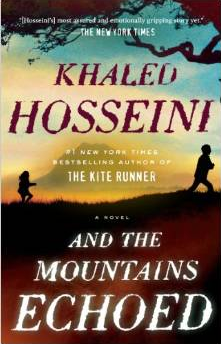
Day 585: And the Mountains Echoed

Cover for And the Mountains EchoedMaybe because it doesn’t have as focused a plot, I didn’t like And the Mountains Echoed as much as I have Hosseini’s other books. Still, its characters involved me in their dilemmas.

I don’t think the blurb helps, because it made me think that the novel centers around Abdullah and his younger sister Pari, who are separated early in the novel. It starts with them certainly, but then it goes on to examine a multitude of relationships between other characters—some relatives of Abdullah and Pari, some connected only peripherally.

The novel explores the difficulties of connections between people—loved ones who are separated, people who are displaced, siblings who don’t understand each other, children who feel their parents disapprove of them, and so on. Although each story is interesting on its own, I felt a certain amount of frustration when some of the characters never reappeared again.

Although the ending of the novel is touching, I feel that the plot is too diffuse to be entirely satisfying. Although Jennifer Egan used a similar approach in A Visit from the Goon Squad, the difference is that I came away from that book feeling thrilled at its cleverness rather than frustrated.

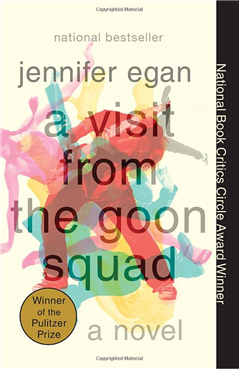
Day 581: Reread! A Visit from the Goon Squad

Cover for A Visit from the Goon SquadWhen I first read this quirky book last year, I said I wanted to reread it so that I could pay better attention to the minor characters in each story. I intended this because Egan’s clever technique to tie these stories together is to make a minor character in one story be the primary character in another.

So, this is my second review of this collection, which is really great. If you didn’t run right out and get it after my last review, I urge you to do so now. The stories are hip, aware, funny, and terrifically smart, centering around the music and public relations industries.

The stories in the first half of the book all touch on two characters—Benny Salazar, who is a music business executive when we first encounter him, and Lou, his mentor. The stories move backward and forward in time, so Benny is first at the height of his career but beginning to realize his taste is falling out of fashion. In a later story he is a teenager in a punk band called the Flaming Dildoes. He has several more appearances before making a comeback in his 60’s with a sensational concert starring his old friend Scotty from that first high school band.

Lou is at the height of his powers in one of the earlier stories, when he seduces one of the girls from the Dildoes, Jocelyn. Her friend Rhea watches their behavior in dismay. Later a dying old man, Lou is delighted to receive a visit from Rhea and Jocelyn, together again after years. But Jocelyn fights an urge to push him into the swimming pool as she considers her 30 years of wasted life as a drug addict, started on her way by Lou when she was 17.

The funniest stories skewer the public relations field. Dolly, once the premier public relations agent in New York (and the boss of Benny Salazar’s wife), has given up her career after a disastrous party she planned. Her brilliant idea to suspend translucent pans of colored oil from the ceiling near spotlights so that the oil would move as it heated was ruined when the plastic pans melted, sending hot oil down to burn all the celebrities. She sees an opportunity to revive her career in a job rehabilitating the reputation of a brutal third-world general. Even though this job almost ends in a murder, when her strategy actually works, she is contacted by a slew of dictators and assorted thugs wanting to hire her.

The has-been starlet Dolly used as the general’s “girlfriend” is the focus in her early career of a hilarious vituperative mock PR piece by the journalist who physically attacked her during an interview (Benny Salazar’s troubled brother-in-law). And finally, a short time in the future, Benny Salazar brings together his smash concert by appealing to the tastes of babies (“pointers,” as they are termed by the marketeers) and using the equivalent of likes on Facebook.

I understood a few things better on rereading the book. In an interview, Jennifer Egan said the stories were about pauses. One of them, a delightful Powerpoint presentation written by a preteen girl (the daughter of Benny Salazar’s ex-assistant Sasha, whose story is the first one in the book), talks about her little brother’s fascination with the pauses in rock music. In the book, we revisit the characters at different times in their lives, after pauses when we don’t see them. This approach leads us to consider the events of their life that we don’t see. Finally, there is the title, explained by the remark of a character. “Time is a goon.”


Day 578: Tethered

Cover for TetheredBest Book of the Week!
Clara Marsh has been wounded by life. She is a mortician who spends her days preparing bodies for burial, caring for them tenderly and tucking a symbolic bouquet of flowers into the coffin of each. But she herself is isolated, afraid to look people in the eye, unable to touch. Her frame is skeletal, her scalp scarred from pulling out her own hair. The only people who seem to care for her are her boss and his wife, Linus and Alma Bartholomew.

One day Clara finds a little girl in the funeral home named Trecie, who says she has been visiting Linus. When Clara asks Linus about the girl, he asks Clara to help her. Soon after, at the scene of a death, Clara finds evidence that Trecie is the victim of child pornographers. When she tells Detective Mike Sullivan that she knows Trecie, he asks her to call him when she sees Trecie again. But Trecie gets away from them.

Mike believes there is a connection between the pornographers and the death of Precious Doe, an unidentified child found murdered after being badly beaten three years before. Soon it begins to look as if he may be right. Unfortunately, a fragile friendship between Clara and Mike is threatened when Mike begins to believe that Trecie doesn’t exist.

Although this novel is framed within a mystery, its soul is within the persona of Clara and her story. Tethered is precisely and beautifully written and absolutely haunting. I was transfixed by it.

Day 574: Little Bee

Cover for Little BeeLittle Bee begins her story from a detention center in England, where she has been held for two years. During this time, she has been learning British English in the hopes she will be allowed to stay. After another girl seduces a guard, Little Bee is released with her and two other girls, with no papers or money, into the depths of the English countryside. Bee calls the only person she knows in England, Andrew O’Rourke, a man she met on a beach in Nigeria two years before.

Sarah O’Rourke is getting ready to attend her husband’s funeral. He had been depressed ever since that day on the beach. Then, suddenly, he committed suicide. When someone arrives at the door, Sarah is surprised to find Little Bee.

Eventually, we find out what happened that day on the beach—how Little Bee lost her sister and Sarah her finger. Sarah is posed with a problem. What can she do about Little Bee to help her stay protected in England? To the British government, Nigeria is a safe country from which Little Bee does not need refuge. The government does not know or is unwilling to learn that the oil companies are murdering entire villages to get rights to the oil beneath them.

I found Little Bee to be affecting all right, and it informed me of a situation I did not know existed. With all the bad news about various countries in Africa lately, I had not heard mention of Nigeria (at least not in this respect).

A few people have written reviews complaining about the ending. Perhaps they like their endings nicely wrapped up. I don’t mind ambiguity, but I did feel sometimes as if I was being manipulated. In addition, Little Bee’s voice, although enchanting and original, is not consistent enough. At times she is amazingly naive, sometimes convincingly so, others not so much. It is some of her more sophisticated knowledge that occasionally doesn’t ring true with the character Cleave has created and can’t be explained by two years of reading classics.

In any case, it is Sarah’s stunning naivety that is more unbelievable, both on the beach that day and when she decides to interview people in Nigeria instead of immediately contacting a lawyer or her embassy in an attempt to save Bee.

With all these caveats, I enjoyed the book, though, and give it a qualified recommendation.

Day 571: The Goldfinch

Cover for The GoldfinchBest Book of the Week!
Theo Decker is hiding in an Amsterdam hotel, ill and terrified. He is afraid to set foot in the street. Through most of The Goldfinch, Theo relates the roots of his troubles, which lie 15 years in the past.

Thirteen-year-old Theo is out in New York City for a day with his mother. Normally, this would be a day he’d enjoy, but he is in trouble at his prep school, and they are on the way to school for a meeting. They are early, though, and his mother wants to stop at the museum to look at an exhibit.

Inside the museum, he spots an unusual couple—a hunch-backed old man and a fairy-like red-haired girl. He is only half attentive to his mother’s explanations of the paintings because he is looking at the girl. They stop to view a painting called The Goldfinch, one of the few remaining works by a Dutch artist named Fabritius.

Theo’s mother goes off to the gift shop while Theo trails after the girl. A few minutes later, Theo is knocked out by an explosion from a terrorist attack. When he comes to, the museum is oddly empty, but he finds the old man dying. The man gives him a ring and tells him to take it to an address, and then he suggests that Theo pick up The Goldfinch from a pile of dust and take it with him. He does, an act that becomes a defining moment of his life.

Assuming that his mother got out okay, Theo goes home, but he soon finds that she was killed. Since his ne’er-do-well father disappeared from their lives, it has been just the two of them for years. Social services ends up taking him to stay with the wealthy family of one of his school friends, the Barbours.

Suffering from grief and untreated post-traumatic stress disorder, Theo tries to hide his insecurity and discomfort. As formal as the Barbour household is, he likes Mrs. Barbour and worries that the family might want him to leave. Eventually, he takes the old man’s ring to the address and meets the man’s partner Hobie and the girl, Pippa, who was badly injured in the explosion. She soon goes away to live with her aunt, but Theo continues to visit Hobie, who is a furniture restorer. And he is always in love with Pippa.

Just after Theo is invited to spend the summer in Maine with the Barbours, his whole life changes again. His father arrives and removes him abruptly from New York to Las Vegas. Theo is left to himself most of the time in a deserted suburb at the edge of the desert. His father at first appears to be well off, but soon it is clear he is living on the edges. Theo befriends another outcast, a Ukranian boy named Boris, and the two begin a slide into drugs and alcohol and the margins of society. Even after he returns to New York and tries to pull his life together, the secret of the painting serves as both a pleasure and a hidden terror.

It seems as if I am giving away a lot, but I have covered only the beginning of this long, involving novel. It explores such themes as the trauma of loss, the yearning for love, and the fragility of happiness and the present. In losing his mother, Theo seems to have lost his moral compass, so that even as he tries to help people, he creates problems for them and himself.

Tartt’s characters are complex and fully realized. Even the villains have facets to their personalities. Although Theo thinks of his father as a scoundrel—and he certainly has few redeeming qualities—Boris points out to him that when Boris was alone with nothing, Theo’s father took him in. An older Theo fears he has too much of his father in him.

The Goldfinch remains a golden, potent symbol throughout the novel. Theo loves the painting and feels that owning it somehow gives him stature. Yet at the same time he is terrified he’ll be found with it. Just as the bird in the picture is shackled, so Theo is captive to the painting.

Throughout the novel Theo disappointed me with his self-destructive tendencies even though he has good intentions. Still, Tartt tells a story that absolutely impels you to keep reading. This is a wonderful job of storytelling.

Day 568: Bridget Jones Mad About the Boy

Cover for Bridget Jones Mad about the BoyAt first, the breezy, dippy tone of Bridget Jones Mad About the Boy is a little disconcerting. Bridget sounds just like her dingy 30-year-old self, but she is now 51. Eventually, though, I was happy to renew my acquaintance with her.

Bridget is struggling to raise two small children on her own, Mark Darcy having died five years before. She also is lonely and misses Mark. Her friends decide it is time she starts dating again. Her technological and dating misadventures are complicated by her bumbling attempts to cope with school functions, for which she is always late, her efforts to write a screenplay, and her encounters with Mr. Wallaker, the teacher who Bridget believes disapproves of her.

The bulk of the novel, though, concerns Bridget’s relationship with Roxster, her 29-year-old boyfriend. This coupling provides food for flashes of insecurity and lots of cougar (and fart) jokes.

We get to spend time with many old friends of Bridget, including Daniel, Bridget’s old love interest, who has turned out almost predictably, still chasing women but now also babysitting (ineptly). This is fluff, but fun fluff, and I think it is a little better than the second Bridget Jones book. It is amusing to revisit Bridget’s world, and we occasionally have a tear in our eyes.