Day 341: Nightwoods

Cover of NightwoodsBest Book of the Week!

Charles Frazier sets his novels in backwoods North Carolina. His first novel, Cold Mountain, was set during the Civil War. His second, Thirteen Moons, went further back to the treatment of the Cherokee in the earlier part of the 19th century. Nightwoods, his third, deals with more recent times, a small mountain town in the early 1960’s.

Luce is a troubled young woman with a traumatized past who has taken up a secluded life as a caretaker for an old disused lodge across the lake from town. She is unprepared when a social worker brings her the young twin children of her murdered sister Lily, an almost feral boy and girl who refuse to speak and like to start fires.

Stubblefield is lazing away his life on the coast of Florida when he learns his grandfather has died and left him, aside from a load of debt, the lodge and a road house and a considerable number of acres on the mountain. When he goes to inspect the lodge, he is immediately smitten by the skittish Luce.

Trouble is on the way, which we know from the beginning of the novel. Bud, the husband and murderer of Luce’s sister Lily has been released from prison because of a hung jury. He is on his way to town in search of the money he stole, which he gave to Lily one night when he was drunk and she refused to give back to him. He beat her to death trying to get her to tell him where it is, and now he thinks the children know.

This novel is at times tender, as Luce blindly copes with the two damaged children in the best way she can, instinctively treating them with delicacy and kindness. At the same time, the violent Bud resembles a character from a Carl Hiaasen or Elmore Leonard novel, almost comic at times in his psychopathic ineptitude.

The result is an enthralling novel that is both a love story, not just between its characters but with the beauty of nature, and a thriller with a true feeling of danger. As usual with Frazier, the novel is wonderfully well written, with entrancing descriptions of nature.

Day 339: A Visit from the Goon Squad

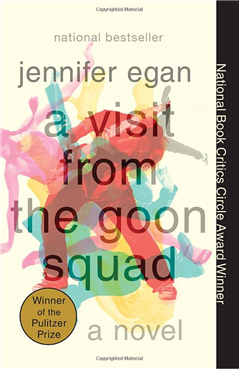
Cover for A Visit from the Goon SquadBest Book of the Week!

Describing this delightful and quirky novel is going to be difficult, so I hope curious readers will try it even if I am unable to convey a sense of it.

First, I call it a novel, but it can be just as accurately described as linked short stories. Each chapter is written from the point of view of a different character who knows one or more of the other characters. The chapters all center around the subjects of music and public relations.

The book begins in New York with Sasha, who is the assistant to Bennie, a music executive, sometime after 9/11. She is on a desultory date with Alex, but she also has a problem with kleptomania. While in the bathroom, she steals a woman’s wallet and then has to watch while Alex gets involved in helping the woman.

Next is a middle-aged Bennie, who torments himself with feelings of shame about past experiences. He takes his son to visit a sister act in order to fire them for not producing an album in the specified amount of time. He realizes he is beginning to see his legendary taste diverge from that of his younger coworkers.

Then we jump back thirty years to Rhea, a teenager in San Francisco who is a member of a punk rock band called the Flaming Dildoes with her friends Bennie (yes, the same Bennie), Scott, Alison, and Jocelyn. Rhea observes Jocelyn’s budding relationship with a middle-aged record executive named Lou, who will become Bennie’s mentor. Rhea is dismayed as Lou gives Jocelyn drugs and gets her to perform sexual acts in public.

These are just the first of the vignettes, which range forward and backward in time over 40 years and extend in structure to a touching PowerPoint presentation and a parody of a celebrity interview. They make stops in Arizona, Italy, and South America but somehow center on New York. Fans of Egan will already be familiar with a certain type of hip, aware New Yorker that appears in her fiction.

By turns funny, touching, and sharp as a razor, Egan’s observations are always entertaining and her intelligence apparent. An obvious theme of this work is the effect of time on characters but another one is how technology seems to have sped time up, the book ending in a futuristic world where public relations is centered on the tastes of babies. The PowerPoint chapter shows us that another theme is pauses, in music and in life.

One of the things I wanted to do when I finished reading A Visit from the Goon Squad was to read it again so that I could know what I was looking for from the beginning and fully understand all the connections. And that is what I plan to do, having inserted the book into my pile of future reading to enjoy again.

Day 331: Peaches for Father Francis

Cover for Peaches for Father FrancisLast seen in Paris in The Girl with No Shadow, Vianne Rocher has been living there on a boat with Roux and her two daughters. However, the wind is about to blow her back to Lansquenet, the village she left at the end of Chocolat. In fact, her summons comes from the dead, as she receives a letter from her long-departed friend Armande. Armande’s grandson has reached his majority and, with other papers, received and forwarded a letter for Vianne telling her that Lansquenet needs her help.

Roux is mysteriously reluctant to return to Lansquenet, so Vianne takes her daughters Anouk, 15, and Rosette, 5, for the journey back to the village. She arrives during Ramadan and finds the village practically in a state of war. A large population of Moslems has moved into Les Marauds, the slums where Vianne had her chocolaterie. At first cautiously welcomed into the community, the Moslems now are at odds with the original inhabitants.

This state of affairs is almost uniformly being blamed on Ines Bencharki, a veiled, mysterious woman dressed in black. However, it has most urgently affected the fate of Vianne’s old nemesis, Father Francis Reynaud. He has been accused of burning Madame Bencharki’s home, the same building Vianne used for her chocolaterie, which Ines had turned into a school for Moslem girls. Father Francis is expecting to be transferred out of the village by the bishop. Ironically, he finds himself forced to turn to Vianne for help.

Although I continue to enjoy Vianne and her family, I feel that this novel does not contain the magic of the previous two and is a little more predictable. Vianne’s doubts about Roux’s fidelity seem too foreseeably wrong. We know that Vianne favors the underdog, but considering Reynaud’s unrelenting treatment of her in Chocolat, their alliance seems unlikely. The flavor of the small village that makes us want to return there, so evocative in Chocolat, is missing.

Also, few of the secondary characters, so colorful and interesting in the other books, are given much consideration here. Luc, whose house Vianne and her family are staying in, barely gets a mention. Even though Vianne makes friends with several of the Moslem women, their personalities do not stand out, one from the other. Only the old lady Omi is her own self. The sole old friend who gets any attention is Joséphine.

Nevertheless, it is always a pleasure to spend time with Vianne. There is real danger in this novel and an evil villain. And as always, the novel is beautifully written.

Day 316: The Keep

Cover for The KeepI only recently discovered the pleasures of reading Jennifer Egan when I read Look At Me last year. The Keep is another of her very interesting novels. Her most well-known novel, which I have on my list to read, is A Visit from the Goon Squad, which won the National Book Critics Circle Award.

Danny is an aging hipster who has long occupied the edges of power looking for a way to get some for himself. He is on his way to Europe to take up an invitation extended by his cousin Howard to help develop an ancient castle into a hotel.

Danny is anxious about accepting this position because of his guilt and paranoia over a horrible childhood event, when his older cousin talked Danny into abandoning Howard in a deep cave. However, Howard’s invitation comes at a time when Danny urgently needs to get out of New York, so he goes.

After an unsettling arrival at the half-renovated castle, which contains opulence and filth within rooms of each other, Danny meets an almost unrecognizable Howard, his wife Ann and their two young children, his second-in-command and best friend Mick, and other assorted workers. Living in the keep of the castle is a mysterious old baroness who thinks she still owns the castle. A creepy feature of the property is a dark, reeking pool that may be haunted by two twins who drowned in it.

Back in the states, Ray, a prison inmate, is taking a writing class and begins reading aloud his story about a guy named Danny who journeys to Europe to help his cousin develop a castle into a hotel. Discovering the connection between the two stories, and a third one involving the writing class teacher, is part of the pleasure of reading this deeply involving novel. Egan moves the narrative back and forth in time to tell these two parallel stories, keeping the reader’s interest with consummate skill.

Day 315: Beyond Black

Cover for Beyond BlackI have liked almost everything I have read by Hilary Mantel but could not finish Beyond Black. It is supposed to be extremely black humor, which I usually enjoy, and the idea is certainly an entertaining one, but somehow I felt it went too far, at least for me.

Alison is a medium who travels the rounds of the psychic “fayres.” She actually does see and hear the dead. Alison meets Colette, an event planner, who she hires as her personal assistant. Soon, the two women are sharing a house in a suburban wasteland, where apparently all hell breaks loose. (I did not get this far in the novel.)

Mantel’s skewering of the “fayres” is amusing. Another clever idea in the novel is that the dead are a bunch of seedy characters obsessed with trivial things, just as are many people in life. However, after awhile the sheer bulk of the trivialities becomes overwhelming.

Alison’s spirit guide, Morris, instead of being the traditional Indian chief or swami, is the ghost of an actual hoodlum Alison knew when she was young. I could deal with the spirits constantly talking about minutia, but Morris was incredibly repulsive and disgusting. With the mundanity going over the top combined with my disgust at Morris, I stopped reading.

Day 312: Castle

Cover for CastleEven from the first moments of reading the unusual Castle, the novel seems to be about more than is on the surface. That notion turns out to be the case.

Eric Loesch returns to the town where he grew up and buys a large piece of property outside of town. Then he starts fixing up the farm house. He almost immediately becomes fixated on a large rock on the property and eventually finds the ruins of a castle behind it.

This activity seems all very straightforward, but something more is going on, we’re sure. Loesch is an unusual man, as demonstrated throughout by his thoughts and actions. His reactions to seemingly ordinary conversational gambits seem extreme. His emphasis on privacy seems excessive. We also feel, although we don’t know why, that he may have a military background.

Castle is a novel that unfolds slowly but keeps your attention throughout. It becomes clear that there are painful incidents in Loesch’s past, but the novel takes its time getting to them, and Loesch seems to be in denial about some of them.

The writing is skillful, particularly in delineating Loesch’s character through his behavior. In fact, I don’t know when I’ve understood the personality of such an unusual character so particularly before without the author actually telling me about it.

The revelations at the end of the novel are not, for the most part, foreseeable, although I could eventually predict at least one important plot point. All-in-all, Castle is a disquieting, dark tale.

Day 306: The Cat’s Table

Cover for The Cat's TableIn the early 1950’s, the 11-year old Michael Ondaatje set sail from his home in Sri Lanka for England to meet his mother and go to school. The Cat’s Table is a fictionalized tale of this journey, he tells us.

On board the Oronsay, Michael (nicknamed Mynah) becomes friends with two other boys–Cassius, a wild, rebellious boy from his school, and Ramadhin, gentle and contemplative, with a bad heart. Also on board is Michael’s cousin Emily, a 17-year-old beauty with whom he is close.

Although Michael’s father has arranged for an acquaintance to look after him, she is in first class and only summons him occasionally during the voyage. Michael and his two friends are assigned to the “cat’s table” with the most insignificant passengers on board–a tailor who never speaks; Mr. Mazappa, a jazz musician who admits he is “on the skids”; Miss Lasqueti, a seemingly colorless spinster; Mr. Fonseka, a literature teacher from Colombo; and Mr. Daniels, a botanist who is transporting an entire garden in the hold of the ship. Other important characters are a deaf Singhalese girl named Asuntha whom Emily befriends and a mysterious prisoner who is brought above board late each night and provides fuel for the boys’ imaginations. Michael and his friends find that no one is paying attention to them, so they run wild all over the ship.

At first this narrative proceeds more or less sequentially in a series of vignettes telling of different passengers or events. Later, the narration branches out, moving forward in time to later periods and incidents in Michael’s life related to the people he knew on the ship, and then back again. Toward the middle of the novel I felt confused, as if the narrative would never resolve itself into a coherent story.

But it does. Events on board the ship affect the future lives of several of the passengers, particularly those of Michael and Emily. In getting to that place, we experience the sights and sounds of this exotic and evocative passage across the Indian Ocean and the Arabian Sea, up the Suez Canal, and into the Mediterranean.

The novel is beautifully written, with the vignettes working together in the same way that Michael describes a series of paintings by Cassius, which he sees in a gallery years later. At first the paintings seem abstract, but if he looks at them from the right distance, he sees they perfectly depict the events of a particular night in their voyage together. The vignettes, like fragments seemingly disconnected and abstracted, slowly come together to show us a coherent whole, of Michael’s understanding of the events of the voyage, of his reinterpretation of those events later in life, of how they affect his life and those of others.

Day 301: 1Q84

Cover for 1Q841Q84 is an extremely unusual novel. I notice that the blurbs about it don’t reveal much about the plot, but I have chosen to describe the incidents in the beginning of the book because I found it difficult to decide whether to read it (I prefer book covers that give some indication of the plot or subject matter instead of just quotes) and probably wouldn’t have were it not for all the buzz.

1Q84 was originally published in Japan as three books, so it is very long. It is sort of a combination of a fantasy novel, a romance, and a mystery, but it is not by any means a genre novel.

In 1984 Tokyo, Aomame is on her way to an important meeting with a client when traffic becomes gridlocked on an elevated expressway. The taxi driver, who has Janáček’s Sinfonietta playing on the radio (which Aomame is surprised that she can recognize), tells her that there is an emergency staircase nearby that will allow her to exit the expressway and catch the train. He mysteriously reminds her that there is only one reality. Aomame climbs down the stairway–and enters a world on a slightly different track from her own.

Aomame is a physical therapist who works occasionally as an assassin, murdering men who have repeatedly abused women. Her appointment is with a victim, whom she murders. When she emerges from his hotel, she notices there are two moons in the sky and realizes she has entered a slightly different world, which she decides to name 1Q84.

In a parallel story also set in 1984 Tokyo, Tengo is a part-time math instructor who wants to be a writer and happens to like Janáček’s Sinfonietta. He is approached by Komatsu, a publishing company editor who is familiar with his work, to rewrite a novel that has been submitted to a competition. The story is unusual and imaginative, he says, but poorly written, and Komatsu believes that with help it can become a sensation. This suggestion is highly unethical for a submission to a literary competition, and Tengo is reluctant, but once he begins working with the material, he can’t resist it.

Tengo finds that the novel, named The Air Chrysalis, was written by a teenage girl named Fuka-Eri, who is a fugitive from an idealistic commune that has become a secretive religious sect. The novel is about Little People who weave a chrysalis out of the air and live in a world with two moons. Fuka-Eri tells Tengo that the Little People exist.

I was driven to finish the first book to try to figure out the connection between the stories of Aomame and Tengo. There are many echoes between the two stories, but the two characters seem to be living in different worlds, as tracked by the number of moons.

In the second book, the connections become clearer. By the third, I was reading to see if Aomame and Tengo are finally able to meet and emerge from danger.

Reviews of this novel are mixed, and I find that I feel the same way. I have seen 1Q84 compared to Ulysses, which is absurd, and on the other end of the spectrum, completely dissed. Certainly, Murakami has written a story that compels you to finish, but I found the mystery of the Little People to be lacking any internal logic and even a bit silly. I also have a sneaking suspicion that if The Air Chrysalis was really published, it would not be a publishing sensation but more likely a publishing joke. And don’t get me started on Cat Town.

Moreover, although Tengo as a character seems attractive and convincing, I found Aomame much less likely. To mention one detail, yes, many women are unsatisfied with their own appearance, including their breast size, but they don’t think about it constantly. After about the twentieth mention of Aomame’s breasts, this repetition becomes tiresome.

Tengo also has an obsessive memory of his mother’s breasts. In fact, the sexual context of the novel is definitely peculiar, with lots of odd descriptions of pubic hair and references to intimate body parts. The physical focus is just one facet of Murakami’s use of repetition as a thematic technique.

My prediction is that if you choose to read this novel you will want to finish it, but you may find parts of it absurd.

Day 295: The Gathering

Cover for The GatheringA large family in Ireland is gathering together for the wake of their brother, Liam, who drowned. Veronica Hegarty, his sister, travels to London to collect the body and keep vigil with it.

This novel follows her consciousness as she thinks about her relationships with her own husband and the rest of her family and considers why her brother’s life turned out the way it did. She describes Liam as a “terrible messer,” who was an alcoholic and finally put stones into his pockets and walked into the sea.

She also remembers her grandmother Ada, and imagines scenes involving her grandmother’s relationship to Veronica’s grandfather and to another man when she was a young woman. Veronica muses about life growing up in her grandparents’ house and the connection with her brother’s secrets and troubles. She feels guilty that she did not help him and that no one sympathized with him when he was alive.

This novel is angry, heavy, and sometimes repels the reader. By page 55, I felt that the narrator was inordinately concerned with the mechanics of men’s penises. Still, it is an evocative story about a woman’s grief and her struggle to understand her brother.

Day 286: Await Your Reply

Cover for Await Your ReplyLucinda Rosenfeld with the New York Times was stuck by this novel’s bleakness. I was more struck with its cleverness. In fact, I think I’ll have a hard time conveying what an incredible novel it is.

At first, it seems to be a set of three stories about people who are not connected, but the connections begin to occur to you as you read it. Although the novel plays with time by relating incidents out of order, you eventually understand how the characters and the incidents are related.

Ryan is traveling to the hospital with his severed hand in an ice bucket. He has been holed up in a remote cabin in Michigan with his father Jay, but a violent incident has just occurred. Later, we learn that Ryan was a student at Northwestern University until he was contacted by Jay, who told him he was his real father–that the parents who raised him actually were his aunt and uncle. Ryan, feeling his life is a sham, has abandoned his school and parents and gone to work with his father as an identity thief.

Lucy has run off with her high school science teacher George, who has promised her they are going to make a lot of money. Lucy has been dying to leave her hick life in a hick Ohio town, as she sees it. She is dismayed, however, when they arrive in Nebraska at an abandoned motel shaped like a lighthouse near a dried-up reservoir and take up residence in a creepy old house the description of which reminds me of the one behind the Bates Motel.

Miles has been searching for his twin brother Hayden for ten years. After a period of extreme mental illness in high school, Hayden disappeared. Miles has never been sure whether his brother’s condition was real or faked, because Miles and his brother used to spend a lot of their time creating elaborate fantasies. Now, every once in awhile, his life working in a mail-order magic store is interrupted by a paranoid and semi-coherent letter from Hayden offering Miles clues of his whereabouts, which sends him off in pursuit. Each time he arrives late, after his brother has left the area, and finds that his brother has been using a different name, working a different job. Now Miles is driving to the farthest reaches of Canada to try to find Hayden.

The novel is constructed like a puzzle, providing the pieces, but jumbled up, and building a sense of suspense and dread. You become completely absorbed in reconstructing the events and connecting the stories. You begin to wonder what has happened to some of the characters, who seem to have disappeared.

My only small problem with the novel is a key incident, where a character is lured to Africa by the classic Nigerian Letter scam, which offers a huge amount of money for helping a stranger get a larger sum out of the country. This scam is well known on the Internet, and I in fact ran into it in letter form about 20 years ago. I have always been incredulous that anyone would fall for it, although I realize that people still do. But the character who falls for it in this novel is one who has long used the Internet for identity theft. It seems as if he would be likely to know of the scam, even though his character is one who seems compelled to believe in the fictions he has created.

This novel is about identity and its relationship to death. Various characters take on different identities throughout the book. In doing so, they come to view their old selves as dead. It is almost as though Chaon views identity and selfhood as being entirely fluid–or perhaps his message is that this is a change wrought by our uses of the Internet.