Day 192: Home

Cover for HomeBest Book of the Week!

The beautifully written, subtle novel Home by Marilynne Robinson makes me thoughtful. It is 1957. After a failed ten-year engagement, thirty-eight-year-old Glory Boughton has moved home to Gilead, Iowa, to care for her elderly father, a retired Presbyterian minister.

Her father has been waiting 20 years for the return of his best-loved son, Jack. Finally, they hear that Jack is coming home. Always unreliable and setting himself apart from the family, he arrives late, and Glory feels ambivalent about his return. Soon, though, she sees that he is tired and having difficulty being there, and she tries to help him.

The novel carefully explores the relationships between the three of them–Glory loving but distrustful of the pain Jack has caused and protective of her father, Jack trying to make a new life in painful and distressed conditions, and their father forgiving and unforgiving at the same time. In the background are the events of the civil rights movement, toward which Jack and his father have radically different views.

Jack is delicate and fragile. He tells Glory he lived as a vagrant, drunk, and cheat until he met a woman named Della, and now Della has gone back to her parents. He tries to find work in town and writes countless letters to Della.

This novel is apparently related to a previous one, Gilead. I do not know whether it could be considered a sequel, although I know it shares some characters.

To modern readers the manners and dress of this devout Iowa family seem very old-fashioned, and some readers may find the novel slow, but I found it engrossing. It is, of course, a retelling of the tale of the prodigal son.

This is a simple story on the surface, but it depicts complex characters and relationships. It is a novel about family relationships and love, written with a delicate touch. I find it difficult to express how fine I felt it to be.

Day 189: The Girl with No Shadow

Cover for The Girl with No ShadowI just reviewed Chocolat recently, so I thought I’d continue with a review of The Girl with No Shadow, Joanne Harris’ sequel to that novel.

The wind is blowing trouble toward Vianne Rocher, now running a small chocolatierie in Montmartre in Paris. The trouble is coming in the form of a con woman with many names, whom Vianne will know as Zozie de l’Alba.

Vianne herself has another name. She is going by Yanne Charbonneau because of some problems that developed after the birth of her second daughter, Rosette, now four. Vianne has been doing everything she can to avoid standing out. Anouk is now known as Annie. Gone are the red dresses with bells hanging from the hems. Yanne is demure and nondescript and doesn’t use her magic, even to know what a customer’s favorite chocolate is.

Annie, at eleven, is unhappy with school and with the changes in their lives. Soon more seeds of discontent are sown. As Zozie weasels her way into their lives and prises away their secrets, she decides that when she leaves, she is taking Annie with her. So, she does her best to encourage Annie’s rebellion against her mother.

Again, Harris combines the gentleness and kindness of Vianne’s temperament with a fair amount of suspense. As we learn more about Zozie’s past, we find out just how dangerous and devoid of conscience she is.

As usual the writing is beautiful, sprinkled with the scents and flavors of the chocolatierie and a dash of magic.

Another novel about Vianne and her family is just out, Peaches for Father Francis, so I guess I had better get reading!

Day 186: The Red House

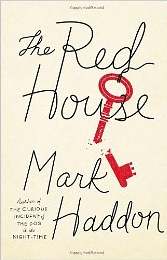
Cover for The Red HouseI really enjoyed Mark Haddon’s The Curious Incident of the Dog in the Night-Time, so I was looking forward to reading The Red House. Curious Incident employs unusual narrative techniques, such as including math games, to try to re-create the thought processes of an autistic teen. The Red House also plays with narration, only not as effectively.

After being estranged for years, siblings Angela and Richard have met again at their mother’s funeral. In an impulsive attempt to restore ties with his sister, Richard rents a holiday house in Herefordshire and invites the other family to join his for a week. Richard’s family consists of his second wife Louise and her teenage daughter Melissa. Accompanying Angela are her husband Dominic and their children Benjy, Alex, and Daisy.

Each of the characters is dealing with issues. Angela had a miscarriage 18 years ago, and she has dwelled on this lost child ever since, naming her Karen and neglecting her teenage daughter Daisy as a result of this obsession. Dominic is having an affair. Daisy has become very religious and fights with Angela about it. Teenage Alex is yearning to have sex with Melissa. Richard is dreading a possible lawsuit from a patient. Louise barely knows the other family and is having problems with Richard. Melissa is awaiting the time when her parents learn that bullying by her group of friends has caused another girl to attempt suicide. Only young Benjy does not seem to have some sort of obsession.

The book jumps among the narrations of all eight characters. The voices are not always so distinct that you can immediately tell them apart. The one that is distinct is expressed as disjointed lists of things, but it is difficult to attach to anyone. For awhile I thought it might be that of the dead daughter and later I thought it may be Angela having a nervous breakdown. Most often, to figure out who the narrator was, I had to relate the narration to something that was already going on. One technique Haddon uses is to interject part of what each person is reading, which at first helps you know which person it is, but after awhile becomes tedious.

Virtually plotless, this dour novel consists of the characters struggling with their own thoughts and with each other. Generally, I disliked most of the characters and thought the novel was a frustrating reading experience.

Day 182: Chocolat

Cover for ChocolatI decided to review Chocolat today because I just started reading The Girl with No Shadow, Joanne Harris’s sequel. Even though I have always enjoyed reading Harris’s books, I didn’t read Chocolat until long after seeing the movie, perhaps because I saw it first. The movie is pleasant enough but anemic and inexplicable, and as I found later, does nothing to convey the magic of the novel.

Vianne Rocher and her six-year-old daughter Anouk blow into the small village of Lansquenet-sous-Tannes with the wind. They are distinctly odd. Vianne wears red skirts with bells on them, and Anouk has an imaginary friend, a rabbit named Pantoufle, that some folks occasionally think they’ve glimpsed.

Vianne opens a chocolate shop, making her own wonderful confections. She seems to have an almost sixth sense about which chocolate will be each person’s favorite, and she creates miraculously inventive window displays for special days. She also begins befriending some of the village’s misfits.

This all sounds very pleasant, but Pére Reynaud, the local priest, hates Vianne on sight. She has opened a chocolate shop during Lent! Right across the street from the church! He begins a campaign to try to force her out of town. When Vianne plans a chocolate festival to celebrate Easter, he believes she is being sacrilegious and vows to ruin the festival.

Vianne herself has lived like a vagabond her entire life and wants to settle down. Her witch mother died on the streets of New York, and she wants her child to have a better life than hers has been.

The novel is colorful and teems with eccentric characters, as well as lovely descriptions of food. It is beautifully written. As I read it, I was able to understand why the book is so beloved.

Day 179: Shadow Tag

Cover for Shadow TagWhen Irene America takes out her diary one day, she realizes that her husband Gil has been reading it. She is outraged, so she starts another diary, a true one, which she keeps in a safe deposit box at the bank. In her original diary, she begins inserting falsehoods to torment Gil. The disintegration of their marriage is the plot of the disturbing Shadow Tag by Louise Erdrich.

Irene wants to leave Gil. He is manipulative and abusive to her and their three children. His moods are mercurial–even the dogs are wary of him. He is obsessively jealous, to the point of resenting the attention Irene gives their children.

Irene is not perfect either. She drinks too much and resorts to subterfuge and manipulation. She is alternately endeared and repelled by Gil’s attempts to win her back.

Gil is a successful Native American artist who has painted only Irene for years, but now she finds his depictions of her degrading. Still, she doesn’t have the courage to leave him, which will have fateful results. The tension in the novel builds to a surprising and tragic finish.

A detached omniscient narrator alternates telling the story with the two diaries written by Irene. You do not find out who the omniscient narrator is until the last chapter.

I can’t help but wonder how much of this psychological novel is a fictionalized account of Erdrich’s marriage to Michael Dorris. I see now that a review in the Washington Post agrees. If so, it is a masterly and brave work of self-exposure that faithfully shows the unpredictability of marital relationships. It is extremely well written and very sad. If you require likeable characters in your fiction, you won’t find them here, however.

Day 172: The Weird Sisters

Cover for The Weird SistersRose, Bianca, and Cordelia Andreas are the daughters of a Shakespeare scholar who is obsessed with the Bard. From their earliest days they were taught to quote from Shakespeare plays, enact scenes, and use Elizabethan curses. Of course, they are named for characters from the plays. Their father’s way of communicating with them when they are away is to send them clippings from the Riverside Shakespeare. This is the setup for The Weird Sisters by Eleanor Brown. You might think such a gimmick would become tiresome, but it does not.

The three sisters have traits in common with their characters. Rose, like Rosalind, is smart and dutiful. Bianca is a flirtacious beauty. Cordelia is the much-loved youngest daughter. They are also a bit estranged from each other. Rose resents that she always has to be the responsible one, but Bean and Cordy think she takes too much upon herself. Both Rose and Bean are jealous of the unconditional love that Cordy receives from their parents. And Rose and Cordy think Bean has too great a need for attention, one that leads her to seduce men indiscriminantly.

When they receive a summons from their father because their mother has cancer (it says “Come, let us go; and pray to all the gods/For our beloved mother in her pains”), the lives of all the women are in disarray. Rose’s fiancé is about to leave for a  job in England, and he wants her to join him. She believes she is too urgently needed at home, where she is the organizer. Bean (Bianca) has been fired from her job in New York for embezzling the money she needs to perpetuate her lifestyle. Cordy has been living from man to man like a vagabond when she finds she is pregnant.

They all return to their crazy, poorly run childhood home, where piles of books are everywhere and all members of the family are perpetually reading but not, perhaps, cleaning. Slowly, the small town in Ohio that Cordy and Bean have been running away from begins to seem not so bad.

The Weird Sisters is an amusing, touching novel about how each of the women finds her path and reconciles with her sisters. It is extremely well written, and oddly enough, you do not tire of its devices.

Day 169: The Distant Hours

Cover for The Distant HoursKate Morton has been one my favorite authors ever since I read The Forgotten Garden, which is still my favorite of her books. The Distant Hours is another of Morton’s atmospheric novels about family secrets.

When a letter posted in 1941 finally reaches its destination in 1992, Edie Burchill is surprised at the emotional reaction of her usually cool mother. She finds out for the first time that her mother was an evacuee during World War II at the home of Raymond Blythe, the author of Edie’s favorite childhood book, The True History of the Mud Man.

Later, after Edie has been asked to write an introduction for a reprint of Blythe’s classic, she gets lost meeting a potential author and accidentally finds Milderhurst Castle, the once stately but now crumbling home of the Blythes. Living there are the Blythe sisters, Percy, Saffy, and the invalid Juniper. In a way, too, the house is still occupied by the memory of their overbearing father.

The novel alternates between the present time and 1941, as we discover what happened during one night in 1941 that has haunted the family ever since. Morton is deft at creating a compelling atmosphere in the moldering castle and in keeping her readers in suspense.

Morton’s latest book, The Secret Keeper, is due out in October. I can’t wait to get my copy!

Day 163: Ghostwritten

Cover for GhostwrittenBest Book of the Week!

Ghostwritten, one of David Mitchell’s earlier books, is about the nature of fate and the strange interconnections between people and events in the modern world. In this unusual novel, Mitchell illustrates his points through the narrations of nine different characters, who at first seem only vaguely connected.

The novel begins with the crazed Quasar, a member of a religious cult who has fled to Okinawa after placing poisonous bombs in the Tokyo subway. As his sect falls apart, he waits for word and instructions from his leader, His Serendipity.

In Tokyo, Satoru, a teenage employee of a record store, falls in love with a pretty customer. In Hong King, Neal Brose, a financier who has conducted some shady business with a mysterious Russian, is letting his life fall apart after his wife leaves him.

In China, an old lady lives through the various upheavals of the 20th century while she tries to keep her tea shop on a sacred mountain from being destroyed, again. In Mongolia, an entity that can move from one human being to another tries to find out what it is and where it came from.

In Russia, Margarita Latumsky, a woman who has made her way in life by seducing powerful men and has landed a job at the Hermitage, is plotting with her gangster boyfriend to steal a Delacroix. In London, Marco Chance is a drummer, ghostwriter, and womanizer whose day isn’t going very well.

Mo Muntervary is a world-famous physicist who returns home to a remote Irish island after fleeing from the CIA for several months. Her decision to stop running has fateful results. Finally, Bat Segundo is a late-night DJ in New York who begins getting annual phone calls from the mysterious Zookeeper.

As these characters pursue their own activities and thoughts in a way that seems completely organic to their natures, Mitchell slowly and skillfully weaves their stories into a dystopian nightmare that works in actual events from the late 1990’s, when the book was written.

I am continually amazed by Mitchell’s imagination and intellect and his ability to write novels that are completely engrossing. Although not every technique he uses is completely successful–for example, there are real and metaphorical ghosts in the novel (in addition to the entity, whatever it is)–his approaches are all still interesting. Ghostwritten reminds me a bit of one of his later books, Cloud Atlas, which I admire very much.

Day 159: The Art of Fielding

Cover for The Art of FieldingI’m not a sports fan, and I don’t really understand why some people view baseball skills as art. This next statement may be heresy to some people, but I also did not enjoy reading Moby Dick. What do these two things have in common? The Art of Fielding, a contemporary literary novel by Chad Harbach. The book would seem to not be a good fit for me. Nevertheless, I was curious about where the plot was leading. I found the book very readable, littered with Melville references though it may be.

The Art of Fielding follows the course of a few important characters. Henry Skrimshander just wants to play baseball but has no particular ambitions until he is spotted in a game by Mike Schwartz, the team captain for the Harpooners baseball team from Westish College in Wisconsin, on the shores of Lake Michigan. Mike recruits him and devotes himself to training Henry to be a great shortstop, to the neglect of his own academic career. Soon, Henry is on the way to breaking a record for no errors held by his hero, Aparicio Rodriguez, the author of The Art of Fielding, a zenlike opus on baseball that Henry has carefully studied.

Henry’s college roommate is Owen Dunne, a brilliant student and baseball player who is also gay. He becomes involved in an affair that will have far-reaching consequences.

The college president Guert Affenlight is happy because his daughter Pella has left her husband and returned home. Affenlight is a Melville scholar, and Westish College adopted a Herman Melville motif at his suggestion because Melville made a lecture stop at the college long ago.

Pella, a difficult and rebellious woman, abandoned a promising college career to drop out of the last few months of high school and run off with an architect she met at a lecture. Guert and Pella have been estranged ever since. Both of them want to make amends but are not quite sure how.

Everything seems to be working out for everyone until Henry makes his first error in years, a disastrous throw. The characters are forced to reassess their own views of their lives.

Harbach is a careful writer who occasionally uses brilliant imagery. At heart, though, the novel is rather slight and shallow. It was 2011’s Big Book and critics raved about it, but those giving it a second look seem to be a little more critical. I enjoyed The Art of Fielding, but my enjoyment was mild.

Day 157: Empire Falls

Cover for Empire FallsBest Book of the Week!

I’ve been picking up Richard Russo novels at the bookstore for years and putting them back down because I wasn’t sure I’d like the subject matter, but now that I’ve read Empire Falls, I wish I’d been reading them all along.

Miles Roby’s life hasn’t been going too well. He quit college to run a diner in his dying home town in Maine when his mother was ill, and 20 years later he’s still flipping burgers. His wife Janine has left him for her dim-witted personal trainer. He has been in love with one of his waitresses, Charlene, since high school but sees no sign that she returns his feelings. He has an uneasy relationship with the owner of the diner, Mrs. Whiting. The only thing that seems right in his life is his teenage daughter Tick, and she is having problems at school.

Miles’s father is an alcoholic ne’er-do-well who was hardly ever around when he was a child. He comes around when he wants to earn a few dollars or hit up Miles for money. The mill has been shut down for years, and most of the townspeople don’t feel like they have much of a future.

Miles’s brother David is recovering from a drug habit, but his cooking and new ideas have recently been responsible for an increase in the diner’s business, and he wants Miles to move the business to a larger restaurant. Miles has been avoiding a decision. He has only been hanging on because he doesn’t know what else to do and because Mrs. Whiting long ago promised to leave him the diner in her will. She owns most of the town and behaves as if she owns him, too.

Miles doesn’t realize it, but his fortunes have been stymied for years because of events in the past. His only clue to these events is his recollection of a summer spent with his mother on Martha’s Vineyard when he was a small boy.

A pleasure of this book is its myriad of small-town characters and the warm, witty way that Russo depicts them. Russo is skilled at involving you in the fortunes of Miles, his friends, his family, and even his town. This novel is delightful.