Day 73: A Thousand Splendid Suns

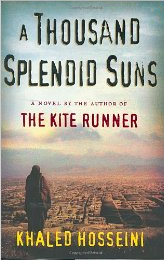
Cover for a Thousand Splendid SunsBest Book of Week 15!

A Thousand Splendid Suns is Khaled Hosseini’s second novel, about the love between two women set in the backdrop of the wars in Afghanistan. The novel begins in a time of peace with the story of the older woman, Mariam, who as a young illegitimate daughter of a wealthy man hero-worships her father and does not believe her mother’s warnings about him. When she is fifteen, she finds out the kind of man he is through a series of horrible events, beginning when she goes to the house of his legitimate family to ask him to take her to the movies. Her mother dies, and within days, her father’s legitimate family marries her off far away in Kabul to a much older man, Rasheed. Rasheed is kind to her at first, but when she cannot bring a child to term, he becomes abusive.

A neighbor of Rasheed and Mariam, Laila is 20 years younger than Mariam. She has been brought up and educated by her loving parents to be brave. She has always been in love with her childhood friend Tajik and they expect to marry, but Tajik’s family leaves the country during the war because of his father’s illness. Just as Laila’s parents are preparing to leave as well, they are killed. Rasheed, now in his 60’s, takes in Laila purportedly as an act of kindness and tricks her into marrying him.

Initially distrustful of each other, the two women soon each becomes the only person the other can trust as they lose all their rights under the government of the Taliban. Trapped in an abusive marriage, they must work together to survive.

Hosseini’s story-telling is absolutely compelling. The women’s existence is harsh, and he tells their story with compassion. The ending will leave you in tears.

Day 68: The Lace Reader

Cover for The Lace ReaderFrom the very beginning of The Lace Reader, the main character tells us she is a liar. The first time I read this book, I paid attention to that comment, but I could not detect any lies and eventually I forgot about that statement. As it turns out, Towner is not really lying, but Brunonia Barry’s novel is an outstanding example of the use of an unreliable narrator, and a haunting story.

Towner Whitney has not been home to Salem, Massachusetts, for 17 years, ever since her twin sister Lyndley committed suicide and she herself had a breakdown and was institutionalized. Now her brother calls asking her to return home because her great-aunt Eva has disappeared.

Towner’s female relatives are all unusual. She comes from a family of lace readers–people who can read the future in a piece of lace–and although she refuses to read, she is clairvoyant and can read people’s minds. These abilities, which she rejects, make her feel unstable, especially since she has gaps in her memory from electro-shock therapy. Towner’s mother May never leaves the island where she harbors abused women and teaches them how to make lace, and her aunt Emma has brain damage from a history of abuse by her husband Cal.

In Salem again, Towner waits for news of Eva. She learns that one of the police officers, Rafferty, is sure that Cal had something to do with Eva’s disappearance as he has been threatening her and other members of her family.

Salem itself is almost a character with its witch-based tourist industry, and now Cal has formed a group of religious cultists who call themselves Calvinists and who taunt the witches and threaten them with damnation. It’s a bad place for Towner to be, and she is just deciding to leave again when Eva’s body turns up.

The Lace Reader is a wonderful book, layered with secrets, an exploration in the difference between perception and reality. With an atmospheric setting, characters to care about, and a compelling plot, the book is a real page-turner. The last few paragraphs made me re-evaluate everything I had read.

Day 59: The Tiger’s Wife

Cover for The Tiger's WifeIn The Tiger’s Wife, Téa Obreht has written an involving novel about the power of myth, memory, and story-telling. In the aftermath of the Balkan war, Natalia Stefanovic travels to the “other side” to help vaccinate children. While she is there, her grandmother calls to tell her that her beloved grandfather has died after telling his family he is going to visit her. When she learns his belongings were left in the clinic of a nearby village, she goes to fetch them, particularly his copy of The Jungle Book, which he has carried since he was a boy.

In remembering her grandfather, Natalia relates two stories that she says contain everything necessary to understand his life, one that he told her and one that he didn’t, that she learned about by traveling to the village where he grew up. The story he told her is about the deathless man, a man he has met time after time who claims he cannot die. The other story is about the tiger’s wife, an abused woman who befriends a tiger that escaped from the zoo during World War II, when Natalia’s grandfather was a boy.

Although I sometimes am unable to suspend my disbelief for magical realism, that is, the technique of mixing realistic story-telling with the magical or supernatural, Obreht skirts it without falling into it. Her book is a meditation on life and death, told in an almost  a dreamy way but also in a style reminiscent of a folk tale or myth. The book is also about how people deal with the past by transforming history into myth. The realistic story is interleaved with the two tales.

Although one of the themes is the separation between the groups of people in the Balkans, it is also about their similarities. In a village where Natalia has gone to give vaccinations, she encounters the same types of stories and superstitious beliefs as reflected in her grandfather’s stories about his youth and her grandmother’s injunctions about how to treat her grandfather’s death and possessions.

The book is stunning–a meditation and tribute to the author’s own grandfather, who died before she wrote it, and memories of the country in which she was born.

Day 49: The Other Family

Cover for The Other FamilyI have enjoyed reading Joanna Trollope’s books about contemporary life for years. In The Other Family, she explores the effects upon two families of a man’s death.

At the death of Richie Rossiter, a musician who used to be famous, his partner Chrissie is horrified to find that he has left his piano and a substantial part of his assets to his first family–Margaret, his first wife, and his son Scott.

The book follows the reactions of both families. This disposition awakens in Chrissie a sense of further insecurity, one that has always existed, since he refused a divorce and never married her. In fact, although she wears a wedding ring, it is one she bought herself. She is hostile toward Margaret and Scott and doesn’t even want them to attend the funeral. She has also been left to pay taxes that she would not otherwise have been liable for, so her family will have to make do with less money.

Margaret, on the other hand, feels better in realizing that she has not been forgotten. She has continued to live close to the humble roots that she and Richie rose from, and has founded an established business. She is a more mature woman than Chrissie, and she has been ambitious and successful, but feels she needs a change in her life.

Two of Chrissie’s daughters are not well-developed characters, but Amy, Chrissie’s youngest daughter, becomes fascinated by her half-brother Scott and tentatively reaches out to him.

As always, Trollope does a good job of portraying the complexities and messy relationships of modern life.

Day 31: Look at Me

Cover for Look at MeIn Look at Me, Jennifer Egan explores the meaning of identity in the modern world, where new identities can easily be created with a few clicks of a mouse. This academic beginning to my review should not dissuade you from reading this absorbing book.

Charlotte Swenson is a fashion model just recovering from surgery after a horrific car accident that smashed every bone in her face. The accident happened near her home town of Rockport, Illinios, which she has not visited in years. She is vague about what happened and what she was doing there: it is hard to tell at the beginning whether she can’t remember or doesn’t want to tell. When she returns to her home in New York, she finds that not even her closest friends recognize her new face. She has become invisible.

Before she leaves for New York, Charlotte meets Charlotte Hauser, the plain sixteen-year-old daughter of her best friend from high school, whom Charlotte has also not seen in years. The younger Charlotte has met a man on a river bank who looks like he has been in an accident.

In New York Charlotte Swenson is futilely trying to resurrect her career when she hears from a private detective who is looking for a mysterious man she met a few times named Z.

In the meantime, Charlotte Hauser has begun studying with her uncle Moose, whose life was changed when he had a revelation about light and history as a young man. Moose has been trying to find a student who can take up his ideas and thinks that Charlotte may be that person. He has struggled with mental problems and was forced to leave a prestigious job in academia to teach part time at a local community college.

Because she made a “timing error” in her first sexual explorations, Charlotte has been ostracized from her high school crowd and has decided to change schools to the rougher one across the river. She is also having an affair with the man she met along the river bank.

Charlotte Swenson has always looked for a way into the “mirrored room” of fame and fortune. Now, without her famous face, she is depressed and struggling to pay the rent until an internet intrepreneur comes to her with a tempting proposal.

Egan skillfully weaves these characters’ stories into an engrossing, thought-provoking novel. Some critics felt the novel suffered from the focus on the empty life of the glitterati that fascinates Charlotte, and truthfully, sometimes you sincerely dislike her. But you also like her pluck and self-truthfulness, and the focus is necessary to the novel’s themes.

Day 27: Major Pettigrew’s Last Stand

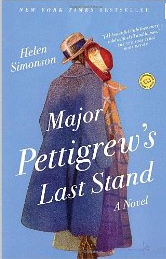
Cover for Major Pettigrew's Last StandBest Book of Week 6!

A touching love story, Major Pettigrew’s Last Stand is also a wry and witty jibe at small village life in England. Major Pettigrew is a proper widower who leads a life of quiet and habit, comfortable in his village and local golf club. Still suffering from the loss of his wife, he has just learned about his brother’s death and he is so shaken by this that he has a dizzy spell. Mrs. Ali, the widow of a Pakistani grocery store owner, has come to his house collecting for charity and helps him recover. The two begin a friendship based around discussions of books.

Besides missing his brother and wife, Major Pettigrew has other worries. He is concerned about his son, who seems only interested in money and prestige, and at times lacks gentility and honor, for which Major Pettigrew cares deeply. He is also concerned about his brother’s greedy wife and daughter, who do not seem likely to honor his father’s request that two valuable heirloom shotguns given to each of the sons be reunited when one of them dies.

Mrs. Ali is having her own battle with relatives. Her husband’s family wants her to give over her store to her religious fundamentalist nephew while she takes her expected widow’s place as a family servant.

Major Pettigrew must navigate the murky waters of village and family disapproval of his relationship because of racism and class snobbery and decide how much he wants to keep his quiet life. Mrs. Ali must in turn decide how much duty she owes to her family.

This novel is charming and delightful, one of my favorite books of 2011. Major Pettigrew’s dry and clever comments amused me throughout. The novel is beautifully written. I have been eagerly waiting to see what Ms. Simonson does next.

Day 24: Great House

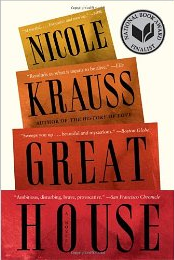
The tale this collection tells is so complex that my book club members asked me to send them an email explaining the sequence of events, once I had figured it out. Great House by Nicole Krauss is written as a series of interleaved stories without regard to sequence, almost as if she wrote the stories in order as a novel and then cut it up into pieces and rearranged it. The effect is interesting, but it is difficult for readers to understand where they are in time as they go from one story to another.

A labyrinthine tangle of people’s stories is written around the migration of a desk from one person to another. Nadia, a writer, tells the story of how she accepted the loan of furniture from Daniel, a Chilean poet, who was soon after murdered by Pinochet’s regime. Years later, a woman comes to her claiming to be Daniel’s daughter and asking for the desk, so Nadia gives it to her.

Arthur, the husband of Lotte, the writer who gave Daniel the desk, finds a secret while he is going through his dying wife’s things. This secret may be the clue to where Lotte got the desk.

Nadia goes looking for the desk to ask for it back because she finds she cannot write without it. She eventually finds herself in Israel. Other characters encounter the desk, are affected by the search, or meet Nadia or each other. We find out that the woman who claimed the desk was not the daughter of Daniel after all, but the daughter of someone who has an even better claim to it, as his family lost it in the holocaust.

Most of the members of my book club were perplexed, and many of them did not like any of the characters. I had a more neutral reaction. The desk eventually comes to represent all of the things that were lost in the holocaust. The stories as a whole are demanding and interesting, and Krauss purposefully leaves you with unanswered questions.

Day Nineteen: Cutting For Stone

Cover for Cutting for StoneCutting For Stone by Abraham Verghese is one of those books that you read more slowly as you approach the end, because you don’t want it to stop. My first impression of it was not positive, because I found the prologue pretentious, but as soon as I started reading the story, I was hooked. Don’t be put off by my description of the unusual plot.

Marion Stone is an identical twin. He and his brother Shiva are the sons of a nun from Kerala, India–Sister Mary Joseph Praise, who dies giving birth in the hospital in Addis Ababa where she works. Dr. Thomas Stone, their father, is so distraught by her death that he runs off, never to return.

Marion and Shiva are so close that they call themselves ShivaMarion. The boys are raised by Hema and Ghosh, two married Indian doctors at the hospital. Hema and Ghosh are delightful characters, and the story of their romance is charming.

The children are raised at the mission that runs the hospital during Emperor Haile Selaisse’s reign. The novel is about their upbringing in this colorful, tempestuous setting. The story of Marion’s life, his relationship with his brother, his love for a rebellious woman, and his search for his father is beautifully told. The novel is sweeping, in both time and place, beginning in India, moving to Ethiopia, and finishing in an inner-city hospital in New York City over a series of decades.

A doctor and author of some nonfiction books, Verghese has been criticized for the amount of medical detail in this book, but I found that fascinating as well. The characters are lifelike and interesting, the scope of the novel impressive, and the story drives you along.

Day Twelve: A Heartbreaking Work of Staggering Genius

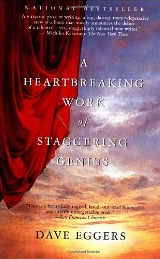
Cover for A Heartbreaking Work of Staggering GeniusBefore I start this review, I have to apologize for the untimely posts this week. I’ve told several people that I would try to post a review every weekday during my lunch, but lately we’ve been having a lot of Internet outages. So, I’m posting when I can.

A Heartbreaking Work of Staggering Genius is based upon true events of Dave Eggers’s life. When he was 22 years old, his mother and father died within months of each other, leaving his family to split up and himself in charge of his eight-year-old brother, Toph. They live in bachelor squalor while Eggers obsesses. Eventually, they move to San Francisco, where he becomes a founder of Might Magazine.

I didn’t read this book for a long time because I was put off by its title, but it received so many good reviews that I finally picked it up from curiosity. I have to preface my remarks by saying that I have lately gotten some clues that I don’t understand modern humor (i.e., I am officially a geezer), especially when I’ve tried to watch movies that are dubbed “hilarious.”

Readers might get a clue about how this book is going to proceed from its set of “Rules and Suggestions for the Enjoyment of this Book.” One of them is to skip the middle of the book. Good suggestion.

I found the first 100 pages or so about his parents’ deaths and his subsequent struggles affecting and absorbing. However, this is one of the few books that I just couldn’t finish. I found it so juvenile and smug that it was absolutely grating, but that’s not why I stopped. When Eggers abandons his straight narrative, he begins musing, and his prose devolves into unbelievably long, rambling paragraphs. His approach has been deemed “inventive” and even “the memoir as metafiction” (yikes!). I was actually only 30 pages from the end of the book when he started another of his lengthy asides, and I just couldn’t take it anymore. I gave up.

Day Eight: The Virgin Suicides

Cover for The Virgin SuicidesI haven’t read this book in a year, but my brother asked me to review it. So, excuse me if I get the chronology mixed up or something. The book is told mostly in flashbacks, and it’s hard for me to remember what happens first.

The Virgin Suicides by Jeffrey Eugenides is one of those incredible books that make you wonder how they could be someone’s first novel. I was turned off by the title and subject matter of the book so I didn’t read it at first. But I caught the movie one night on TV and was mesmerized by it, so I decided to read the book.

The Virgin Suicides is written from the point of view of a group of boys growing up in the 70s in Grand Blanc, Michigan, a wealthy suburb of Detroit. The boys are fascinated by the five beautiful Lisbon sisters and their family life. Although they all go to the same school, the girls are kept isolated from other teenagers by their mother’s strictness. Their father is an easy-going science teacher at their school.

The boys begin by spying on the girls, then collecting souvenirs of the girls’ lives, which they go over incessantly, trying to understand them. In an experiment of leniency, Mrs. Lisbon allows the sisters to have a few classmates over to the house, including the boys, but the deadly dull party ends disastrously with the suicide of the youngest girl.

As the boys begin to connect more directly with the girls and the family alternates between trying to be more normal and totally isolating the girls, the family becomes more unhinged.

The book is sometimes lyrical, sometimes sophomoric sounding, sometimes witty, and savagely ironic, painting a vivid picture of the time and place. The disintegration of urban Detroit and its surrounding areas, symbolized by the neighborhood losing all its trees to the Dutch Elm disease, parallels the disintegration of the Lisbon family.