Day Nineteen: Cutting For Stone

Cover for Cutting for StoneCutting For Stone by Abraham Verghese is one of those books that you read more slowly as you approach the end, because you don’t want it to stop. My first impression of it was not positive, because I found the prologue pretentious, but as soon as I started reading the story, I was hooked. Don’t be put off by my description of the unusual plot.

Marion Stone is an identical twin. He and his brother Shiva are the sons of a nun from Kerala, India–Sister Mary Joseph Praise, who dies giving birth in the hospital in Addis Ababa where she works. Dr. Thomas Stone, their father, is so distraught by her death that he runs off, never to return.

Marion and Shiva are so close that they call themselves ShivaMarion. The boys are raised by Hema and Ghosh, two married Indian doctors at the hospital. Hema and Ghosh are delightful characters, and the story of their romance is charming.

The children are raised at the mission that runs the hospital during Emperor Haile Selaisse’s reign. The novel is about their upbringing in this colorful, tempestuous setting. The story of Marion’s life, his relationship with his brother, his love for a rebellious woman, and his search for his father is beautifully told. The novel is sweeping, in both time and place, beginning in India, moving to Ethiopia, and finishing in an inner-city hospital in New York City over a series of decades.

A doctor and author of some nonfiction books, Verghese has been criticized for the amount of medical detail in this book, but I found that fascinating as well. The characters are lifelike and interesting, the scope of the novel impressive, and the story drives you along.

Day Twelve: A Heartbreaking Work of Staggering Genius

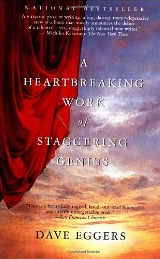
Cover for A Heartbreaking Work of Staggering GeniusBefore I start this review, I have to apologize for the untimely posts this week. I’ve told several people that I would try to post a review every weekday during my lunch, but lately we’ve been having a lot of Internet outages. So, I’m posting when I can.

A Heartbreaking Work of Staggering Genius is based upon true events of Dave Eggers’s life. When he was 22 years old, his mother and father died within months of each other, leaving his family to split up and himself in charge of his eight-year-old brother, Toph. They live in bachelor squalor while Eggers obsesses. Eventually, they move to San Francisco, where he becomes a founder of Might Magazine.

I didn’t read this book for a long time because I was put off by its title, but it received so many good reviews that I finally picked it up from curiosity. I have to preface my remarks by saying that I have lately gotten some clues that I don’t understand modern humor (i.e., I am officially a geezer), especially when I’ve tried to watch movies that are dubbed “hilarious.”

Readers might get a clue about how this book is going to proceed from its set of “Rules and Suggestions for the Enjoyment of this Book.” One of them is to skip the middle of the book. Good suggestion.

I found the first 100 pages or so about his parents’ deaths and his subsequent struggles affecting and absorbing. However, this is one of the few books that I just couldn’t finish. I found it so juvenile and smug that it was absolutely grating, but that’s not why I stopped. When Eggers abandons his straight narrative, he begins musing, and his prose devolves into unbelievably long, rambling paragraphs. His approach has been deemed “inventive” and even “the memoir as metafiction” (yikes!). I was actually only 30 pages from the end of the book when he started another of his lengthy asides, and I just couldn’t take it anymore. I gave up.

Day Eight: The Virgin Suicides

Cover for The Virgin SuicidesI haven’t read this book in a year, but my brother asked me to review it. So, excuse me if I get the chronology mixed up or something. The book is told mostly in flashbacks, and it’s hard for me to remember what happens first.

The Virgin Suicides by Jeffrey Eugenides is one of those incredible books that make you wonder how they could be someone’s first novel. I was turned off by the title and subject matter of the book so I didn’t read it at first. But I caught the movie one night on TV and was mesmerized by it, so I decided to read the book.

The Virgin Suicides is written from the point of view of a group of boys growing up in the 70s in Grand Blanc, Michigan, a wealthy suburb of Detroit. The boys are fascinated by the five beautiful Lisbon sisters and their family life. Although they all go to the same school, the girls are kept isolated from other teenagers by their mother’s strictness. Their father is an easy-going science teacher at their school.

The boys begin by spying on the girls, then collecting souvenirs of the girls’ lives, which they go over incessantly, trying to understand them. In an experiment of leniency, Mrs. Lisbon allows the sisters to have a few classmates over to the house, including the boys, but the deadly dull party ends disastrously with the suicide of the youngest girl.

As the boys begin to connect more directly with the girls and the family alternates between trying to be more normal and totally isolating the girls, the family becomes more unhinged.

The book is sometimes lyrical, sometimes sophomoric sounding, sometimes witty, and savagely ironic, painting a vivid picture of the time and place. The disintegration of urban Detroit and its surrounding areas, symbolized by the neighborhood losing all its trees to the Dutch Elm disease, parallels the disintegration of the Lisbon family.