Day 125: Arcadia

Cover for ArcadiaAfter reading Lauren Groff’s first book, The Monsters of Templeton, I was expecting something totally different, something perhaps more sinister. But Arcadia is a quiet and thoughtful novel. It is the story of Bit, the first child born in a group of a couple dozen hippies who are following a charismatic musician named Handy–essentially a bunch of groupies–during the 1970s. They are also idealists who want to create a utopian commune where they can support themselves entirely from their own efforts, living off the land. The book follows the rise and fall of the commune and its aftermath.

The first part of the book takes place when Bit is a young boy. The group has settled on a large estate in upstate New York to found their commune. Bit’s father Abe is a master carpenter and his mother Hannah is a baker and the group historian. We sense that Abe is the parent more fully invested in this way of life, as Hannah does not accept or observe all of the commune’s rules.

Hannah is a golden earth mother type who is active and ebullient in the summer but falls into severe depressions in the winter. One winter, Bit sets himself a test inspired by a fairy tale book he found in the ruins of the property’s mansion house by making himself a bargain to stop speaking until she comes out of her depression. Abe is absorbed with trying to organize the renovation of the house so that everyone will have a warm place to live, since for years they all have been living out of their cars and vans and homemade shacks.

In the second part, Bit is a teenager trying to cope with the disintegration of Arcadia, which is overcrowded with runaways, junkies, and other refugees from outside and having problems with the law. He is also in love with Helle, Handy’s disturbed but beautiful daughter.

The third part takes place a few years into a dystopian future. Everyone has left Arcadia. Bit is a photography professor living in New York City, a single parent mourning the departure of his wife. It is a time of social disintegration because of the forces brought about by climate change, especially a series of pandemics.

The novel is the work of a vivid imagination, as Groff is able to fully realize what it would be like to grow up completely cut off from the world, learning mores that are different from those of society, and how that would affect the rest of a person’s life. The novel’s biggest weakness is in having too many characters to get to know them well, especially in the middle section, where Bit’s teenage friends all sort of blur into each other. I found the tale interesting but at times slow moving, somewhat meditative, which I believe is intentional.

Day 121: Gone Girl

Cover for Gone GirlBest Book of the Week!

A lot of people are reading Gone Girl by Gillian Flynn, and no wonder! Usually, I would wait awhile to present another Flynn book after just having reviewed one last week, but I couldn’t wait to do this one! If you like dark, twisted plots, and great psychological thrillers with a smidgen of evil humor, this is the book for you.

Nick and Amy Dunne are having some marriage problems. When they met, they were both cool young Manhattanites. He was a magazine journalist and she a quiz writer and the model for a series of Amazing Amy children’s books written by her psychologist parents. Five years later, they have both lost their jobs and moved to a dying small town in Missouri to help his mother take care of his ailing father. With the rest of Amy’s money, Nick has bought a bar to keep himself and his twin sister Go busy. Their relationship has been deteriorating ever since.

On their fifth wedding anniversary, Amy disappears, leaving evidence of violence. Of course, Nick is the police’s prime suspect, and it doesn’t help that he hasn’t been altogether truthful with them. The public, galvanized by the Amazing Amy connection, almost immediately turns against him. The investigation turns up money problems and worse. Secrets are flushed out.

Most of the first part of the novel is narrated alternately by Nick and by diary entries written by Amy. Amy seems disingenuous and appealing, almost giddy, reminding me sometimes of Bridget Jones. Nick commits many lies of omission. Here’s a hint. Both Nick and Amy are liars.

Just when we think we know what’s next, the plot twists. The book is completely engrossing and very darkly funny, suspenseful and chilling. Think psychopath, but guessing who that person may be is just one of the book’s pleasures. In the reviews, I’ve seen several comparisons to Patricia Highsmith, and I think that’s about right.

Day 113: Extremely Loud and Incredibly Close

Cover for Extremely Loud and Incredibly CloseI’m probably the last person to read Jonathan Safran Foer’s Extremely Loud and Incredibly Close, which was enormously popular six years ago. I suspect I avoided it for awhile because of the subject matter, which is, of course, 9/11.

Oskar Schell is an extremely precocious nine-year-old boy who is grieving for his father, a casualty at the World Trade Center on 9/11.

Hidden away in a vase in his father’s closet, Oskar discovers a key with a label that says “Black.” Since his father was always leaving him puzzles, he believes that if he can find the person named Black who has the lock that goes with the key, he will get a message from his father. He especially needs this message because that day, his father called repeatedly from the World Trade Center but Oskar could not make himself pick up the phone. In search of this message, Oskar begins visiting everyone in New York whose last name is Black.

The story of his grandparents’ past is told in parallel in a series of notes and letters. His grandparents both lost their families in the bombing of Dresden (perhaps too neat a parallel). Later, they met in New York, but his grandfather, severely traumatized and unable to speak, deserted his grandmother when she became pregnant.

Although it has been criticized for triteness, I found Extremely Loud and Incredibly Close a touching and funny novel about loss and about the relationship between fathers and sons (but also implicitly about mothers and sons). It is told in the nontraditional narrative style that is becoming almost traditional–in first-person narration by Oskar, in letters and pictures, and even in pages of illegible typing.

Oskar is a frighteningly intelligent, creative, unusual, and quirky child, and the depiction of his character is my major criticism. To me, he seemed very similiar in tone and style, and in repetitions and oddness, to the autistic older boy in The Curious Incident of the Dog in the Night-Time by Mark Haddon. Other reviewers have mentioned Holden Caulfield. In fact, although you will like Oskar, you will also find him annoying at times and, I feel, unbelievably precocious for his age. He does not make a believable nine-year-old, no matter how intelligent.

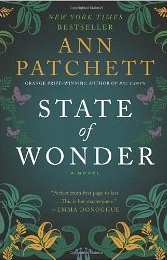
Day 109: State of Wonder

Cover for State of WonderBest Book of the Week!
Ann Patchett is another writer whose works are all different from each other. You never know what to expect, except that they will be compelling, imaginative, and beautifully written.

At the beginning of State of Wonder, Dr. Marina Singh’s coworker has died in the Amazon. Their employer, Vogel Pharmaceuticals, sent him out to determine the status of a project run by the reclusive Dr. Annick Swenson. Swenson has sent a brief message saying that Anders Eckman died of a fever.

Mr. Fox, the company’s CEO and Marina’s lover, asks Marina to go out to Manaus, locate Dr. Swenson’s encampment, and find out what happened to Eckman and what is going on with the drug. Dr. Swenson is working on a drug to help women conceive, based upon the startling late fertility of the women in a tribe of Amazonian Indians, and Vogel has given her an open check book. But she has written no reports, nor has she provided any information about how the project is coming along.

As Marina changed her career path years ago based upon a tragic incident while Dr. Swenson was her medical school professor, she is not at all convinced she is the right person for the job. To make things worse, the drug she is given for malaria in preparation for the trip awakens nightmares about her father that she had as a child.

In Manaus, the airport loses her luggage and she is left waiting, because no one knows where Dr. Swenson’s camp is. Finally, Dr. Swenson arrives and reluctantly takes her back into the Amazon to the encampment of scientists, all investigating their own projects. In a way, this journey into the heart of darkness is also a journey Marina takes to confront her own past.

It is difficult to describe why this is such a wonderful book without giving too much away. If you are expecting a travelogue of beautiful jungle sights, you’ll be disappointed. Manaus is an unpleasant city, although with a gorgeous opera house, and Patchett describes the Amazon as both beautiful and terrible at the same time.

The plot takes unexpected turns as Marina gets involved in life at the outpost and becomes attached to a young deaf boy. It’s a book that is written in exquisite prose, that is totally enthralling, that you do not want to put down.

Day 96: The Forgotten Garden

Cover for The Forgotten GardenKate Morton’s The Forgotten Garden was one of my big discoveries two years ago. I absolutely love this book.

A four-year-old girl walks off a ship in Australia in 1913 with a little white suitcase. No one meets her. She won’t say who she is or where she came from. The harbor master takes her home, calls her Nell, and adopts her, and she forgets her previous life. When she is 21 and on the verge of marriage, he tells her about it. This information is so shocking to Nell that she breaks with her fiancé and her family and isolates herself, feeling that she has been living a lie.

In 1975, Nell’s irresponsible daughter drops her own teenage daughter, Cassandra, at Nell’s house and drives away, never to return. Nell has other plans, but puts them aside to take care of her granddaughter.

In 2005, Cassandra is mourning Nell’s death. She has inherited Nell’s property but is only vaguely aware of her history. When she looks through Nell’s things, she finds a white suitcase with a book of fairy tales in it. She also finds that Nell never stopped looking for her real family. Continuing Nell’s search, Cassandra ends up in a small Cornish village where she learns she has inherited a small cottage on the Mountrachet estate.

Cassandra finds an entrance into a walled garden, and another one from there to the estate. Eventually, she also discovers the history of her grandmother’s parentage.

The book traces Nell’s history by alternating among these times. The modern story is one of investigating one’s roots, but the older tale is more gothic. Ultimately, it is the story of two cousins, the wealthy Rose Mountrachet and the slum-born Eliza Makepeace, who comes to live with her and be her companion.

A mystery about family secrets, the story is complex and enthralling. Some readers may be daunted by its length, but once you begin reading, you will not be able to stop.

Day 94: The Tricking of Freya

Cover for The Tricking of FreyaThe Tricking of Freya by Christina Sunley is a novel about discovering family secrets. Freya, granddaughter of a famous poet, is a young woman of Icelandic descent who was brought up in Connecticut. Her mother, a widow, keeps her apart from her grandmother and aunt until she is 7, when they visit the Icelandic community near Winnipeg called Gimli for the summer.

The adult Freya is scarred by three traumatic events when she was a child–one from that summer, when her mother is injured badly enough to affect the rest of her life, and another when she is 13. On that occasion, her fascinating Aunt Birdie, who is always talking about their Icelandic heritage and Norse mythology and getting her to memorize Icelandic sagas, takes her off to Iceland without her mother’s permission, and while Freya is alone with her, has a massive breakdown.

Finally, Birdie commits suicide on Freya’s 14th birthday. The timing makes Freya believe the suicide must be somehow her fault, so she blames herself for that and for her mother’s accident. Since then, she has lived a sort of subdued, underachieving life, keeping her distance from others.

This book is written in the form of letters to her cousin, for Freya sets off on a journey to Iceland after she overhears something that makes her think that Birdie had a child before she died. Her intention is to find her cousin.

An involving story, the book is full of details about Icelandic culture, history, and language, which add to its interest. Its slowly unfolding mystery keeps your attention.

Day 91: Mortal Love

Cover for Mortal LoveMortal Love is Elizabeth Hand’s extremely unusual and strange novel about artistic inspiration and its relationship to obsession. It is narrated in two parallel stories, one taking place in the present and the other in the Victorian age.

In the story from the past, an American painter named Radborne Comstock meets Evienne Upstone, a model who has inspired the work of members of the Pre-Raphaelites and who has supposedly driven one painter insane. He finds this woman irresistable but she may be insane herself. Evienne has a close associate, a maid, who has blue fingers. Comstock experiences weird hallucinations when he is near Evienne, but is not sure whether they are hallucinations or he is going insane.

In the present time Daniel Rowlands, an American writer visiting in London, meets Larkin Meade, who seems to be the same woman as Evienne Upstone. She becomes his lover and leaves him physically and emotionally deranged.

In the meantime, a young man, Comstock’s grandson, who has been raised by a man with blue fingers and has fought insanity all his life, has become obsessed with his grandfather’s paintings of Evienne and decides to visit London.

This book is a wild, fantastic tale linking Celtic folklore, the Pre-Raphaelite art movement, and ancient mythologies. It is at times bewildering but also makes compelling reading.

Day 76: When Rain Clouds Gather

Cover for When Rain Clouds GatherMakhaya, a refugee from South Africa, slips into Botswana at the beginning of When Rain Clouds Gather by Bessie Head. It is the mid-60’s, and Botswana is peacefully gaining its independence from Britain. It is a poor country with much unarable soil and primitive farming techniques.

Makhaya has some problems settling into the village of Gomena, not the least of which is that the corrupt local Chief Matenge will not allow him in the village. He gets a job with a white man named Gilbert Balfour helping teach the villagers new agricultural methods.

The book is sparsely written and very short. Its themes are the conflict between tribalism and the newer ways, about the political changes and changes in customs occurring in the 60’s in Africa.

I found the book interesting, especially the depiction of traditional customs, but I felt it required more knowledge of the situation in Botswana and South Africa in the 60’s than I had. More is implied than expressed, which is a part of its beauty but can also be frustrating. For example, Makhaya has just left prison in South Africa, but I guess we are supposed to know what he might have been in prison for. We believe it is for political reasons, but no details are provided.

Bessie Head herself was a refugee from South Africa who settled in Botswana. I’m sure the novel reflects both some of the problems she had in making a new life and the relief she felt in being able to settle into a relatively tranquil place.

Day 73: A Thousand Splendid Suns

Cover for a Thousand Splendid SunsBest Book of Week 15!

A Thousand Splendid Suns is Khaled Hosseini’s second novel, about the love between two women set in the backdrop of the wars in Afghanistan. The novel begins in a time of peace with the story of the older woman, Mariam, who as a young illegitimate daughter of a wealthy man hero-worships her father and does not believe her mother’s warnings about him. When she is fifteen, she finds out the kind of man he is through a series of horrible events, beginning when she goes to the house of his legitimate family to ask him to take her to the movies. Her mother dies, and within days, her father’s legitimate family marries her off far away in Kabul to a much older man, Rasheed. Rasheed is kind to her at first, but when she cannot bring a child to term, he becomes abusive.

A neighbor of Rasheed and Mariam, Laila is 20 years younger than Mariam. She has been brought up and educated by her loving parents to be brave. She has always been in love with her childhood friend Tajik and they expect to marry, but Tajik’s family leaves the country during the war because of his father’s illness. Just as Laila’s parents are preparing to leave as well, they are killed. Rasheed, now in his 60’s, takes in Laila purportedly as an act of kindness and tricks her into marrying him.

Initially distrustful of each other, the two women soon each becomes the only person the other can trust as they lose all their rights under the government of the Taliban. Trapped in an abusive marriage, they must work together to survive.

Hosseini’s story-telling is absolutely compelling. The women’s existence is harsh, and he tells their story with compassion. The ending will leave you in tears.

Day 68: The Lace Reader

Cover for The Lace ReaderFrom the very beginning of The Lace Reader, the main character tells us she is a liar. The first time I read this book, I paid attention to that comment, but I could not detect any lies and eventually I forgot about that statement. As it turns out, Towner is not really lying, but Brunonia Barry’s novel is an outstanding example of the use of an unreliable narrator, and a haunting story.

Towner Whitney has not been home to Salem, Massachusetts, for 17 years, ever since her twin sister Lyndley committed suicide and she herself had a breakdown and was institutionalized. Now her brother calls asking her to return home because her great-aunt Eva has disappeared.

Towner’s female relatives are all unusual. She comes from a family of lace readers–people who can read the future in a piece of lace–and although she refuses to read, she is clairvoyant and can read people’s minds. These abilities, which she rejects, make her feel unstable, especially since she has gaps in her memory from electro-shock therapy. Towner’s mother May never leaves the island where she harbors abused women and teaches them how to make lace, and her aunt Emma has brain damage from a history of abuse by her husband Cal.

In Salem again, Towner waits for news of Eva. She learns that one of the police officers, Rafferty, is sure that Cal had something to do with Eva’s disappearance as he has been threatening her and other members of her family.

Salem itself is almost a character with its witch-based tourist industry, and now Cal has formed a group of religious cultists who call themselves Calvinists and who taunt the witches and threaten them with damnation. It’s a bad place for Towner to be, and she is just deciding to leave again when Eva’s body turns up.

The Lace Reader is a wonderful book, layered with secrets, an exploration in the difference between perception and reality. With an atmospheric setting, characters to care about, and a compelling plot, the book is a real page-turner. The last few paragraphs made me re-evaluate everything I had read.