
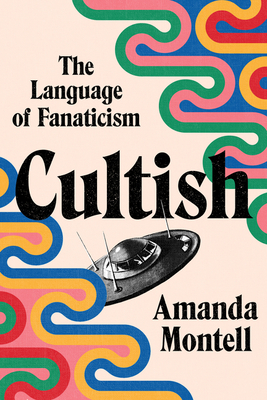
In February, I decided to take a break from trying to finish A Century of Books and revisit my intention to read more nonfiction books that I formed during Nonfiction November. I realized I hadn’t read any nonfiction at all in 2025, so I picked Cultish, which I read about last November.
Montell is a writer and language scholar, although, taking a note from her own approach, I wonder what “language scholar” means. This book is written for the general public and takes an entertaining rather than scholarly approach.
Although I noticed at the time I was reading that I was unable to summarize the topic of any chapter (each of which is unhelpfully named with something like “Repeat after me”), Montell makes clear what she means by a cult, broadens that definition to explore whether some organizations are cults or not (hence, “cultish”), and shows how true cults use language to attract and hold followers. She starts with some of the usual suspects, moves to the death cults, and then examines the cultish qualities of marketing companies like Amway and the niche health businesses like Peleton.
This is an interesting book, but it felt a little muddled to me, probably because I didn’t feel I could single out, except by the type of business or group, the central ideas of each section of the book.
Also, I saw some evidence of sloppiness. The first was simply a syntax issue. It says on page 28, “If you subscribe to an astrology app or have ever attended a music festival, odds are that in the 1970s, you’d have brushed up against a cult.” Now, what does that mean, given that there were no astrology apps in the 1970s? or any apps for that matter. I think she meant, “If you . . . app or attended a music festival in the 1970s, odds are . . . .” To make that sentence crystal clear, you’d start the pairing with the music festival.
That’s fairly minor (except that she’s a language scholar), but she twice brings up the Branch Davidian incident and both times slightly misrepresents what happened. I lived in Texas then and remember what happened, but just in case my memories were false, I looked it up. On pages 38 and 39, she says that the FBI showed up in response to concerns expressed by families of the members. I thought, what? The FBI would never show up en masse for a reason like that, and I remembered that it was actually the ATF who came first. They came based on reports from neighbors and a gun sales business that the Branch Davidians were stockpiling weapons. Of course, everyone was shocked by the incident, especially its outcome, but it is interesting that Montell left that out, because it minimizes the role of the Branch Davidians in how the incident started. And that is also an interesting use of language.



 What? Me Read?