
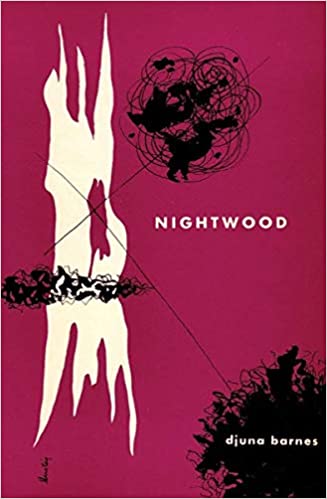
When I looked for books to read for the 1936 Club, I picked a couple of rereads, as I usually do, but also tried to find one I hadn’t read before. That novel was Nightwood, which I had heard of for years.
T. S. Eliot, who wrote the original Introduction and had a great deal to do with its publication, said that it would “appeal primarily to readers of poetry.” That comment struck dread into my heart, because I am not a big poetry reader. And indeed this is a difficult novel.
The plot is relatively slight. Felix, an Austrian Jew and pseudo-baron, marries Robin Vote because he wants a son to pass his heritage to. Robin is an enigma whom we only see through the eyes of those infatuated with her. She is boyish, and the Doctor, an intersex character who is also an enigma, implies that she is also intersex. Robin seems to view motherhood with horror, so she leaves Felix with his son and takes up with Nora, who is madly in love with her and spends most of her time dragging her, dead drunk, out of sleazy Parisian nightclubs. Then Robin dumps Nora for Jenny, a woman who always wants what other people have.
All the characters are distraught.
The novel is most known for its style and language. It is crammed with images and metaphor, but it is difficult to understand what the characters are talking about, especially the Doctor. I felt like I understood him less than half the time.
The novel seems filled with dread, as it might well in pre-World War II Europe, even though its characters’ preoccupations are not political. I found it disturbing, thought-provoking, and astonishing.
 What? Me Read?