Review 2207: Birnam Wood

Well, this is quite a novel. Unfortunately, I don’t know how to explain what it is like without giving too much away. But I’ll try. Let me say that I don’t know whether I liked it, but it certainly is effective.

First of all, you’re not going to find a character in this novel to outright like. Catton has fully realized her characters as flawed people, and she keeps turning back to them and showing another side. There is definitely a villain, though.

Mira is the founder of Birnam Wood, a gardening collective that plants vegetables in unused spaces. Mira is not picky about whether they do this with permission from owners or even steal water or tools to do their work. However, most of the members believe their activities are legal.

Shelley is Mira’s roommate and best friend but also the person in Birnam Wood who does most of the management and publicity work. She is tired of not being listened to or having her contributions unacknowledged.

Mira reads that a landslide near Korowai National Park has cut off one of the accesses to the park, leaving only one road to a nearby town. A prominent businessman, Owen Darvish, who has property in the area that he had been planning to subdivide, took the property off the market because after the landslide it will not sell. Mira decides that this large, unoccupied property in a remote area would be perfect for a major planting operation, so she drives there to check it out.

On the property, though, she is apprehended by Robert Lemoine, an American billionaire who has been in the news because of a deal with Darvish. Eventually, he explains that he is buying the property from Darvish and is interested in donating a large sum of money to Birnam Wood to help ramp up their organization.

Tony, a radical Birnam Wood member who has been away teaching in Mexico, comes back to a meeting. When Mira presents Robert Lemoine’s proposition, he is very much against it but is outvoted. He walks out but decides to go to the area, thinking an article on what Lemoine is doing there would help his attempts to become a journalist.

Lemoine has a secret agenda that none of these characters know about. The novel moves from seeming to be a combination of a study of characters and somewhat of a sendup to a plot full of suspense.
Related Posts

The Rehearsal

The Luminaries

The Bone People

Day 1137: The Rehearsal

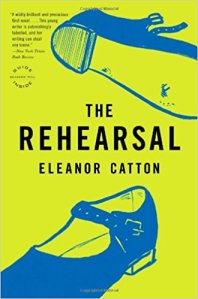
Cover for The RehearsalThe Luminaries was one of my favorite books several years ago, so when I ran across a copy of The Rehearsal at Powell’s a few months ago, I snapped it up. The Rehearsal is Eleanor Catton’s first novel.

The novel focuses obliquely on an affair between a high school student and her teacher. Although those two characters hardly appear in the novel, it is about how the discovery of the affair affects the girl’s younger sister, Isolde, and others in the all-girls’ school the two sisters attend.

At the nearby drama institute, the freshman students decide to design a play around the affair for their first-year project. This conceit and the nonlinear organization of this portion of the narrative have the effect of blurring reality, making it hard to tell which scenes are part of the novel’s “real life” and which are part of the play rehearsal. I had to admit to being confused about whole story lines.

There are clues. Characters sometimes break out into astounding monologues or remarks that people would not make in real life. The saxophone teacher, an unnamed character, is very important in the novel but often makes these kinds of remarks. I took this to mean that the teacher was often in the play—and in fact that is signaled at times by references to who is playing her or lighting changes and so on. Sometimes I wondered if in terms of this novel she was entirely fictional, that is, just a character in the play.

The afterward tells how Catton originally wrote a monologue for the saxophone teacher, using the position of her sax as body language. I did note as I read that the positioning of the sax seemed to be important, but either I have little visual imagination or this is something you have to see, because I could make nothing of it.

Dealing with themes like sexual identity, victim and perpetrator, and coming of age, the novel is brilliantly written and very inventive. But sometimes I felt as if it was not altogether successful, perhaps its originality being pushed too far and getting in the way of itself.

Related Posts

The Luminaries

The Virgin Suicides

A Visit from the Goon Squad

Day 463: The Luminaries

Cover for The LuminariesBest Book of the Week! Year!

This last year I read several books that played wonderfully with structure. I’m thinking particularly of A Visit from the Goon Squad, a series of stories linked by their characters that somehow forms a whole, and Life After Life, in which the heroine’s life is repeated, with slight changes that lead to significant ones. I loved both of these inventive approaches to structure, and now I add to this list The Luminaries, the latest winner of the Man Booker Prize. This book is also my second recently reviewed novel set in New Zealand.

Walter Moody is newly come to the gold fields of the South Island of New Zealand in 1866. He has arrived in rough seas and is shaken by an apparition he has seen in the bowels of the ship. Seeking warmth and comfort, he checks into a seedy waterfront hotel and enters the parlor, where he accidentally interrupts the meeting of 12 other men.

After some initial hesitancy, the men begin telling him a series of tales, all interconnected, but the whole of which they cannot make out. The tales concern a missing trunk, a fortune found in a dead man’s cabin, the disappearance of a prominent citizen, the apparent attempted suicide of a whore. Each man at the meeting has his own part of the story to impart. Moody is able to make some sense of the story, but all go away from the meeting knowing that pieces are missing.

This section of the book is the longest, making up almost half its length. The cover of the novel, showing a waning moon, gives you a hint to its structure. It is divided into 12 sections, each one shorter than the one before but each one adding to the revelations of the original tales, until the final very short slivers of sections reveal all.

Each of these sections is also headed with an astrological chart that shows how the heavenly bodies are positioned within the signs of the 12 initial characters. This I did not understand at all, but Catton provides some indication at the beginning of the sections about what the astrology predicts.

The chapters of the novel are charmingly headed with old-fashioned descriptions of what happens in the chapter. Over time, the descriptions themselves begin to drive the narrative.

In The Luminaries, we’re presented with a novel that embodies a puzzle, a complex tale of villainy and foul crimes but also of love and loyalty. I was completely engrossed in  entangling the threads of this story. Despite its beginnings as a tale of cheats and chicanery, you may be surprised to find that you are reading a love story about two characters connected by their stars.