Review 2272: The Other Day

The Other Day is Dorothy Whipple’s charming memoir of her childhood in Blackburn, starting when she was very young until she was about 12. She clearly has a vivid memory of such things as her inability to understand when someone was teasing her, the ways she misunderstood things, and her great ideas based on childish misconceptions.

Her experiences of school were especially unfortunate. She was hopeless at mathematics, and her math teacher at her first school ridiculed her mercilessly until she “cheated” by claiming to get two answers right on a quiz. Later, she was entered into a convent school and became confused about what she was told about religion.

Most of her stories, whether happy or not, reflect a happy childhood, especially when the family later takes a cottage. Her memories reflect a lot of humor even though she seems to have been a serious child.

Related Posts

Someone at a Distance

Young Anne

Greenbanks

Review 2263: The Shadows of London

Cat Lovell and her partner Brennan have a commission to build a new almshouse and some houses where the old almshouse burnt down in 1666. However, workmen find a body in a rubbish pile on the site. Not only does the body need to be identified because it has no face, but a magistrate named Rush closes down the entire site until the inquest. This is unnecessary, but Cat’s employer Mr. Hadgraft, says that Rush originally was a partner in the undertaking and pulled out, so he is trying to get back at Hadgraft. For Cat and Brennan, the situation is urgent, because they only have a few months before winter closes the work down.

Cat’s friend James Marwood now works entirely for Lord Arlington, who assigns him the task of discovering the corpse’s identity. He finds there are two missing men who might be the victims. One is John Ireton, a civil servant who has disappeared. The other is a Frenchman, Monsieur Pharamond (a pseudonym). Both were involved in fleecing a young French lady-in-waiting in Dieppe.

This novel also tells the true story of that lady-in-waiting, Louise de Keroualle, who has attracted the attention of Charles II. Both Lord Arlington and the King of France see a benefit in having a young French, Catholic girl in the King’s bed. But Louise herself is hoping for a way out.

Marwood’s investigations indicate that his and Cat’s old nemesis, Roger Durrell, a tough for Buckingham, might have killed the dead man. Another issue is that James has become infatuated with Hadgraft’s daughter, and Hadgraft seems unexpectedly eager for the marriage. Cat finds herself surprisingly jealous.

This is an excellent series, and another exciting entry in it. I especially liked the ending.

Related Posts

The Royal Secret

The Last Protector

The King’s Evil

Review 2262: The Theft of the Iron Dogs

The Theft of the Iron Dogs is another novel by E. C. R. Lorac that is set in the beautiful Lune valley of Lancashire, along with Fell Murder and Crook O’Lune. In order, it comes after Fell Murder and before Crook O’Lune.

Giles Hoggett has been busy with the harvest for weeks, but it is over, and he decides to walk over to check a cottage he owns next to the river. After he notices that someone has disarranged his woodpile, he goes into the cottage and finds someone has stolen an old coat, hat, and glasses as well as a bag, rope, and the iron firedogs out of the fireplace. In speaking with neighbors, he finds that another cottage owner has had his waders stolen.

Giles is inclined to blame small thefts on a tinker couple, referred to as potters in the North. No one has seen the potter’s wife, Sarah Gold, for some time, and it’s not lost on Giles and his brother George that the missing items could point to the disposal of a body. Hoggett knows that Chief Inspector Macdonald was in the area earlier investigating the fell murder, so he writes a letter to Macdonald expressing his concern.

Macdonald is investigating the theft of clothing coupons that he thinks might involve a criminal named Gordon Ginner, and he takes a weekend off after a trip up to Manchester on this case to check out the situation in the fells. While he is there, he finds a body hidden under tree roots in a deep pool of the river. It is Gordon Ginner.

I especially like these mysteries set in the fells, because they are so atmospheric. It is clear Lorac loved that area of the country. And incidentally, from this one I learned what a fell is. I just had a vague idea that it was a valley.

I received this book from the publisher in exchange for a free and fair review.

Related Posts

Fell Murder

Crook O’Lune

Murder in the Mill-Race

Review 2261: Jenny Wren

This novel is called Jenny Wren after its main character, Jenny Randall, but I actually preferred her sister, Dahlia. The two sisters are the daughters of a mismatched couple, beautiful but lower-class Louisa and Randall, who is her social superior. Once her husband got over his infatuation, he criticized her actions and her manners and made himself responsible for their daughters’ education. Both have the right accents and manners, but Jenny cares more about what people think than Dahlia does and is ashamed of her mother, particularly because while their father was away at the war (WWI), Louisa had an affair with Thomas Grimshaw, a local farmer.

Now their father has died, and Louisa has sold the farm and purchased a large house in a fashionable neighborhood in Upper Radstowe to open a boarding house. The Dakins next door are friendly to the girls until they mistake Louisa for the cook. Miss Jewel, who also runs a boarding house, is hostile and on the look out for hints of scandal, such as that suggested by Thomas Grimshaw’s visits every Saturday. Louisa isn’t happy to see him, but she sold him the farm and borrowed money from him to buy the house. He’s hoping she will fail and be forced to marry him.

Jenny has dreams of meeting some young upper-class man and falling in love with him, but she sees the very existence of her mother as a threat to this “future.” She is disposed to like Edwin Cummings, their boarder, but looks down on him as worker in a shop. He is an expert on antique furniture and wants to have his own shop, and she is beginning to be friends with him when she meets the son of the local gentry, Cyril Merriman, and falls in love with him. After a misunderstanding, she lets him believe her name is Jenny Wren and is afraid to tell him who she actually is.

In the meantime, Dahlia goes from making fun of Mr. Sproat, the curate, to beginning to like him. However, the family’s second boarder, Miss Morrison, hopes to marry him.

Louisa, who makes several badly misjudged decisions based on wrong assumptions, invites her sister Sarah to stay with them. Sarah turns out to be an unpleasant woman who wants to take the boarding house over from Louisa. To do that, she decides both girls must leave the house and Louisa must marry Grimshaw, and she sets out to bring these outcomes to pass.

The novel concentrates on Jenny, because she undergoes the most personal growth. I found her to be quite foolish at times, and her attitude to her mother made it hard for me to relate to her, but she grows up in the end.

Related Posts

Chatterton Square

Miss Mole

Four Gardens

Review 2256: He Who Whispers

I was going to schedule this review for November, but this novel was at times so exciting and with a plot point so appropriate for the season that I had to move it to October.

Miles Hammond thinks of a meeting of the Murder Club for the first time in five years as another indication that life is returning to normal after the war. He is not a member, but he has been invited by his friend Gideon Fell. However, when he arrives for the meeting, only the speaker, Professor Rigaud, a woman named Barbara Morrell, and himself are there.

The three decide to hold the Murder Club anyway, so Professor Rigaud tells the story of an unsolved French case, in which Howard Brooke was murdered at the top of a tower that no one else had entered. Implicated in the crime but found not guilty was the fiancée of Brooke’s son Harry, Fay Seton. A verdict of suicide was found, but no one could account for a missing briefcase that Brooke took up to the top of the tower.

Miles has recently inherited his uncle’s estate, including an extensive library. The next day he has an appointment to hire a librarian, and to his surprise, the applicant turns out to be Fay Seton. He hires her and they travel to his house in the New Forest.

Miles and Miss Morrell did not hear all of Professor Rigaud’s presentation, because it was interrupted, so Miles does not know that before the murder, a whispering campaign accused Fay of infidelity and vampirism. But during the next night, something terrifies Miles’s sister so much that she is almost scared to death. And Gideon Fell and Professor Rigaud are already on their way there, because the inhabitants are in danger.

This attack on Miles’s sister leads them all to re-examine the original case. How was Howard Brooke murdered when no one else was on the tower? Is Fay Seton a murderer or has her past somehow followed her to the New Forest?

I received this book from the publisher in exchange for a free and fair review.

Related Posts

The Seat of the Scornful

The Lost Gallows

The Black Spectacles

Review 2255: Introduction to Sally

Ever since Sally Pinner was very young, her parents have tried to keep her isolated. That’s because, although she is obedient and good, she is the most beautiful creature anyone has ever seen. Crowds gather when she goes out, and Mr. Pinner views the extra profit he makes when she helps him in his small grocery store as dishonest.

After his wife dies, Mr. Pinner is at his wit’s end trying to protect her in London, so he swaps stores with a man who lives in the middle of nowhere. This plan seems to work very well at first, most of their neighbors being widows and spinsters, but Mr. Pinner gets a shock after Christmas. He lives only ten miles from Cambridge. Term has been out, but as soon as it starts, the village fills up with young men.

Jocelyn Luke, a young man with a promising future in the sciences, spots Sally and immediately loses his head. He decides to marry her, throw up his university career, and go work in London as a writer. When Mr. Pinner hears the word “marry,” he hastily agrees, because other men have wanted something from her, but it wasn’t marriage. Soon poor Sally finds herself married to a stranger, who quickly realizes that her accent and her way of expressing herself are not going to impress his mother. So, he begins trying to get her to say her h’s. Everyone she meets has plans for Sally, but no one bothers to ask her what she wants.

This novel is played mostly for laughs, but it has some serious messages about the treatment of women and people’s view of women. A Pygmalion-like story where the girl to be transformed has no aptitude for change turns that idea on its head. Chaos ensues.

I received this book from the publisher in exchange for a free and fair review.

Related Posts

Expiation

Cluny Brown

Sally on the Rocks

Review 2252: #1962 Club! A Murder of Quality

The second book I chose for the 1962 Club is A Murder of Quality, the second George Smiley novel. I found it surprising because all the other George Smiley novels I’ve read have been espionage novels, and this one is a straight mystery.

George Smiley is retired when he is summoned by his old colleague, Miss Brimley, now the editor of a Christian magazine. She tells Smiley she would like him to investigate a letter the magazine received from Mrs. Rode, whose family are great supporters of the magazine. In the letter, Mrs. Rode claims her husband is trying to kill her. Smiley agrees to look into it, but the next day they learn that Mrs. Rode has been brutally murdered.

Mr. Rode is a tutor at a prestigious boys’ school, Carne, with a high church atmosphere. Smiley attends Mrs. Rode’s funeral pretending to be a journalist from the magazine. He finds out that though both Rodes belonged to a Baptist chapel when they arrived, Mr. Rode has converted to the English church and has been trying to fit in with the school staff, while Mrs. Rode did not. Mrs. Rode appears to have been deeply involved in chapel charitable activities.

The police are searching for a homeless woman named Jane. When Smiley goes to look at the crime scene, he meets Jane, who tells him she saw the devil fly away on silver wings.

The solution to the murder relies heavily on Smiley’s ability to understand his suspects’ characters. The novel is an interesting character study and a plunge into the school’s secrets.

Related Posts

A Perfect Spy

Tinker Tailor Soldier Spy

The Honourable Schoolboy

Review 2249: Murmur

When the cover of a book calls it “hallucinatory,” I know it’s not going to be a good fit for me. However, since Murmur is part of my James Tait Black project, I felt compelled to read it.

The novel aims to portray the mindset of an Alan Turing-like scientist named Alec Pryor after he is undergoing chemical castration because of a homosexual encounter. Aside from making his body more feminine, the chemical makes him dream and eventually induces wakened dream states, including ones where he fantasizes letters from his friend June, whom he hasn’t seen in years, and relives events of his boyhood.

Those who have been reading my reviews know how much I hate reading about dreams. Since it is difficult to know some of the time whether he is dreaming or remembering, this was a novel I found it hard to stick with, despite it being very short.

The rest of the novel is filled with philosophical musings about whether machines could have consciousness and other subjects. I felt that either I didn’t want to follow his thoughts or they were too hard for me to grasp. The journal section at the end is the most accessible part of the novel.

Related Posts

Crudo

Umbrella

Outline

Review 2246: One Year’s Time

Liza, a “bachelor girl” in 1930s London, has a job as a secretary in an office where she likes all the people and a basic flat that she’s fixing up. It’s January 2 and she’s painting the floor and feeling lonely when she gets a call from Walter, a young man she met at a party. She invites him over and they quickly become lovers.

Everything is smooth at first, and she quickly falls in love, but she is always trying to match his mood and to appease him. When he disappoints her, she thinks it is her fault for being disappointed. She madly wants to marry him, but he doesn’t ask.

In April, he decides to spend the summer in the country. He asks her to go, and with very little planning, she quits her job and gives up her flat.

Liza is the type of person who’s either very happy or in the depths of despair. She has high expectations for this trip, but we already know it won’t go as planned.

I hope girls have gained more self-confidence, but I’ve known girls like this who spent a lot of time waiting by the phone (which you presumably don’t have to do anymore, because you carry it with you), and even when I was young, quite a few decades after this book is set, I knew girls who were focused only on marriage. It was interesting but sometimes excruciating to observe what’s going on in Liza’s mind. When will she realize she always puts Walter first and so does he, charming as he may be?

This is an unusual novel for the 30s, showing how things have opened up a little for women sexually but not too much, as her fretting over her fake wedding ring shows. I felt both impatient with and sympathetic to Liza for most of the book.

I received this book from the publishers in exchange for a free and fair review.

Related Posts

Grand Hotel

Which Way?

Sally on the Rocks

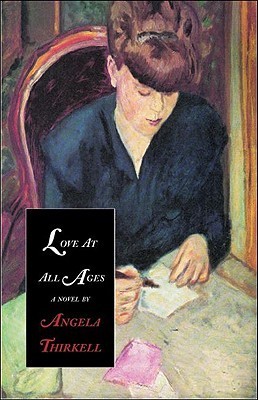
Review 2244: #ThirkellBar! Love at All Ages

If Love at All Ages can be said to have a plot, it’s the wedding of the vicar Mr. Oriel and Lady Gwendolyn, the sister of the Duke of Towers (not to be confused with the Earl of Pomfret Towers). If these names do not sound familiar, it’s because as far as I can remember, we have not met these characters before, or anyone else in that family, and we don’t really seem to get to know them now. However, other familiar characters help with or appear at the wedding.

The back of the novel also mentions the christening of the first child of Lady William Harcourt (previously Edith Graham, who monopolized at least three of the previous novels), but by the time we get done with the wedding, I’d forgotten it.

The title hints that the book includes another love affair, and since Lady Gwendolyn and her intended are well into middle age, the implication is that it involves younger people. This is just a hint that there may be a suitable mate for young Ludo, Lord Mellings, the heir of the Earl of Pomfret.

Otherwise, the book contains the usual plethora of literary allusions, tea parties, boating parties, and so on. The preoccupations that I complained about last time are still all there, too—including yet another mention of Mrs. Fewling’s lack of proper undergarments when she was still Margot Phelps—although not repeated as often. However, there is a scene where Lydia Merton remembers her husband’s old infatuation (with someone very much like Mrs. Brandon but not her, I can’t remember) and then two pages later, her husband thinks about it, and as if that weren’t enough, it’s mentioned again later in the book.

So, no improvement here and less interest, because so much of the book is about characters we don’t know and don’t get to know. However, there’s only one book left to go. (In fact, the cover of my book says this one is the last one, which if it were, would be quite a disappointment as the last in the series.)

Related Posts

Close Quarters

A Double Affair

Never Too Late