Review 1801: Classics Club Dare! The Grand Sophy

The latest Classics Club Dare is to read something romantic for February, so I have chosen The Grand Sophy from my list.

When Sir Horace Stanton-Lacey unexpectedly arrives at Lord Ombersley’s home to ask his sister to take charge of his daughter Sophy for a while, he discovers a depressed household. Lord Ombersley’s gambling debts had almost overrun the establishment until his son and heir, Charles Rivenhall, inherited a fortune from a distant relative. Charles “did something with the mortgages” and paid off the debts, and now he is trying to get the household to economize.

Charles is also engaged to Eugenia Wraxton, whose outward sweetness hides a self-righteous and meddling disposition. Her plans to occupy the family home after the wedding depress everyone except Charles.

By the time Sophy arrives, the announcement of her cousin Cecilia’s engagement to Lord Charlbury has been delayed by his having contracted mumps. Cecilia now thinks herself in love with Augustus Fawnhope, a devastatingly handsome but vague young man who fancies himself a poet.

Sophy arrives like a breath of fresh air. She brings a monkey and a parrot to entertain the children, a shy greyhound, and a fabulous black steed to ride. She immediately realizes that the family needs her help. And she never shirks her obligations.

Sophy is a firecracker of a heroine, and The Grand Sophy is one of Heyer’s most beloved novels. There is lots of fun to be had as Sophy’s stratagems twist and turn the plot. The novel is a re-read for me for the Classics Club, but I loved it this time just as much as I did the first time I read it.

Frederica

Venetia

Faro’s Daughter

Review 1799: Summer Will Show

I have enjoyed the two other books I read by Sylvia Townsend Warner, but I am not as sure how I feel about Summer Will Show. According to the Introduction by Claire Harman, the two main characters bear a strong resemblance to Warner’s real-life companion, Valentine Ackland (Sophia) and herself (Minna). This may be the problem I have with this novel, because, as with Vita Sackville-West’s Challenge, depicting a semblance of her own true-life relationship, I think perhaps the closeness of the relationship inhibits the writing. In this case, I didn’t really get the attraction between the two women. It didn’t seem convincing.

in 1848, Sophia Willoughby has been running her estate and raising her children on her own for some time. She has long tolerated her husband’s affairs, but when she hears of one with Minna Lemuel, she is enraged. Minna is famous as a sort of actress/prostitute/mountebank, and she is not only unattractive but older than Sophia. Sophia tells her husband Frederick he can stay in Paris.

Although Sophia is an extremely competent manager, she is impatient in many ways with her woman’s role. She wants to live a free life. She is not happy in society and has no friends. Although an attentive mother, she thinks her children are too soft and doesn’t coddle them. Then a mistaken attempt to toughen them up ends in their deaths.

With no one to care for, Sophia decides to go Paris and talk her husband into having another child with her. She arrives there as the Parisians are preparing for another revolution.

In searching for Frederick, Sophia meets Minna and is immediately captivated. In a short time, she is caring for her instead of a new child. Minna is a revolutionary, however, and although Sophia is skeptical of the movement, whose advocates seem to hang around Minna’s flat and do little, she is slowly drawn to Communism. In the meantime, Paris is starving.

Aside from what I felt was an unconvincing love affair, I wasn’t really interested in the revolutionary setting or the turn to Communism, which wasn’t very coherently explained. I was also appalled by Sophia’s treatment of Caspar, her husband’s illegitimate half-caste son. So, not so excited about this one.

Lolly Willowes

The True Heart

Challenge

Review 1796: The Uninvited

The movie The Uninvited has long been the Halloween movie of choice for me and my husband. It is vintage 1930’s with Ray Milland and a great ghost story. However, I had not read the book until now.

Roderick Fitzgerald and his sister Pamela have been fruitlessly looking for a house in the west country that they can afford when they come across Cliff End. Although it needs work, it is so beautiful that they are sure they can’t afford it. However, it has not been occupied for 15 years, and Commander Brook reluctantly agrees to their price. He does say, though, that there have been “occurrences.”

All is well at first, and the Fitzgeralds are happy fixing up their house, but eventually the occurrences begin—a light in a room that had been the nursery, a sighing sound, the scent of mimosa, and more terrifying, an enervating cold in the studio and the attempt of an apparition to form. The Fitzgeralds begin to learn the story behind the home—that it belonged to the Commander’s daughter, Mary Meredith, and her artist husband, that an artists model died there after attempting to kill Mary, whom most people treat like a saint, and that Mary died soon afterwards.

The Fitzgeralds soon meet Stella Meredith, the Commander’s granddaughter, and befriend her. She has yearned to visit the house, but after she does, the manifestations grow stronger. Soon, the Fitzgeralds believe they have a choice between making the manifestations disappear by understanding what they want or giving up the house.

Although this novel didn’t really make my hair stand on end, it is a good ghost story. The characters are interesting, and the descriptions of the Devon coast are striking. I enjoyed the book very much.

Dark Enchantment

The Unforeseen

The Uninhabited House

Review 1794: Fell Murder

The Garths have been at Garthmere, a farm on the fells of the Lake District, from before Flodden Field. The patriarch, Robert Garth, is a hard man of 83, stubborn and hot-tempered, who will not agree to the modernizations proposed by his daughter, Marion. He has long been estranged from his heir, oldest son Richard, who moved away to Canada. His middle son, Charles, lost every penny out in Asia to the Japanese invasion and loafs around unless put to work. His youngest son, Malcolm, is frail and spends his time keeping bees and writing poetry.

It is 1944, and Richard returns to the area, on leave from the Navy. He meets his father’s bailiff, John Staple, on the fell. He doesn’t want to see his family—he just wanted to look at the land—so he asks Staple not to tell them he is there. But he is overheard by Malcolm. A few days later, Robert is found dead, shot and left inside an old outbuilding.

Chief Inspector Macdonald is called on the scene after initial interviews by Superintendent Layng, who is not good at handling the reticent farmers. Although Macdonald gets along better, he finds himself with either too many or too few suspects and no proof against anyone.

If Fell Murder has a fault, it is that the murderer is too easy to guess, being the only unlikable main character. This was often a fault of Georgette Heyer’s mysteries, too, but I still enjoyed reading them. Oh, there’s one other problem, the handling of a boy of limited intellect, but that’s due to the change in times. Just a warning.

Of these British Library Crime Classic reprints, I’ve discovered E. C. R. Lorac to be one of my favorites, because of her attention to setting and character. This is a good one.

Two-Way Murder

Murder in the Mill Race

The Chianti Flask

Review 1792: #ThirkellBar! Before Lunch

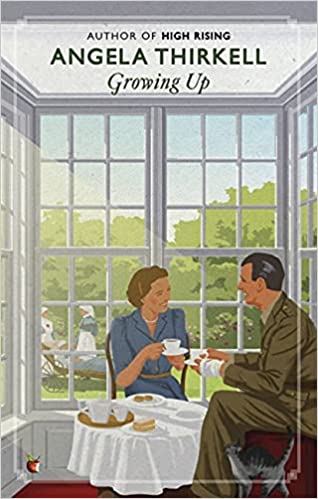
Before Lunch is one of Thirkell’s Barsetshire Series that I have not read before. It possesses both the charm and slightly acid humor of the previous novels and a new sense of sadness.

In this novel we meet the Middletons. Jack is a trying man who often has to be soothed by his wife, Catherine. Jack’s sister Lilian Stoner, a young widow, is coming to stay in an adjacent house with her stepchildren, Denis and Daphne, who are almost as old as she is. The three have a loving relationship, all understanding that Lilian’s marriage was a difficult one.

The major focus of the plot in this novel is who will Daphne marry, for she meets two men she likes very much. Mr. Cameron is the partner of Lord Bond in their architectural firm. Although he is in his forties, Daphne thinks he’s the nicest man she knows. Cedric Bond, Lord Bond’s son and heir, also gets along with Daphne very well, but Daphne keeps hearing about another young lady named Betty in connection with him. Both men are smitten by Daphne.

Along with this plot, a lot is going on. The overbearing Lady Bond is leading a protest against the unwitting purchaser of a parcel of land called Pooker’s Piece (I love the place names in this series, particularly the oft-mentioned “Winter Overcotes”), where he plans to erect a tea shop and a garage (which rumor eventually converts to a road house). The countryside is outraged, as it is a favorite place for rambling.

The entire county is also preparing for the Agricultural Show, and Daphne talks cows with the best of them. She also takes a secretarial job with Lady Bond.

Denis takes a liking to Lord Bond, who is as kind as he is long-winded. Denis has been an invalid, but in the summer country air he begins to improve, and he is looking for backing for a ballet for which he is composing the music. He treats Lord Bond to Gilbert and Sullivan evenings when Lady Bond is away. He also has a secret of the heart.

Catherine and Lilian begin a friendship that is comforting for them both. We also briefly meet some of the characters from previous books, including Lord Pomfret, now a grieving widower, the Leslies, and Roddy Wicklow. And Thirkell does not fail to provide another irritating character (besides Lady Bond), Miss Starter, an ex-royal attendant who fusses constantly about her diet.

I think I liked this novel best so far, but I know one of my favorites, Cheerfulness Breaks In, is coming up.

The Brandons

Pomfret Towers

Summer Half

Review 1790: Mrs. Tim of the Regiment

I accidentally read Mrs. Tim Gets a Job first, but when I discovered it was third in a series, I decided to read the rest in order. Mrs. Tim of the Regiment is the first.

Hester Christie (Mrs. Tim—I didn’t discover her first name until I read this book) leads an active and happy life where her husband’s Scottish regiment is based in Southern England. However, her life is upended when her husband is temporarily transferred to Westburgh, Scotland. She must find a house, move, and then try to create a new social life. She feels especially close to her neighbor, Mrs. Loudon.

It isn’t long, though, before her husband gets his majority, which means they must move right back to where the regiment is stationed. Tim is sent back almost immediately, while Mrs. Tim prepares for the move. Before she leaves, though, she is invited to see the real Scotland by staying with Mrs. Loudon farther north.

At first, with its diary entry format, this novel was so full of little everyday events that, even though amusing, it began to seem too like the Provincial woman series. However, it eventually develops more of a plot, in particular, Hester’s attempts to help Mrs. Loudon, whose son Guthrie has fallen for an unsuitable young lady.

Although written in 1940, Mrs. Tim of the Regiment is set earlier. The exact year isn’t stated, but the soldiers all have relatively recent memories of World War I. This is a charming novel, although it does have some snobbery toward some wealthy acquaintances. However, Hester is a lively, likable heroine.

Mrs. Tim Gets a Job

Miss Buncle’s Book

Miss Buncle Married

Review 1789: The Postscript Murders

This second Harbinder Kaur novel begins with the apparently natural death of 90-year-old Peggy Smith. Peggy was a sprightly old lady with an interest in crime fiction who used to record everyone who passed her apartment.

Her carer, Natalka, thinks there might be something wrong about Peggy’s death. When she and a neighbor, Benedict, are packing up some of Peggy’s things, they notice that several mystery writers have thanked Peggy for her help. Then someone holds them up with a gun and takes a copy of an old murder mystery.

Dex Challoner is one of the writers who thanked Peggy. Natalka, Benedict, and Peggy’s friend Edwin talk Harbinder into attending a book event for Dex, and he admits that Peggy used to help him come up with interesting murders. He makes an appointment to meet with them later, but the next day he is found dead, shot in the head in his home.

This novel was certainly a page turner, so much so that I read most of it in one day. It has a light cozy feel to it, and clues galore. I found it an enjoyable read.

The Stranger Diaries

The Stone Circle

The Dark Angel

Review 1788: Miss Plum and Miss Penny

At 40, Miss Penny leads a full life in the village. She has her village activities and her two close friends, Hubert, the vicar, a timid widower with a son, and Stanley, a self-pleasing fussy man. Miss Penny always receives a birthday letter from George, the suitor her parents disapproved of, but this year it doesn’t arrive. Miss Penny is hurt and begins to wonder what her life would be if she had left with George.

On her way to the movies, Miss Penny stops a woman from drowning herself in the duck pond. When she finds out the woman has no money and nowhere to go, she takes her home and is soon nursing her through an illness. Miss Plum turns out to be a whiny neurotic who bursts into tears and complains about her hard life. She also shows a tendency to hero-worship Miss Penny.

This darkish comedy shows an insight into human character, for you needn’t make the mistake of thinking Miss Penny’s efforts are rewarded with gratitude. In fact, she is soon consumed by only one thought—how to get Miss Plum out of her house.

This fun novel is filled with eccentric characters. I enjoyed it a lot and was happy to read it for my Classics Club list.

O, The Brave Music

The Stone of Chastity

All Done By Kindness

Review 1785: The Half-Crown House

The Half-Crown House is Fountain Court, a once-stately home that has fallen into disrepair after years of money and estate mismanagement and crippling death taxes. Its heir is Victor Hornbeam, a little boy who is coming to live there for the first time, his widowed mother preparing to marry. The property has been supported for years by Victor’s young aunt, Henrietta, who opens the house for viewing, and her cousin Charles, wounded during the war, who runs a market garden. They are struggling to support the estate so that they can hand over something to Victor when he comes of age. The only other family member living in the house is their grandmother, now bedridden, whose ferocious spending and mismanagement has bankrupted the family.

As the novel opens, Victor is arriving on one of the visitor’s days. Henrietta has a wealthy American suitor who wants to buy one of the valuable paintings, and she is hoping to sell it. However, that morning her grandmother tells her that it, along with many of the other paintings and jewels in the house, is a worthless copy that she had made when she needed to sell the original to pay her debts.

The household is wondering if Henrietta will marry the American, but it was apparent to me early on that her heart lay elsewhere. That only increases the little bit of suspense around this decision.

This novel is a meandering one. At times, it is much more concerned with the past elegance of the house and the events of the long-dead Hornbeams than with the living, for it goes off into little vignettes either through the memories of its inhabitants or during the descriptions of its current state. Thus, it particularizes the postwar state of the country, when many large homes were being dismantled or sold.

It’s an odd little book that reminded me a bit of Lady Rose and Mrs. Memmary and a couple of Rumer Godden novels that center around a house over the generations.

Lady Rose and Mrs. Memmary

China Court

A Harp in Lowndes Square

Review 1782: The Toll-Gate

I was rereading some Georgette Heyer novels last winter as I replaced some of my ratty old 70’s copies, and I remembered The Toll-Gate as one of my least favorite of her romances. I was confused, however, for the novel was amusing and had a fun adventure plot.

Back the second time from the Napoleonic Wars, Captain Jack Staple has been intending to settle down. His mother and sister have accordingly presented a string of attractive, eligible girls, but Jack hasn’t been interested. He says he doesn’t want to get married until he receives “a leveller.”

On going to visit a friend, he loses his way and comes to a toll-gate that is manned at night by a terrified young boy. The boy tells Jack that his father told him to mind the toll-gate for an hour, and he hasn’t been back. The boy is terrified of a man his father sometimes meets during the night. Jack decides to stay with the boy until his father returns. Then the next morning, he receives his leveller, in the person of Nell Stornaway.

This novel is just delightful, and I don’t understand how I misremembered it so badly.

The Talisman Ring

Sprig Muslin

Faro’s Daughter