Review 1564: Dangerous Ages

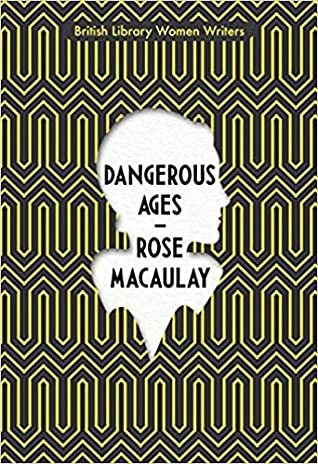
Thanks to Simon Thomas’s posts (Stuck in a Book) on the new British Library Women Writers series, I was able to request some review copies. I received Dangerous Ages, which, according to the novel, are all of them. This novel examines the lives of women in the early 1920’s.

Neville is 43, a woman who gave up her medical studies as a young woman to marry and raise a family. That job done, she finds herself feeling adrift, with no purpose, and views her mother, Mrs. Hilary, as an object lesson. She must find work and decides to return to studying medicine.

Mrs. Hilary is a silly woman who always pretends she has read important books and is knowledgeable on all subjects. At 63, she has nothing to do, because she defines herself as a wife and mother. Now she is a widow whose children are grown. She is jealous of anyone being intimate with Neville if her son Jim isn’t around and is jealous of Neville’s intimacy with Jim. She thinks psychoanalysis, which is being talked about, is horrid until she realizes it means someone will listen to her stories.

Nan, Neville’s younger sister, has been courted by Barry for ages. She finally decides she loves him, but instead of telling him so, she goes off to Cornwall to finish writing her latest book, never thinking that Barry might give up on her.

Gerda, Neville’s daughter, is ardently engaged in left-wing activities. The question is, when she falls in love with a man of a different background, whether she will compromise her principles, which reject all the values of her parents’ generation.

Macaulay’s novel is rooted in the early 1920’s, as characters examine hot topics of the time. I had to laugh at the scenes where Mrs. Hilary’s psychoanalysts inundate her with Freudian jargon that she has very little understanding of. That most of these women are frustrated in their aims should not be surprising, for this is a satirical look at the position of women in society. Only Neville’s sister Pamela, who refuses to be bothered, and Neville’s grandmother, who says she is past all that, seem happy.

Simon Thomas’s Afterword provides some insight into views of psychoanalysis in the early 1920’s, which is interesting.

I enjoyed this novel very much. It feels like light, lively reading while dealing with experiences that are universal, no matter the generation.

Related Posts

The Towers of Trebizond

Consequences

South Riding

Review 1561: #1956 Club! Sprig Muslin

Seven years ago, Sir Gareth Ludlow’s fiancée died tragically. Since then, he hasn’t met any woman who would make him forget her. He knows it’s his duty to marry, though, so he decides to propose to his shy friend Lady Hester Theale.

On his way to Lady Hester, he meets a beautiful young lady in some difficulty. He learns that in trying to force her grandfather to let her marry, she has run off with the aim of becoming a governess. When her supposed employer turned her away, she presented herself at the inn where he meets her proposing herself as a chambermaid.

Gareth is afraid that Amanda is too inexperienced to know what dangers she may encounter, but she will not tell him her grandfather’s name, so he takes her to Hester. Hester’s family assumes he has brought along his mistress, and her roué uncle spirits Amanda away the next morning.

Sprig Muslin is Heyer at her most ridiculous and fun, as Amanda’s fibs land her and Sir Gareth into serious trouble, requiring, of course, more and more fibs. As usual, her characters are lovable and her wit engaging. I always love reading Heyer, This one, I reread for the 1956 Club.

Related Posts

The Talisman Ring

Cotillion

Cousin Kate

Review 1558: Classics Club Spin Result! Kennilworth

Here’s another book for RIPXV!

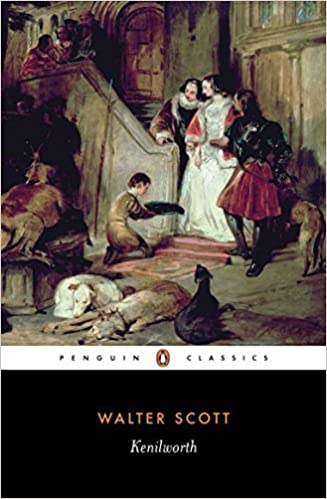
Reading Kenilworth for the Classics Club Spin made me contemplate the question of how important it is in a historical novel to stick to the historical facts. Of course, historical novels are fiction, so by definition something is invented. And there have been really interesting historical novels where the author purposefully changed some facts to speculate on other outcomes. But do historical novels have the license, just for a more dramatic story, to change what actually happened?

Kenilworth is the novel that famously reawakened interest in the story of Amy Robsart’s death. Amy Robsart was the wife of Robert Dudley, the Earl of Leicester, during the reign of Elizabeth I. Amy’s death is the classic mystery of did she fall or was she pushed? At the time of her death, the rumor in court was that Leicester colluded in her death because he believed he could then marry Elizabeth.

In the novel, Amy is a young bride who has run away from home for a marriage with Leicester that is secret because he is afraid for his position in court, having married without royal permission. Amy’s jilted fiancé, Tressalian, comes looking for her on behalf of her father, believing that Amy was seduced away from her home by Varney, Leicester’s master of horse.

Varney is the villain of this piece. He has Amy kept as a virtual prisoner, and eventually Amy has reason to fear for her life. So, she flees to Kenilworth, Leicester’s estate, where he is preparing to entertain Elizabeth and the court.

I fear that Scott has woven a romance with very little basis in fact, as he did with a Crusader-based novel I’ll be reviewing in a few months. First, in Kenilworth, Amy and Leicester are newly married when in fact they were married about 10 years. Next, their marriage was no secret; in fact, she was allowed to visit him in the Tower of London when he was imprisoned by Queen Mary as a relative of Lady Jane Grey. Did Leicester have a hand in her death? I read a novel a while back that posited that (it may have been Alison Weir’s The Marriage Game, but I’m not sure), but we’ll never know. More recently, historians are inclined to believe that she simply fell down the stairs. By the way, she was not being kept captive in a moldy old house but visiting friends.

So, that is a strongish negative for me, at least. I could accept a premise that Leicester ordered his wife’s death because we don’t know, but playing with the chronology of the marriage for drama’s sake (and to have a younger, dewier heroine) and making it a secret (as it was also in a movie I saw several years ago) is throwing in a bit too much fiction.

On the positive side, Scott’s descriptions of the Elizabethan court are vibrant and his attempts at Elizabethan dialogue are convincing. Also, if he was not distorting history I’d say that his plot is quite suspenseful. At the time of its publication, historians slammed The Talisman just because Scott created a fictional Plantagenet, even though he did much worse things historically in that book and in this one.

Related Posts

Guy Mannering

Waverly

The Marriage Game

Review 1543: The Bookshop

I decided to read The Bookshop after seeing the movie of the same name. The two are very similar, but the movie doesn’t convey the subtlety of the book, which is a little more remorseless.

Post World War I, the widow Florence Green decides to open a bookshop in her East Sussex village of Hardborough, which does not have one. For the premises, she purchases the Old House, which has been vacant for seven years and is in need of a lot of work. It is also rumored to be haunted.

Her aims seem worthy and harmless, but no sooner does she purchase the Old House than a local worthy, Mrs. Gamart, invites her to a party only to inform her that she, Mrs. Gamart, intended the Old House for an arts center. Florence has no idea who she’s dealing with when she asks Mrs. Gamart why then she didn’t buy the house any time in the past seven years and refuses to let it go.

This novel seems to be light fare, but it has some cynical observations about small-town gentry and betrayal. It is short, fully engaging, sparely and beautifully written, and sad.

Related Posts

Sofia Petrovna

Expiation

Fidelity

Review 1540: The Uninhabited House

Miss Blake is an eccentric figure whose arrival is looked forward to by the clerks in Mr. Craven’s office, including Harry Patterson, the narrator. She only arrives when the tenants have unexpectedly left her niece’s house, which is all too often. For the house has a reputation.

Miss Blake and her ward Helena have been a charge on poor, kind-hearted Mr. Craven since the death of Robert Elmsdale, Helena’s father. Thought to be wealthy, he was found to be in considerable debt when he died. Now, the house in which he died is supposedly haunted. Mr. Craven doesn’t believe in ghosts and supposes someone is trying to keep the house from being occupied.

After a disastrous lawsuit resulting from the early vacancy of the house by a tenant, Miss Blake declares she will pay £50 to anyone who can solve the mystery of the house. Although Miss Blake has never paid any of Mr. Craven’s bills, Mr. Craven is so desperate to relinquish Miss Blake’s account that he vows to pay the money to anyone who can solve the mystery.

Patterson finds himself in need of money, because he has fallen in love with Helena Elmsdale. So, he volunteers to stay in the house and try to discover its secrets.

This is a joyful little novel despite its theme. Patterson tells the story with plenty of gentle, good-natured humor, and his affection for Mr. Craven is very clear. The mystery is perhaps not too confounding, but the book itself is a pleasure to read, with eccentric characters and lots of atmosphere. Is it a ghost story as well as a mystery? I’ll never tell.

Related Posts

The Uninvited Guests

Lincoln in the Bardo

All Done by Kindness

Review 1537: The Moth Catcher

The body of a young man is discovered beside the road in a remote valley near Kimmerston. He was house sitting for Major and Mrs. Carswell while they are in Australia. When the investigative team goes to the attic apartment where he was staying, they find the body of a middle-aged man in a suit.

The house sitter was a researcher named Patrick Randle, but Vera Stanhope’s team is unable for some time to figure out the identity of the second man or the order in which the two were killed. When they finally identify the second man as Martin Benton, the IT person for a local charity, they have a hard time figuring out what the two have in common. They eventually identify an interest in moths.

In this valley, the only residents are the owners of three barn conversions nearby. Yet, the six people who live there, three sets of retirees, claim not to know either Randle or Benton.

Cleeves always presents real puzzles, and this one’s a doozy. Although the clues are there, I couldn’t figure this one out at all. There’s a slight cheat, in that information discovered 50 pages from the end isn’t divulged until the end, but frankly, even if it was, I’m not sure I’d make the connection. A good mystery, as usual.

Related Posts

Harbour Street

The Glass Room

Silent Voices

Review 1535: The House at Sea’s End

Forensic archaeologist Ruth Galloway is called in by DCI Harry Nelson when a group of archaeologists studying a Norfolk cliff find a collapsed cleft containing bones. There are six bodies, their hands bound. Ruth thinks they are recent, within the last hundred years, and all men.

Ruth’s university determines that the men were German, and Harry’s team begins concentrating on a time during World War II when the Home Guard of the village, Broughton Sea’s End, was preparing for a German invasion. The Home Guard men were led by Buster Hastings, father of the current owner of Sea’s End House, near where the body was found.

In the meantime, Ruth is struggling with the balance between her work, at the university and for the police, and her baby daughter, Kate. She is also concerned because Michelle, Harry’s wife, has been trying to befriend her, unaware that Kate is the result of a harrowing night during Ruth’s first case with Harry.

Aside from one ridiculously easy clue, I found this mystery much harder to guess than the first two. I continue to be interested in the characters and the setting, although it looks like we may be in for major melodrama in the next book. I like the concept of this series, which is inspired by the profession of Griffith’s husband.

Related Posts

The Crossing Places

The Janus Stone

206 Bones

Review 1533: The Mystery of the Peacock’s Eye

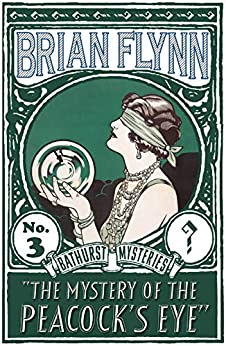
A mysterious man dances with Sheila Delancy at the Hunt Ball, the same night the Crown Prince of Clorania is rumored to be there. Some months later, a young woman is murdered in a dentist’s chair in Seabourne, and Detective Bannister is called away from his vacation to take charge.

A few weeks before, Anthony Bathurst is requested by the Crown Prince of Clorania to look into a case. Someone is attempting to blackmail him over an affair with a young woman. Soon, Bathurst begins to suspect that the two cases are related.

While I enjoyed the first book in this series, I thought this one was a bit of a cheat. That’s because only one piece of information links the killer to the case, and we don’t get to hear that conversation. The plot has a clever concept, but there’s no way a reader could guess the solution.

Related Posts

The Billiard-Room Mystery

Death Has Deep Roots

The Red House Mystery

Review 1532: Tidelands

For years, I read Philippa Gregory’s books faithfully, but at some point I decided that she was just cranking them out, so I stopped. I felt that less attention was going to such things as fully realized setting and well-rounded characters.

Recently, however, I noticed that she was doing something different with Tidelands, so I thought I’d give her another try. This book is set in the 17th century and features a heroine living in poverty.

Alinor is a wise woman—a healer and a midwife who does not deal in magic and charms and is very concerned, as she has to be, about her reputation. It is in jeopardy, because her husband has disappeared, and if he has deserted her, she will be considered a loose woman. So, on Midsummer’s Eve at midnight, she goes to the church believing she will see the ghost of her husband if he is dead.

She does not see her husband but a total stranger. He is a young man, a gentleman in difficulty, who introduces himself as James Summer but is a Catholic priest in a time when Catholicism has been banned in England. He is traveling and was supposed to find refuge with Sir William Peachey, but Sir William is not home. Although she is Protestant, Alinor is not much concerned with religion, so she gives him refuge overnight in her shed and leads him through the marshes in the morning to consult with Sir William’s steward.

As a result of her actions, Sir William gives her son a place as his son’s companion. This is a step up for him, and she is grateful. James Summer masquerades as a tutor for Sir William’s son, but he is really there to help free King Charles, in prison on the Isle of Wight.

Unlikely enough, I thought, James and Alinor fall in love. James begins to lose faith in his religion and his king as events progress. But he is a priest, and Alinor is married, and on the Isle of Wight, he encounter’s Alinor’s husband, who does not intend to return.

For a long time I found the situation unconvincing and considered dropping the book. The ending, however, was surprising and affecting, so I’ve changed my mind. I’m willing to try the second book of this series.

Related Posts

Merivel: A Man of His Time

Lark

Corrag


Review 1529: The Second Sleep

There are some authors whose books I’ll buy immediately, and Robert Harris is one of them. This means that I haven’t always read what the book is about, and I seldom read the jacket to remind myself before I begin reading, even if I did when I bought the book. Generally speaking, Harris writes excellent historical novels. So, I was reading along, thinking I was in the 15th century, when I suddenly realized I was reading a dystopian novel set far in the future.

After a cataclysmic event, the world has gone through another dark age, and England has emerged into a pre-industrial-age society ruled by the church with a culture that is superstitious and suspicious. Christopher Fairfax is a young priest who has been dispatched by the bishop of Exeter to a small village, Addison St. George, to see that the recently deceased local priest, Father Lacy, is buried.

Upon his arrival, he notices right away that Father Lacy was a heretic, for he finds a library and a collection devoted to the past, before the Apocalypse. Such studies are considered blasphemous, yet the father has a cache of such objects as plastic straws, Barbie dolls, and iPhones.

Fairfax also begins to fear that Father Lacy’s death may have been different than an accidental slip from a feared local structure called the Devil’s Chair. When he investigates, he finds a huge mass grave where Father Lacy had been digging, but it looks like Father Lacy was chased up the slope, which then collapsed.

This is an atmospheric novel, but I didn’t enjoy it as much as I have Harris’s previous novels. For one thing, the idea of the world going into a familiar religious-based Dark Age after a cataclysm isn’t exactly original. For another, the ending is quite abrupt, and I’m not sure how I’m supposed to interpret what Fairfax and the others ultimately find. It’s disturbing, yes, but what does Harris mean by it? I was also confused about something unexplained concerning the title. Harris includes a quote at the beginning of the book that tells us that Western Europeans used to sleep twice each night, waking and returning to sleep after midnight. During his first night in the village, Fairvax awakens to realize that the villagers have all gotten up and gone out, despite an apparent nationwide curfew. All along I was expecting some weird explanation for this. Instead, Fairfax himself is incurious about it, and what the villagers are doing is never explained. Yet there’s the book’s title, which I assume does not refer to this event but to the second dark age.

Related Posts

Oryx and Crake

The Testaments

Parable of the Sower