Review 1478: Literary Wives! War of the Wives

Today is another review for the Literary Wives blogging club, in which we discuss the depiction of wives in fiction. If you have read the book, please participate by leaving comments on any of our blogs. Be sure to read the reviews and comments of the other wives!

Eva of Paperback Princess
Lynn of Smoke and Mirrors
Naomi of Consumed By Ink

* * *

Selina Busfield thinks her husband Simon is working in Dubai when the police notify her that he’s been found drowned in Southwark. She can’t imagine what he’s been doing there, and the circumstances around his death are unclear. Did he commit suicide, was his death an accident, or was it murder?

But this concern is soon pushed aside when some complete strangers show up at the funeral, one of them claiming to be Simon’s widow. It appears that for the past seventeen years, Simon had two families, one with Selina and one with the much younger Lottie.

When we chose the last set of books for Literary Wives, I could tell by the description that this would be the one I liked least. And so it proved. I am always wary of any book that describes almost any outfit a woman has on except if it’s important to the plot. But worse, I thought that almost everything about this book was predictable except for the cause of Simon’s death, and that was too far out in left field. The wives were such extremes of direct opposites that they were almost clichés—Selina the society dame focused on appearances and Lottie the air-headed artsy girl. Then there was their immediate reaction of fury at each other when they were both victims of their husband’s deceit. Finally, the pileup of discoveries showing what a creep he was (and by the way, they never knew!). And then the finish, which I won’t reveal. Sorry. Absolutely not for me. I only finished it because it was for the club.

What does this book say about wives or about the experience of being a wife?

In the context of this book, I find this question almost impossible to answer because both marriages were a mirage. Although there have been a few disconcerting exchanges in the past, as far as Selina knew, she was the wife Simon wanted—organized, active, immaculate, still attractive, a good if reserved mother. He has frequently told her she is the perfect wife. As the book continues, Selina finds some reward in relaxing her standards a bit, including a more genuine relationship with her children.

As for Lottie, her marriage seems murkier to me. She is much more emotionally dependent on Simon even while being less financially so. She is also so engrossed in her romantic feelings that it’s hard to get an idea of their day-to-day life. Certainly, it seemed as though Simon was a warmer husband to her and her daughter than he was to Selina and her children.

But this novel has a lot more to say about life after marriage than about life during it.

Related Posts
A Circle of Wives

The Disobedient Wife

A Separation


Review 1475: Dark Saturday

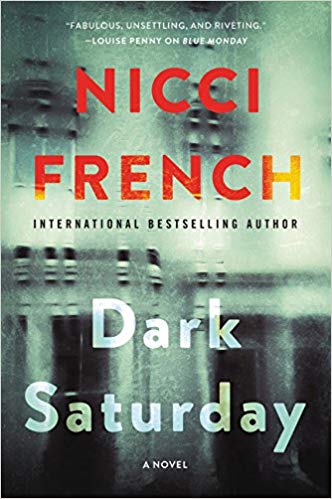
When I went looking in the library for something suitable for the end of October, I found one of Nicci French’s dark and disturbing mysteries featuring psychotherapist Frieda Klein. I have read all but the book before this one in this series. I missed the last book but did not feel that it threw me off in reading this one.

The Frieda Klein series began with a dangerous psychopath escaping justice by killing his twin brother. Only Frieda believes he is alive, and she knows this because he has been both harassing and protecting her. So, this ongoing plot is always mixed with one that is solved in each book.

Frieda is hired by a mysterious man named Levin, whose role I don’t quite understand, to look into the case of Hannah Docherty. Fifteen years ago, she was permanently hospitalized after being found guilty of the murders of her entire family.

In Frieda’s initial examination of the case files, she finds some discrepancies that are not explained by the theory of the case. After she goes to visit Hannah in the mental hospital, she begins to entertain the possibility that Hannah did not commit the crime.

During the course of the investigation, she finds an eccentric crime blogger who stole all of the Docherty’s possessions after they were thrown out. Frieda takes these possessions from her and shortly thereafter the woman is killed in a fire that burns down her house. Now, Frieda is sure that Hannah is not the murderer.

Frieda is an enigmatic character whom I find fascinating, and the other characters in the book are convincing. Although some of the books in this series are not really thrillers (some are), they never fail to send a chill down my spine.

Related Posts

Thursday’s Children

Waiting for Wednesday 

Tuesday’s Gone

Review 1474: The Wolf Border

Best of Ten!
Rachel Caine is an emotionally detached woman who manages a wolf reintroduction program on a reservation in Nez Perce, Idaho. She prefers to keep her sexual liaisons brief and hasn’t returned to her home country of England for years. She takes the opportunity to visit her mother, Binny, when she meets with the Earl of Annandale about a project he has taken on to move wolves into a contained area on his huge estate and nearby national forest lands in Cumbria, near where she grew up. She isn’t interested in the job, but her brother Lawrence has told her that Binny won’t be around long.

After a meeting with the Earl, whom she doesn’t trust, she has a difficult visit with Binny and then returns home. Her personal circumstances change after Binny’s death, though, so she finds herself accepting the Earl’s job.

This is a thoughtful and vital novel that examines the nature of Rachel’s relationships with her family. Events allow her to open the door to people in her life. The novel is complex, not because of the plot but because of the tangle of human thoughts and feelings it examines.

The writing is clear and vivid. I read this book for my James Tait Black project—another winner!

Related Posts

The Lesser Bohemians

First Love

Dear Thief

Review 1469: The Long Call

The Long Call is the first book in Ann Cleeves’s new mystery series set in North Devon. It features Matthew Venn, a detective who differs from Vera Stanhope and Jimmy Perez in that he is gay, married, and immaculately dressed, also unsure of himself.

The body of a man is discovered out on Crow Point near Matthew’s house. He has been stabbed, and he has no identification, so it takes a while for Matthew’s team to figure out who he is.

He turns out to be Simon Walden, a recently homeless man with alcohol abuse issues who volunteered at the Woodyard, a warehouse that was converted to a center offering studios for local artists, classes to the community, and a day center for mentally disabled adults. Matthew’s husband is the director of that center, so he wonders if he should take himself off the job.

link to NetgalleyIn investigating Simon, the police find more connections to the Woodyard. One of his roommates was Gaby, an artist who teaches there and disliked him. Also, a Downs Syndrome woman named Lucy who uses the center reports that he was her friend, he rode the bus with her out to Lovacott every day in the past few weeks. The police can’t figure out what he was doing there. Soon, the connections become even stronger when a Downs Syndrome woman named Chrissie goes missing from the Woodyard. Something tells Matthew that the events are related.

As usual, Cleeves presents us with a difficult mystery. I found Matthew somewhat unknowable with less of a persona than her other detectives, Vera and Jimmy, but that may be because I discovered both of those series through the television programs. I am more than willing to read another Matthew Venn book.

Related Posts

Thin Air

The Glass Room

Silent Voices

Review 1462: Not at Home

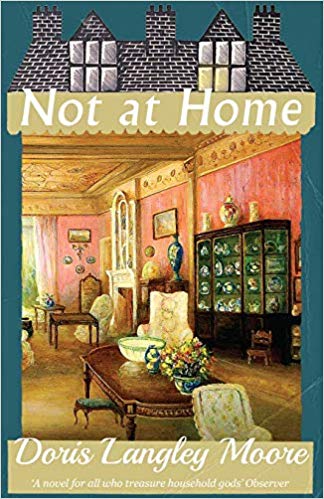
Miss Elinor MacFarren is dismayed to realize that something must be done about her finances. With World War II just past, there has not been much recent demand for her beautifully illustrated books on botany. She decides, with the London housing shortage going on, that she must find someone to share her lovely family home, filled with treasures.

When she interviews Mrs. Bankes, whose husband is an American journalist, she has some misgivings, but Mrs. Bankes agrees to all her conditions, and she relies upon the warm recommendation of her friend, Harriet Greenway. It’s not too long after Mrs. Bankes moves in, though, that the house is noisy and disorganized. Miss MacFarren’s precious objects are being mistreated, and Mrs. Bankes is using up all the time of the shared housekeeper. She is even taking Miss MacFarren’s food from the kitchen.

Mrs. Bankes proves to be a manipulator and a liar, willing to do or say anything to get her way. The situation is complicated when Mr. Bankes arrives, because he is so nice and appreciative of the house. Miss MacFarren can’t bring herself to give them notice while he is there.

This domestic comedy is thoroughly enjoyable as Miss MacFarren gets out of her rut, meeting new people and re-evaluating old acquaintances. With their help, she tries to figure out how to eject her unwelcome lodger.

I received this book from the publishers in exchange for a fair and honest review.

Related Posts

All Done by Kindness

A Winter Away

The Old Man’s Birthday

Review 1461: Expiation

Milly Bott, a plump little woman like a dove, is suddenly a widow after her husband Ernest’s accident. The respectable Botts gather around her to commiserate, but she appears to be stunned. Then comes the fateful news. Her husband has left her only £1000 of his huge fortune, giving the rest to a home for fallen women and ending his will with “she will know why.”

Of course, the family assumes that Milly has had an affair. They decide that the only way to avoid scandal is to rally around her. But Milly has other ideas. She decides to run off to London to get her legacy and then travel to Switzerland to stay with her sister, Agatha. For, the only other scandal in the Bott family was created when Agatha eloped with a Swiss. Milly decides she will confess her sins to Agatha and go on to live a life of expiation, for she has indeed had an affair.

But naïve and sweet-natured Milly is in for many disillusions, beginning with her first meeting with her sister in 25 years, for Ernest forbade the association. Milly has been writing to her sister secretly and encounters her in London.

Expiation is a social satire that is sometimes hilarious and sometimes touching. As the virtuous characters jump from one conclusion to another and behave with less Christian forgiveness the more religious they are, poor silly but penitent and unfailingly kind Milly unwittingly turns their lives topsy-turvy.

I received this book from the publishers in exchange for a free and fair review.

Related Posts

Our Spoons Came from Woolworths

Cakes and Ale

Love in a Cold Climate

Review 1458: Winter

The beginning of Winter was so bizarre that I wasn’t sure I was going to finish it. Sophia is an older woman living in a large home in Cornwall. She has begun to hallucinate a child’s head that floats in the air and interacts with her.

Art, Sophia’s son, has split from his girlfirend, Charlotte, and she is now posting tweets on his Twitter account that are causing problems for him. Art is supposed to take Charlotte to his mother’s house for Christmas. Unable to explain what happened, he hires a girl named Lux to pretend to be Charlotte.

When Art and Lux arrive at Sophia’s house, they find it barely furnished, with no beds in the extra bedrooms and no food in the refrigerator. Sophia seems vague and much too thin. At Lex’s insistence, Art summons his Aunt Iris, even though Iris and Sophia haven’t spoken in years.

As I said, this novel started in such a way that I wasn’t sure I would like it. It is quirky, certainly, but it grew on me. Things that seem inexplicable are explained, in a way. As usual with Smith, there is a strong focus on art and ideas. Smith is always interesting and inventive.

Related Posts

Autumn

How to Be Both

Look at Me

Review 1451: Big Sky

I always buy anything by Kate Atkinson as soon as it comes out, but I was especially pleased to learn there was another Jackson Brodie novel. I think her last three books have put her in another category altogether, but it’s fun to see Jackson again after an absence of nine years.

Jackson is out with his son Nathan when he spots a young girl being picked up by a man in a car. She is young enough to sport a backpack with rainbows and unicorns, which he finds the next day in a bay near his home in Bridlington. The police don’t seem to be interested.

Later, he is hired by Crystal Holroyd to find out who is following her in a silver BMW. When Crystal’s kids are threatened, this case becomes more serious.

Jackson also stops a man from jumping off a cliff. This man is Vince Ives, who has lost his job and was being divorced by his wife until his wife is found murdered. Now, of course, the police suspect him of murder.

More is going on than that, though, as a series of coincidences leads Jackson to discover a human trafficking operation.

Atkinson’s mysteries are more quirky than otherwise, following lots of threads that end up being connected (some of them) at least by the presence of Jackson himself. In the meantime, we’re entertained by the musings of Jackson and some of his more likable fellow characters. Another entertaining read for us by Atkinson.

Related Posts

Started Early, Took My Dog

Transcription

A God in Ruins

Review 1450: The Christmas Card Crime and Other Stories

For a Christmas season treat, I read this latest British Library Crime Classic short story collection, published in October. Most of its stories are set in winter and several around Christmas. This collection includes crime stories published between 1909 and 1965.

I was surprised to find the first story was written by Baroness Orczy, whom I associate with the Scarlet Pimpernel. It turns out that she started by writing crime fiction. In “A Christmas Tragedy,” her detective is Lady Molly, who is convinced that the accused Mr. Smethick did not murder Major Ceely. The police theorize that the motive was the major’s refusal to allow his daughter’s engagement to Mr. Smethick. Lady Molly discovers a more obscure motive for the crime.

In “By the Sword” by Selwyn Jepson, Alfred Caithness plots and kills his cousin Herbert after Herbert refuses to lend him more money. Alfred’s guilt is explored in an unusual way.

“The Christmas Card Crime” by Donald Stuart is more of a crime adventure, as a criminal tries to steal an heiress’s proof of her identity.

Although some of the stories were more clever than others, the only story I couldn’t finish was “Twixt the Cup and the Lip” by Julian Symons, a caper story that seemed to go on and on.

I received a copy of this book from the publishers in exchange for an honest review.

Related Posts

Silent Nights

Murder at the Manor

Deep Waters

Review 1429: The Old Man’s Birthday

I’ve only read two books by Richmal Crompton, but she seems to be interested in studying the individual members of large families. In The Old Man’s Birthday, she focuses this interest around Matthew Rowston’s 95th birthday.

Matthew has led an exciting and sometimes disreputable life, but he married an extremely conventional woman and now lives in a village stifled by class consciousness and respectability concerns. To this birthday party, he has insisted on inviting his grandson Stephen, who is living with a married woman and has been cast off by most of the rest of the family. Part of Matthew’s motivation is a perverse desire to shock these family members, but when he meets Stephen’s partner, Beatrice, he is also reminded of a girl he loved when he was young.

This novel is about how the introduction of a single person into a group can change dynamics that seem fairly set. You may feel that a multitude of difficult situations are resolved too easily, but still, this is an enjoyable and touching novel. I read it for Classics Club and was glad I did.

Related Posts

Family Roundabout

Greenbanks

The Priory