Day 902: Who Was Changed and Who Was Dead

Cover for Who Was Changed and Who Was DeadWho Was Changed and Who Was Dead is another eccentric and original novel by Barbara Comyns. With its characters and plots, it contains more than a slight touch of the bizarre.

We meet the Willoweed family after the nearby river has flooded. Some of the family are wading on the lower floor of the house, and Ebin Willoweed has taken the girls out in the boat, from which they are observing the dead animals floating by.

The novel is almost entirely concerned with the Willoweeds. Ebin is a writer who lost his newspaper job years ago and hasn’t worked since. He lives in his mother’s ramshackle but enormous house with his three children, the entire household terrorized by his tyrannical mother.

The Willoweeds seem stuck in a monotonous existence. Ebin occupies some of his time by having an affair with the wife of the village baker. Emma, the oldest daughter, yearns for pretty clothes and shoes but has to be content with clumsy ones made in the village. Dennis and Hattie love playing in the river.

Then a mysterious malady strikes the village. People begin to run mad and commit suicide. No one knows who will die next.

Who Was Changed and Who Was Dead is narrated with the same innocent simplicity of Comyns’ other novels, which deal with similar grotesque situations and characters. It’s one of the things that makes them so readable, yet so eerie.

Related Posts

Sisters by a River

The Vet’s Daughter

Let Me Tell You

Day 901: As She Left It

Cover for As She Left ItAt some point, I decided that the heroine of As She Left It just got herself involved in trying to solve too many mysteries. So, I didn’t find this novel quite as good as I have McPherson’s others. Also, there is at least one whopping big coincidence.

Opal Jones has moved back to the house in Leeds where she grew up. Her mother recently died, and she then learned that the house was in her own name. Since her life is in some disarray, she decides to move back.

Opal hasn’t been to Leeds for 10 years, since she was 13. She also hasn’t been in touch with her alcoholic mother. She has been totally unaware that 10 years before, a little toddler, Craig, whom she used to babysit, disappeared when he was under the care of his grandparents, Dennis and Margaret. Through a series of misunderstandings, each of his grandparents thought the other was looking after him. Opal decides to try to find Craig.

Some other neighbors in her street are old men, members of a jazz band with whom Opal used to play the trumpet. One of the old men, Fishbo, says he hasn’t been in touch with his family in New Orleans since Hurricane Katrina. Opal decides to try to find Fishbo’s family, despite warnings from his friends.

Opal also finds a puzzle in the posts of part of her bed. Needing something to sleep on, she has bought a magnificent bed for a very low price, not realizing until she got it home that the headboard and footboard are mismatched. In the posts of half the bed, she finds messages of distress, but she needs the other half of the bed to see the entire message. In trying to find the other half, she meets Norah, a little old lady suffering from dementia living in a house full of antiques. Soon she believes that someone is looting Norah’s house of its valuable furniture.

Having embroiled herself in these mysteries, Opal begins receiving threats, but she doesn’t know how the threats are connected with the mysteries. There is also the mystery of the person next door, whom she hears crying at night. Since she can’t believe her neighbors would have taken Craig, she wonders if his kidnapper has moved in next store. But then, all of her neighbors seem to be hiding something.

Although I liked Opal and was interested in the story, there just seemed to be too many threads to the plot. Overall, I think, it limited the possible suspense of the novel. The coincidence, too, of what happened to the other half of the bed is pretty unbelievable. But a lot of the puzzles are noise, to keep Opal from facing her past.

Related Posts

Quiet Neighbors

The Child Garden

The Day She Died

Day 900: The Monogram Murders

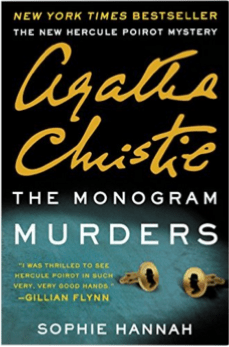
Cover for The Monogram MurdersThe Monogram Murders is the first Hercule Poirot mystery written since Agatha Christie’s death that was approved by her estate. It is written by the British thriller writer Sophie Hannah, whose books I have enjoyed. I was curious to see how authentic the novel seemed as a Christie mystery.

Hercule Poirot visits Pleasant’s Coffee House every Thursday night because he finds that its delicious coffee activates the little grey cells and he likes the astute observations of a waitress named Fee. One evening a regular patron comes in disturbed, behaving as if she fears for her life. When Poirot tries to convince her to confide in him or go to the police, she runs away. All Poirot can find out about her is that she works in some large house across town and her name is Jennie.

Hercule returns to his rooming house to confide in his fellow lodger, Mr. Catchpole, who works for Scotland Yard, but Catchpole is disturbed by having just attended the scene of a murder. Three people have been found dead at the exclusive Bloxham Hotel, and each had a monogrammed cufflink in his or her mouth.

Investigation soon finds that the two women victims, Harriet Sippel and Ida Gransbury, both lived in the small town of Great Holling. They traveled up separately to London and had rooms on different floors, but they both had tea with the third victim, Richard Negus, at 7:15 PM. They were all found dead in their rooms after 8 PM.

It soon becomes clear that the deaths have something to do with a tragedy years before in Great Holling, when lying rumors about the town’s vicar resulted in the loss of his reputation and the subsequent suicides of his wife and himself. The three dead were the couple’s biggest traducers, and a servant named Jennie Hobbs told the original lie. But who is the murderer? Some pieces don’t fit.

So, how does The Monogram Murders stack up against other Christie mysteries? It is certainly as complex as any other Poirot mystery and as difficult a puzzle. Hercule Poirot is very much himself. Catchpole is a suitably dense sidekick, a bit reminiscent of Mr. Watson in another series. The novel is engaging and interesting. The one distinctive characteristic of Christie’s novels that it lacks are her deft characterizations, her way of making readers be able to visualize them with just a few sentences. Still, this novel makes a fairly worthy entry into the series.

Related Posts

At Bertram’s Hotel

Death on the Nile

The Truth-Teller’s Lie

Day 895: Red Pottage

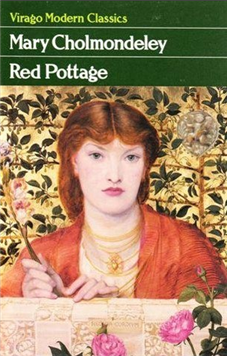
red-pottageBest Book of the Week!
Red Pottage is another find for me this year of a novel by a terrific classic author. I can include Mrs. Oliphant, Dorothy Whipple, and Julia Strachey in this list of classic authors I have not read before that I really enjoyed. My Doughty Library edition says the novel contains “every ingredient for a Victorian bestseller” and mentions wickedness and greed.

Hugh Scarlett has been having an affair with a married woman, Lady Newhaven. At first he thought he was in love with her, but now he has recognized her for who she is—a shallow and stupid beauty. He has already decided to break with her when he meets Rachel West at a party. At one glance he decides that Rachel is the woman to make a better man of him.

Rachel has also attracted the attention of Dick Vernon, a wine grower from Australia who is visiting his friends and family. Rachel likes him, but she is thinking of others.

Rachel has an unhappy past. Once the daughter of a wealthy man, she lost her fortune with her father’s death. For seven years she struggled to support herself, living in London’s East End and working as a typist. At that time, she fell deeply in love with an artist, Mr. Tristram, and was devastated when she realized he had no intention of marrying her. At the beginning of the novel, she has inherited another fortune and still believes herself in love with Mr. Tristram. Now that she has a fortune, though, she is looking like a much better prospect to him.

Another important character is Hester Gresley, an author who has been Rachel’s friend since childhood. Although Hester is better born than Rachel, her fortunes have suffered as Rachel’s have improved. She lives with her brother James, a rector who disregards her talent as a novelist and can only see his own point of view. James’s wife is jealous of Hester, and the children lovable but noisy. Hester finds herself unable to work during the daytime, so she stays up into the morning working, only to be accused by her sister-in-law of laziness.

Red Pottage is a story about morals and manners. That sounds boring, but it is quite satirical at times, while at other times it brought me to tears. The central conflict begins shortly after Hugh meets Rachel, when Lord Newhaven confronts him about Hugh’s affair with his wife. He makes Hugh a challenge, that they draw “lighters” (matches? straws?) and whoever draws the short one must take his own life within four months.

To complicate matters, Lady Newhaven eavesdrops on this conversation but does not learn who drew the short lighter. Then foolish, self-centered Lady Newhaven confides in Rachel, along with her assumption that if her husband dies, she will marry Hugh.

The story turned out just about how I thought it would, but I found the journey completely gripping. Another success from my Classics Club list!

Related Posts

Salem Chapel

Cheerful Weather for the Wedding

Someone at a Distance

Day 893: Classics Club Spin! A Wreath of Roses

wreath-of-rosesToday is another Classics Club Spin, and the book that was chosen for me from my Classics Club list is A Wreath of Roses by Elizabeth Taylor. Compared to the other two books I’ve read by Elizabeth Taylor, this novel seems less blighted in its setting. It takes place in a countryside that is lushly described. But before we get there, a shocking event occurs in the railway station that foreshadows the atmosphere and events to come.

Camilla is on her way for her annual holiday, which she has spent for years with her closest friend Liz and Liz’s former governess, Frances. Frances has become a famous painter, and they stay with her in her home. But this year things are different. First, Camilla has met a man, Richard Elton, on the train. Although she ordinarily wouldn’t have even spoken to him, categorizing him as a certain type, the incident at the train station has shocked them both. Then, Liz has brought along her baby Henry. Liz’s marriage to Arthur, whom Camilla dislikes, has created distance between the two women, and Camilla isn’t interested in the baby. Finally, Frances is looking like an old woman. She has difficulty painting, and has radically changed her style.

But the focus of the novel is on Camilla’s relationship with Richard Elton. When we see him on his own, we realize he is a liar who has difficulty telling his own lies from the truth. He may also be dangerous. He has told Camilla stories about violent activities during the war, but they seem unlikely. And he keeps reading in the paper about the murder of a woman.

Camilla is both repelled by and attracted to Richard. At first, she agrees to see him only to irritate Liz, but then she begins to feel sorry for him. Also, she sees herself drawing ever closer to a sort of dried-up spinsterhood, while Liz is positively blooming in her fecundity.

Although some of Taylor’s other novels are depressing in their realism, A Wreath of Roses is much darker. It juxtaposes the heat and lushness of its country setting with Camilla’s feelings of sterility and the themes of murder and suicide. The novel is disturbing yet compelling.

Related Posts

Mrs. Palfrey at the Claremont

A View of the Harbour

The Moviegoer

Day 890: Charlotte and Emily

Cover for Charlotte and EmilyI have read two of Jude Morgan’s literary biographical novels but never felt I was really seeing the true character of the subjects. However, with Charlotte and Emily, Morgan seems to have found his subject.

Charlotte and Emily covers most of the Brontës’ lives, from the time they were children until Charlotte marries Arthur Bell Nicholls. By that time, all the other Brontë siblings have died.

Charlotte is the main character of the novel, although it is occasionally told from the point of view of Anne. Emily remains distant from the reader, harder to know.

Much of the novel is concerned with the focus of the entire family on the future of brilliant Branwell, the only son. The girls are sent for schooling so that they can be teachers and earn money to help educate Branwell. Although Charlotte wonders if she can become a writer and even tries sending poetry to Southey, the poet laureate, she is discouraged by both Southey and her father.

Of course, Branwell never finds a vocation and instead becomes a wastrel. Charlotte and Anne work doggedly as teachers, although they hate it. Emily gets herself sent home both from school and work.

I have read biographies of the Brontës, but this novel is the first I’ve read that gave me a sense of what their lives may have been like. I found it completely absorbing. If you are a Brontë lover, this is a book for you.

Related Posts

Passion

The Secret Life of William Shakespeare

Indiscretion

Day 889: An Inquiry into Love and Death

Cover for An Inquiry into Love and DeathFor light reading with a supernatural twist, I’m developing an affection for the novels of Simone St. James. Her romantic suspense novels are set in post-World War I England and feature spunky heroines who get embroiled in mystery, always with a supernatural element.

Jillian Leigh is an Oxford student in one of the few colleges for women. She is summoned away from her studies with news that her Uncle Toby has died. Her parents expect her to take care of his affairs, saying that her father is unable to leave his work in Paris.

Jillian hasn’t actually seen her uncle since her parents broke with him when she was 14, for reasons she does not know. The one thing she knows about him is embarrassing, that he worked as a ghost hunter. Other than that, she remembers him as a shy, quiet person who was kind to her.

She is appalled, however, to find she is expected to identify his body. He was staying in the seaside village of Rothewell, thought to be haunted by the ghost of a smuggler, when early one morning he fell off a cliff.

Jillian stays in the house where Toby lived, an isolated cottage nearest the activities of the purported ghost. Almost immediately, odd things begin happening. She finds things in odd places, a book in  the stove, for example. At night she hears what she thinks is a tree scratching her window, but in the daytime she sees there is no tree anywhere near it. Then Scotland Yard Inspector Drew Merriken arrives and tells her that Toby may have been murdered.

After reading a few of St. James’s novels, I have no doubt there will be a romance with the inspector, but her combination of ghost story and mystery is truly suspenseful. I found this to be another enjoyable romantic suspense novel.

Related Posts

The Haunting of Maddy Clare

The Other Side of Midnight

The Winter People

Day 883: Salmon Fishing in the Yemen

Cover for Salmon Fishing in the YemenI enjoyed the movie Salmon Fishing in the Yemen, a light romantic comedy, so I picked up the novel. Although most of the same elements are there, the novel is a bit darker and more satirical, the emphasis on government idiocy.

Dr. Alfred Jones is a scientist for the National Centre for Fisheries Excellence. He loves his work but is taken aback when he receives a letter about assisting with a project to establish salmon in the Yemen, to be sponsored by a wealthy sheik. Fred thinks the idea is scientifically absurd and ignores it.

But government officials in the prime minister’s office get wind of the project and see it as a possible source of good publicity about the relationship between the U.K. and the Middle East. The outcome is that Fred is ordered to follow through on the project.

Fred is pleasantly surprised at the apparent competence of the project manager, Harriet Chetwode-Talbot, but it is when he meets the sheik that he begins to have an interest in the project. The sheik is a devoted fisherman who has an outlandish but possibly feasible plan for his project.

Fred’s marriage isn’t going smoothly. His no-nonsense wife Mary has accepted a temporary posting to Geneva without consulting him. She is far better paid than he is and is dismissive in her attitudes toward his career, even when a political shift toward the project gets him fired and he is taken on by Harriet’s company at a lot higher salary.

Harriet also has some personal problems. Her fiancé Robert has been posted somewhere in the Middle East, and she is no longer receiving his letters. Nor can she get any information about him from the Marines.

This novel is epistolary, told completely in emails, Fred’s diary entries, letters, transcripts of interviews, and newspaper articles. It is occasionally funny, almost ridiculously satirical, and a little bit sweet. However, if you are hoping for the movie ending, you will be disappointed, because in the movies, the boy always has to get the girl, especially if he’s played by Ewan McGregor. In fiction, things can be more complicated.

Related Posts

To Rise Again at a Decent Hour

The Descendants

Major Pettigrew’s Last Stand

Day 882: Rebecca

logo for the 1938 clubBest Book of the Week!
Since Rebecca is a book that qualifies for The 1938 Club and is also on my Classics Club list, I thought this was a good time to reread it. I must say that during this reread, I noticed things I’d never noticed before.

Some years after the time of the novel’s action, the narrator recollects the events at Manderley from a life of exile. As a young, naive woman working as a companion for the vulgar Mrs. Van Hopper, the narrator meets the older, sophisticated Maxim de Winter one spring on the Riviera. When Mrs. Van Hopper becomes ill, the narrator spends some time each day with him, driving through the countryside. Mrs. Van Hopper recovers and decides abruptly to return to the States. When the narrator tells Maxim, he proposes.

Cover for RebeccaThe narrator, whose first name we never learn, is an immature girl who is prone to imagining what people are saying about her or what may happen, usually in exaggerated terms. The wedding is not the romantic event that she imagined, but she goes along with whatever Maxim suggests.

Finally, they come home to Maxim’s family home of Manderley, and that’s where the novel really gets going. For the narrator is already haunted by the thought of Rebecca, Maxim’s first wife. Rebecca was beautiful, assured, accomplished—everything the narrator believes she is not. Everyone assures her that Maxim adored Rebecca and was shattered when she died in a sailing accident. Everyone tells her she isn’t at all like Rebecca. The decor of the house reflects Rebecca’s taste, her name is scrawled inside books, her monogrammed handkerchiefs are in the pockets of coats, and the servants tell her, when she timidly makes a request, “Mrs. de Winter used this vase,” or “Mrs. de Winter sat in this room in the morning.”

Further, there is the terrifying Mrs. Danvers, the housekeeper, from whom the new Mrs. de Winter senses actual hostility. Mrs. Danvers was devoted to Rebecca and resents a new wife taking her place, especially one so much Rebecca’s inferior.

The narrator was not brought up to a life with servants, running a big house, and she has no idea how to behave. Maxim gives her little help in this regard, just expecting her to adapt. She makes mistakes, and his moods become more erratic until she thinks he regrets their marriage. As she becomes more unhappy, events build to a climax on the night of a big costume ball.

This is an extremely powerful novel that, I think, hits you differently depending upon the age you are when you read it. When I was young, I thought it was romantic and scary. Now, I think it’s more of a study of some very maladjusted characters. But this is the first reading where it made me think of Mr. Rochester.

Even though I love Jane Eyre, I’ve never been much of a fan of Mr. Rochester. But what does he do? He yearns for a young, innocent girl and is prepared to commit a crime to get her. We can say this for Jane, though, she has a strong sense of herself.

I don’t want to say much more about Rebecca in case you haven’t read it. But let’s keep it at this. Maxim de Winter also yearns for a young innocent girl, but his choice has such a weak sense of self that we don’t even learn her name. He takes her to a life for which she is completely unsuited and untrained, with a servant he might predict would be hostile, and just leaves her to make the best of things. And this comment doesn’t even touch on the darker secrets of the novel.

Do these observations make me love the novel less? No, this is a great novel. Rebecca is one of Daphne du Maurier’s most atmospheric novels, in a career with many atmospheric novels. I believe she modeled Manderley after the house where she lived in Cornwall, and its description is detailed and loving. Du Maurier was interested in aberrant personalities, in which she probably counted her own. This is a dark novel that fully draws you in. It is very well written, an excellent character study and a masterful suspense novel.

Related Posts

Castle Dor

The Poison Tree

Daphne du Maurier: The Secret Life of a Renowned Storyteller

Day 880: Exposure

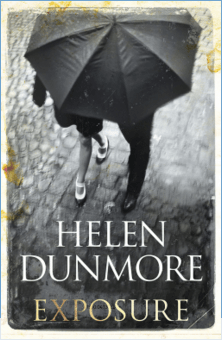
Cover for ExposureIt’s the early 1960’s, the height of the Cold War, and Giles Holloway is a spy for the Russians, employed by the British Admiralty. He has been slipped a file to copy by his superior, Julian Clowde, and he takes it up to his secret attic room to photograph it.

But Giles has become an unreliable drunk. He falls down the stairs, breaking bones. He knows he must do something about returning the file by the next day, so he calls Simon Callington from the hospital and asks him to pick up the file and give it to Julian Clowde’s secretary.

Simon is not a spy. He’s an unambitious coworker who is more interested in his family than his job. Long ago, when Simon was at university, he was Giles’s lover, and Giles thinks he will do as he’s told. But when Simon sees the folder, he knows it should not be in Giles’s possession and realizes the truth. Instead of taking it back to work, he hides it in a briefcase in the closet. But someone has seen Simon in Giles’s apartment.

Simon’s wife Lily finds the briefcase with the file behind Simon’s shoes while she is cleaning. She knows Simon isn’t guilty of espionage and can guess what happened, as she is aware that Simon went out the night before in response to a call from Giles. Lily buries the briefcase in the garden.

Suddenly, policemen arrive to arrest Simon and search the house. They find nothing, but somehow a small camera for microfilm has been found in Simon’s office.

link to NetgalleyDunmore does an excellent job of invoking the Cold War era and of creating suspense in this novel. The authorities are misguided, as it becomes clear that the real spies are trying to frame the innocent Simon. Lily, a German Jewish refugee during World War II, is questioned as if she were a Nazi. The newspapers break the news, and Lily loses her job as a French teacher and is treated like a pariah. After a while, the novel moves its focus to the struggles of Lily and her children, who go to a small village to live.

Although it took me a while to warm up to Lily and Simon, I was gripped, wondering what was going to happen to them and their three children. I liked this novel much more than I did The Greatcoat, the only other book by Dunmore I have read.

Related Posts

The Greatcoat

Sweet Tooth

A Perfect Spy