Day 860: Thursday’s Children

Cover for Thursday's ChildrenFrieda Klein has not been back to her home town of Braxton since she was 15, so she is surprised to hear from Maddie Capel, once a member of her group of friends. Maddie is concerned about the behavior of her teenage daughter Becky and wants Frieda to try to find out what’s bothering her.

Frieda is eventually able to get Becky to tell her that she was raped. A man came into her bedroom at night and raped her. Then he told her that no one would believe her if she reported it. Frieda believes her, though, because the same thing happened to her when she was a teenager, and the person used the same words. Frieda’s mother didn’t believe her at the time, and unfortunately Maddie doesn’t believe Becky.

In fact, once Maddie hears what Frieda has to say, she wants her to stay away from Becky, but she agrees to let Frieda see her one last time so she can recommend a different therapist. Frieda thinks Becky seems better, and Becky agrees to report the rape to the police. However, before she can do so, she is found dead, presumably having hanged herself.

Frieda doesn’t think Becky killed herself, though. She thinks the same person who raped her has been assaulting other troubled girls over the years. She also thinks the person learned Becky was going to the police and murdered her.

Frieda is determined to find the perpetrator, which means tracking down all her male friends from the time as well as a popular teacher who was reputed to have affairs with students. She also learns that her mother, whom she hasn’t seen in 23 years, is dying of cancer.

This novel is the fourth in Nicci French’s mystery/thriller series featuring psychotherapist Frieda Klein. Frieda is an interesting and complex character, extremely reserved but with a few close friends. A thread that continues from the first series is the existence of a serial killer that only Frieda knows is still alive. I enjoy this series, which always presents a challenging puzzle.

Related Posts

Blue Monday

Tuesday’s Gone

Waiting for Wednesday

Day 846: The Girl on the Train

Cover for The Girl on the TrainRachel has been having a hard time the past year or two. Her husband Tom left her for another woman, and her excessive drinking lost her her job. She is so ashamed of this that she pretends to go to work every morning on the train so that her flatmate won’t know.

On the train each day she passes her old neighborhood, and she spots a couple living in a house four doors down from where she used to live. She fantasizes that the two are a happy couple and even gives them names. But one day as she passes by, she sees the wife kissing another man.

That weekend, the wife, whose name is Megan, disappears. Throughout the book, some chapters are written from Megan’s point of view, starting a year before and moving quickly to the present. Immediately, it becomes clear that Megan is a woman with secrets.

Rachel goes to the police with her information about a lover, mainly because she knows they will look first at Megan’s husband Scott, and Rachel doesn’t think he did anything. But Rachel’s credibility is soon destroyed by Tom and his new wife Anna, who let the police know she’s been stalking them when she drinks too much.

In fact, the night Megan disappeared, Rachel was in the neighborhood trying to see Tom. But she was drunk and only has a hazy memory of being helped up by a red-haired man she sometimes sees on the train. After the incident, she awakened at home with a gash in her head that she can’t remember getting.

Rachel can’t seem to keep herself from inserting herself into the investigation, even lying to Scott that she and Megan were friends. Of course, it will all fall apart. The reader wonders, did Rachel herself kill Megan?

This novel has been compared to Gone Girl after that novel’s great success. I realize that is a marketing ploy, but it actually had the effect of making me avoid The Girl on the Train for a while. That said, I think a better comparison is with the novels of Sophie Hannah, which feature troubled heroines who are usually being gaslighted by someone.

As such, it is an effective thriller, difficult to guess. As Rachel slowly pulls her act together, we get to like her. I liked this novel well enough, but Gillian Sharp is great. I’ve admired her work since well before Gone Girl became popular. So, no comparison.

Related Posts

Gone Girl

Sharp Objects

The Wrong Mother

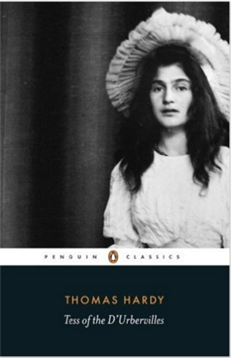
Day 844: Tess of the D’Urbervilles

Cover for Tess of the D'UrbervillesBest Book of the Week!
I love Thomas Hardy’s rural novels set in southwest England, and one of the highlights of a trip to England years ago was visiting his cottage in Dorset. My favorite of his novels has long been Tess of the D’Urbervilles, which I recently reread. I don’t mind admitting that in this reread, I was picturing scenes from Roman Polanski’s wonderful movie Tess, which follows the novel carefully and envisions it beautifully.

There is no doubt about it, Tess is a real tear-jerker, so if you prefer novels with happy endings, this is not the one for you. Still, in its own way, the novel ends hopefully.

The novel spans about five or six years, and we meet Tess as a naive young country girl attending a club dance. There she first sees a young man who will be important to her, Angel Clare, but he does not dance with her.

Hardy can be quite the fatalist, though, and Tess’ fate is sealed already, when her father John Durbeyfield meets a clergyman who dabbles in genealogy. Parson Tringham ironically addresses him as “Sir John” and tells him his family is the remains of the once-powerful D’Urbervilles. Her father immediately sets off to celebrate.

Tess’ foolish and feckless parents learn there is a rich old lady by the name of D’Urberville some counties away, so when Tess is partially responsible for the death of her father’s horse (because her father was too drunk to take the bees to town), they push her to go visit the old lady and claim kinship with her in hope of financial benefit. There she meets the charming wastrel Alec D’Urberville, who knows perfectly well they are not related, his family having bought the name and titles.

Tess gets a job from Mrs. D’Urberville as a poultry keeper, but Alec is always pursing her with his attentions. Tess finds these attentions unpleasant, but she is too naive to know what they mean or what she might fear.

Tess returns home with a past that is obvious to everyone and heartache ahead of her. Eventually, she gets another chance, as a dairymaid. There she meets Angel Clare, a gentleman studying to be a farmer, and finally falls deeply in love. But Angel is an idealist who has fantasized her into the embodiment of a pure child of nature. So, he is the last person to forgive her past.

Tess of the D’Urbervilles was a controversial book when it was published in 1891, because Hardy subtitled it “A Pure Woman.” This subtitle caused an uproar with the Victorians. Hardy’s message is strongly against the societal and religious laws that would condemn Tess.

Another aspect of the novel that I found more interesting this time through is that it depicts a rural way of life that is long gone. Although many of Hardy’s novels are rurally based, this one has more about the customs, work, and lifestyle as we follow Tess from one workplace to another than any of his novels except Far from the Madding Crowd. Tess’ father is a freeholder, a step up from a migrant farm worker, one whose family has leased the same land for generations. But when John Durbeyfield dies, the lease is up, and his widow and family are abruptly evicted so that the landlord can make room for someone who works for him. Such activities, Hardy makes clear, are the root cause of people migrating from the country to towns and cities, not that they were unsatisfied with country life.

Years after reading this novel last, I still became thoroughly engrossed in the story. It is a powerful one, poetically written, with gorgeous descriptions of the countryside and vivid imagery. I just love this novel.

Related Posts

The Land of Green Ginger

Independent People

The Warmth of Other Suns: The Epic Story of America’s Great Migration

Day 840: Juggling

Cover for JugglingI am usually a huge fan of Barbara Trapido, but I have to admit to being slightly disappointed by Juggling. I think my problem is in the depiction of its characters.

Christina is the youngest of two sisters. Her parents, Alice and Joe, decided to get married after Alice’s best friend died and Alice decided to adopt her baby, Pam. They all moved to the U.S. from England, and Christina came along seven months later.

Christina is a pushy, lippy, verbally active child, and from early on she doesn’t get along with her father. She finds him too controlling and manipulative, even though he seems to encourage her sauciness.

When Alice met Joe, she was dating Roland. Later, Roland met and married Gentille, Peter’s French mother. Although Peter gets along with Roland, the move from his quiet Paris apartment to England and boarding school is hard on Peter until he comes under the protection of Jago.

Jago is a popular boy in school, but like many popular boys, he tends to be a bully and hangs with a thuggish crowd. Still, he is good friends with Peter until adolescence, when Peter’s lack of coolness becomes too obvious.

Fatefully, Christina and her gentle sister Pam enroll at the same school as Jago and Peter. Christina is fascinated by Jago, but she and her sister are too clean cut in their American fashions for him to be bothered. Still, Jago finds himself drawn to Pam. Pam is oblivious and begins a friendship with Peter based on a mutual love of music. Then a terrible event occurs that changes everything.

This Trapido novel is all over the place, with a boy who floats in the air, another boy who is a mean bully, a Cambridge don who cheats his student by stealing her paper, reshuffling of partners into too many combinations, a woman who purposefully tries to cause problems between a woman and her daughter. And we’re supposed to like all the characters, I think.

I usually like Trapido characters despite their flaws, but in this case I didn’t. I found it hard to like Christina, who takes everything so personally that she splits from her family about something that happened to someone else, even splitting from that person, who was not at fault. I didn’t buy her antipathy to her father. In fact, if anyone is manipulative, it is she. The more likable characters, such as Peter and Pam and Alice, are neglected for the loudmouths and bullies. About the only one of the more forceful characters I liked was Dulcie, who is loud and exuberant, not a bully.

Trapido seems to have made a thing about people pairing up with the wrong partners. In this case, there are just too many of them and too many coincidences. Hence the title of the book, I suppose.

Related Posts

Sex and Stravinsky

Brother of the More Famous Jack

The Travelling Hornplayer

Day 839: Charles Dickens: A Life

Cover for Charles DickensCharles Dickens: A Life covers some of the same material as The Invisible Woman, Claire Tomalin’s excellent book about Dickens’ affair with Nelly Ternan, but it is broader in scope and provides more information about his life. Of course, The Invisible Woman was in a way ground-breaking, because it brought out into the open a relationship that was concealed for many years. In fact, the Dickens biography by Peter Ackroyd, which came out in 1991, the same year as The Invisible Woman, dismissed the affair as an improbability.

I much preferred this biography to Ackroyd’s. While Ackroyd practically falls all over himself telling us what a genius Dickens was, Tomalin is not afraid to examine the whole person, warts and all. Certainly, Dickens was charming, energetic, lots of fun for his friends, and the possessor of a serious social conscience. He was also one who ruthlessly cut ties to some friends and family, occasionally for trivial reasons; who treated his wife shamefully when he separated from her after 22 years of marriage (insisting, for example, that his children take his side and cut off ties to her); who made a young girl from a financially struggling family his mistress when he was more than twice her age. I feel that his fame was not good for him—that it gave him an inflated sense of his own importance and made him think he was infallible. Of course, he was probably the most famous person of his time. We have no modern equivalent.

Those interested in Dickens’ life and works will enjoy this biography. Dickens’ story is unique. He certainly had a difficult early life and worked hard for his success. He also started out as a much nicer person than the man he became, so during most of the book he is very likable. In fact, it’s easy to see why he was so loved by most of his friends and family. He was one of those charming people who are loved whether they deserve it or not. And in many ways, he did deserve it.

The book is extremely well written and very well researched, with more than 100 pages of notes and bibliography. Although more than 400 pages long (not counting the back matter), it moves along nicely and is entertaining. There are three insets of pictures and photos to illustrate the discussion along with a few interspersed drawings.

Just a small comment on my recurring theme of the quality of publishing. My copy of the book was bound upside down. Yes, the cover is on upside down, which I found rather disconcerting as I was always picking it up to read upside down. Unfortunately, I had it too long before opening it to return it for another copy.

Related Posts

The Invisible Woman: The Story of Charles Dickens and Nelly Ternan

Charles Dickens

Jane Austen: A Life

Day 837: Highwayman: Winter Swarm

Cover for Highwayman: Winter SwarmHighwayman: Winter Swarm is a novella-length story that appears to be an episode of a larger novel. This confused me a little until I read that the publisher, Endeavor Press, was publishing electronic novels in installments.

Samson Lyle is a former Roundhead major who is now a highwayman, doing his best to sabotage the efforts of Oliver Cromwell and particularly General Goffe. Lyle’s disaffection came about because of his refusal to participate in Goffe’s massacres of Catholics in Ireland. Lyle’s goodwife was killed in battle after this incident, and Lyle believes the death was no accident. Since then, he has been a bandit, seeking revenge.

Lyle, known as the Ironside Highwayman, is assisted by a teenage girl, Bella, whom he rescued as a young girl from prostitution, and a tavern owner, Eustace, whose live he saved. He also has various informants around the countryside.

The novella opens with a daring theft of the strongbox containing the back pay for the Middlehurst garrison. Later, Lyle attacks the salt detail, knowing Goffe cannot get through the winter without salt to preserve the meat.

This novella is mildly enjoyable as an old-fashioned swashbuckling adventure. If I understand what the publishers are doing correctly, I’m not sure how well it will work. As the first installment, the novella spent time on exposition that may have to be repeated, but it spent little time on characterization. In the tricks Lyle plays on the soldiers, it reminds me just a bit of the first book in Dorothy Dunnett’s Lymond Chronicles, but there is no way to judge whether the series will develop any depth. In general, I felt the approach to be unsatisfying, even though I like the idea of reading a novel in serial form, like the Victorians did. But this episodic approach, which probably doesn’t assume people will read the episodes in order, is not the same thing. It reminds me more of episodic graphic novels, without the pictures.

Related Posts

Viper Wine

The Candlemass Road

Captain in Calico

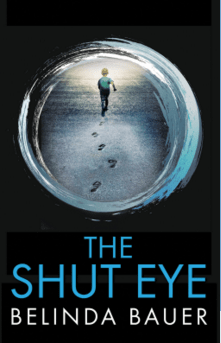
Day 833: The Shut Eye

Cover for The Shut EyeJohn Marvel is the main character of The Shut Eye, Belinda Bauer’s latest thriller. He has been an unlikable recurring character in her books, an abrasive police inspector, but previously, he has always been peripheral to the story.

Marvel is obsessed by an unsolved case, the disappearance of Edie Evans, who vanished on her way to school 11 months earlier. Her bike was found a few days later. Marvel has been fighting to keep the case open.

But it’s another case that we encounter first. Marvel saves a young woman from jumping off a bridge one night. She is Anna Buck, whose little boy Daniel wandered out of the house one day and hasn’t been seen since. Anna is distraught and blames her husband James for accidentally leaving the door open.

Marvel is revolted to have his new chief, Clyde, ask him to do him a favor, help find his wife’s dog. Clyde’s wife Sandra has been attending psychic sessions at a church, and Anna meets her there. The sessions are run by Richard Latham, who tried to help police in the Edie Evans case.

When Anna looks at the photo Sandra gives her of herself and her dog, she has her own psychic experience. She sees a garden that looks artificial. When she tells this to Inspector Marvel, he is disturbed to remember that Richard Latham made a similar remark. But he doesn’t believe in the supernatural, so he thinks Latham said something to Anna. Even more disturbing is the blurred picture of Edie on her bicycle that appears in the background of the photo, taken weeks after Edie’s disappearance and while her bicycle was impounded by the police.

We know that Edie has drawn a picture of a garden on the walls of her prison, because we periodically visit her. What we don’t know is when we see her within the time frame of the main story.

This is the first time I recall Bauer’s books having any supernatural content. I don’t know if she plans to have more or not. This is also the first time that Marvel is a main character, and although we don’t like him, we understand him better.

link to NetgalleyI did guess the identity of the perpetrator early on, but I think the guess was more intuitive than anything else. I did not, however, figure out what links the disappearances of the two children.

As usual, Bauer kept me riveted to the page. This novel is a little more mystery than thriller, but her last two novels seem to be moving in that direction.

Related Posts

Blacklands

Darkside

Finders Keepers

Day 831: Fresh from the Country

Cover for Fresh from the CountryOne of the pleasures I have not had for years is to read a novel by Miss Read, who wrote quite a few books over the course of 50 years, beginning in the 1950’s. Many of these novels are gentle stories about village life, but Fresh from the Country is about living in town.

Anna Lacey is a country girl who has recently finished training as a teacher and has taken a position as a primary school teacher in a new suburb of London. The school and the town are suffering the results of the post-war baby boom. Shoddy houses are going up quickly, and lodging is scarce. In the first scene of the novel, Anna inspects the grim quarters that will be her new home and is clearly cheated in her rent by her miserly landlady, who also underfeeds her throughout the novel.

The school, too, is crowded, as 48 children are crammed into her class in space meant for 20. The numbers in her class are a constant worry as she learns how to control the children, work in limited space, and keep the class productive. She also has to cope with the peculiarities of the various inspectors, since as a new teacher she is on probation.

Anna flees joyfully home on the weekends and holidays, to the large old farmhouse, her cheerful parents, and the beauties of the countryside. She finds the ugly scenery and the noise of the suburb hard to take.

Although Anna is a nice person, she at first tends to look askance at some of the foibles of her coworkers. It is her friendship with another teacher, Joan Berry, that teaches her not to be so hard on people who haven’t had the advantages of loving parents and a stable upbringing.

This is a gentle novel about the difficulties of being away from home for the first time, about learning new skills and learning to understand others, about the problems of the teaching profession. It has a tinge of light romance as well. It is mildly humorous, especially in the details of Anna’s life as a teacher.

Related Posts

South Riding

Miss Bunting

A God in Ruins

Day 828: Sex and Stravinsky

Cover for Sex and StravinskySex and Stravinsky is about two families that live far apart from each other but eventually meet. Caroline and Josh live in England with their daughter Zoe, while Hattie and Herman live in South Africa with their daughter Cat.

Caroline is Australian, tall, beautiful, and vastly capable. All her life she has been striving to please her mother, who continues to favor her other daughter Janet. Caroline leaves Australia to study in England and eventually marries Josh, a small, mild-mannered theatre academic. They struggle financially for their first few years. They are just able to afford their own house when Caroline’s mother moves to England without warning. She demands that they buy her a house and give her an allowance, and they seem unable to resist her commands. So, they continue struggling, living in a bus even though they have two professional salaries.

Hattie was Josh’s girlfriend until she met Herman. She was a ballerina despite the lack of support from her family. But when she married Herman, she started teaching and began writing a series of children’s books about a girl who wants to dance. Herman, a wealthy businessman, is away on business most of the time, and Hattie’s teenage daughter Cat treats her with contempt.

Caroline and Josh’s daughter Zoe has always wanted to learn ballet, and she adores the ballet series written by Hattie, who was Josh’s first love. But Caroline thinks Zoe is being silly about wanting to dance, even though Josh’s career deals heavily with ballet. Caroline says that in any case they can’t afford ballet lessons.

When Josh goes to a conference in South Africa, he reconnects with Hattie. Caroline finds out something shocking about her mother that sends her flying to South Africa to find Josh; Hattie finds out her lodger has a secret identity.

Trapido’s novels are witty and engaging. I always love them. They are sparkling with amusing dialogue, they have likable and not so likable characters, but ones that seem to be real people. Trapido continues to be one of my favorite writers.

Related Posts

Brother of the More Famous Jack

The Travelling Hornplayer

The Weird Sisters

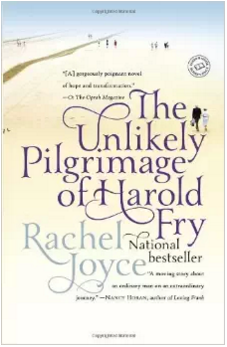
Day 826: The Unlikely Pilgrimage of Harold Fry

Cover for The Unlikely Pilgrimage of Harold FryI know that many people enjoyed reading The Unlikely Pilgrimage of Harold Fry. Unfortunately, I’m not one of them. The reason? I think that this novel is manipulative, pulling out all the stops to make you feel for its characters. What it didn’t do is make them convincing.

Harold Fry is retired, but since his retirement he’s done virtually nothing. He and his wife are estranged over a series of misunderstandings followed by a tragedy. He is an ineffective person who blames himself for lack of action at important times during his life.

One morning Harold receives a letter from a former coworker, Queenie Hennessy. Harold feels guilty about Queenie because he wronged her in some way, but we don’t find out why for some time. Queenie tells him she is in a hospice in Berwick-upon-Tweed, dying of cancer.

Harold, who is not good at self-expression, writes her a stiff letter and sets off to the post office to mail it. But he feels reluctant to return home and makes an excuse to walk to the next post office. Soon, Harold finds himself walking from Kingsbridge in far southern England to Berwick-upon-Tweed on the Scottish border.

This novel is about Harold’s self-redemption through the accomplishment of a difficult goal. It is a feel-good novel that uses all kinds of tricks, including a dead child, to make us feel sorry for Harold and sympathetic to his wife Maureen. But I did not find Harold’s journey very involving, and all along I felt manipulated, probably because, as I said before, the characters in the novel don’t seem to be real. They are instead types. This novel just doesn’t have much depth. It seems to be catering to the audience for “quirky,” saccharine, feel-good stories, which I am not a part of, and I didn’t find it very interesting.

Related Posts

My Wish List

Pastoral

This Is Your Life, Harriet Chance!