Day 327: The Five Red Herrings

Cover for Five Red HerringsAlthough I am normally a fan of Dorothy L. Sayers’ Lord Peter Wimsey series, The Five Red Herrings is exactly the novel I’m talking about when I say that I don’t care for the Golden Age mysteries full of railway timetables. This type of novel boils down to a puzzle designed to confuse the reader with a lot of detail. I do like Lord Peter, but I like him better when I have to keep track of fewer things.

Lord Peter is visiting an artists’ colony in Scotland when a painter is found dead. He is Sandy Campbell, a talented artist but one who also has a talent for getting drunk and picking fights. He is found in a stream with his half-finished painting on the bank high above, and the reasonable explanation is that he accidentally fell to his death. However, Lord Peter immediately notices inconsistencies that make it impossible for Campbell to have painted the picture.

Whoever the murderer is, he or she must also have been a talented painter, for the picture is exactly in Campbell’s style. Six other artists in the area who had quarrels with Campbell have enough ability to be the killer. Some of them have convincing alibis, and the solution revolves around–yes–railway timetables.

As usual, Lord Peter is entertaining. His man Bunter is not as much in evidence as in other novels, which is a little disappointing, but Sayers capably depicts a group of colorful suspects.

Day 325: Over Sea, Under Stone

Cover for Over Sea, Under StoneOver Sea, Under Stone is a charming children’s story with an Arthurian theme. Simon, Jane, and Barney Drew are vacationing with their parents and great uncle Merriman Lyon in a fishing village in Cornwall. While exploring the attic of the old house they rented, the children discover an ancient map of the local coast line. Barney realizes that the map refers to King Arthur.

The children’s parents are befriended by a Mr. Withers and his sister Polly, who invite the entire family to go fishing on their yacht. Jane is reluctant to go, though, and while everyone else is out, discovers a guide book that is similar to the map. It soon becomes clear that the Withers and perhaps other parties are looking for the secret that the documents reveal.

After a robbery, in which the robbers only rummaged through books and documents, the children decide to confide in great uncle Merry. They all figure out that the map and guide book may hold the secret to the Holy Grail. The children and their uncle become forces of the Light, while the others are forces of the Dark.

Over Sea, Under Stone is an entertaining book that should appeal to older grade school and middle school children. As an adult, my only quibble with it is the coincidence that other people suddenly begin looking for the map in the house just after the children find it. However, that is something that most kids wouldn’t think of.

The novel is well written and packed with adventure. I believe it is the first book in a series called The Dark Is Rising.

Day 324: Trick of the Dark

Cover for Trick of the DarkCharlie Flint is a profiler who is on probation because her testimony freed a man who went on to murder four women. She is asked by Corinna Newsam, her old tutor, to investigate the lesbian lover of the tutor’s daughter, Magda. Corinna Newsam thinks that this lover, Jay Stewart, may be a serial killer, because several people who were in her way conveniently died, including Magda Newsam’s husband on the night of their wedding.

Charlie finds herself attracted to a woman she meets in a seminar. (Spoilers follow in this paragraph and the next. I usually don’t include spoilers, but these are integral to my criticism.) This woman is clearly manipulating her from day one, and in the course of her investigation, Charlie violates the confidentiality of the people she is investigating by confiding in her. Of course, without this happening, there wouldn’t be a plot, but it is still the crux of my problem. I don’t think it would be likely that a person in her position would make the mistake of confiding information on a sensitive case to a new acquaintance, even if she is dating her.

It is the nature of this violation that bothers me most, as it is extremely unprofessional and I felt it unlikely from a profiler. Of course, the woman actually turns out to be connected to the murders, and this coincidence also bothered me.

Finally, I am reluctant to say this for fear it will be misconstrued, but at least five characters are fretting about their sexuality. These characters are lesbians, but I don’t enjoy this kind of emphasis in heterosexual literature either.

I am a big fan of the Tony Hill/Carol Jordan books, and I also like the Kate Brannigan series by McDermid. I know she has a Lindsay Gordon series, but I don’t think I have read any of those. McDermid has written some of the best stand-alone thrillers I have ever read, particularly A Place of Execution. I was disappointed not to enjoy this novel as much.

Day 323: Oliver Twist

Cover for Oliver TwistOliver Twist was one of the first adult books I read as a child, although I believe that David Copperfield was the very first one. This book is, of course, Dickens’ famous indictment of the British treatment of and attitudes toward the poor, as followed through the adventures of Oliver Twist, an innocent and hapless young orphan.

Oliver is born in the workhouse after his mother dies in childbirth without identifying herself. He is named by the beadle and brought up at a baby farm, the intent of which seems to be to starve as many babies to death as possible. The story really begins when Oliver is 10 years old and is moved to the workhouse to begin an illustrious career picking oakum, which is unraveling and picking apart old ropes. There he is voted by the boys to be their representative in asking for another bowl of thin gruel at mealtime (or rather is the only one naive enough to agree to do it).

This act brands Oliver as a malcontent, and he is apprenticed out to a coffin maker with dispatch. His employer seems disposed to be kind, but he is bullied by a “charity boy,” Noah Claypole, as well as by the housemaid and the coffin maker’s wife. Finally, after being unjustly punished for standing up for himself, he runs away.

Oliver’s adventures lead him to London, where he innocently falls in with a gang of thieves lead by the infamous Fagin. Oliver’s struggles to make his way in life without becoming a criminal and the mystery of his identity are the focuses of the rest of the book.

Although this novel has a few amusing and lovable characters, it is fairly grim compared to some of Dickens’ later efforts. It is merciless in its satire of institutions such as the workhouse and the law courts. Oliver himself is more of a symbol for goodness than a fully developed character, yet we are touched by his plight.

It is a long time since I read this novel, and I found I had forgotten just how complex the plot is. Although I do not feel that it is as good as some of Dickens’ later works, as his first serious novel, it is compelling reading.

Day 315: Beyond Black

Cover for Beyond BlackI have liked almost everything I have read by Hilary Mantel but could not finish Beyond Black. It is supposed to be extremely black humor, which I usually enjoy, and the idea is certainly an entertaining one, but somehow I felt it went too far, at least for me.

Alison is a medium who travels the rounds of the psychic “fayres.” She actually does see and hear the dead. Alison meets Colette, an event planner, who she hires as her personal assistant. Soon, the two women are sharing a house in a suburban wasteland, where apparently all hell breaks loose. (I did not get this far in the novel.)

Mantel’s skewering of the “fayres” is amusing. Another clever idea in the novel is that the dead are a bunch of seedy characters obsessed with trivial things, just as are many people in life. However, after awhile the sheer bulk of the trivialities becomes overwhelming.

Alison’s spirit guide, Morris, instead of being the traditional Indian chief or swami, is the ghost of an actual hoodlum Alison knew when she was young. I could deal with the spirits constantly talking about minutia, but Morris was incredibly repulsive and disgusting. With the mundanity going over the top combined with my disgust at Morris, I stopped reading.

Day 308: Love in a Cold Climate

Cover for Love in a Cold ClimateLove in a Cold Climate is more of a companion novel to Nancy Mitford’s The Pursuit of Love than a sequel, because it focuses on a different group of characters. Fanny is still the narrator, and she returns to tell a little more of her own story but mostly that of her beautiful friend and distant relation Polly Hampton.

When Fanny receives an invitation to stay with the family upon their return from India, she is happy to renew her friendship with Polly. Polly’s demanding mother, Lady Montdore, has been pushing her toward marriage, but Polly resists. Polly has always been difficult to read, unlike Fanny’s Radlett cousins from The Pursuit of Love, who “told everything.” Although Polly is so beautiful that she could have her pick of the eligible bachelors, she tells Fanny that she finds the whole life of the social season boring.

Lady Montdore is a rapacious, snobbish manipulator with social ambitions, although not without charm. Another family member who is important to the novel is also a snob, “Boy” Dougdale, the husband of Polly’s aunt, Lady Patricia. Fanny and her cousins have always called Boy “the Lecherous Lecturer” because of his tendency to furtively grope very young girls. Much to everyone’s surprise, Polly’s secret comes out when, shortly after Lady Patricia’s death, she marries a reluctant Boy, for she has been in love with him for years.

Polly is ostracized from her family and cut out of her father’s will as a result. But the plot thickens upon the arrival of Lord Montdore’s heir, the effeminate and hilarious Cedric Hampton.

As usual with Mitford, we have a strong suspicion that all her ghastly and funny characters strongly resemble real-life society members of her time. Her novels are full of vivid characterizations and incisive dialogue. Even in today’s world, so removed from her own, her novels are extremely funny.

As a side comment about the cover art, I find the covers of the most recent editions of Mitford’s novels to be too romantic and to do nothing to convey the spirit of her novels. I was able to find a better cover for The Pursuit of Love, but this was all I could find for Love in a Cold Climate.

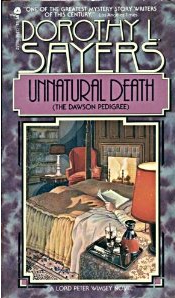
Day 307: Unnatural Death

Cover for Unnatural DeathAfter a long battle with cancer, Miss Agatha Dawson dies, leaving her considerable fortune to her great niece, Miss Whittaker. Nothing may be suspicious about this, but a local doctor is uneasy. He did not attend her at her death, but he treated her earlier and distrusts Miss Whittaker. When he cautiously voices his doubts, he is drummed out of the community for blackening Miss Whittaker’s name. So, he turns to Lord Peter Wimsey for assistance.

Miss Dawson’s nurse insists that the old lady was delirious the last month of her life and couldn’t possibly have written a will. The witness to Miss Dawson’s will claims that Miss Dawson did not want to be involved in the signing of the document. This does seem suspicious. Lord Peter is vaguely interested, but when he starts looking into the case, odd things happen. The first is that the maid dies.

Lord Peter and his friend Inspector Parker pursue the case, Lord Peter with his usual humor and urbanity. Lord Peter is an interesting character. A World War I veteran who is still haunted by the events of the war, he hides his nerves with bouts of silliness. He is a collector of rare books and a pianist who also flies his own plane and barrels around the countryside in his motorcar.

By and large, I enjoy Sayers’ Lord Peter Wimsey novels, although on occasion they get bogged down in a myriad of details, for, as a Golden Age mystery writer, Sayers prefers to present her readers with puzzles rather than motives. However, the complexity in Unnatural Death is created with the plethora of suspects who managed to traipse through the dying woman’s bedroom, all with their own stories–an approach that is more to my taste than complicated railway timetables.

Day 306: The Cat’s Table

Cover for The Cat's TableIn the early 1950’s, the 11-year old Michael Ondaatje set sail from his home in Sri Lanka for England to meet his mother and go to school. The Cat’s Table is a fictionalized tale of this journey, he tells us.

On board the Oronsay, Michael (nicknamed Mynah) becomes friends with two other boys–Cassius, a wild, rebellious boy from his school, and Ramadhin, gentle and contemplative, with a bad heart. Also on board is Michael’s cousin Emily, a 17-year-old beauty with whom he is close.

Although Michael’s father has arranged for an acquaintance to look after him, she is in first class and only summons him occasionally during the voyage. Michael and his two friends are assigned to the “cat’s table” with the most insignificant passengers on board–a tailor who never speaks; Mr. Mazappa, a jazz musician who admits he is “on the skids”; Miss Lasqueti, a seemingly colorless spinster; Mr. Fonseka, a literature teacher from Colombo; and Mr. Daniels, a botanist who is transporting an entire garden in the hold of the ship. Other important characters are a deaf Singhalese girl named Asuntha whom Emily befriends and a mysterious prisoner who is brought above board late each night and provides fuel for the boys’ imaginations. Michael and his friends find that no one is paying attention to them, so they run wild all over the ship.

At first this narrative proceeds more or less sequentially in a series of vignettes telling of different passengers or events. Later, the narration branches out, moving forward in time to later periods and incidents in Michael’s life related to the people he knew on the ship, and then back again. Toward the middle of the novel I felt confused, as if the narrative would never resolve itself into a coherent story.

But it does. Events on board the ship affect the future lives of several of the passengers, particularly those of Michael and Emily. In getting to that place, we experience the sights and sounds of this exotic and evocative passage across the Indian Ocean and the Arabian Sea, up the Suez Canal, and into the Mediterranean.

The novel is beautifully written, with the vignettes working together in the same way that Michael describes a series of paintings by Cassius, which he sees in a gallery years later. At first the paintings seem abstract, but if he looks at them from the right distance, he sees they perfectly depict the events of a particular night in their voyage together. The vignettes, like fragments seemingly disconnected and abstracted, slowly come together to show us a coherent whole, of Michael’s understanding of the events of the voyage, of his reinterpretation of those events later in life, of how they affect his life and those of others.

Day 305: The Dark Enquiry

Cover for The Dark EnquirySome elements of Deanna Raybourn’s Lady Julia Grey romantic mystery series sometimes get old, such as the debate between Lady Julia and her husband Brisbane about how involved she is allowed to get in his investigations. This debate begins The Dark Enquiry, and eventually Brisbane reluctantly agrees that she can be a partner in his investigations, but not before she discovers for herself that her own proper, conservative brother, Lord Belmont, is being blackmailed. As a government official, he should have known better than to get involved with a lady, but especially to send her love letters. The lady turns out to be working for a foreign government.

In following up her investigation into her brother’s difficulties, Lady Julia disguises herself as a man to go to the Ghost Club, where Madame Séraphine holds nightly séances. There she is discovered by Brisbane. As they sneak back into the club together later in the evening, they are just in time to see Madame Séraphine be murdered by poison.

This novel is peopled with Lady Julia’s eccentric family, but it also features blackmail, gypsies, and spies. Raybourn’s novels are lively, and the dialog is entertaining. If we can just get over the endless debate about Julia’s part in the investigations, the series will continue to be fun to read.

Day 304: Flashman

Cover for FlashmanHaving enjoyed Fraser’s The Candlemass Road, I thought I would give his satirical Flashman series another try. I read one years ago but wasn’t prepared to be met with such an unmitigated scoundrel as the main character.

Flashman is the first of the series, and it begins when Flashman is expelled from Rugby. Apparently, the character is based on a bully who appears in Tom Brown’s School Days, a novel I have never read but which is frequently referenced in other literature.

Flashman at a young age is already a complete scoundrel, cheat, and poltroon, so the comedy in the novel centers around his ability to be successful and eventually to be lauded as a hero despite his true nature. Having set his sights on a position as officer in the Eleventh Light Dragoons, a unit he selects as unlikely to see combat, Flashman is getting along swimmingly under the ridiculous Lord Cardigan until he makes the mistake of seducing a Scottish merchant’s daughter and being forced to marry her. To the snooty Lord Cardigan this fraternization with the middle class is unacceptable, so Flashman is forced into an Indian regiment.

Flashman is not happy to be consigned to what was then regarded as second class service, but once he arrives in India he finds he enjoys bossing around the natives and discovers in himself a facility for languages. Unfortunately from his point of view, this talent gets him assigned to Afghanistan as an aide to Lord Elphinstone just before the infamous and harrowing 1842 retreat.

This satire of the army and society reminds me of Thackeray’s more subtle Vanity Fair. I think you have to be in the mood for Flashman’s antics, but the novel is based on solid historical research and is certainly entertaining. Fraser’s prose is incisive as he cuts swaths through Victorian society and skewers the ineptitude of the British army.