Day 151: Moonfleet

Cover for MoonfleetMoonfleet is a boy’s adventure story similar to Kidnapped or Treasure Island. Written by J. Meade Falkner in 1898, it was very popular for many years. I had actually never heard of it but picked it up out of curiosity a couple of years ago.

John Trenchard is an orphan boy who lives with his aunt in the small village of Moonfleet in the south of England in 1757. The village has been dominated by the Mohune family for centuries. There is a legend that Colonel John “Blackbeard” Mohune stole a diamond from King Charles I and that his ghost roams the crypts looking for it.

One day John hears noises from Mohune’s crypt, and when he goes to investigate, finds the landlord of the local inn, Elzevir Block, and Mr. Ratsey, the sexton, who say they are looking for damage from a storm. John assumes they are looking for Blackbeard’s ghost. He finds his way into the crypt through a large sinkhole and gets inadvertantly trapped there overnight. While he is trapped there, he overhears enough to realize that Block and Ratsey are actually smugglers.

John’s aunt assumes he has been up to no good when he doesn’t come back for the night, so she throws him out of the house. Fortunately, Block takes him in. But when Block’s lease expires, the lease goes up for auction and is purchased by Maskew, the unpopular local magistrate. Before Block leaves the area, John accompanies him on one last smuggling venture, during which Maskew, who has lain in wait for the smugglers with the excisemen, is accidentally shot by the excisemen. John is wounded and is falsely accused in absentia of murdering Maskew, so he must flee to the continent.

The rest of John’s adventures include diamond hunting, being imprisoned for theft when he is cheated by an avaricious diamond merchant, working as a galley slave, and shipwreck. Moonfleet is an exciting book with a gripping story line that is still popular with children.

Day 141: Shadow of Night

Cover for Shadow of NightAs with most second books of a trilogy, Shadow of Night is transitional and therefore harder to describe than the first book.

At the end of the A Discovery of Witches, the first book of Deborah Harkness’s “All Souls Trilogy,” Diana Bishop, an Oxford scholar and nonpracticing witch, and her husband Matthew Clairmont, a geneticist and vampire, were forced to flee because a union between a witch and a vampire is forbidden. Using Diana’s newly discovered time-travel skills, they have arrived in Elizabethan England so that Diana can find a witch to help her learn her powers. Even more importantly, they want to look for Ashmole 782, an enchanted manuscript that Matthew believes may hold the secret to the existence of witches, vampires, and daemons. This decision proves potentially hazardous, though, as the age they’ve chosen is one of persecution of witches and Diana has a tendency to draw attention to herself.

In Tudor England Matthew of the past is part of an intellectual group called the School of Night, the members of which include Sir Walter Raleigh and Kit Marlowe. Kit is a deeply disturbed daemon who is insanely jealous of Diana. Another hazard is that Matthew’s acquaintances may realize he is not the same person as the person from the past. In the meantime, both Diana and Matthew’s friends and enemies back in the present time watch for clues to their existence in the past.

Although this novel is a great sequel that propels you to the next book, it has the typical middle book problem of furthering the plot without arriving anywhere. Strictly because of personal taste, I could also have done without some of the heavy romantic passages, although other readers will like them. Nevertheless, I am extremely interested to see how Diana and Matthew will resolve all their problems in the final book.

Day 137: Little Face

Cover for Little FaceIn Sophie Hannah’s complex thriller Little Face, Alice Fancourt leaves her infant daughter with her husband for a few hours and returns to find, she says, another baby in her place. Her husband David tells Detective Simon Waterhouse that the baby is theirs and insists his wife is crazy. David’s overbearing mother Vivienne is not so sure, but she treats Alice like she is the infant. The cops, for the most part, agree with David.

But Waterhouse is inclined to believe Alice and finds what he thinks is a very good reason to look into it further. David’s first wife was murdered. He thinks the key to the possible kidnapping may be in the first wife’s death.

Simon’s boss Detective Sergeant Charlie Zailer thinks Alice is losing her mind and refuses to let Simon investigate. She also thinks Simon is too protective of Alice and may also be inappropriately attracted to her. To add to the confusion, Simon and Charlie are navigating their own minefield of Charlie’s infatuation with Simon. But suddenly, both Alice and the baby disappear.

Sophie Hannah is a master of the psychological thriller, and Little Face is no exception. Her plots are carefully constructed, and Hannah employs her usual technique of alternating the point of view between characters. Sometimes I think that all the characters in Hannah’s books, including the detectives, are insane, but somehow this just adds to the atmosphere and the fun. You can bet with Hannah that the ending will be thrilling.

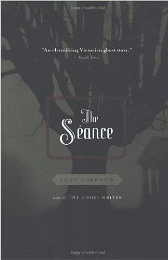
Day 136: The Séance

Cover for The SeanceThe Séance is a modern novel that is written like a Victorian gothic mystery. It features narrations by several different characters–a typical Victorian device that was used successfully in Wilkie Collins’s The Moonstone.

John Harwood’s novel is difficult to describe without going too far into the plot, because some important characters do not appear until later in the book. It begins with the story of Constance Langdon’s dreary childhood and young adulthood. Her mother has been depressed and nonfunctional since her sister died, and her father behaves as if he lives alone in the house. When Constance reaches the age of 11, her father withdraws her from school and abandons her and her mother to go live with his sister. Later, a disastrous experiment with spiritualism (very popular in Victorian times) in an attempt to help her mother results in her mother’s suicide.

Constance accepts her uncle’s invitation to live with him in order to avoid being thrust upon a father who doesn’t want her. But shortly after moving in with him, she finds she has inherited Wraxford Hall, an infamous house, old and crumbling, where two boys died; an old man mysteriously disappeared; and Magnus Wraxford was apparently murdered by his wife, Eleanor, who has also disappeared.

The next section of the novel is narrated by John Montague, a lawyer who visits Constance. He was involved in the experiment at Wraxford Hall that ended in the murder of Magnus Wraxford, and he tells the story of the experiment. This visit and Constance’s subsequent agreement to take part in a séance at Wraxford Hall lead us to Eleanor’s story, which is taken up by a diary that Eleanor wrote. Finally, we return to Constance. When she arrives at Wraxford Hall, she finds the experiment is to take place in a spooky gallery occupied by an odd-looking set of armor and a sarcophagus.

The novel is successfully creepy and mysterious. However, by the time of the séance I had figured out one character’s crucial secret identity, which made several other plot points clearer. Some readers may find it takes a long time to get to the crux of the novel, but I enjoyed the journey.

Day 134: A Red Herring Without Mustard

Cover for A Red Herring Without MustardBest Book of the Week!
A Red Herring without Mustard is another of Alan Bradley’s delightful, comic mysteries featuring Flavia de Luce, the eleven-year-old detective and chemist.

In this book a mysterious gypsy woman is nearly beaten to death after Flavia allows her to camp on de Luce land. Something odd is going on. After Flavia surprises a neighborhood thug in the de Luce’s drawing room when everyone else is in bed, she finds him dead the next day, hanging from the trident of a fountain of Poseidon.

As usual, Flavia races all over the countryside on her bike Gladys, feuds with her sisters, consorts with her father’s shell-shocked batman, and tumbles into trouble in this novel, set in England just after World War II.

Bradley’s plots are implausibly complex, but it is not for the mysteries that I read these books but for the funny, irrepressible character of Flavia.

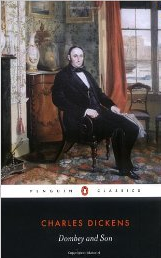
Day 126: Dombey and Son

Cover for Dombey and SonI recently re-read Dombey and Son after not having read it in so long that I could not remember its plot. The novel is Charles Dickens’s tale about Paul Dombey, a wealthy, cold, self-important man who cares only about his son, not about his wife or his gentle, loving daughter Florence. His wife dies in childbirth, and his son Paul is weak and often ill, but Paul and Florence have a loving relationship. When Florence is kidnapped as a child, she is rescued by Walter Gay, a young employee of Dombey. Dombey ships him off to Barbados to get him away from Florence, but Walter’s ship is lost and he is presumed drowned.

With Walter gone, Florence has only her brother Paul for her friend. Then Paul dies, and her father even resents Florence for the love his son had for her, which he did not give to his father.

Dombey meets a beautiful widow, Edith Granger. She is a cold, haughty but impoverished woman, and Dombey essentially “buys” her by marrying her. She despises Dombey for his pride and herself for having married him for his money. The only person she is kind to is Florence, which provides more fuel for Dombey’s dislike of his own daughter. His attempts to subdue his wife end in her disgracing him as best she is able by running away to Dijon with Mr. Carker, one of Dombey’s rivals. When Florence attempts to offer sympathy, Dombey strikes her and she leaves the house, friendless and destitute.

Although the novel is not critically accepted as one of Dickens’s major works, it is still enjoyable. It is full of vibrant characters–mostly those of good will but also some villains–and it is gripping to the end. Some critics have noticed a change in the novel that takes place with the death of the young Paul, believing that having the colorless Florence and the unlikable Dombey as the main characters is not enough to carry the story forward. The absence of Walter and his uncle through much of the book is also thought to be a problem. However, the novel has all of the Dickens hallmarks–social commentary, comic absurdity, realism, pathos, and transformation. Dombey and Sons was written before most of Dickens’s real masterpieces like Bleak House or David Copperfield, but it certainly shows the movement from his lighter, shorter works toward the qualities of his more major works.

Day 124: Whose Body?

Cover for Whose BodyIt has been years since I read Whose Body? by the British writer from the Golden Age of Mysteries, Dorothy L. Sayers. Unfortunately, as soon as I saw the murderer’s name, I remembered who did it, so I was not able to judge how difficult it was to guess.

Mr. Thipps finds an unidentified body in his bathtub wearing nothing but a pair of pince-nez. The body bears a resemblance to a missing financier, but it is not him. Who is the dead man and how did the body get into the tub? Where is the missing financier? Is this one case or two? Of course, the police suspect Mr. Thipps. After Mr. Thipps’s mother asks him to help, Lord Peter Wimsey gets interested in the case and decides to find the answer to these questions in his inimitable way.

As always, Sayers is fine in characterization, much better than many of her Golden Age peers. Lord Peter is his usual apparently frivolous self. He and his man Bunter are fun. Lord Peter’s mother, the Dowager Duchess, is adorably ditzy. The plot is clever. However, as with many early mystery novels, it is overcomplicated and very unlikely. For people who haven’t read any Lord Peter books, I recommend Murder Must Advertise as a better starting place.

As a total side note, the cover I’m showing is not the one for the book I read, but is just one I found on Amazon. It occurs to me, why would they show the body of a woman when the victim is a man? This disconnect in publishing is always a mystery to me. One peek at the first few pages would have told the artist the sex of the body.

Day 122: The Tudor Secret

The Tudor SecretI have heard about C. W. Gortner before, but The Tudor Secret is the first book of his I have read. My overall impression is that the book reflects some knowledge of Tudor times and some research, but is generally on the light side, with a fairly predictable plot.

Brendan Prescott is a servant of the powerful Dudley family, a foundling who has been mistreated by the Dudleys all of his life. He is surprised when he is removed from the stables and given training as a body servant. He is dismayed when he is sent to court to wait on the cruel Robert Dudley.

He is almost immediately thrust into dangerous circumstances as he tries to help the Princess Elizabeth see her dying brother, King Edward. Edward’s regent Northumberland, Robert’s father, is trying to keep everyone away from the king.

Elizabeth is in contention for the throne against her half-sister Mary. But Northumberland is trying to manipulate his daughter-in-law, Lady Jane Grey, and his son Lord Guildford Dudley, onto the throne. Soon, Brendan finds himself spying for William Cecil to help Princess Elizabeth.

Although the Tudor era was a turbulent time, involving much intrigue and a lot of paranoia, I felt that some of the plots suggested in the book were absurd, such as Northumberland poisoning Edward so that he can put himself on the throne. I understand from reading one of the reviews on Amazon that this was an early book by Gortner and not up to his usual level, so perhaps I will try another.

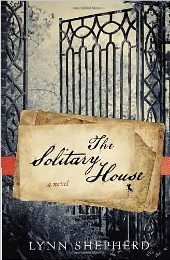
Day 118: The Solitary House

Cover for The Solitary HouseBest Book of the Week!

I had an ambivalent reaction to The Solitary House, which is sort of a riff on Bleak House. It is not exactly a retelling of Dickens’s book. Although some story lines are re-interpreted, most of the Dickens characters appear in the background of the novel. My ambivalence is because Bleak House is one of my favorite Dickens novels, and I have not been happy with some of the retellings of classics that have appeared lately, particularly those that seem to miss the point of the original works. I am also a little dismayed by what Shepherd has done to some of my favorite Dickens characters. However, I find I have to admire the masterful way Shepherd has worked the threads of Dickens’s novel into such a different story. On the whole, almost despite myself, I am giving this novel a big recommendation for its originality.

Charles Maddox is a former detective for the London police force who left under undesirable circumstances. He is hired by Edward Tulkinghorn, a mysterious solicitor who has an evil reputation. A client of Tulkinghorn’s has been receiving threatening letters, and Maddox’s assignment is to find out who is sending them. Charles descends into the squalor of London to discover the author of the notes, but when he turns the information over to Tulkinghorn, the author of the notes is brutally murdered.

Thinking that this is not a coincidence, Charles begins investigating Tulkinghorn himself, as well as his client, Julius Cremorne. In doing so, he comes upon evidence of a serial killer. He also runs up against Inspector Bucket, his former police supervisor.

Charles’s story is written in a jokey third-person omniscient narration that often addresses the reader directly and is interlarded with many references to Dickens and some quotes from Shakespeare. Imagine a style that is like a postmodern Dickens. This narration is interleaved with the first-person narrative of Hester, seemingly the same quiet, loving, capable Esther Somerset of Bleak House. It is not until the end of the novel that these two stories merge horribly together.

Ultimately, I am coming down on the side of strong admiration for this book. It is completely absorbing and inventive, well written and literate, and actually convincing as a twisted alternate vision of Bleak House minus the case of Jarndyce vs. Jarndyce. It made me want to return to Bleak House, which I have not read recently, and dig out all the references. It is a gothic novel that becomes a serious creepfest, and you know how I love those.

I see that Shepherd has also riffed on Mansfield Park. As much as I am dreading what she will do to my beloved Jane Austen, I think I’m going to have to read it.

Day 117: Tinker Tailor Soldier Spy

After seeing the exciting movie this winter, I decided to read the novel Tinker Tailor Soldier Spy by John le Carré. George Smiley has been drummed out of the service and the entire leadership of “The Circus” (slang for Britain’s intelligence organization) replaced after the death of Control, their former leader.

But the ministry calls him in to listen to the tale of Ricky Tarr, a low-level operative from Penang, who has been missing for months. Tarr’s story includes information from the wife of a Soviet operative and an allegation that The Circus has a mole at the highest level, moreover, that the mole has been sending the Russians information for some time. The ministry wants Smiley to investigate. It is soon clear that the mole is one of only a few of Smiley’s colleagues, whom he has known and worked with for years.

The novel is breathtakingly suspenseful even though, having seen the movie, I knew the ending. Smiley puts the pieces together by going over records of significant events and interviewing several agents who were replaced because of suspicions they raised or events they witnessed.

This may not sound exciting in this day of explosions and car chases, but le Carré is a master at building up the intrigue and suspense. You will not want to put this book down. I recommend the movie as well, featuring a host of excellent British actors.