Day 684: Ella Minnow Pea

Cover for Ella Minnow PeaEven though I enjoyed Mark Dunn’s unusual novel Under the Harrow, I avoided Ella Minnow Pea for some time because it sounded too gimmicky. When I finally read it, I found it mildly entertaining, but yes gimmicky, although I can see why it would amuse those with a different sense of humor than mine.

Ella Minnow Pea is a 17-year-old girl living on a fictional island off the coast of South Carolina that is not part of the United States. This island, called Nollop, is named after Nevin Nollop, the supposed author of “The quick brown fox jumped over the lazy dog.” Nollop is the island’s most eminent native son, and there is a cenotaph containing the sentence in the middle of Nollopton.

This epistolary novel opens with a letter from Ella to her cousin Tassie in Nollopville, in which she relates that the letter z fell off the cenotaph. Soon, the island council announces that the spirit of Nollop has used this way to send the message that the letter z must be removed from all island correspondence and speech. Violation of this statute is punished severely with a third occurrence resulting in banishment. The libraries are soon closed, because no books exist without the letter z. A rebellious youth is banished almost immediately. Conveniently, the procedures for running the government are destroyed, including those for recalling the council, because they contain the banned letter. People make mistakes and are punished or banished. The radio station eventually shuts down and the newspaper struggles, because it is too difficult to avoid the letter.

Then another letter falls, then another.

It is mildly amusing to see how the characters get around the problem of the disappearing letters in their correspondence. Of course, the novel is a statement about tyranny and freedom of expression.

Dunn’s latest novel Ibid, a novel written entirely in footnotes, has good reviews for its originality. Another gimmick, and I’m not sure I’ll try it. Dunn’s interests seem to lie in inventing isolated imaginary places where over-elaborate speech is common, along with made-up words, and where the government can’t be trusted.

Have you read Ibid? What did you think of it?

Related Posts

Under the Harrow

Good Omens: The Nice and Accurate Prophecies of Agnes Nutter, Witch
Brave New World


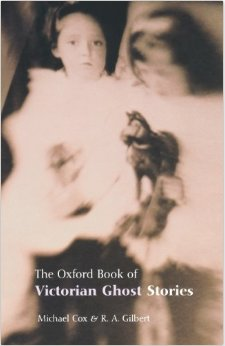
Day 604: The Oxford Book of Victorian Ghost Stories

Cover for The Oxford Book of Victorian Ghost StoriesIn honor of Halloween, I decided to read this collection of 35 ghost stories from Victorian times, when they were very popular. This collection contains stories by well-known writers of the time, such as Charles Dickens, Mary Elizabeth Braddon, Wilkie Collins, and Rudyard Kipling, as well as those by other less-known writers.

First, I’ll comment that modern audiences probably won’t find them very scary. But I’m not so sure this has anything to do with the period or the ability of the writers. I think it’s very difficult to handle genre fiction successfully in a short story. Short stories seem to me to be more suited for literary fiction somehow. A few years ago, for example, I read a collection of mystery short stories but felt that the form didn’t allow much space to really develop an interesting atmosphere or characters. It merely allowed the author to pose a puzzle and a solution.

The Victorian ghost stories seem to observe a few conventions. Unlike the gothic stories from the preceding years, Victorian ghost stories are more homey and less likely to include oddities, fantastic events, or exotic settings. Many of them are presented as a person telling a story to one or more other people, often as an evening entertainment before the fire. Almost all of them involve haunted houses, which often seem to be leased to unwary renters at a suspiciously low price. (But I shouldn’t mock. I actually have a friend who found himself in precisely this situation.) Another common theme is a haunted object. In most of the stories, the worst thing that happens is that someone sees a ghost, although there are a couple that are a little more gruesome.

I found the story-telling approach a little tiresome after awhile and was refreshed by the ebulliant characters writing the letters in the epistolary story “The Truth, the Whole Truth, and Nothing but the Truth,” by Rhoda Broughton. “The Romance of Old Clothes” by Henry James and a few others also stood out. The collection even includes one vampire tale.

If you are looking for some chilling reading, you’re not really going to find it here. (Although I’ll suggest that any of these stories may be more successful if read out loud, preferably on a dark and stormy Halloween night.) However, if you are interested in the genre or the time period, you’ll probably find the collection worth dipping into.

Day 552: Dracula

Cover for DraculaHaving experienced other gothic classics of the 18th and 19th century, I was delighted to find Dracula unexpectedly readable. I was also surprised to find how little it resembles its many theatrical and movie productions, even those that attempt to stay closer to the original work.

All versions begin the same, however, with poor Jonathan Harker sent out by his office to Transylvania to complete a property deal with his client, Count Dracula. While staying at Dracula’s castle, he begins to suspect something is badly amiss and eventually fears for his life.

Back in England, his fiancée Mina Murray corresponds with and later stays with her good friend Lucy Westerna at a seaside town. In one day, Lucy has received proposals from three different young men, who all feature strongly in the novel. Dr. Jack Seward is in charge of a local insane asylum. Quincy Morris is a manly, amiable Texan, whom I feared all along was designed for a ghastly death. Lucy’s chosen is Arthur Holmwood, another manly young man who is soon promoted to a lordship by the convenient death of a benefactor. (I don’t think these things work this way, since Arthur is not his benefactor’s relative, but never mind.)

After a freakish storm, a Russian ship arrives unmanned at the port where Mina and Lucy are staying with Mrs. Westerna, who is gravely ill. As it arrives, a large dog jumps off it and runs ashore. Aboard is not a single live human. We horror aficianados know that Dracula has arrived.

While Mina waits for news of Jonathan, Lucy begins sleepwalking and behaving oddly. Dr. Seward makes notes about a patient who eats bugs and babbles about his master. Soon Van Helsing will be needed.

Unlike in most of the spin-offs, except for Jonathan Harker’s experiences at the beginning, Dracula is mostly an unseen menace for much of the novel. I’m guessing that the original readers did not necessarily realize the identity of that bat fluttering outside Lucy’s window.

In any case, the novel covers a lot more ground than does the standard remake. It is epistolary, written entirely as letters and journal entries. It is well written and moves along nicely except for the occasionally long-winded expulsion of pseudo-scientific mumbo-jumbo by Van Helsing or Seward. In the true gothic fashion, it is a classic battle of good versus evil, with the prize the soul of our heroine Mina.

Modern readers may be bothered by the depiction of the two women. Lucy is supposed to be a modern woman—who else would have three suitors at a time? She is both innocent and pure in herself and quite the seductive vamp when under the spell of Count Dracula. The men do a lot of harm to both her and Mina by trying to protect the “little women” from knowledge of what is going on. Again, try to judge the novel’s attitudes by the standards of its own time, when it was simply considered a whomping good tale.

Day 376: Where’d You Go, Bernadette

whered-you-go-bernadetteDespite the cover, Where’d You Go, Bernadette is not chick lit; however, it is a great beach read, and summer is almost over (except if you live in Texas, like I do)! This novel is quite a romp. It has a zany, ridiculous plot and is full of little jibes at such things as suburban mothers who are overly involved in their children’s schools, Microsoft, and Seattle.

Bee loves her mother, who is creative and funny, but Bernadette has managed to alienate the other mothers at Bee’s school. She is slightly agoraphobic, so she stays home most of the time and does not volunteer at school, and she has hired a virtual personal assistant to help her run errands, even though Bee’s father doesn’t approve. Bee’s father Elgie is a computer genius who is practically worshipped at Microsoft and is seldom at home.

Bee’s parents have promised her that if she gets perfect grades, she can have any gift she wants. She picks a trip for the entire family to Antarctica over Christmas. To Bernadette, the idea of such a trip is intimidating, but she thinks Bee deserves it, so she begins ordering supplies online and getting Manjula, her online personal assistant, to take care of travel arrangements.

However, Bernadette’s dispute with a neighbor (and school mom enemy) about blackberry brambles creates complications that are both appalling and hilarious. When Elgie gets drawn in, he misunderstands what is going on because of his ignorance of home events. Crisis ensues, and Bernadette disappears on the eve of the trip.

Elgie is convinced that Bernadette had a breakdown, but Bee refuses to give up on her mother. She decides to try to figure out what happened the last few weeks before her mother disappeared.

My description does nothing to convey how cheeky, inventive, and funny this novel is. It is told in an epistolary style through emails from Bernadette to Manjula, emails between plotting mothers who hate Bernadette, emails between Elgie and his administrative assistant, and Bee’s record of her search for her mother. Bee and Bernadette are appealing, even while Bernadette is going a little crazy. If I have one little quibble, it’s that I don’t believe the personality change that one character undergoes. Still, if you want something light and lots of fun, this is the book for you. I have to thank my friend Gunjan for this recommendation.