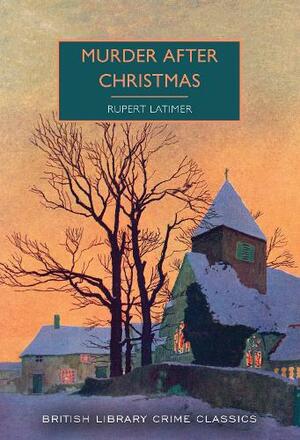
Review 2519: Murder after Christmas

There’s nothing like a nice, cozy mystery to read at Christmas time. This one is so cozy, in fact, that you don’t want any of the characters to be murderers. And what better day to post the review of a book called Murder after Christmas than New Year’s Eve?

When Rhoda Redpath invites her eccentric, elderly, very wealthy stepfather to spend Christmas, none of the Redpaths expect him to come. After all, he has never come before. Uncle Willie is nearly 90 and has lived a rambunctious life, so there are lots of people who want to meet him. Thus, when he agrees to come, the Redpaths decide to throw a real blowout, a Christmas Tree on Boxing Day, and invite everyone.

Once he arrives, his behavior is a bit odd. He eats a lot, stuffing down loads of mince pies and chocolates even though it is wartime. He gets the order of his wives mixed up, and all the Christmas packages disappear. He also starts writing his memoirs, so they have to hire a secretary.

During the party, he is hardly to be seen except when he appears dressed as Santa to pass out the packages. Frank Redpath, the host, also appears as Santa, but having been upstaged by Uncle Willie, his appearance is a bust. Then the next morning, Uncle Willie is found frozen stiff out by the snowman, still in his Santa suit. Was it a natural death or did someone murder him? When everyone learns that his wife died on Christmas day, the timing becomes very important.

Uncle Willie is found to have laudanum in his system. Nevertheless, the coroner’s hearing finds the cause of death accidental, assuming the batty old man took an overdose. Inspector Culley isn’t quite sure, so when Frank and Rhoda Redpath ask him to stay and figure out what really happened, he agrees.

Inspector Culley’s clue collection involves lots of mince pies—sewn into a chair cushion, eaten before Christmas, eaten after Christmas, packages hung from the ceiling, chocolates hidden in the snowman, and a turkey in the wardrobe—among other things. The whole thing is ridiculous and hard to keep track of, so I just went along for the ride.

Lots of fun, this one. I’ll never look at mince pies the same again.

Related Posts

The Iron Clew

Who Killed Father Christmas?

Silent Nights

Review 2517: Dead Ernest

I very much enjoyed the Tilton books I have read so far, especially for a certain wacky energy, so when I saw that Dead Ernest filled a hole in my Century of Books project, I looked for a copy. At first, this novel was almost too frenetic for me, but either it calmed down a bit or I got used to it.

Leonidas Witherall, Tilton’s amateur sleuth, is trying to finish one of his Lieutenant Haseltine adventure novels before his publisher goes crazy, so he has asked not to be disturbed. However, telegrams keep arriving that he doesn’t look at, people keep coming to the door, and his housekeeper, Mrs. Mullet, keeps trying to tell him things he refuses to listen to. Of course, we know he should at least be opening the telegrams and listening to Mrs. Mullet.

After Leonidas sends her home, two young men show up with a truck and try to deliver a freezer. Leonidas thinks they have the wrong address and sends them next door where new neighbors are moving in. The two men come back and say the neighbors don’t want it either, but Leonidas sends them away again after they tell him that a man fixing a tire beside the road paid them to deliver it. Later, he finds the freezer shoved into his kitchen. Inside is a leg of lamb, some haddock, and a body. Leonidas is horrified to recognize it.

Leonidas recently picked up some new offices and duties. One of them involves Meredith Academy, which was taken over by the Navy during the war. Now that the war is over, the Navy has handed it back without warning. This would normally not affect Leonidas, but he was willed the school by a friend and has decided to act as head at least for the meantime. He recognizes the body as that of Ernest Finger, whom he hired as French instructor the day before.

As soon as he discovers the body, the doorbell rings. It’s a girl dressed in violet who says she was sent for his birthday. And she is determined to stay for the time she was hired even when he tells her it is not his birthday. People keep coming over, and it’s all he can do to keep his nosy neighbor, Mrs. Havershaw, from opening the freezer. Once he gets rid of all of them except Terry, the girl, he tells her what’s going on and they decide to join forces.

As Leonidas keeps getting pulled into social engagements he’s forgotten about, he continues to investigate, ruling suspects out and gaining and losing partners as he goes. This novel is funny and entertaining, and the case is ridiculous. The perfect light reading.

Related Posts

The Iron Clew

Beginning with a Bash

The Mayor’s Wife

Review 2485: #RIPXIX! The Listening House

This old mystery, written in 1938, is a doozy. And, it qualifies for RIP XIX!

After losing her job through no fault of her own, Gwynne Dacres decides she has to move out of her apartment. She takes a couple of rooms in a rooming house owned by Mrs. Garr. Although the house is dreary, the rooms are spacious and nice—and available at a cheap rent.

Once she moves in, she is taken aback by Mrs. Garr’s behavior, popping in every time she moves furniture, and also her stinginess about hot water. But worse, at night she feels as if the house is listening for something.

Her rooms are on the ground floor with a door to the back overlooking a steep hill. One morning she goes outside and sees a dead body lying on the ground below the property. He is identified as Mr. Zeitman, a local gangster. The conclusion is that the area behind the house made an easy dumping ground.

Things keep happening, though. Gwynne sees a stranger dart down the stairs. She hears footsteps at night. Someone breaks in and is clearly looking for something.

Then Mrs. Garr goes on an outing to Chicago with her niece and doesn’t return. When her niece comes over, the residents find she may never have gone. She is finally found dead inside the kitchen that she always keeps locked.

Gwynne has gotten acquainted with another lodger, Mr. Hodge Kistler, who owns a local newspaper, and together they begin talking over the string of events. When Lieutenant Strom comes into the investigation, he begins to involve Gwynne because she keeps discovering things that his men have missed.

Then one night someone knocks Gwynne over the head.

Gwynne is 1930s smart and sassy. The story is fast-moving and it’s hard to know what’s going on. Once the investigation gets going, Mrs. Garr is connected to a horrible crime from years before, and connections begin to be made with some of the lodgers. This is quite a fun book, deeply entertaining.

Related Posts

The Iron Clew

The Circular Staircase

The Uninhabited House

Review 2451: Endless Night

Mike Rogers is a wanderer who moves from job to job, never seeming to amount to much. But he has a taste for finer things. One thing he wants is to have an architect he’s met build a house at Gipsys’s Acres, but even though the property is going cheap because of the curse on it, he can’t afford it.

He goes up to look at the property one day and meets Ellie Guteman. She is a young, wealthy heiress who has slipped her leash from trustees who keep her so protected that she never has any fun. With the help of her companion, Greta, she contiues to see Mike, and they daydream about buying Gipsy’s Acres and building their dream house. Eventually, they decide to get married on the day she turns 21. (Here’s some book serendipity, a concept coined by Bookish Beck, two books within a week that have houses being built that may turn out to be haunted. The other is The House Next Door.)

All goes well until they move into Gipsy’s Acres. Ellie keeps meeting Mrs. Lee, an old gypsy woman who warns her of danger. Someone throws a stone through the window. Even though Ellie’s relatives are American, they show up for visits, and they are not very nice. And Ellie has offered Greta a place to live. Lots of people seem not to like Greta, including Mike.

The novel is narrated by Mike, who seems disarmingly straightforward. However, there is a lot going on under the surface, and Mike is an unreliable narrator.

Although I guessed what was going on fairly early, that didn’t ruin my appreciation of how Christie slowly builds suspense. Then, at the very end, the novel took a turn I didn’t expect. Note that gypsies don’t fare well in the comments of characters.

Related Posts

They Do It with Mirrors

Taken at the Flood

Murder at the Vicarage

Review 2444: Ibiza Surprise

I know I must have read this novel back in the days when it was named Dolly and the <Whatever> Bird, Dolly being Johnson Johnson’s yacht and <whatever> being whatever they politically incorrectly called each book’s female narrator, thinking they were being hip. Anyway, I enjoyed this reread years later.

Sarah Cassels may be the daughter of Lord Forsey, but she’s been broke most of her life. She wants nice things, and the only way she can get them, she reckons, is by marrying a rich man. Although on the lookout, she is likable and doesn’t seem rapacious. In the meantime, she is working as a caterer and sharing a flat with a girlfriend.

Sarah gets word that her father has committed suicide on Ibiza. But when she receives a last letter from him, she’s not so sure it was suicide, because she doesn’t think he wrote it. She can’t imagine why anyone would murder him, though. He was just a harmless drunk who earned his way with his friends by his entertaining chatter.

Sarah meets Mr. Lloyd, the wealthy father of her school friend Janey, at her father’s funeral. That’s when he realizes she was Lord Forseys’ daughter and tells her that her father was staying with him in Ibiza when he died. Mr. Lloyd invites her to Ibiza to visit his daughter, but she only agrees if he’ll let her cook. She decides to go to Ibiza to find out why her father died.

Dunnett’s plots tend to be complicated, so it’s hard to provide any more of a synopsis. I’ll say one thing further. Sarah finds out that her brother Derek’s firm believed a piece of stolen machinery was taken by her father. Derek was in Ibiza the weekend her father died, so the family reunion is bumpy—and there’s more family than that.

She also, of course, meets Johnson Johnson, the internationally renowned portrait painter. He’s staying at the same yacht club where her father died.

These mysteries are written using a light tone with sharp dialogue and complex plots. The story involves jet setters and some wild parties, but it ends in an ancient religious ceremony. The descriptions of Ibiza are vivid and make me wish I could have visited 50 years ago.

Related Posts

The Game of Kings

King Hereafter

Station Wagon in Spain

Review 2427: Impact of Evidence

The area around St. Brynneys on the English side of the Welsh borderlands has been snowed in for days. It has finally started to thaw, and that has brought flooding to the valleys like the residents have never seen before. Up at St. Brynneys, the Lambton family is safe from floods and working hard on their dairy farm when they hear old Dr. Robinson go out in his car. The doctor is a menace on the road, being deaf and nearly blind, but it is his habit to drive to the top of Hollybank and back, a short distance. This time, however, they all hear a crash.

It’s a while before they can get the old Ford going, but when they do, they head to the accident, meeting Mike and Sue Dering coming home on their bikes. They all find the doctor’s car in the stream and Bob Parson standing nearby all bloody with his Jeep wrecked. Bob tells them he was driving fast down the road to get up the next hill when the doctor emerged without stopping from the side road.

The Lambtons, the Derings, and Ken, Lambton’s young hand, manage to haul Dr. Robinson’s body out of the water. But Ken notices another body. This man is a total stranger.

The phone is out and driving still dangerous, so after delivering the concussed Bob and the two bodies to the farm, Henry Lambton and Mike Dering decide to walk to the magistrate Colonel Wynne’s house to notify him of the accident. Since the area is now isolated because of floods, Colonel Wynne rides his horse the next morning to the nearest constabulary. Eventually, Chief Inspector Julian Rivers and Inspector Lancing are dispatched to find out who the second body is, when he arrived in the area, and why he was apparently in Doctor Robinson’s car.

Carol Carnac is another pen name for E. C. R. Lorac, who always writes beautiful descriptions of the local landscape. With quite a few suspects but most of them likable, I was never sure where this one was going to end up. The culprit was a complete surprise. I liked this one a lot.

Related Posts

Crook O’Lune

Fell Murder

The Theft of the Iron Dogs

Review 2341: #1937Club! Beginning with a Bash

I really enjoyed reading Alice Tilton’s The Iron Clew a few years ago for the 1947 Club so when I saw that Beginning with a Bash qualified for the 1937 Club, I was delighted. And this novel proved to be as much of a romp as the other.

This year, because I had so many previous reviews for books published in 1937, I did a separate posting. You can see that list here.

Beginning with a Bash is Tilton’s first book featuring Leonidas Witherall, the ex-teacher who looks just like William Shakespeare, so that his friends call him Bill. The novel begins with Martin Jones fleeing the police down a Boston street on a wintry day, clad inappropriately in flannels and carrying a set of golf clubs. He takes refuge in a used bookstore, where he finds Leonidas, his ex-teacher, as well as Dot, an old friend and new bookstore owner. There Martin explains that after he got his dream job at an anthropological society, $50,000 in bonds disappeared. (In a nod to Bookish Beck and what she calls book serendipity, this is the second book I’ve read in a month that involved stolen bonds.) Even after Martin was proved innocent, his boss John North fired him. He has lost his home, got accidentally mixed in with a demonstration by Communist sympathizers and got arrested again, and is a vagrant, so when someone snatched a lady’s purse, the police thought it was him.

Martin is hiding out in the bookstore when he discovers John North dead in the back, having been bashed over the head. The police naturally arrest Martin for murder. However, Leonidas notices that on that same morning two different customers came in looking for volume four of the same obscure book of sermons, and John North was one of them.

Leonidas decides that there’s nothing for it but that he and Dot must figure out who killed John North so that Martin can be set free. In no time at all, they have accumulated helpers in the form of North’s maid Gerty, her gangster boyfriend Freddy, and the indomitable widow of the governor, Agatha Jordan. They blithely engage in house breaking, vehicle theft, and even kidnapping while being chased around by other gangsters and hiding from the police. And let’s not forget that aside from stolen bonds, the story involves secret passageways, gun battles, and capture. All of this is told in a breezy style with lots of humor. It’s a totally improbable story but lots of fun.

Related Posts

The Iron Clew

The Circular Staircase

Partners in Crime

Review 2332: The Circular Staircase

Rachel Innes, a 40-some-year-old spinster who has raised her niece Gertrude and nephew Halsey, is persuaded to leave the city and take a house in the country near where they have friends. She leases a large house from the Armstrongs, a banking family who are visiting California for their health.

Miss Innes arrives first with her servants and passes a comfortable night. However, the next night she and her servant see a face at the window and later on hear noises as if someone has broken in, although the windows and doors remain locked.

Gertrude and Halsey arrive with a friend, Jack Bailey, who is a clerk at the Trader’s Bank in town. That night, there is another disturbance. This time, an intruder is shot to death at the bottom of the circular staircase. He is Arnold Armstrong, the estranged son of the house owner, who should not have had a key. If that’s not bad enough, both Halsey and Jack have vanished. Right about this time it becomes known that the Trader’s Bank has failed because someone has stolen millions of dollars of securities. Suspicion has fallen on Paul Armstrong, the bank president, but maybe also on Jack, to whom Gertrude is engaged.

The house now becomes the target of a series of mysterious intrusions. Strangers appear on the grounds, noises are heard in the house, holes appear in the walls of an unfinished ballroom. Miss Innes runs up against someone on the staircase in the dark, and the events continue even with police guarding the house.

It’s not hard to guess why people are trying to break in, especially after Paul Armstrong dies in California, leaving an unexpectedly small estate. But Rinehart keeps the action going with lots of perplexing incidents.

The novel is engagingly written and moves along quickly. There isn’t much character development here, but that’s not to be expected from a thriller from 1908. However, we like Miss Innes and we also like Mr. Jamieson, the police detective who gradually lets Miss Innes in on the investigation.

Related Posts

The Uninhabited House

Seven Keys to Baldpate

The Iron Clew

Review 2331: Skeletons in the Closet

A quote by Frederick Méziès on the cover of my edition of Skeletons in the Closet says, “Writing so dark it gives a new meaning to the word noir.” The novel was written in 1976, a bit after the height of French film noir, and it is certainly violent, although probably not as shocking to modern readers.

Eugene Tarpon is a private detective whose office is next to his bedroom. He only has one client when one of his contacts in the police department sends him an old lady, Mrs. Pigot. Her daughter, Philippine Pigot, has disappeared. She left for work one day and never arrived. Further, she is blind.

Tarpon’s contact, Coccioli, has strongly hinted that he shouldn’t actually look for Philippine, but he does. The next day, Mrs. Pigot arranges to meet him in a public square, and she is shot to death before his eyes. Soon, people are trying to kill him.

This novel is dark; nevertheless, there is a certain lightness and humor about it. Manchette is credited with redefining the noir genre for social criticism, but although there is certainly corruption going on, that theme is not so stressed in this novel.

I received this book from the publishers in exchange for a free and fair review.
Related Posts

The Disappearance of Adèle Bedeau

The Blank Wall

The Blunderer

Review 2329: The Warrielaw Jewel

I have read a few novels by Winifred Peck, so I was intrigued to learn she had also written some mysteries.

Betty Morrison is the newly married wife of an Edinburgh lawyer, John. She accompanies her husband on a call to the Warrielaws, an old family whose members are constantly feuding. The most recent dispute concerns the fairy jewel, a chunk of amber said to be given to an ancestor by a fairy and subsequently encrusted in jewels. Jessica Warrielaw, the old lady who was left the estate, hadn’t spent a penny on its upkeep but instead has been selling off treasures and giving the money to her nephew Noel. Shis is planning on selling the fairy jewel.

Jessica’s sister Mary as well as the other potential legatees are horrified by this. Mary, who lives with Jessica in shabby rooms divided in half by physical markers, wants the jewel to stay in the family as does niece Cora. Niece Rhoda, on the other hand, would like money to start over in America. She is horribly managing and makes the life of weaker Aunt Mary miserable. Other potential heirs are Neil, of course, and Rhoda’s much younger sister Alison.

First, there is an odd incident at the house that seems like a break-in except nothing is missing. Then Jessica leaves for London, presumably to sell the jewel—and isn’t heard from again. John, as trustee of the estate, finally hires Bob Stuart, an ex-police detective and friend, to find Jessica.

Weeks later Jessica is found dead, not in London but in the estate’s dilapidated stables. The jewel is nowhere to be found. Was Jessica murdered? How did she get back home when Betty herself saw her on the train to London?

As is often the case with mystery novels of the period (1933), this novel is more concerned with the puzzle than characterization. However, several characters do have strong personalities. The plot is rather slow moving, and once or twice just when things were getting exciting, Peck drove me crazy by inserting a several-page description. However, I liked Betty and though the novel was entertaining.

Related Posts

Bewildering Cares

House-Bound

4:50 from Paddington