
Review 2586: The White Bear

The newly released (today, I think) reprint of The White Bear by NYRB is actually two novellas, The White Bear and The Rearguard. I wasn’t familiar with Pontoppidan but find he was an early 20th century Danish Nobel laureate. Both of these novellas were published in the late 19th century.

In The White Bear, we meet Thorkild Müller, who as a young misfit was directed into the ministry because of a grant that offered a generous university stipend for a theological degree if the recipient was willing to minister in the frozen north for an unspecified period. Thorkild takes the stipend but fritters away his time at university, barely setting foot in the classroom.

But then because of the deaths of two ministers, he receives his summons, which he tries to avoid by flunking his exams. That doesn’t work, and he ends up in Greenland ministering to the Inuit.

There he is miserable until one summer when, instead of returning to a trading post as expected while the Inuit were leading their nomadic summer lives, he goes with them.

Much of the story is about what happens when, as an old man, he decides to return to Denmark.

I really loved this story. I have a fascination for books about cold and desolate climates, but what’s more important is that Thorkild is an unforgettable character—huge and covered with an unkempt white beard, boisterous, simple, yet not as simple as he seems.

The Rearguard is about Jørgen Hallager, in some ways a bit like Thorkild but in others, not. He is also a big boisterous man, a social realist painter who considers that artists who turn away from realism are traitors, who is loud in his condemnation of almost everyone that doesn’t believe what he does.

He has recently become engaged to Ursula Branth, the frail, gently reared daughter of a state counselor. He has become engaged to her in Rome, where they make a lengthy stay and eventually marry. Her father and Hallager dislike each other. He is trying to separate her from her friends and family because of his socialist principles, and her father is worried about her.

I found Hallager to be insufferable—so full of himself and sure of his ideas, belligerent with anyone who disagrees, and verbally abusive to his wife, trying to bring her to a mental place where he wants her. I didn’t understand some of the basis for his rants (not being up on 19th century Danish politics and art).

I liked Thorkild a lot better. Both of the novellas are wonderful character sketches, though.

I received this book from the publishers in exchange for a free and fair review.
Related Posts

Germinal

The Devils

The Return of the Native

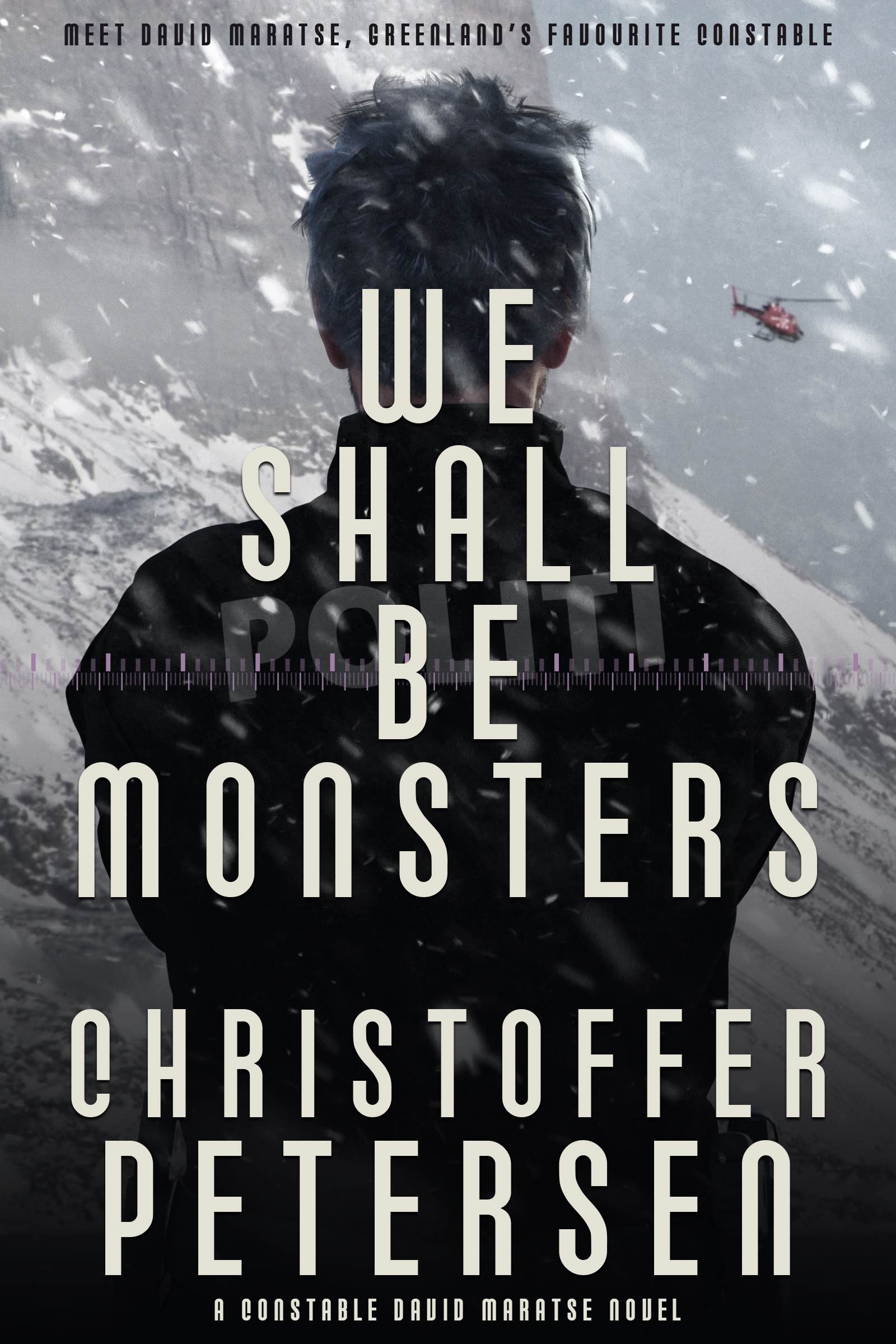
Review 2209: We Shall Be Monsters

If you are interested in reading this book, you will understand it much better—and there is a warning to that effect in the book—if you read the two books that came before it.

At the end of Blood Floe, retired Constable David Maratse’s friend and lover, Sergeant Petra Jensen, was kidnapped. Now the body of a teenager is found naked, his back embedded with fishing hooks with colored threads attached. Not far away, next to an ice-fishing hole, are Petra’s clothes and a suicide note.

Maratse knows that the use of her Greenlandic name in the signature is a message to him that she did not commit suicide. He arranges a funeral for her so that the authorities won’t realize that he plans to go off on his own to find her—and that’s what he does.

While Maratse is following leads and other police investigate the boy’s murder, there are glimpses of what is happening to Petra. Tensions rise when her captor tells her she will soon be set free, as the readers know that for him setting free means killing.

I was drawn to this series because of its glimpses into life in Greenland, but except for Maratse dressing in white and taking a sled dog team, there wasn’t anything particular to Greenland in this one. It’s a fairly standard thriller.

Related Posts

Blood Floe

Seven Graves One Winter

The Mist

Review 2073: Blood Floe

Blood Floe is the second book in Christoffer Petersen’s Greenland Crime Series featuring David Maratse, a former police constable who was invalided out of service. Although Maratse keeps telling people he’s retired, he seems to attract trouble.

Maratse has taken his sledge out to train a new sled dog when he comes across the Ophelia, an ice-strengthened yacht that was carrying an expedition team. He sees blood at the gangplank, so he goes on board and finds five people, all either dead or wounded. He also sees signs that they have been drugged.

When the police begin investigating, they find that a sixth expedition member, Dieter Müller, is missing. Dieter is an expert on a 1930’s explorer, Alfred Wegener, and he is searching for a journal believed to be left in a remote cabin. Dieter has found the cabin and the journal.

Soon Maratse is contacted by a wealthy businessman, Mr. Berndt. The expedition was his, but he is more interested in finding the journal than in what befell his team and wants to hire Maratse to find it. Maratse says he’s retired but soon finds Berndt’s stepdaughter in his home assuming he will help.

Meanwhile Maratse’s friend Petra, a police sergeant, has been taken aside and told why finding the journal is so important.

Blood Floe is another interesting mystery with a fair amount of action. I like it best for the glimpses of Greenland life, in this case, sledding and narwhal hunting.

Related Posts

Seven Graves One Winter

Last Rituals

Gallows Rock

Review 2028: Seven Graves One Winter

Before winter in the small Greenland village of Inussuk, the gravediggers dig seven graves and hope that will be enough. One is about to be filled when a man throws a young woman overboard a boat and then runs over her.

Constable David Maratse is nearly ready to be released from the hospital, where he has been recuperating from torture. He has been given early retirement because of his injuries and plans to retire in Inussuk. Once there, though, he and his friend Karl pull up the body of a young woman while fishing.

It’s pretty obvious who she is. First Minister Nivi Winthur’s daughter Tinka has gone missing. It soon seems clear that the murder was political. Although Nivi’s opponent in the coming election, Malik Uutaaq, is running on a platform of Greenland for Greenlanders, not Danes, he prefers his sex partners to be half Danish and very young. Tinka was the most recent. But would Malik actually murder her?

When Nivi meets Maratse, she asks him to help find her daughter’s killer.

Although after two revealing conversations, I didn’t find it hard to guess the murderer, I liked this novel for other reasons, mostly its exotic setting and descriptions of life in Greenland. (How many mysteries have sled dogs in them?) It is described as Arctic Noir on the cover, but except for the crime and the suspenseful ending, it was more of a cozy mystery.

Related Posts

Free Falling, As If in a Dream

Last Rituals

The Water’s Edge

Review 1372: The Greenlanders

Best of Ten!
The Greenlanders took me quite a while to read, and that wasn’t because it wasn’t interesting. My hardcopy book was 558 pages, which isn’t that long a book for me. The type was small, however, and the pages dense, so that I would guess it normally would be closer to 1000 pages long.

This novel is also unusual because it is written in the tradition of the Nordic sagas. Although it centers on the activities of the family of Asgeir Gunnarsson, it also tells of other events taking place in the country, beginning in about 1345 until roughly 1415. Because of this style, the actions of the people are described, but there is little conventional character delineation.

Much of the novel has to do with the events spawned by a feud between Asgeir Gunnarsson’s family and that of their nearest neighbor, Ketil Erlendsson. Asgeir and Ketil are wealthy landowners, but life on Greenland is hard, and no landowner can be assured he or someone in his household will not starve during a difficult winter.

In fact, the Greenlanders don’t know it, but in the mid-14th century, they are at the beginning of a long downhill slide for the country. Although ships used to arrive with relative frequency from Norway or Iceland, at the beginning of the novel, the first ship arrives in 10 years. The Greenlanders hear that much of Europe has been overcome by the plague, and so many people have died that the church has not been able to send priests to Greenland nor has the bishop been replaced.

In fact, Greenland has already suffered some diminishment. There used to be settlers in the Western Settlement but now it is deserted. As time progresses, more and more farms in the Eastern Settlement are abandoned as farmers become unable to support their households. The novel documents famines, illnesses, outlawry, the loss of laws and the country law-keeping institutions as well as weddings, births, and deaths.

Despite its nontraditional approach, I was deeply absorbed by this book and particularly by the events in the lives of Gunnar Asgeirsson, Asgeir’s son, and his daughter Margret Asgeirsdottir. I was particularly struck by how similar the lives of these 14th century Greenlanders were to those of the Icelanders described in Halldór Laxness’s Independent People. I think I mentioned in my review of that book that I assumed it was set in the Middle Ages, only to be floored when I realized it was set in the 20th century.

Related Posts

Independent People

Iceland’s Bell

King Hereafter