Review 1728: A Sin of Omission

A Sin of Omission opens with Stephen Mzamane making a long journey to see his best friend, Albert Newnham, across the region known in the 19th century as Kaffraria on the Cape of South Africa. During this journey, the novel looks back on his life.

Picked up as a starving child in the bush by Reverend Basil Rutherford, Stephen is raised at a mission to become an Anglican priest. Once his family learns where he is, his father brings his older son, Mzamo, there too, reasoning that the boys will not succeed unless they learn to be English. The Ngqika tribe has been driven off its lands by the British, and because of a prophecy that foretold the British would leave if the people destroyed their crops and animals, his father has killed his cattle and burned his crops. Although he is an important man, he has to work on the roads to avoid starving.

The Church is making it a practice to raise the sons of important natives as British clerics in an attempt to convert the people. Both Stephen and Mzamo are intended for this program. However, Mzamo is rebellious while Stephen is dedicated and devout, so Mzamo is ejected from the program.

Stephen is eventually sent to Canterbury to be educated at the Missionary College. There, although he is a fish out of water, he becomes best friends with a fellow student, Albert Newnham. Unfortunately for this friendship, Albert eventually chooses to marry a girl who is completely unsuited to be a missionary’s wife and is racist.

Things begin to go wrong after the young men take an ill-considered shortcut so as not to be late for tea, but Stephen only begins to learn the fruits of this event when he returns to Africa. Although he still needs to pass Greek and Latin exams to become a priest, unlike his white fellows, he is given a post far from any libraries or tutors. The job he expected to get working at the missionary college with his beloved Mfundisi Turvey, principal of that college, eventually goes to Albert. Instead of being give a post together, as promised, they are separated. In fact, Stephen is alone because the nearest cleric to his post is racist.

Stephen is also no longer a part of his own people, although his brother plays a large part in his fate. The major events of this novel are initiated when he learns of his brother’s death.

This novel is partially based on the life of Stephen Mtutuko Mnyakama, a missionary of the Anglican Church of the Holy Trinity. Although it didn’t initially pull me in, I eventually found it absorbing and heart-rending. This is a novel I probably wouldn’t have discovered had it not been for my Walter Scott project.

Related Posts

Things Fall Apart

The House Gun

Sex and Stravinsky

Review 1726: To Calais, In Ordinary Time

It’s 1348, two years after the battle of Crécy, which won Calais back from the French to the English. Will Quate is betrothed to Ness, the prettiest girl in his Cotswold village, but his liege lord, Sir Guy, wants him to join a group of archers on their way to defend Calais. Will would rather stay, but he bargains for a document showing he’s a free man. Sir Guy tells him he will send along the paper with Captain Laurence Haket in exchange for five pounds once he has won his fortune.

Will agrees to go. In fact, his attitude toward Ness seems ambivalent. He doesn’t seem to care that she had an affair with Haket and became pregnant. Will’s friend Hab is plainly in love with him, but Will doesn’t seem inclined.

Sir Guy’s daughter Bernadine is incensed that Sir Guy has betrothed her to a man his own age when she is in love with Laurence Haket. Inspired by La Roman de la Rose, she feels she is entitled to a more romantic life, so she runs away, following Haket on his way to Calais.

Another voice on the journey is Thomas Pitkerro, a proctor, who is sent along with the archers on his way to his home in Avignon to give last rites, if needed. Thomas is afraid of the plague, which is said to be moving north from Italy and France.

To Calais, In Ordinary Time echoes its medieval inspirations with its tale of adventures while on a journey. It does so in more than just plot, however, for it is written with only words in use in the time it was set. Thomas, who is writing letters and keeping a diary, writes in a stiff, bombastic style that thankfully loosens up . The novel is narrated in a style a little less formal than the speech of Bernadine, which contains some French modes of expression. Several times the point is made that her workers do not understand many of the words. The speech of Will and the characters around him is littered with expressions native to the Cotswolds.

This attempt is similar to that of Paul Kingsnorth in The Wake, which I read several years ago—written to be readable to modern audiences but to have the feel of Old English (in the case of The Wake, that is). This effort doesn’t seems as likely to me except in the speech of the characters of the lowest status, which has a flow to it. The dialogue between characters of higher status seems overly elaborate, even pretentious, and perhaps echoes written work of the time.

Meek doesn’t do much to get readers interested in his characters, so at first I had difficulty becoming involved in the novel. After a while, I got more interested. I read this novel for my Walter Scott prize project.

Related Posts

The Wake

The Last Hours

The Illuminator

Review 1723: A Fugue in Time

Godden attempts something unusual in A Fugue in Time. She makes a house that has held the same family for a century into a sort of conscious entity and tells the story of the family in collapsing time.

It’s World War II, and old Rolls Dane has received notice that the 99-year lease on his house has elapsed and the owners want it back. The house was the one his parents moved into upon their marriage, and it has been the scene of many events, including his own unhappy love affair.

Rolls has been leading a reclusive life with only one servant left in the big house, and he is not pleased when his great niece, Grizel, an American officer, comes to ask if she can stay in the house. Later, Pax Masterson, an RAF officer being treated for burns, comes to visit the house that he’s heard about all his life from his mother, Lark, the girl Rolls’s father brought home many years before after her parents died in a railway accident.

Although I eventually got involved in this novel, its basic premise seemed at first affected and I didn’t think it was going to work. Early on, for example, there is a five- or six-page description of the house that slowed momentum to a standstill. Then, the shifts in time sometimes take place within the same paragraph, and at first it’s hard to grasp the when. There are some cues, for example Rolls’s name changes from Roly to Rollo to Rolls.

This is not one of my favorite Godden books, but the idea behind it is an interesting one. It reminded me a little of A Harp in Lowndes Square, in which images and sounds of the future and past reside in a house.

Related Posts

A Harp in Lowndes Square

The Lady and the Unicorn

Pippa Passes

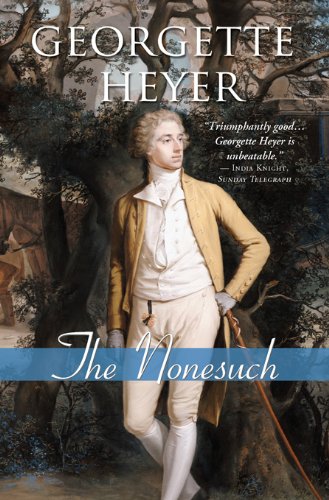
Review 1719: The Nonesuch

Often when I am in the middle of some hefty nonfiction book, I take a break by reading some sort of light fiction. I was reading a biography of Lyndon Johnson when I thought I hadn’t read any Georgette Heyer lately, so I picked The Nonesuch out of my library.

The inhabitants of the village of Oversett are all interested when they hear that Sir Waldo Hawkridge, known as the Nonesuch, has inherited Broom Hall from the miserly Joseph Calver and will be arriving to look it over. The young men are excited to see this notable whip. Up at Staples, kindly Mrs. Underhill is dismayed to learn that Sir Waldo has arrived with a lord, his young cousin Lord Lindeth, for her unprincipled but beautiful ward, Tiffany Wield, has announced that she means to marry into the nobility. Tiffany’s governess/companion, Ancilla Trent, remarks with her customary humor and calmness that they will just have to convince Tiffany she is wasted on anyone under a Marquess.

Lord Lindeth meets Tiffany after she carefully arranges an encounter while he is out fishing. When Waldo sees her and her affect on Lindeth, he is dismayed. However, he is much struck by Ancilla. It is Ancilla who does not have a high opinion of Corinthians, the set to which Waldo belongs.

As usual with Heyer, this novel is full of likeable characters, humor, and an engaging hero and heroine. I tend to like Heyer’s sillier plots best, because they are so funny. This is not one of them, but I enjoyed it very much just the same. A perfect Covid-era lightener. (I re-read it last January.)

Related Posts

The Convenient Marriage

Sprig Muslin

Cotillion

Review 1718: Literary Wives! The Amateur Marriage

Today is another review for the Literary Wives blogging club, in which we discuss the depiction of wives in fiction. If you have read the book, please participate by leaving comments on any of our blogs.

Be sure to read the reviews and comments of the other wives!

Eva of Paperback Princess
Lynn of Smoke and Mirrors
Naomi of Consumed By Ink

* * *

It’s December 7, 1941. Michael Anton is working in the family store in an Eastern European Baltimore neighborhood when Pauline comes in with some neighborhood girls. It’s apparent to everyone that he’s a goner. Excitement is in the streets because of that day’s declaration of war against Japan, and in the impulse of Pauline’s excitement, Michael enlists.

Michael is injured during training, so he never goes to war but instead marries Pauline. Michael is steady, perhaps a little stolid. Pauline is emotional, reacting to every little thing and often over-reacting. The Amateur Marriage follows what is really an ill-assorted couple through their marriage—children, deaths, family crises—and beyond.

Tyler is excellent in her minute observations of everyday life. She sees the cracks in the American dream and reveals them with empathy. I enjoyed this novel, although at times Pauline drove me crazy.

What does this book say about wives or the experience of being a wife

At first, I thought Tyler was going to show how this admittedly mismatched couple could still make a lasting marriage, but that turned out not to be the case. The couple come together almost completely by chance, and later, when we learn about Pauline’s previous dating career and her career while Michael is in the service, we realize that if Michael had gone to war, Pauline would almost certainly have found someone else before he got back.

In the beginning of the relationship, the chemistry between them works pretty well, even though they obviously go into marriage with different expectations. Michael, for example, believes they will continue to live above the store, while Pauline assumes they will buy a house in the suburbs even though they can’t afford one. Michael at first seems relatively unambitious, while it is Pauline’s ideas that push him to do better than his parents’ store. The difficulties come when the chemistry starts to wear off.

This novel depicts a couple a little older than my parents although more conservative. In fact, in many ways they resemble my parents, some in temperament and others generationally. However, frankly Pauline is sometimes so volatile that I don’t know how anyone could live with her. It seems as though someone more expressive than Michael would make her feel more secure but would be even more likely to fight with her. And some of the things she says when she’s upset, which in later years seems like all the time, are really nasty.

Although Tyler isn’t explicit about this, I can’t help thinking that a lot of Pauline’s unhappiness comes from the sterile suburban life that my mother also lived, because the Antons do eventually move to the suburbs. Theirs is a typical 50’s marriage, with Michael away working a lot and not as involved with his children as he could be, with Pauline taking all the responsibility for the house and child care.

Pauline, a social girl, is isolated in the suburbs except for neighborhood parties and gossip by the pool or visits back to the old neighborhood (which, however, was not her old neighborhood, but Michael’s). However, she also cultivates a helplessness that I found shocking, when later in life she can’t light her own pilot light or shovel her own driveway.

Literary Wives logo

Michael is a little more of a mystery because we don’t hear from him as often. He makes the same kind of mistakes as my father did, for example, buying practical gifts instead of frivolous or romantic ones. They fight about money, but he has had a careful immigrant upbringing of scrimping and saving, while hers has been more privileged—and she does seem to do some reckless spending.

I also felt this novel showed how people tend to concentrate on the negatives of their relationship when they’re at odds. It is only when things are long over that both Michael and Pauline begin to remember some of the things that brought them together in the first place.

Related Posts

Monogamy

Alternate Side

Happenstance

Review 1713: The Narrow Land

As a young child, Michael Novak was rescued during World War II and sent to the States as part of a program for orphaned children. There, he was adopted by the Novaks. At 10, he is still extremely fearful and full of routines he follows to calm himself. So, he is resistant when Mrs. Novak tries to put him on a train, the first step in a journey to spend the summer on Cape Cod with the Kaplans. Finally, he decides to go.

On the island in 1950 live the artist Edward Hopper and his wife Jo. Although they tend to be standoffish with the vacationers, Michael forms a friendship of sorts with Jo. And it’s really the relationship between Edward and Jo that this book is about.

Edward has been having a dry spell, and he seems preoccupied with trying to find a woman he painted a few years before. She is right under his nose in the person of Katherine Kaplan, Mrs. Kaplan’s daughter, who is dying of cancer. He has seen her and noted the resemblance, but she is no longer dyeing her hair blond. He is an introvert who spends most of his time in his own head.

Jo is extremely jealous of him and thinks he pays too much attention to Olivia, Mrs. Kaplan’s daughter-in-law, when it is really Olivia paying attention to him. Jo is in fact irrationally and violently angry at times, particularly when she feels she had to abandon her career when she became his wife. Although Jo has some moments of self-awareness, I really think Hickey treats her harshly as a character. Granted, I know nothing about the couple’s life, but Hickey shows her making a fool of herself at a party with her airs and graces and spiteful remarks about other people.

Hopper is not very nice to Jo and belittles her art, although I read about that and found she had some standing as an artist.

This novel, which I read for my Walter Scott project, was slow moving, and for a long time I couldn’t tell whether it was going anywhere. Sometimes that doesn’t bother me, but in this case I had a hard time staying interested. The novel does have a payoff in the end, but it is more character study than plot-based.

Related Posts

That Old Cape Magic

The Blazing World

Suzanne

Review 1711: The Women of Troy

I enjoyed very much the novel by Pat Barker that precedes this one, The Silence of the Girls. It was the story of Achilles at Troy told by Briseis, one of the women captured in the siege of Troy and the surrounding countryside. Later, though, when I read a criticism that a novel supposedly about the Trojan women was mostly about Achilles and Patroclus, I had to agree.

At first, The Women of Troy didn’t seem to have much to add. It takes up the story with the Trojan horse and the fall of Troy. Achilles’ son Pyrrhus is the focus of this novel, a young man trying to live up to his father who is very unstable. However, we do see more of the women, and besides the characters Barker has invented, we find out about Hecuba, Andromache, and Cassandra, the royal women.

link to Netgalley

Still, although I found The Women of Troy mildly interesting, I don’t think it added very much to the original story. It covers a period when the Greeks are stranded by a fierce wind on the shores of Troy so cannot go home until they bury Priam’s body and the wind breaks.

Related Posts

The Silence of the Girls

The Song of Achilles

House of Names

Review 1709: The Redeemed

The third book of Pears’ West Country Trilogy and the book I read for my Walter Scott Prize project, The Redeemed begins in 1916. Leo Sercombe, now about 16, joined the Royal Navy at the beginning of the war as a boy seaman. In a battle, his ship, the Queen Mary, is sunk, and he is one of only 20 crew members rescued.

His father’s former employer’s daughter Lottie begins training as a veterinarian with Mr. Jago. He believes that soon the veterinarian college will be opened to women and she will be the first graduate.

The novel works slowly toward the reunion of its two main characters. There is one incident where this reunion is delayed because of a misunderstanding. It’s the type of plot device used frequently in movies, where the problem could be solved in a few words, and I think using it was a bit lazy.

Although Pears continues with his spare, understated writing style that is so eloquent, I found after a while that his minute descriptions of work, whether it be birthing a foal or floating a sunken ship, were losing my attention. Finally, the long-awaited reunion seemed somewhat anticlimactic. Pears’ style is very detached, maybe too much so. Although I was always interested in what happened to the characters, I probably could have been more so. Of the trilogy, I think the first book was the strongest.

Related Posts

The Horseman

The Wanderers

All the Birds, Singing

Review 1701: The Wanderers

The Wanderers is the second book in Pears’ West Country Trilogy. After the startling events at the end of The Horseman, 13-year-old Leo Sercombe is on his own. Almost starving, he is rescued by gypsies. Thus begins a wandering life.

Lottie lives an odd life on her father’s estate. She is angry with him because of his treatment of the Sercombes, so she keeps very much to herself. Reluctantly, she engages with society, but she is most interested in studying biology.

Like most middle books, The Wanderers seems a little unfocused because it can’t by definition have a climax. It is interesting enough and devotes the same kind of minute observation as in the first book to such subjects as castrating sheep.

We are obviously working toward the First World War and presumably some kind of reunion for Leo and Lottie as the class gulf between them broadens. And yet, of course, it will soon narrow again.

Related Posts

The Horseman

Tinkers

Lila

Review 1695: The Bridge of the Gods

A friend who knew I was writing a story set locally before the arrival of white men gave me The Bridge of the Gods, which was written in 1899 as a result of Balch’s years of collecting Native American folklore and customs in Oregon. The novel is based on a legend about a bridge of stone across the Columbia.

The novel begins in 17th century Massachusetts, where Reverend Cecil Grey feels the mission to preach Christianity to the indigenous people of the West and dreams of a huge stone bridge over a river. His wife having died, he sets off to do just that, accompanied by his Native American nurse.

Eight years later, Multnomah, chief of the Willamette tribe, decides to test his allies. His tribe is the leader of a confederation united against their enemies, the Spokanes and the Shoshoni. The ascendancy of the Willamettes is prophecied to last until the Bridge of the Gods, a massive stone arch over the Columbia River, is destroyed. However, Multnomah has been hearing that some tribes want to leave the confederation. He decides to summon all of the tribes for a great council on Wappatta Island (now Sauvie Island).

Multnomah has a beautiful daughter, Wallulah, whose mother was an Asiatic princess shipwrecked at the mouth of the Columbia. Multnomah wants to betroth her to Snohomish, chief of the Cayuses, to cement their alliance. Wallulah, having seen Snohomish once, is not averse—until Cecil Grey comes on the scene.

I didn’t expect much from the attitudes of this book, considering when it was written, and I didn’t get much. Despite the young Balch having been interested enough to travel around and interview indigenous people, they are referred to constantly as savages, their traditions are treated with abhorrence, their villages are described as degraded, they are shown as violent and cruel. Even Multnomah, who compared to Snohomish is a good guy, is depicted as obdurate and cruel. Grey’s faithful nurse doesn’t even have a name.

Only Wallulah escapes this treatment, but note that she is half “Asiatic” (and a confused half at that, for her mother is said to have taught the Willamettes something about Buddha but calls god Allah). Her mother is described as white. Wallulah is herself a typical late 19th century romantic heroine, fragile and weak and a completely unlikely indigenous woman.

Although this novel is billed as a romance, Grey’s struggle is between his mission and Wallulah (even though they do not seem mutually exclusive), and since Grey is a zealot, Wallulah doesn’t have much of a chance. This is actually a romance in the older sense of the word, an adventure novel.

Since Balch went to so much trouble to personally speak to indigenous peoples and collect stories, I was hoping this book would be a little more enlightened—say, perhaps, written by someone who actually liked the people. It wasn’t. If you’re interested in an older book based in the life of indigenous peoples, I recommend The Loon Feather.

Related Posts

The Loon Feather

Caleb’s Crossing

One Thousand White Women