Review 1558: Classics Club Spin Result! Kennilworth

Here’s another book for RIPXV!

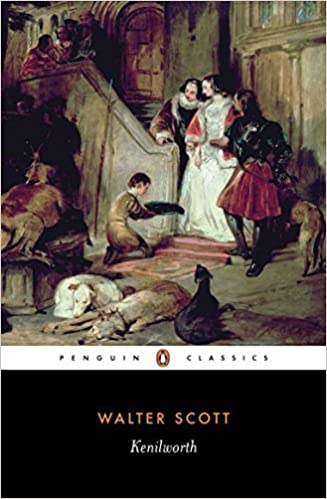
Reading Kenilworth for the Classics Club Spin made me contemplate the question of how important it is in a historical novel to stick to the historical facts. Of course, historical novels are fiction, so by definition something is invented. And there have been really interesting historical novels where the author purposefully changed some facts to speculate on other outcomes. But do historical novels have the license, just for a more dramatic story, to change what actually happened?

Kenilworth is the novel that famously reawakened interest in the story of Amy Robsart’s death. Amy Robsart was the wife of Robert Dudley, the Earl of Leicester, during the reign of Elizabeth I. Amy’s death is the classic mystery of did she fall or was she pushed? At the time of her death, the rumor in court was that Leicester colluded in her death because he believed he could then marry Elizabeth.

In the novel, Amy is a young bride who has run away from home for a marriage with Leicester that is secret because he is afraid for his position in court, having married without royal permission. Amy’s jilted fiancé, Tressalian, comes looking for her on behalf of her father, believing that Amy was seduced away from her home by Varney, Leicester’s master of horse.

Varney is the villain of this piece. He has Amy kept as a virtual prisoner, and eventually Amy has reason to fear for her life. So, she flees to Kenilworth, Leicester’s estate, where he is preparing to entertain Elizabeth and the court.

I fear that Scott has woven a romance with very little basis in fact, as he did with a Crusader-based novel I’ll be reviewing in a few months. First, in Kenilworth, Amy and Leicester are newly married when in fact they were married about 10 years. Next, their marriage was no secret; in fact, she was allowed to visit him in the Tower of London when he was imprisoned by Queen Mary as a relative of Lady Jane Grey. Did Leicester have a hand in her death? I read a novel a while back that posited that (it may have been Alison Weir’s The Marriage Game, but I’m not sure), but we’ll never know. More recently, historians are inclined to believe that she simply fell down the stairs. By the way, she was not being kept captive in a moldy old house but visiting friends.

So, that is a strongish negative for me, at least. I could accept a premise that Leicester ordered his wife’s death because we don’t know, but playing with the chronology of the marriage for drama’s sake (and to have a younger, dewier heroine) and making it a secret (as it was also in a movie I saw several years ago) is throwing in a bit too much fiction.

On the positive side, Scott’s descriptions of the Elizabethan court are vibrant and his attempts at Elizabethan dialogue are convincing. Also, if he was not distorting history I’d say that his plot is quite suspenseful. At the time of its publication, historians slammed The Talisman just because Scott created a fictional Plantagenet, even though he did much worse things historically in that book and in this one.

Related Posts

Guy Mannering

Waverly

The Marriage Game

Review 1554: The Vanishing Futurist

Right before the start of World War I, Gerty Freely goes to Moscow to be a governess for the Kobelev family. There she falls in love with one of Pasha Kobelev’s friends, Nikita Slavkin, a brilliant, idealistic scientist and revolutionary. Although Gerty is not political, she eagerly embraces the life of a communard in a commune Slavkin founds in the Kobelev’s house after the revolution. With them are Pasha and his sister Sonya and a few other young people.

Slavkin’s mission becomes to invent a machine that will change people’s cellular structure making them perfect Communists. Eventually, he comes to believe that he can make a machine that will transport a person into another dimension where perfect Communism is possible. Certainly, it doesn’t seem possible in the present one.

Hobson’s novel skillfully depicts the idealist euphoria and immense creativity of the early days of the Russian revolution as well as the hardships, the inevitable disintegration of communal life, and the craziness of those days as the revolution begins to turn in on itself. It makes really interesting reading and seems to much more authentically depict the time than any of the recent novels I’ve read about it.

I read this book for my Walter Scott Prize project and really enjoyed it.

Related Posts

The Revolution of Marina M.

A Gentleman in Moscow

Memories: From Moscow to the Black Sea

Review 1551: The Grey Woman

Here’s another book for RIPXV.

This novel opens with an unnamed narrator, a traveler in Germany, who meets a pale woman known as The Grey Woman. When he asks for her story, she gives him a letter she wrote to her daughter. This letter contains her story.

As a young girl in 1778, Anna Scherer is very beautiful. A miller’s daughter, she is invited to visit a school friend in Karlsruhe, where she stays with the Rupprechts. She is a shy girl, but she makes a conquest of her social better, a Frenchman named Monsieur de la Tourelle. She is pushed by Frau Rupprecht into receiving him and accepting his gifts, and the next thing she knows, she is engaged to marry him even though he makes her feel uncomfortable.

After their marriage, de la Tourelle takes her to his castle in the Vosges Mountains, where she feels that the servants spy on her. He makes her cut all ties to her family and tries to control her every movement, not allowing her even to go for a walk. The saving grace is Amante, the servant he hired to be her lady’s maid.

Aside from being a stern and controlling husband, de la Tourelle has a fearsome secret, which Anna and her maid discover by accident.

This novel is typical of the gothic genre that was popular in its time, except that it is much more believable than most that I have read, not including any supernatural elements. I took it to be one of Gaskell’s earlier works, and it may have been, because it was published the year of her death, in 1865. It is very short, easy reading, although the antique-sounding dialogue is a bit cumbersome. Luckily, there’s not much of it.

Related Posts

Tales of Mystery and the Macabre

The Castle of Wolfenbach

The Mysteries of Udolpho

Review 1547: The Mistress of Husaby

In this second volume of Kristin Lavransdatter, Kristin has finally won through on her determination to marry Erlend Nikulaussön. The novel starts with them journeying to Erlend’s estate of Husaby to take up their residence. Kristin finds the estate poorly managed and the serving people slovenly and lazy, so she goes about setting all to rights.

To gain Erlend, though, Kristin has committed many sins, and much of the first part of the novel deals with her relationship to God. Although the preoccupations in this section certainly reflect the times, I found them to be heavy going. Later, though, the novel caught more of my imagination as it dealt with Erlend and Kristin’s marriage, her relationship to her father, and the political situation under first a regent, and then King Magnus.

This trilogy approaches its story by employing an old-time style of writing that does not seem forced and works for its subject. It is clear that Undset was an expert on 14th century Norway. Although at times I found it a little hard to follow, especially in the implications of the dialogue, the novel is very interesting.

Related Posts

The Bridal Wreath

The Greenlanders

The Last Hours

Review 1538: Miss Boston and Miss Hargreaves

Rachel Malik’s investigation into the life of her grandmother has resulted in a gentle and touching story of friendship and love. It is an unusual one, too.

Rene Hargreaves leaves her difficult marriage to sign on as a land girl during World War II. She is assigned to work on a remote farm named Starlight owned by Elsie Boston. Elsie is a little peculiar and uncomfortable with strangers, but the two form a close friendship.

When a law is passed allowing the agricultural board to take charge of poorly run farms, Elsie’s greedy neighbors on the board use it to cheat her out of her farm, even after the examiner rates it “fair.” As a result, Elsie must leave the farm. Rene goes with her, and they become itinerant workers.

A promise Rene made to an old friend puts their lives in peril when Elsie is nearing old age and Rene is middle aged. Rene promised Bertha she would take care of her in old age, but it is Bertha who dies, leaving her difficult and senile husband Ernest with no place to go, so the two women take him in.

Although the two women live unremarkable lives for most of the novel, something about their story is compelling. Ultimately, it takes a turn I didn’t expect at all, despite its opening. I read this novel for my Walter Scott prize project.

Related Posts

White Houses

The Paying Guests

The Danish Girl

Review 1536: The Vanishing Act of Esme Lennox

Best of Ten!
I’m late to discover Maggie O’Farrell, but better late than never. I’ve read a few books by her now, and she just keeps getting better and better.

Iris Lockhart is contacted by a mental hospital, which wants to find out if she can offer a home to her great aunt, Esme, who has been incarcerated there for more than 60 years. The problem is that Iris has never heard of Esme and believes her grandmother to be an only child.

Her mother now lives in Australia and has never heard of Esme, either. When Iris tries to discuss Esme with her grandmother, Katherine, who is suffering from Alzheimers, she gets a fractured response that implies Esme is her sister. In particular, she says, “She wouldn’t let go of the baby.”

Through third-person narration from Iris’s point of view, Esme’s stream of consciousness memories, and Katherine’s more fractured ones, we learn how it came to pass that vibrant and unconventional Esme was abandoned in the hospital from the age of 16. Iris is shocked to learn that Esme was incarcerated for such outrages as insisting on keeping her hair long and dancing in her dead mother’s clothes. She learns that at the time women could be committed on the signature of one doctor.

This is a shattering, sad story about a girl whose life is stolen because she doesn’t fit in. It is spellbinding as it draws you along to learn Esme’s story. This is also fascinating tale about how sisterly love turns to jealousy and anger.

Related Posts

After You’d Gone

Instructions for a Heatwave

This Must Be the Place

Review 1532: Tidelands

For years, I read Philippa Gregory’s books faithfully, but at some point I decided that she was just cranking them out, so I stopped. I felt that less attention was going to such things as fully realized setting and well-rounded characters.

Recently, however, I noticed that she was doing something different with Tidelands, so I thought I’d give her another try. This book is set in the 17th century and features a heroine living in poverty.

Alinor is a wise woman—a healer and a midwife who does not deal in magic and charms and is very concerned, as she has to be, about her reputation. It is in jeopardy, because her husband has disappeared, and if he has deserted her, she will be considered a loose woman. So, on Midsummer’s Eve at midnight, she goes to the church believing she will see the ghost of her husband if he is dead.

She does not see her husband but a total stranger. He is a young man, a gentleman in difficulty, who introduces himself as James Summer but is a Catholic priest in a time when Catholicism has been banned in England. He is traveling and was supposed to find refuge with Sir William Peachey, but Sir William is not home. Although she is Protestant, Alinor is not much concerned with religion, so she gives him refuge overnight in her shed and leads him through the marshes in the morning to consult with Sir William’s steward.

As a result of her actions, Sir William gives her son a place as his son’s companion. This is a step up for him, and she is grateful. James Summer masquerades as a tutor for Sir William’s son, but he is really there to help free King Charles, in prison on the Isle of Wight.

Unlikely enough, I thought, James and Alinor fall in love. James begins to lose faith in his religion and his king as events progress. But he is a priest, and Alinor is married, and on the Isle of Wight, he encounter’s Alinor’s husband, who does not intend to return.

For a long time I found the situation unconvincing and considered dropping the book. The ending, however, was surprising and affecting, so I’ve changed my mind. I’m willing to try the second book of this series.

Related Posts

Merivel: A Man of His Time

Lark

Corrag


Review 1522: A Single Thread

Violet Speedwell’s fiancé was killed during the First World War, and twenty years later she’s one of the many single women in Winchester. Even though there are so many, they haven’t gained any respect, it seems. Violet has managed to free herself from her difficult mother by arranging a work transfer from Southampton to Winchester, but so far she hasn’t made much of a life for herself.

When she stumbles upon a private ceremony in Winchester Cathedral, she gets interested in the work of the broderers, a group of women who embroider kneelers and seat cushions for the cathedral. She joins the group and soon has made friends with an office worker because of it. Although Violet is at first hyper aware of other people’s attitudes, through her new friendships she begins to become more accepting and take more risks.

I was reasonably interested in Violet’s journey, but this novel seemed unfocused to me. For example, although people are inconsistent, Violet’s extreme awareness of what other people think does not seem to mesh well with a woman who occasionally goes out to pick up men for sex. This characteristic seems much too modern for the woman Violet was at the beginning of the book, although the affair at the end is more plausible. Also, as to the two preoccupations of the novel, embroidery and bell ringing, it was as though Chevalier couldn’t decide which to write about. She did a better job at bell ringing than did Dorothy Sayers in The Nine Tailors, which I found incomprehensible (not the mystery, just the information about the bells), but I think that perhaps two focuses is one too many.

Maybe to Chevalier the cathedral said cushions and bells to her, but she wasn’t really writing about the cathedral. In any case, I’m trying to poorly express that I found this novel mildly interesting but also unsatisfying.

Related Posts

Burning Bright

Remarkable Creatures

The Summer before the War

Review 1519: Perdita

On holiday from his university job, Garth Hellyer takes on a task for the Longevity Project by calling on Marged Brice, who is supposed to be 134 years old. Garth can hardly believe she can be as old as she says she is, and although she has a birth certificate, she has no other form of identification. Marged says she would like to die, but she has to find someone to take care of Perdita.

Marged gives Garth her journals, and he begins to read the fascinating story of a girl attuned to nature, in particular to Georgian Bay off her home on the Bruce Peninsula of Ontario. The journals begin in 1887 and tell the story of the girl’s love for the bay and for George Stewart, an artist.

Meanwhile, Garth becomes reaquainted with Clare, a neighbor on the bay. She, it appears, has cared for him since they were teenagers, but he has never paid attention to her.

This novel is atmospheric with a strong sense of place, particularly the older story, and interesting, although I sometimes wondered when we would get to Perdita. It’s a long novel at 400+ pages, and it takes a long time to get to Perdita, but it kept my interest. If anything, the explanation of Perdita seemed a little unclear. I almost think I would prefer this as a ghost story, which it is not. It does have a faint ecological message.

I’ve said I’m getting tired of the split timeframe novel, but it didn’t bother me for this one and was, in fact, necessary. On the other hand, the historical portion of the novel was definitely the more important.

Related Posts

The Luminous Sea

Mortal Love

Melmoth

Review 1517: House of Glass

Clara is born with bones so fragile that as she grows, they can snap for the slightest reason. Her mother and stepfather keep her inside a home filled with padded corners until she is an adult. When they judge that she is finally able to come out, she is slightly misshapen through injuries that didn’t heal well.

Shaken after her mother’s death, Clara finds comfort in visiting Kew Gardens and learning about the plants. Her voracious curiosity tends her to spend a lot of time talking to the foreman of the glasshouse. Eventually, he offers her a job. A wealthy man wants to establish his own glasshouse to rival that of Kew. Will she take a job overseeing the planting and establishment of this garden?

Clara decides to take the job at Shadowbrook, where she is received by the housekeeper, Mrs. Bale. The owner of the house, Mr. Fox, is often away on business, and even when he is home he doesn’t like to be disturbed in his rooms on the upper floor.

Clara finds there are rumors in the village about the house and its former occupants, the Pettigrews. Mrs. Bale seems to be under some strain, and she eventually reports that the house is haunted by Vivenne Pettigrew. Clara doesn’t believe in ghosts and begins trying to learn about the Pettigrews. Those who are willing to talk about Vivienne seem to be describing a different person than she imagines from the few words spoken by those who knew her.

Ever since Fletcher’s marvelous Corrag, I have been waiting for her to write something as good. This novel comes very close. It starts out as a ghost story but goes much farther, exploring women’s role in pre-World War I society. It is atmospheric and wonderfully written, with an assertive and appealing heroine. I recommend it highly.

Related Posts

Corrag

Let Me Tell You about a Man I Knew

The Lace Reader