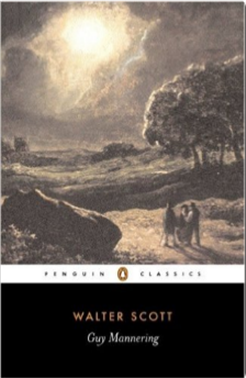
Day 980: Guy Mannering

Cover for Guy ManneringGuy Mannering is the second of Sir Walter Scott’s Waverly novels, set in Scotland and featuring Scottish dialect and folklore. It is a romping adventure, with smugglers, hidden caves, a kidnapped child, a gypsy queen, a hidden identity, and murder.

The novel begins in the 1760’s with a visit by Mannering as a young man to Ellangowan, an estate on the southwest cost of Scotland. Mannering arrives there on a rambling tour in time for the birth of Harry Bertram, the son of the Laird of Ellangowan. Mannering is an amateur astrologer, and he casts the baby’s horoscope, revealing that he will encounter dangers at the ages of 5 and 21. Then Mannering disappears from the story for 21 years.

The tragedy of the household occurs when Harry is five. He disappears after being the inadvertent witness to the murder of a customs officer. The family assumes he has been murdered. His foolish father being overwrought by grief, the estate is plundered by his agent Glossin, and Bertram is bankrupted.

Mannering comes back on the scene after many years as an army officer in India. He arrives in time to witness the sale of the Bertram estate to Glossin. It cannot be saved from its debtors without a male heir, and there is only Lucy Bertram, born the day her brother disappeared. In his fury at Glossin, Bertram has a fit and dies, leaving Lucy without home or money. Since Mannering’s daughter will be joining him in a nearby manor, he offers Lucy a home.

Mannering has his own troubles with his daughter Julia. In India, he had reason to believe that a young officer, Vanbeest Brown, was courting his wife, so he challenged him to a duel and wounded him. But Brown was actually courting Mannering’s daughter, and her guardian has caught her meeting secretly with him. Mannering summons Julia to join him, but Brown soon follows.

It is when Brown arrives in the locality that the plot heats up, for he begins finding things familiar, and he meets a mysterious gypsy woman named Meg Merrilies who makes some mysterious pronouncements. Of course, it soon obvious that Brown is the long-lost heir to Ellangowan. But he has the enmity of local villains, who are afraid he can accuse them of murder and malfeasance against him, as well as circumstances that appear to convict him of a crime. Moreover, he doesn’t know who he is, and once he knows, how will he prove it?

This is an entertaining adventure novel about the wild borderlands of Scotland. It has some fine villains, upright heroes, and an amusing couple of comic characters, one being the farmer Dandy Dinmont, a terrier breeder, whose name has since been taken for a breed of terriers.

Related Posts

Waverly

The Candlemass Road

Christowell: A Dartmoor Tale

Day 975: Master & God

Cover for Master & GodFor many years I faithfully read Lindsey Davis’s entertaining mystery series set in ancient Rome and featuring informer Marcus Didius Falco and his lovely wife Helena Justina. I only stopped reading after about 20 books because I was a little tired of the situation. Still, I occasionally pick up one of the series.

So, when I saw that Davis wrote a straight historical novel about the reigns of Domitian and Vespasian and Titus (Domitian’s father and brother), this seemed perfect to me. The novel covers the whole of the Emperor Domitian’s reign and has as its main characters Gaius Vinius Clodianus, a Praetorian guard, and Flavia Lucilla, a hairdresser.

And this was a bit of a problem. I initially had a hard time getting into this novel, and one reason, I think, was the sort of bifurcated story of Domitian’s reign. Gaius Vinius and Flavia Lucilla are just too far removed from the action to integrate them successfully into this story. The result is that the bulk of the novel is exposition, pages and pages of the author telling us what’s going on rather than events being told through the story of its characters.

Later, the two main characters become more important to the general thrust of the novel, and it improves. But for most of the novel, we’re left with a two-pronged approach, Domitian’s reign on the one hand and the romance between the two main characters on the other. This approach even becomes three-pronged during several years when Gaius Vinius is prisoner in Dacia. I couldn’t help contrasting this novel with Colleen McCullough’s excellent Master of Rome series (about Sulla, Julius Caesar, and Mark Anthony), or even better, Robert Harris’s series about Cicero (reviews upcoming).

This isn’t to say that I didn’t eventually settle down and enjoy the novel. I did. I just didn’t think it was one of Davis’s best. Occasionally, a hint of her trademark sardonic humor appears, but overall, I feel that she struggles to keep the novel moving.

Related Posts

Alexandria

Quo Vadis

Acté

Day 973: The Lie

Cover for The LieBest Book of the Week!
Helen Dunmore has this thing she does. I’ll be reading along, moderately interested, and then at the end of the novel she’ll do something that makes me realize the novel is much better than I first supposed. She does this again with The Lie.

Daniel Branwell has returned to his home town in Cornwall from World War I. A dying old lady took him in when he arrived home, and he cared for her until her death. He doesn’t want to mix much with other people, though. He is traumatized from the war and particularly by the death of his friend Frederick, who is haunting him.

As Daniel struggles to make a living, his memories alternate between those of the war and of his childhood friendship with Frederick. Although Daniel was bright and did well in class with an eidetic memory for poetry, he was forced to drop out of school at the age of 11. Frederick, as the son of a wealthy man, was being prepared for better things. Still, even as young men, when Frederick was home they were nearly inseparable.

Daniel meets Frederick’s sister Felicia, now a widow with a young daughter. Their mutual grief brings them together, and they begin spending time with each other, he helping her around the house or both of them visiting the sites of his adventures with Frederick.

But Daniel has told a lie about something. Because of it, he is aware he’s being misunderstood by the village.

This is a powerful novel that I may not have looked for were it not for my Walter Scott Prize project. Although I have not enjoyed all of the short listed books, this one sneaked up on me.

Related Posts

Exposure

The Greatcoat

No More Parades

Day 970: The Four Swans

Cover for The Four SwansThe sixth book in the Poldark series finds George Warleggan unable to dismiss the allegations that Aunt Agatha made about his son Valentine’s parentage before she died. He has been treating the baby Valentine with some distance and has been having Elizabeth followed. But he finds no evidence in support of his suspicions.

Ross Poldark has been offered a seat in Parliament, but he refuses to run, thinking that such a job will not suit his disposition. He is not happy to learn, however, that George Warleggan gets the position instead.

Demelza hears of a meeting between Ross and Elizabeth Warleggan, so she fears that Ross may be seeing Elizabeth again. When a young naval officer that Ross rescued from prison in France is attracted to her, Demelza is in the mood to pay him more heed than she ordinarily would be.

The economy is shaky during the wars with France. At first, the French seem to be foundering, but then everyone begins hearing of the victories of a new general, Bonaparte. Ross becomes impatient of having no more role to play than as leader of a group of Volunteers.

With the latest two novels, the scope is branching out to include more characters. This novel goes into the fate of Elizabeth’s cousin, Morwenna, who George Warleggan forced into an unhappy marriage when she fell in love with Demelza’s brother, Drake Carne. Morwenna’s repellent husband, Reverend Osborne Whitworth, has used the excuse of Morwenna’s illness after the birth of her child to molest her younger sister Rowella, who is the children’s nursemaid. We also hear more about the difficulties of the Carne brothers.

After six books, this series has not palled. From a mildly interesting start, it gets more and more compelling as it goes on. I have already bought the other six novels in the series.

Related Posts

The Black Moon

Warleggan

Jeremy Poldark

Day 967: The Danish Girl

Cover for The Danish GirlThe Danish Girl is another example of how untrustworthy book blurbs are for conveying the sense and feel of a novel. The blurb talks about “the glitz and glamour of 1920’s Copenhagen, Paris, and Dresden.” Yes, there is a bit of going about to bistros in Paris, but this novel is not about glitz and glamour. It is mostly about the tender relationship between two people, Greta and her husband Einar, who becomes the first man to undergo a sex change operation. Ebershoff lightly based this fictional book on the lives of Lili Elbe and Gerda Wegener, both artists, but he says the details of their lives are wholly invented.

It is Greta who realizes something first. She is a portrait painter with a deadline. When an opera singer can’t make her sitting, Greta asks Einar to put on a stocking so she can use his leg as a model. Later, she has him put on a dress. Einar is a delicate man who is not self-aware. From the time he begins dressing up as Lily, he becomes more and more abstracted from his painting and his former life. Greta sees him drifting vaguely away from Einar, becoming Lily.

I wondered if Ebershoff’s description of Lily’s state of mind really reflected how a transexual person would feel, as Lily seems barely able to remember anything about Einar and vice versa. It almost seemed more like a description of a person with multiple personalities. But I don’t know much about this subject.

This is not a novel of action or plot. It is more about the states of mind of the people involved. It is sympathetic and touching. I didn’t think it would be my subject matter, but I found it affecting.

Related Posts

The 19th Wife

A Place Called Winter

The Other Daughter


Day 965: Strange Company

Cover for Strange CompanyI read about half of Strange Company but decided not to finish it. It just wasn’t the book for me. I thought it might be interesting because it is about Native Americans during the Civil War.

Roderick “Dhu” Walker is a member of a group of the Cherokee Nation called the Pins, for pins they wear under their lapels. They are traditional Cherokees on the side of the Union who begged the government to protect them from the Confederates under the terms of their treaty. The government did nothing, though, and the Confederacy has forced the Pins to fight on its side.

Before a battle in Missouri, some of the Pins decide not to fight but instead to kill Confederate soldiers during the battle. Dhu kills a couple men but mostly because they get in his way while he’s trying to escape. Later, though, he is captured by the Confederates as a deserter.

As a prisoner, Dhu is teamed up with a Union soldier and forced to fight him at the instigation of Captain Gordon Early. This amusement is only stopped by the intervention of the Colonel. When the Union soldier, Ben Lacey, tells Dhu that Early is off to escort a load of gold from Mexico, Dhu talks Ben into escaping with the idea that, along with some other Cherokees, they’ll intercept the shipment.

The novel moves along fast enough but does little else. There seems to be no idea of characterization. Sentences are short and choppy. Although the writing is grammatical, it is not polished by any means. Any metaphors are clichés. In short, the novel is not very good. If you are interested in reading a Western, you’ll be much better off with one of the “Related Posts” at the bottom of this post.

Disclosure: This eBook was sent to me by the publisher in exchange for an honest review.

Related Posts

The Son

Appaloosa

The Sisters Brothers

Day 962: The Red Queen

Cover for The Red QueenThe Red Queen is a novel split in two. The first half is a narrative written by the ghost of an actual 18th century Korean princess, Lady Hyegyŏng. The second half follows a modern British academic, Dr. Barbara Halliwell.

“Lady Hong” relates her difficult life as the girl chosen at the age of nine to be the bride of Crown Prince Sado. This role is already a perilous one, and she and her parents are terrified. It is made more terrifying, though, by the fraught relations between Prince Sado and his demanding father King Yŏngjo.

When it slowly becomes apparent that Prince Sado is mentally disturbed and somewhat dangerous, his wife’s life becomes even more one of stress and fear. The princess’s story eventually builds to the climax of her husband’s horrible death.

The Crown Princess’s story is interrupted occasionally by the comments of her ghost, who provides an acrid note informed by writings of thinkers like Voltaire and Freud. Obviously, this ghost has been doing a little reading since she died. I found these interjections odd, but they did little to disturb the flow of what was a fascinating story.

Then I got to Barbara’s half of the book. Barbara has received the princess’s memoirs anonymously and takes them along with her on a trip to an academic conference in South Korea. The ghost makes clear that she sees Barbara as a host whose purpose is to extend her legacy. Barbara is fascinated by the memoir and goes to visit some of the settings of the princess’s life, but she is also engaging in an affair with a famous Dutch sociologist who is the keynote speaker for the conference.

Here is where I thought the narrative broke down. Despite the occasional presence of the ghost and some similarities of taste and experience between Barbara and the ghost, I felt that there was only a flimsy connection between the two halves of the novel. And I wasn’t really interested in Barbara and her fascination with Jan Van Jost.

Additionally, the second half is narrated by some sort of pixie-like guardian angels who have no apparent role. What’s wrong with third-person limited? She’s writing in that anyway with an occasional lapse into second person plural. This seems like a pointless device that becomes even more wink-wink when Drabble introduces herself as a minor character. So, with a little sleight-of-hand, the novel becomes postmodern, but it does not contain any of the cleverness of technique and approach of other postmodern novels I’ve read. This novel is introduced as a tragicomedy, but I didn’t find it comic. Whimsical, perhaps, ironic, certainly.

Related Posts

The Thousand Autumns of Jacob de Zoet

Empress of the Night

The Orphan Master’s Son

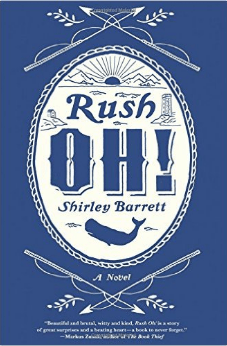
Day 961: Rush Oh!

Cover for Rush Oh!Best Book of the Week!
Perhaps I am harping on this subject, but yet again a distinctive authorial voice has made for an outstanding novel. In this case, the voice is that of Mary Davidson, the 18-year-old daughter of a whaler in 1908, Eden, Australia. Mary is relating the events of the year from a distance of 30 years later.

At that time, some of the whaling in Australia was done from shore, the whalers rowing out to chase the whales. In this activity, the whalers of Eden were assisted by, amazingly, a group of killer whales, who behaved more or less like really rough sheepdogs, herding and battering the other whales. In the novel, the leader of the killer whales, Tom, summons the whalers when whales are in the bay by smacking his tail loudly, and the whalers at times attempt to call the killer whales by smacking their oars.

The story begins with the arrival of a young man hoping for a seat in one of the boats. He is John Beck, reputed to be an ex-Methodist minister. Beck very soon seems to be courting Mary, although he is inconsistent in his attentions. Also, there are some indications that he has not been strictly truthful about his past.

Mary’s father George is short on men and had a very bad whaling season the year before, when they caught not a single whale. Although George “Fearless” Davidson (an actual historical person) is highly esteemed in the region, the financial situation is dire, and he must accept this totally inexperienced man onto his second boat.

The novel is peppered with rampaging whaling scenes and descriptions of the whaling life. It is written in a sprightly, witty, and engaging tone that reflects the personality of naive young Mary. Although it documents a disappearing way of life, it is wonderfully entertaining, and I loved every minute of it.

Related Posts

The Rathbones

Galore

History of the Rain

Day 958: Merivel: A Man of His Time

Cover for MerivelIt wasn’t until I started reading Merivel for my Walter Scott prize project that I realized it was a sequel to Rose Tremain’s better-known novel Restoration. I hadn’t read Restoration in 20 years, but I decided not to reread it first. I only remembered that it was about a doctor who got caught up in the debaucheries of the court of Charles II.

Merivel is a picaresque novel, like its predecessor. In its bawdy exuberance, it reminds me a bit of Tom Jones or Tristam Shandy. It begins in 1683, when Robert Merivel is living alone on his estate, an older man suffering from melancholy. His young daughter Margaret spends much of her time with the neighbors, who have four daughters. He is lonely and feels his life has had little purpose. He discovers his original manuscript (presumably the text of Restoration), which he refers to as the Wedge, but he doesn’t have the energy to read it.

On a whim, he decides that since Margaret is going on a trip with her friends to Cornwall, he will journey to the court of Louis XIV in Versailles and offer his services as a physician. To do this, he gets a letter of introduction from Charles II.

It is difficult to describe the plot of this novel. It doesn’t have a central concern except the feeling of its hero of having accomplished nothing. Merivel has many adventures, including falling in love with a woman he meets at Versailles and dueling with her husband, but they are all related in a semi-comic, mocking manner. Merivel, who seems ready to fall into every folly, is a sort of hapless anti-hero who hasn’t grown up much from the first novel.

Behind the scenes, we see that England is faltering. The poor are getting poorer as the court indulges itself. Merivel, who remains aware of the plight of others, can’t help observing that Charles II seems to feel no responsibility for this. Although this novel is not one of my favorites on the Walter Scott Prize short list, it certainly seems to reflect the time period in which it is set.

Related Posts

Viper Wine

The Sun King

The Nature of Monsters

Day 956: The Black Moon

Cover for The Black MoonThe Black Moon is the fifth book in Winston Graham’s Poldark Saga. It is now 1794.

Ross and Demelza Poldark have weathered the difficulties of their marital breach, and the result is that Demelza is again pregnant. The feud between Ross and George Warleggan has been in abeyance, but in this novel George shows that he is even more of a villain.

The difficulty begins with a friendship. George Warleggan thinks that Geoffrey Charles Poldark, his stepson, is spoiled from spending too much time with his mother. He wants to send Geoffrey Charles to school or failing that, get him a tutor, but he compromises with Elizabeth by allowing her to hire her cousin, Morwenna Chynoweth, as Geoffrey Charles’s governess. While Geoffrey Charles and Morwenna are out on the beach, they meet Drake Carne, one of two of Demelza’s brothers who have come to the area looking for work.

Although there is quite a distance in their stations, Drake being the son of a miner and Morwenna the daughter of a vicar, Drake and Morwenna’s friendship gradually turns to love. Morwenna has no idea that George has been plotting an advantageous marriage for her—at least one that allies him with an established family of the area.

In the meantime, others are interested in the news from France. Ross hears that Dwight Enys’s ship has been sunk after a naval battle. He goes to some trouble to find out if Dwight is alive, both for his own sake and that of Dwight’s fiancée, Caroline Penvenen. Eventually, Dwight’s plight leads Ross into an even more hazardous venture.

Some foreshadowing of future events, possibly, comes with the birth of George Warleggan’s son Valentine. He is born under a black moon (an eclipse), which the local people believe is an ill omen. And perhaps there are small indications that he will not be a normal child. I don’t know, but I am interested to find out.

Related Posts

Demelza

Jeremy Poldark

Warleggan