Day 720: Galway Bay

Cover for Galway BayGalway Bay is fiction based on the stories of Mary Pat Kelly’s great-great grandmother about leaving Ireland in the first half of the 19th century to come to America. The novel covers a lot of ground—the iniquities of Ireland’s Anglo-Irish landlords, the Great Famine, early Chicago, the American Civil War, the Fenian Brotherhood—and ends with the Chicago World’s Fair.

Honora Keeley is a young girl living in a fishing village on Galway Bay when she meets Michael Kelly and they fall in love at first sight. They want to marry, but they have to convince Honora’s family, because Michael owns nothing but his horse. However, he earns enough to marry by winning a horse race in Galway.

Honora’s sister Maire, who was married the day Honora met Michael, is soon a widow after her husband dies in a fishing accident. On Honora’s wedding night, Maire saves Honora from the landlord’s droit du seigneur by volunteering in her stead. I’ll say something about this later.

Michael is no fisherman. Honora and Michael have a tough enough time of it farming but are making out okay when the potato blight hits. The behavior of the landlords and the British government during this time is shameful, and Kelly depicts it vividly. After several years of the blight and other misfortunes, Honora finally is able to convince Michael to leave for America, to Chicago, where his outlawed brother Patrick is said to reside.

Although this novel has a fairly good story, there is something about the narrative style that bothered me. It is told in first person, but in a modern style that is not convincing. Many things happen, but I didn’t ever feel as if I understood much about the characters’ personalities. Especially early on, when we are getting to know the main characters, often opportunities for revealing dialogue turn into storytelling episodes, where we hear another Irish legend. Everyone has one or two identifying characteristics, but they don’t feel like real people. I think the novel may have been more successful in the third person.

Finally, I was highly skeptical of whether droit du seigneur would have occurred in the 19th century, as it is usually associated with Medieval times. I’m sure this event is based on family legend, but I think Kelly could have treated this one with a little skepticism, especially as the lord’s behavior is abetted by a priest. I attempted some research on the topic and was surprised to find a lot of discussion about whether it was ever actually practiced at all. But with one exception, the references were to Medieval mainland Europe, not the British Isles. That exception was a Facebook page about Ireland, but I was unable to find the actual reference on the page to see if it cited any sources. I have read several history books about Ireland and took a graduate course in Irish history, and I have never heard anything about this, although the other abuses are well known. (I have since found one source for this alleged practice, Arthur Young, the author of a book called Tour of Ireland in 1780, who stated it was commonly practiced in rural Ireland. He is listed in Wikipedia as an agriculturalist who traveled to observe agricultural practices. Still, with this little information, we have no idea if his statement is based on rumor or fact, and this report is 50 years or so before the time of this novel.)

Related Topics

The Sea House

Troubles

Giants in the Earth

Day 718: A God in Ruins

Cover for A God in RuinsBest Book of the Week!
In my opinion, Kate Atkinson’s Life After Life was absolutely the best book I read in 2013. It is the story of Ursula Todd, who dies and comes back to life until she accomplishes her goals. A God in Ruins is about her beloved brother Teddy. Atkinson describes it as a companion piece rather than a sequel.

Like Life After Life, Teddy’s story dwells on the effects on his life of World War II, during which Teddy is an RAF bomber pilot. Although the novel covers his entire life in a nonsequential, rambling order, clearly the events of the war are a major focus to which he keeps returning.

During the war he makes himself a promise that if he lives through it, he will always be kind. And he is, to his sisters, his matter-of-fact scientist wife, and his unlikable daughter Viola. When his daughter fails spectacularly at child-rearing, his home is a harbor for his two grandchildren.

Although Teddy does not have Ursula’s ability to shape her own future, during the war he flies so many missions without being killed that his comrades deem him invincible. And in later life his daughter comes to fear he will live forever.

I can’t explain why A God in Ruins is such a wonderful follow-up to Life After Life without giving too much away. Its focus is on the bombing campaign against Germany, and it explores the ethical issues of that campaign, which killed many German civilians. It also shows the waste of the  young men sent to pursue it, sometimes in conditions almost guaranteeing they won’t return. And the terror of these young men.

Atkinson is deft in her depiction of believable characters and is also a beautiful, inventive writer. It’s quite possible that A God in Ruins may be my favorite book of 2015.

Related Posts

Life After Life

Started Early, Took My Dog

The Greatcoat

Day 716: The Siege of Krishnapur

Cover for The Siege of KrishnapurThe Siege of Krishnapur, the second in J.G. Farrell’s trilogy about the British Empire, is a novel of ideas, full of the mordant humor and irony that characterizes the first book, Troubles. Farrell based his novel on the true-life 1857 siege of Lucknow, during which British residents held out for five months against attacks from Indian sepoys.

As author Pankaj Mishra explains in the introduction, this siege and similar incidents generated at the time a popular romantic genre of fiction, wherein two young English people meet in India just before the rebellion and bravely withstand privation to prevail in the end. In The Siege of Krishnapur, Farrell is among other things satirizing this genre.

George Fleury arrives in Calcutta with his sister Miriam just before news of the first sepoy rebellions. Like Farrell’s protagonist of Troubles, Fleury is an unformed young man, and worse, he tends to the pedantic. He is inclined to the romantic and likes to lecture about the supremacy of feelings and ideas over the new plethora of objects and inventions resulting from the current Industrial Revolution.

In Calcutta, Fleury and Miriam meet another brother and sister, Harry and Louise Dunstable, offspring of one of Krishnapur’s doctors. Harry is a young lieutenant, and Louise is thought to be the prettiest (English) girl in India. Fleury is taken by her, but she spends her time flirting with the young soldiers.

Once the young people reach Krishnapur, it is not long before the rumors of trouble turn into reality. The Collector, who is in charge of the district, has been paying attention, though. The others have been ridiculing him for surrounding the Residency with trenches and sending his wife home to England.

The Collector can’t quite comprehend why the natives would want to attack the British, who in his mind are bringing them the wonderful benefits of civilization. He himself attended the Great Exhibition and has filled his house with some of the marvels exhibited there, including electroplated busts of some of the great poets. (Shakespeare’s head turns out later to make a great cannonball; Keats’ does not.)

Once the British are under attack, there are thrilling yet funny descriptions of the fighting, bravely and innovatively conducted by Harry and the other soldiers, who have limited resources, and incompetently assisted by Fleury. Fleury is continually arming himself with some bulky and impractical weapon. Inside the Residency, the British begin by maintaining strict social levels and having tea parties. Once Fleury and Harry have rescued Lucy, a suicidal fallen woman, from her bungalow outside the compound, the other ladies are horrified at having to share quarters with her, even though they are sleeping on billiard tables.

Many vibrant characters inhabit this novel. The Padre is an Anglican clergyman who endlessly tries to convert his flock’s thoughts into more pious channels, haranging them even in the midst of battle. Dr. Dunstable is so incensed by the more modern treatments of his rival, Dr. McNab, that he challenges him to verbal debates and eventually gets himself killed trying to prove Dr. McNab is wrong about the cause and treatment of cholera. Even when Dr. Dunstable’s death proves Dr. McNab is right, the supposedly rational and enlightened British still somehow believe he is wrong. The Magistrate is so interested in phrenology that he shocks everyone by feeling the back of Lucy’s head to determine its amativeness and is slapped for it.

As conditions in the Residency deteriorate, the true nature of the British rulers of India emerges, petty, jingoistic, and chauvinistic, caring little for the natives, who do not appear much in the novel except as servants or attackers. In one revealing speech, an opium grower rejoices at how much money has been made by forcing the Indians to grow opium and then using it to addict the Chinese. In fact, it was just at this time that the 8th Earl of Elgin stopped to hear about the rebellion in northern India while he was on his way to China to force the Chinese emperor to admit British opium dealers.

The novel tells a great story, while still being full of wit and philosophy.

Related Posts

Troubles

Sea of Poppies

River of Smoke


Day 715: Lark

Cover for LarkJust an aside to start. When I was in high school, I had a job at the public library. There I discovered lots of authors I may not have come across elsewhere, and one of them was a writer of books for teens and preteens who specialized in historical novels featuring likable, feisty heroines. I read every one the library had.

Years later, I would try to remember who this author was to see if I could find some of her books and discover whether I still liked them as much. But all I could remember was she had a relatively common name that started with W. I searched Amazon for children’s books with authors beginning with a W. There are a lot of them. Then one day just awhile ago, a word popped into my head, “Lark.” A Google query accomplished the rest. I found a wonderful page on a site specializing in children’s books called “Stump the Bookseller” where you could ask exactly that kind of question, and more than one person asking about the author of a historical novel with a character named Lark. The author was Sally Watson. A little more searching found she is back in print.

* * *

Elizabeth Lennox has not been called by her nickname of Lark since her Uncle Jeremiah came and took her away from her family. He always thought she would make a good wife for her cousin Will-of-God if she was just raised correctly. Since he is one of Oliver Cromwell’s officers and Lark’s father was away fighting with the Royalists, he could do what he wanted. So, he took Lark away and she has been living miserably in a Puritan household ever since. She has no desire to marry Will-of-God, whom she dislikes. She deliberately tries to appear young so that her uncle won’t realize how close she is to being marriageable.

Lark has had nowhere else to go, since her family had to leave for the continent after their property was confiscated. But one day she receives word from her sister up in Scotland, so she decides to go there, not realizing how far away the Highlands are from southern England. She sneaks out of the house in the middle of the night and sets off.

James Trelawney is a young Royalist who disguises himself as a Roundhead to run errands and pass messages in the interests of Charles II. He comes along as Lark is being accosted by a Puritan man after singing a Cavalier song on the road. James takes her for a child, for she looks much younger than her thirteen years. After tossing the Puritan into the river, he reluctantly agrees to take her north, but only because she seems to be too young to leave on her own and she won’t tell him who she is. The two of them have adventures involving intrigue, capture, travels with gypsies, and other exciting incidents.

When I reread a children’s or young adult book, I try to evaluate how interesing it is for both the adult and the intended audience. I don’t think Lark has as much to offer an adult as some of the old classics I’ve reread recently, such as The Secret Garden or Anne of Green Gables. However, I did enjoy it as a bit of light reading. It is written for girls around ten to thirteen or fourteen years old. Although I loved it as a sixteen-year-old, older teens today may be a bit too sophisticated for it. I’m not sure. Still, it has plenty to recommend it, a good background in the history and a pleasant way of presenting it—through James’ confusion about his own loyalties—adventure, humor, and light romance. It is much more innocent than many of today’s books for teens, but that’s not necessarily a bad thing.

Related Posts

Anne of Green Gables

The Loon Feather

Swamplandia!

Day 710: The Kept

Cover for The KeptBest Book of the Week!
The Kept is a mysterious and darkly moody novel that I found compelling from the first sentences. Elspeth Howell arrives home on a snowy winter day in upstate New York near the turn of the 19th century. She has been away for months working as a midwife. But when she reaches home, she finds that her husband and all of her children that live in the house have been murdered. Only her 12-year-old son Caleb, who has taken to living in the barn, is alive, but he has been hiding in the pantry for days, and when she opens the pantry door, he shoots her in terror.

Caleb spends the next few days alternately trying to take care of his mother and dispose of the bodies of the rest of his family. He cannot bury them in the frozen earth, but in his attempt to burn them, he accidentally burns down the house. He ends up caring for his mother in the barn.

The Howell’s home is isolated and difficult to find. As a young girl, Espeth was driven from her home for having spoken to Jorah, the man she later married, because he was Native American. But there are other reasons for the family’s isolation. In any case, Elspeth thinks the murderers must have sought for their house.

When Elspeth is barely healed, she and Caleb set forth to find the three men who murdered their family, men whom Caleb watched from the barn. They stay briefly with an old couple who have been terrorized by the same three men and who point them in the direction of a town on Lake Erie with a terrible reputation. There, with Elspeth disguised as a man, they go to search for the men.

Beginning as a straightforward revenge novel, the book goes on to explore deeper themes. One of them is that of unintended consequences, as Caleb finds that their troubles result from Elspeth’s own actions years before.

This novel is well written and packed with atmosphere. It is vivid and brutal and beautiful.

Related Topics

Seven Locks

True Grit

Neverhome

Day 708: At the Water’s Edge

Cover for At the Water's EdgeMaddy, Ellis, and Hank make a riotous threesome as they party and caper their way through Philadelphia high society. It is World War II, but both Ellis and Hank are classified 4F. In any case, taking upon any adult responsibility doesn’t seem to be in their plans. Maddy and Ellis Hyde are married, but they live with Ellis’ parents. Hank has a girlfriend but has shown no interest in marrying Violet.

After a particularly drunken New Year’s Eve, Ellis’ father throws Ellis and Maddy out of the house to fend for themselves and cuts Ellis’ allowance. To get back into the good graces of Mr. Hyde, Ellis and Hank come up with a hare-brained scheme. Long ago, Mr. Hyde went to Loch Ness to look for the monster. He claimed to have found it and circulated photos. But they were revealed as fakes. Ellis thinks if they can find the monster and take legitimate pictures of it, he can revive the family name and make his family proud.

But getting to Scotland during wartime poses problems. Hank finally gets them on a freighter, but when their ship rescues some men whose vessel was torpedoed, Maddy begins to understand the horrors of war. Arriving at their destination, she is the only one of the three who seems to understand how ridiculous their presence as tourists is during this difficult time. The three know nothing of ration cards, air raids, or war casualties. And the men’s boorish attitude about the lack of conveniences at the inn doesn’t help.

Maddy settles in and gets to know the villagers, but she is soon disturbed by how much Ellis and Hank are drinking and how many of Maddy’s “nerve pills” Ellis takes. Maddy herself has only ever taken one.

link to NetgalleyAlthough dealing with another period and setting, Gruen is covering some of the same ground as in Water for Elephants. She clearly enjoys the wives in distress theme. Still, after I experienced an initial distaste for all three main characters, Maddy grew on me with her evolving sensitivity and efforts to help the villagers. I enjoyed this novel and think it makes a good light historical romance. Gruen periodically gives us details of the war and does a fair job of evoking the atmosphere of a small pub, where everyone nightly listens to the war news.

Related Posts

The Postmistress

Studio St.-Ex

Rules of Civility

Day 706: The Devil’s Backbone

Cover for The Devil's BackboneThe Devil’s Backbone is a western adventure tale related in an unsophisticated vernacular style in both first person and third person. It is an unusual novel but reminds me most of, perhaps, True Grit or The Adventures of Huckleberry Finn. The third person narrator is barely there but relates the first person story his father told him. The book is illustrated by Jack Unruh.

Papa, as the third-person narrator calls him, is a young boy growing up in the Texas Hill Country when his father Karl kills a horse after a dispute about it with his wife Amanda. Amanda saddles up her horse Precious with the concho-decorated saddle her father gave her and leaves. After Karl has gone off for a few days and returned, a neighbor, Miz Choat, arrives to tell Karl that she has promised Amanda to send the boys to school, so she takes Papa and his older brother Herman back with her. But after Herman has attended school awhile, he takes off.

Papa enjoys his time with the Choats, but after a few months his father arrives to take him back. At home he has installed another woman, Miss Gusa, who is pregnant.

Papa has clearly been brought home as a cheap source of labor. Eventually, Karl’s brutality makes Papa decide to leave and look for his Mama. On his journey he encounters outlaws, a dying Indian, a prematurely born baby, a family of Mexican migrant workers, and several loyal friends, including the cowboy Calley Pearsall.

I enjoyed this tale. At first, I thought it might become a series of tall tales, but nothing happens in it that seems wildly exaggerated. However, it does have the flavor of a folk tale. The only thing I found a little irritating was the double narration. We learn nothing at all about the narrator, so I don’t really see the purpose of that approach, which leads occasionally to such confusing constructions as “I said, Papa said.”

Although this novel may sound like children’s fiction, I don’t think I would recommend it for younger children because of some of the events. Older children would probably like it, as it has lots of adventure. Some of the subject matter may be inappropriate, however, as there are events such as murders and death in childbirth, so use your discretion. This book was a choice of my book club, all adults, and we all enjoyed it.

I have been on the Devil’s Backbone (pictured on the cover). These days it is a narrow two-lane highway across a ridge with spectacular views on each side. I heard it had been widened, but to think it was once so narrow is amazing.

Related Posts

True Grit

Appaloosa

Treasure Island


Day 703: The Tilted World

Cover for The Tilted WorldBest Book of the Week!
On Good Friday 1927 after months of rain, the levee on the Mississippi near Greenville, Mississippi, collapsed, causing a gigantic flood that swamped 27,000 square acres of land in the Delta, made many people homeless, and killed an untold number of people. The Tilted World is a fictional account of the days before and after the flood.

Dixie Clay has been married for six years. Although her husband Jesse was a fur trader when she married him, it has taken years for her to realize he’s a bootlegger or to see him for the kind of person he is. After her baby died, she started making liquor herself, but she has come to hate her husband. At the beginning of the novel she helps him capture two revenue officers, thinking he will bribe them to make them go away. But she hasn’t heard of them since and is worried that he killed them.

Ingersoll and his partner Ham Johnson are revenuers who have been dispatched by Secretary Herbert Hoover to Hobnob to find out what happened to the other two officers. On their way, in the sodden territory along the river, they find a dying store clerk who has shot two looters. The looters were a couple with a baby, and Ingersoll can’t bring himself to leave the baby there alone. So, Ham goes on ahead to Hobnob while Ingersoll takes the baby to the orphanage in Greenville. But he is an orphan himself, so he turns around and brings the baby back to Hobnob to inquire for someone who would like to take him. He ends up giving the baby to Dixie Clay.

Later, he is disturbed to realize that Dixie’s husband is probably the bootlegger. But he and Ham don’t have time to look for the bootleggers. They have represented themselves as engineers and find that the levee needs to be guarded. There are rumors that rich bankers are planning to sabotage the levee at Hobnob so that the flood will be lessened in urban areas.

This novel is full of energy and action. There is a growing attraction between Dixie and Ingersoll, but their differences seem too large to overcome. I really enjoyed the characters and setting as well as learning about this massive flood that we have all forgotten.

Related Posts

The Known World

The Hamlet

The Johnstown Flood

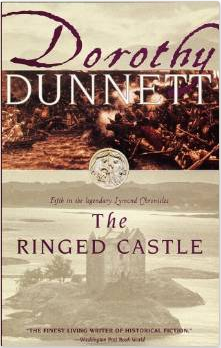
Day 701: The Ringed Castle

Cover for The Ringed CastleBest Book of the Week!
In this fifth book of the Lymond Chronicles, Francis Crawford of Lymond goes on a journey to an uncivilized land. He has already traveled and battled his way over Europe, North Africa, and Asia Minor, but this time he takes his small band of mercenaries to Russia. In an attempt to avoid the consequences he fears from a prophecy by the Dame of Doubtance, he feels he must stay away from his home in Scotland. So, he decides to go to Russia and offer to fight for Ivan IV (Ivan the Terrible) against the Ottoman Turks.

With Lymond and his mercenaries goes the mysterious Guzel, a beautiful, cultured former mistress of the Ottoman admiral Dragut Rais. She wants to make Lymond a powerful ruler. Lymond sees Russia as an undeveloped country full of opportunity for an intelligent leader, a place that will allow him the scope to create something great. Since Russia has no modern army in the sense of those of 16th century France and England, he offers to build one for the tsar.

Lymond’s struggles to work with the erratic tsar are complicated by his relationship with Dmitri Vishnevetsky, or Baida, the volatile Hetman of the Ukrainian Cossacks and a man of legend who has pledged his help to the tsar. Baida sees Lymond as a possible companion but also as a threat to his own power, and he desires Guzel for himself.

Back in England, Philippa Somerville has made a debut at the court of Mary Tudor that is surprising to even her mother, because her sojourn in the sultan’s harem has changed her from a scruffy teenager to a beautiful, polished, and sophisticated young woman. The treacherous Margaret Lennox and the queen’s sister Lady Elizabeth seem to be interested in involving her in their various schemes, but Philippa is tactful and cautious.

This novel, like the others, involves plenty of political maneuvering, adventure, danger, and battles, but also features winter sledge races and the burning of Moscow. Lymond, as usual, is arrogant, frightfully intelligent, and always ready with a blistering comment. Still, we find him irresistible. I cannot tell more for fear of spoilers, but if you decide to read this series, you will not regret it.

Related Posts

Pawn in Frankincense

The Disorderly Knights

Queen’s Play

Game of Kings


Day 700: Some Luck

Cover for Some LuckSome Luck begins in 1920, five months after the birth of Frankie, Walter and Rosanna Langdon’s first child. They have only been settled on their own farm a short while.

This novel is the first of a trilogy about the Langdons, an Iowa farm family. It covers a turbulent 33 years, during which occur the Great Depression, the long drought, and the Second World War.

Most of the novel concentrates on the Langdon children. Frankie is active and always into trouble. He teases his younger brother Joey unmercifully. Joey is gentle and good with animals, dutiful and obedient. Lilian is angelic looking and well behaved, good at taking care of the younger children but a bit prissy. Henry is self-contained and spends as much time reading as possible.

It is hard to describe this novel. It moves constantly from character to character in viewpoint and has no main character, but is more like an ensemble piece. The action that takes place is mostly that of everyday living, although there are births, deaths, and weddings. Rosanna goes through a religious phase after one child’s death and drags the family to a fundamentalist church for several years and then stops.

Smiley’s characters are very human, with faults and foibles. So far, this trilogy is developing slowly, but the family’s lives make interesting reading.

Related Posts

A Thousand Acres

The All-True Travels and Adventures of Lidie Newton

Gilead