Day 278: Gentlemen of the Road

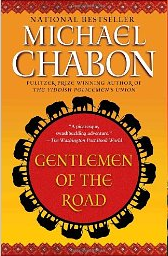
Cover for Gentlemen of the RoadGentlemen of the Road is like a boy’s adventure story for adults. Before 1000 AD, Zelikman and Amram are two adventurers travelling in the Caucasus Mountains. They make money by faking fights to be wagered on. Zelikman is a thin, gawky physician from Regensburg who has broken with his family, while Amram is a giant of an ex-soldier looking for his daughter, who was stolen from his village.

An old man hires the men to escort an unwilling young boy named Filaq to his grandfather. The boy’s father was a bek in Khazaria, a legendary Jewish country on the Caspian Sea, when he was murdered by a rival. The boy wants to return to take his revenge, but the rival is having his entire family murdered and enslaved. Filaq eventually persuades Zelikman and Amram to return to Khazaria and help him retake his father’s position.

Chabon originally published this novel as a serial in the New York Times Magazine, ending each chapter with a cliffhanger. He obviously had a great time writing it and it is lots of fun to read, with colorful characters, exotic settings, and deeds of derring-do.

Day 274: Red Water

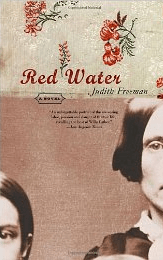
Cover for Red WaterBest Book of the Week!
I read this book on the recommendation of friend Dave Palmer. Thanks, Dave!

In Red Water Judith Freeman has accomplished something difficult–created characters whose beliefs I have no sympathy for, and who I’m not sure I even like, and made me want to read about them.

The novel is about the aftermath of the Mountain Meadows massacre of 1857, when 120 Arkansas emigrants on their way to California were slaughtered in southwestern Utah. This event is one for which the Church of Latter-Day Saints has never to this day admitted responsibility. In particular, this novel is about John D. Lee, the Mormon bishop who was eventually hanged for his part in the event, from the points of view of three of his wives.

Red Water begins with Lee’s execution in 1877, as Emma Lee looks back at her conversion to the religion in England, journey to Utah, and acceptance of Lee as a husband. Although he is twice her age and she will be his eighth wife, he is charismatic and commanding, and she marries for love.

Once she arrives in southwestern Utah, a barren and harsh landscape, she begins to hear things that disturb her. The initial version she is told of the massacre is that the settlers were slaughtered by Indians. But Lee has their stock in with his, and the settlement has a room stuffed with men’s, women’s, and children’s clothing, some of it badly stained. Other versions of the story come out, ones that point the finger partially, or wholly, at the Mormon men, some alleging her husband was a leader. But Emma feels she must trust her husband.

Emma finds she has other hardships. She is not Lee’s eighth but seventeenth wife, although the other nine have left him. There is jealousy among some of the remaining wives. Lee’s families are so far-flung that Emma often goes days without seeing him. The land is bleak and unforgiving, and the work is hard. But Emma decides to face every hardship cheerfully.

Ann is Lee’s child bride, married to him at the age of 13 shortly after his marriage to Emma. Her narrative begins after Lee’s death as well, when she has long been separated from the family. On a pursuit of a horse thief from Idaho to southern Utah, she finds herself back in Lee’s old territory and reflects upon her life with him.

Ann marries Lee to keep her mother, who has lost faith and criticized the Mormons, under Lee’s protection. Despite their age difference, she is also attracted to him. After an initial rough start with Emma, the two became the closest of friends.

However, by the time Brigham Young sends Lee away from the southern settlements that he helped found and banishes him from the order as a scapegoat for the massacre, Ann has made some disillusioning discoveries and decides that Lee’s driving forces are greed and the pursuit of power. She leaves the family to wander on her own, often dressed as a boy.

Once Lee is thrown off by the Mormons, Emma and Rachel keep faith with him, but only Rachel willingly shares his prison. Her narrative is the last. As an old, bitter woman, she fights to survive in a remote area of northern Arizona where Lee has sent her.

This novel is fascinating for the details of the characters’ beliefs and the hard lives that they must live in settling these wild parts of the country. I also find fascinating the ability of men to rationalize as the will of god whatever foul or greedy things they want to do. Freeman’s portrayal of her characters, however, is amazingly unjudgmental and perceptive.

On a side note, for those who are interested in this subject, an excellent nonfiction source about modern fundamentalists, whose beliefs and rationalizations are strikingly similar to those depicted in this novel, is Jon Krakauer’s Under the Banner of Heaven.

Day 269: The Song of Achilles

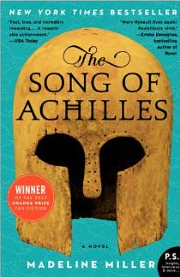
Cover for The Song of AchillesMadeline Miller has attempted a difficult task in The Song of Achilles–to make the story of Achilles, Patroclus, and the Trojan War more understandable to a modern audience. To some extent she succeeds, but in some cases I think she interjects too modern a sensibility into the ancient tale.

I have never been a big fan of Achilles. The image of him sulking in his tent because of pique while the Greeks get slaughtered is not a pleasant one. But for the benefit of those who are not familiar with The Iliad, if there are any, I will leave that part of the tale for them to discover.

The novel is narrated by Patroclus, who is exiled as a boy after accidentally killing another boy. In Miller’s novel this gives him a horror of killing and he never learns to fight–the first instance of that modern sensibility I mentioned. Not only is there no evidence in the Greek myths that Patroclus didn’t fight, there is evidence to the contrary.

In exile, Patroclus is brought up with Achilles, son of the goddess Thetis, and Miller makes the interesting choice of having the gods and goddesses be characters in the novel, just as they are in ancient stories. Patroclus and Achilles become close companions and eventually lovers.

Here again is where modern sensibilities come in, not because the two were lovers–they almost certainly were–but in the way she treats the relationship. I’m no Greek scholar, but I’m fairly sure that such relationships were rather common, and I’ve read somewhere that in some armies they were encouraged because the friends fought better for each other. Yet here, the two hide their relationship, and Thetis despises Patroclus from the first. In fact, in The Iliad, the relationship is implied but not commented upon, more as if it is accepted.

I don’t want to sound too particular, though, because almost despite myself I was drawn in and ultimately touched, not by Achilles as much as by Patroclus.

In a class discussion of The Iliad years ago, when the students were commenting on Achilles’ behavior, the instructor made it very clear that despite what we may think of him today, to the ancient Greeks he was indisputably a hero. So, modern sensibilities come in again, as Patroclus worries that the Greeks will begin hating Achilles because he refuses to fight, and they do.

To a great extent, most of the characters in the novel are one- or two-dimensional–Agamemnon is stupid and brutish, Odysseus is wily and clever, and so on. Only a few characters are more fully developed. But then, the narrator is Patroclus, and his life revolves around Achilles, who is unbearably proud and full of himself. Yes, I still don’t like Achilles. To Miller’s credit, I don’t think I’m supposed to. Despite my caveats, though, I enjoyed the novel and am looking forward to reading another book by Miller.

Day 265: Here Was a Man: A Novel of Sir Walter Raleigh and Elizabeth I

Cover for Here Was a ManI don’t think I’ve read anything by Norah Lofts before, but even though she was a prolific historical novelist, I would rate this effort as mediocre.

Here Was a Man attempts to draw most of Raleigh’s life in a short space and does so by a series of vignettes illustrating important events. Although I am not completely familiar with his career, I know that Lofts  has chosen to portray a couple of apocryphal events, in particular the cloak in the mud story, which I believe has no basis in fact. The other serious lack of the novel is any depth of characterization.

The novel begins with Raleigh as a teenager, listening to sailors’ tales and dreaming of traveling the seas. He is also full of ambition for worldly success, an ambition that sometimes works to his disadvantage.

We are told many times about Raleigh’s sense of adventure, but we don’t really feel it. In fact, he seems to spend more time in prison than on his adventures. It is curious, too, that although he has many enemies at court, at least in this novel he has done nothing to earn their enmity. I would doubt that was really the case.

Raleigh is probably a character who could support an interesting and exciting novel, but this is not it. To be fair, it looks like it may have been one of Lofts’ first works.

Day 264: The Ballad of Tom Dooley

Cover for The Ballad of Tom DooleySharyn McCrumb has written several series of light mysteries, some better than others. I have usually enjoyed her “ballad” series–atmospheric, sometimes ghostly mysteries set in Appalachia and each named after a traditional folk ballad. The Ballad of Tom Dooley, despite a background of historical research (because this folk ballad is based on a true case), is not her best, however.

According to McCrumb’s notes at the end of the novel, she got interested in the story after researching it for an article and decided that the prevailing theories of the crime are not satisfying. So, she reconstructed her theory of the crime in this book. As such, it is not so much a mystery as an explication.

Most people vaguely know the story, that Tom Dooley (actually Dula) met Laura Foster “on the mountain/stabbed her with [his] knife.” Another defendant, Ann Melton, was let go. But McCrumb says most people in Wilkes County, where the crime occurred, will tell you Ann did it. To McCrumb, knowing that Ann was Tom’s long-time married lover, Tom being guilty didn’t make sense.

The novel is narrated by two characters who were actually involved in the incident: Pauline Foster, who was Ann Melton’s cousin and servant girl; and Zebulon Vance, the ex-governor and senator of pre-Civil War North Carolina who defended Tom. Pauline is an interesting character–McCrumb depicts her as a sociopath who manipulates the others and wants revenge for Ann’s slights.

The biggest fault in the novel is the narration of Zebulon Vance. At first, I thought McCrumb’s intent was to depict him as a maundering old bore, possibly even senile, as his section is so repetitive and adds so little to the narrative. It is mostly about himself and has little to do with the story. But then I read that Vance’s career was one reason McCrumb wanted to do the story. Instead of adding to it, it detracts from and drags against the impetus of the plot.

The fact is that none of the characters are likable people, and the crime isn’t particularly interesting. From the author of some haunting stories, this novel is a disappointment. If McCrumb wanted to write about Vance, she may have done better to write a biography.

Day 262: River of Smoke

Cover for River of SmokeA month or two ago I reviewed Sea of Poppies, Amitav Ghosh’s riveting first book in his Ibis trilogy. I have been waiting since then for a good opportunity to post my review of River of Smoke, the second book in the trilogy.

The various passengers and crew members of the Ibis have been separated and now several of them travel toward China on three different ships. Paulette Lambert has been taken on the Redruth by Filcher Penrose, a nursery man for a major botanical garden who hopes to exchange New World plants for those of China. He has hired Paulette, whose father was a renowned botanist, to help take care of the plants.

En route to China with a shipment of opium, the merchant Bahram Moddie, Ah Fat’s father, takes on the disgraced Raja Neel as a munshi, or clerk. Neel travels on the Anahita to Canton in Bahram’s entourage under the name of Anil Kumar.

The Ibis, now containing the owner Benjamin Burnham, is also on the way to Canton.

In Macao, Paulette meets a friend from her childhood, Robin Chinnery, the unacknowledged illegitimate son of a famous painter. As a woman, Paulette is not allowed into Canton. She can only go as far as Hong Kong, then a desolate, almost uninhabited island, where she searches for plants. But Robin goes on to Canton with a mission to try to find out for her and Penrose who painted a picture of a golden camellia and possibly to trade for such a plant.

Robin is in town during the unsettled days before the beginning of the Opium Wars, when the Chinese Emperor is trying to halt the opium trade into China, while the opium traders are purposefully trying to instigate war so that they can call for the intervention of the British navy. Robin’s entertaining letters to Paulette keep us informed about the political debate as he is befriended by Charles King, the only merchant of stature who believes China is in the right.

Bahram Moddie, a well-meaning man who loves Canton on sight, has unfortunately invested his entire fortune in this shipment of opium. He is caught between his conscience and his need to be successful as the Chinese government tries to keep the foreign ships at bay.

As rich in language and storytelling as the first book, this novel is completely engrossing, showing the American and British opium dealers as the venal, hypocritical men they are, with their self-serving arguments about Free Trade and their arrogant disdain for their Chinese hosts. I’m afraid it may be two or three years of waiting before I can read the final book in the trilogy.

Day 259: The Greatcoat

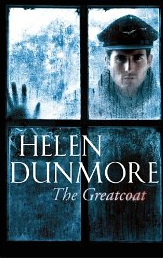
Cover for The GreatcoatI am not familiar with Helen Dunmore, but I looked for this book after reading a review of it on another blog citing it as a good ghost story.

At first I was inclined to dislike it. Isabel Carey is a new wife in 1952, married to a young doctor in a small village in Yorkshire. Isabel is a poorly trained housewife who spends her time disliking her new home in the bottom floor of the landlady’s house and feeling as if everyone is looking at her. She especially dislikes the landlady, Mrs. Atkinson, who paces back and forth on the floor above, sometimes all night.

Unable to get warm in the dank little house, one night she searches through a cupboard and finds an officer’s wool greatcoat, which she uses as an additional bedcover. The next night a strange man dressed as a World War II officer comes and taps on her window.

Soon the officer, Alec, begins coming to visit her and by his behavior shows that he thinks they are lovers. She knows almost immediately that he is a ghost but seems to passively accept their relationship. Who the soldier’s actual lover was should be almost immediately apparent, but Isabel doesn’t seem to guess.

At this point, I was extremely annoyed with the novel, believing I was supposed to find all this romantic when all I could think about was Philip, Isabel’s poor, hard-working husband, who only treats her kindly. The only negative thing about his character is his desire to protect Isabel from everything, and I believe that attitude was typical of the times. I also thought Isabel is a spoiled little brat who does little but complain and thinks nothing of launching into an affair with another man, ghost or not.

Eventually, though, the novel takes a more sinister turn, which is more to my taste. My final overall impression was ambivalence.

By the way, the Amazon write-up of this book (probably taken from the publishers) compares Dunmore as a historical novelist to Tolstoy and Emily Brontë. Aside from the oddness of an implicit comparison between those two writers, this is a gross overstatement of Dunmore’s abilities. What Dunmore has written is a slight, moderately entertaining novel that cannot be compared to the work of the other writers.

Day 257: Galore

Cover for GaloreA whale comes ashore at the remote coastal town of Paradise Deep, Newfoundland, in the early 19th century. The people, who have been starving all winter, come out to scavenge what they can of the meat. When Devine’s Widow, an old Irish “wise woman,” cuts open the belly of the whale, a man falls out, pale as an albino, mute, but still alive. Although he stinks like a fish, the Devine clan gives him room in a shed and calls him Judah. Nevertheless, he is treated with dread and superstition until he goes out fishing one day with Colum Devine and they take a huge load of fish in waters that have been barren that season.

The Devines have been at odds with the powerful King-Me Sellers since he proposed marriage to a young Irish bondswoman years ago and she refused him rudely, then went off to marry Devine, practically the first young man she met. Their relationship was not improved years later when King-Me’s daughter Lizzy married Colum Devine.

When King-Me’s spite turns against Judah, the only way the Devines can save him is by marrying him to Mary Trephyna Devine, Colum and Lizzy’s daughter and King-Me’s granddaughter.

Michael Crummey’s multigenerational novel captures the relationships between these two families along with the history of the town, with all its eccentric characters, ghost stories, myths, and tall tales. The novel is fascinating, unusual, and beautifully written. I don’t usually enjoy magical realism, but in this novel it is handled so well that I accepted it and was engrossed in the story. Galore is probably unlike any novel you are going to read, although in its focus on a sea-going people and its occasional feel of a sea tale, it reminds me a bit of We, the Drowned  by Carsten Jensen.

Day 251: The Disorderly Knights

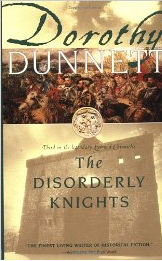
Cover for The Disorderly KnightsBest Book of the Week!
The Disorderly Knights is the third novel in Dorothy Dunnett’s rousing Lymond Chronicles series. I previously reviewed the first two novels, The Game of Kings and Queen’s Play.

Upon his return to Scotland from his adventures in France, Francis Crawford of Lymond establishes a small fighting force of independent knights and begins training them. As their reputation spreads, the band begins to attract more knights, and he hears that they are to be joined by a renowned fighter, Sir Graham Reid Mallett, Knight Grand Cross of the Order of St. John. Many of the men who know Reid Mallet consider him almost a living saint. In disposition and talents he seems to be a perfect foil for Lymond, but they clash, and some of Lymond’s men begin to turn against him. As usual, Lymond’s behavior appears to put him in the wrong, and Reid Mallett seems to want to usurp the fighting force.

This conflict eventually leads to Malta, where Lymond arrives just before the Ottoman Turks attack. During the siege, Lymond becomes involved in the political maneuvering and feuds among the various national factions of the declining Order of St. John. He also hears that Oonagh O’Dwyer, the beautiful Irish rebel he encountered in Queen’s Play, is captive in another city on the island. After the siege, he follows her to North Africa in an attempt to free her.

It is difficult to write more about this novel because of spoilers, but also because the plot becomes increasingly complex from this point on, with threads that are not all explained until the sixth book. Suffice it to say that, although this is a slow-starting series, if you get this far, you will be hooked. The novel is suspenseful and exciting, and Lymond makes a complicated and compelling main character, almost an anti-hero at times. These books were written in the 1960’s and 1970’s, and I think the only series to compare with them might be George R.R. Martin’s Song of Fire and Ice or Dunnett’s own House of Niccolo series.

Day 249: The Physick Book of Deliverance Dane

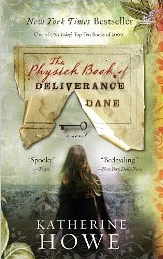
Cover for The Physick Book of Deliverance DaneBest Book of the Week!
Connie Goodwin has just passed her orals in history at Harvard and is one thesis away from her doctorate when her advisor, Manning Chilton, challenges her to find an undiscovered primary source on which to base some subject about Colonial America. She is almost immediately side-tracked in her research by a request from her mother to sort out her grandmother’s long-abandoned house in Marblehead and sell it to pay off back taxes.

Connie finds a very old, filthy house with a gate so overgrown with vines that it’s hard to find the house. Almost immediately she has a few odd glimpses, as if she can vividly picture her grandparents and other people in the house.

While sorting through the objects and papers in the house, she finds evidence of a woman named Deliverance Dane, who was found guilty of witchcraft in the Salem trials and left behind a “recipe” book, possibly of spells. Chilton immediately begins putting pressure on Connie to find the book, as it could provide the first evidence that people were actually practicing witchcraft at that time in Massachusetts. As Connie searches for the book, she makes some astonishing discoveries about her family and herself.

Back in the 17th century, Deliverance Dane, a wise woman or healer, is called to attend a child she cannot save. When the child dies, her father accuses Deliverance of satanism.

Some small things at the beginning of the novel irritated me. In laying the foundation of some basic history, I think Howe condescends to the reader a bit too much. For example, she finds occasion to tell us what a familiar is. Although many people may assume that all familiars are cats and find out differently from this novel, I would be surprised if people didn’t know what they were, if only from remembering their grade school lessons about the Salem witch trials. But perhaps I’m wrong.

There are also a couple of instances where Connie takes awhile to figure out something that she, as a graduate history student, should already know. For example, she doesn’t immediately know that “receipt” is another word for “recipe,” and then she has to explain this term to her professor, supposedly an expert in Colonial America. I am no historian or even generally interested in this period of history, but I knew immediately what the word meant. She does the same thing with figuring out that “Deliverance Dane,” mysterious words on a piece of paper, is someone’s name, as if in all her studies of the period she never encountered such an unusual name.

It is also very easy to see where the novel is going and who will turn out to be a villain. However, I still found it interesting enough to regard it as a strong first novel, especially if you enjoy the mixture of historical fiction and the supernatural. The characters are believable, and both story lines kept my attention. The historical portion seems solidly researched.

And I won’t mention the tomatoes, because it’s just too picky.