Day 151: Moonfleet

Cover for MoonfleetMoonfleet is a boy’s adventure story similar to Kidnapped or Treasure Island. Written by J. Meade Falkner in 1898, it was very popular for many years. I had actually never heard of it but picked it up out of curiosity a couple of years ago.

John Trenchard is an orphan boy who lives with his aunt in the small village of Moonfleet in the south of England in 1757. The village has been dominated by the Mohune family for centuries. There is a legend that Colonel John “Blackbeard” Mohune stole a diamond from King Charles I and that his ghost roams the crypts looking for it.

One day John hears noises from Mohune’s crypt, and when he goes to investigate, finds the landlord of the local inn, Elzevir Block, and Mr. Ratsey, the sexton, who say they are looking for damage from a storm. John assumes they are looking for Blackbeard’s ghost. He finds his way into the crypt through a large sinkhole and gets inadvertantly trapped there overnight. While he is trapped there, he overhears enough to realize that Block and Ratsey are actually smugglers.

John’s aunt assumes he has been up to no good when he doesn’t come back for the night, so she throws him out of the house. Fortunately, Block takes him in. But when Block’s lease expires, the lease goes up for auction and is purchased by Maskew, the unpopular local magistrate. Before Block leaves the area, John accompanies him on one last smuggling venture, during which Maskew, who has lain in wait for the smugglers with the excisemen, is accidentally shot by the excisemen. John is wounded and is falsely accused in absentia of murdering Maskew, so he must flee to the continent.

The rest of John’s adventures include diamond hunting, being imprisoned for theft when he is cheated by an avaricious diamond merchant, working as a galley slave, and shipwreck. Moonfleet is an exciting book with a gripping story line that is still popular with children.

Day 147: Quo Vadis

Cover for Quo VadisI picked up Quo Vadis because I so much enjoyed Henryk Sienkiewicz’s Polish history trilogy, as you know if you read my review of With Fire and Sword. This novel is about a young Roman patrician, Vinicius, who falls in love with Ligia,  a Christian, in the time of Nero’s rule. Sienkiewicz did extensive research on the period to get the details right.

About half of the book is about Vinicius’s pursuit of Ligia, first through ruthless means, including kidnapping (presumably pagan patricians have no morals), and later through conversion to Christianity. I was frankly uninterested in either Vinicius or Ligia, who are cardboard characters, and I couldn’t care less about whether they got together.

The last half of the book is about the burning of Rome and the persecution of the Christians. It features the last days of St. Paul.  The pace picks up a little here, but overall the novel is marred by its focus on extolling Christianity. All of the Christians are noble, and most of the other characters are not. Sienkiewicz was a devout Catholic, as is obvious from a few scenes in all his books, and I can only think that the added emphasis on this aspect in this particular novel gets in the way of the book’s effectiveness, at least as viewed by a modern audience.

I know that Quo Vadis was extremely popular in its time (it was published in 1896) and contributed toward Sienkiewicz winning the Nobel Prize for Literature. I also know that Sienkiewicz was capable of creating more interesting characters and writing more exciting scenes. Perhaps the times have just changed too much since this book was written for it to appeal to a wide audience now.

Day 143: West of Here

Cover of West of HereThis peculiar novel starts out as a straight intergenerational history showing how the building of a dam by a small town in 1890, which was meant to make the town prosper, ends up determining its future as a permanent backwater. The novel also tells the story of a nearly disastrous expedition into the Olympic Peninsula. The time alternates between 1890, when the dam becomes an idea of an early entrepreneur, and 2007, when the town is beginning to dismantle it. 

If there is such a thing as ensemble fiction, this is it, since the book has many characters, none of whom seem to be more important than the others. Because it has many characters, it has many stories, the oddest of which is that of a mute Klallam Indian boy in 1890 who somehow shares consciousness with a troubled Indian boy in 2007. In 2007, everyone assumes the boy is psychotic and he is admitted to a mental ward. In 1890, he starts his own cult.

Characters in the historical portion are an early feminist fleeing her lover; a prostitute who is fighting with the owner of the whorehouse; the Klallam Indians, already on their way to being destroyed; and an idealistic entrepreneur. Characters in the later story are a Bigfoot enthusiast, a seafood plant worker who longs for the days when he was a high school basketball star, an ex-convict who wants to live off the land, and an environmental scientist.

Evison has written a quirky, interesting book that is sometimes humorous, but I found it a little too diffuse, with too many characters, and too much going on. Although we may be meant to contrast the vigorous original settlers with the sad sacks of the present, the seeds of the area’s troubles are there right from the beginning. Perhaps that is the point. Still, I think the intentions of the author are unclear, and the novel is muddy as a result.

Day 141: Shadow of Night

Cover for Shadow of NightAs with most second books of a trilogy, Shadow of Night is transitional and therefore harder to describe than the first book.

At the end of the A Discovery of Witches, the first book of Deborah Harkness’s “All Souls Trilogy,” Diana Bishop, an Oxford scholar and nonpracticing witch, and her husband Matthew Clairmont, a geneticist and vampire, were forced to flee because a union between a witch and a vampire is forbidden. Using Diana’s newly discovered time-travel skills, they have arrived in Elizabethan England so that Diana can find a witch to help her learn her powers. Even more importantly, they want to look for Ashmole 782, an enchanted manuscript that Matthew believes may hold the secret to the existence of witches, vampires, and daemons. This decision proves potentially hazardous, though, as the age they’ve chosen is one of persecution of witches and Diana has a tendency to draw attention to herself.

In Tudor England Matthew of the past is part of an intellectual group called the School of Night, the members of which include Sir Walter Raleigh and Kit Marlowe. Kit is a deeply disturbed daemon who is insanely jealous of Diana. Another hazard is that Matthew’s acquaintances may realize he is not the same person as the person from the past. In the meantime, both Diana and Matthew’s friends and enemies back in the present time watch for clues to their existence in the past.

Although this novel is a great sequel that propels you to the next book, it has the typical middle book problem of furthering the plot without arriving anywhere. Strictly because of personal taste, I could also have done without some of the heavy romantic passages, although other readers will like them. Nevertheless, I am extremely interested to see how Diana and Matthew will resolve all their problems in the final book.

Day 136: The Séance

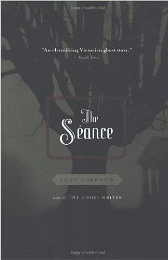
Cover for The SeanceThe Séance is a modern novel that is written like a Victorian gothic mystery. It features narrations by several different characters–a typical Victorian device that was used successfully in Wilkie Collins’s The Moonstone.

John Harwood’s novel is difficult to describe without going too far into the plot, because some important characters do not appear until later in the book. It begins with the story of Constance Langdon’s dreary childhood and young adulthood. Her mother has been depressed and nonfunctional since her sister died, and her father behaves as if he lives alone in the house. When Constance reaches the age of 11, her father withdraws her from school and abandons her and her mother to go live with his sister. Later, a disastrous experiment with spiritualism (very popular in Victorian times) in an attempt to help her mother results in her mother’s suicide.

Constance accepts her uncle’s invitation to live with him in order to avoid being thrust upon a father who doesn’t want her. But shortly after moving in with him, she finds she has inherited Wraxford Hall, an infamous house, old and crumbling, where two boys died; an old man mysteriously disappeared; and Magnus Wraxford was apparently murdered by his wife, Eleanor, who has also disappeared.

The next section of the novel is narrated by John Montague, a lawyer who visits Constance. He was involved in the experiment at Wraxford Hall that ended in the murder of Magnus Wraxford, and he tells the story of the experiment. This visit and Constance’s subsequent agreement to take part in a séance at Wraxford Hall lead us to Eleanor’s story, which is taken up by a diary that Eleanor wrote. Finally, we return to Constance. When she arrives at Wraxford Hall, she finds the experiment is to take place in a spooky gallery occupied by an odd-looking set of armor and a sarcophagus.

The novel is successfully creepy and mysterious. However, by the time of the séance I had figured out one character’s crucial secret identity, which made several other plot points clearer. Some readers may find it takes a long time to get to the crux of the novel, but I enjoyed the journey.

Day 131: The Dark Lantern

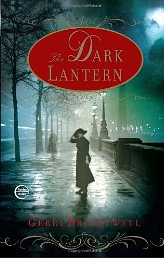
Cover for The Dark LanternI had mixed feelings about The Dark Lantern, Geri Brightwell’s novel of deception and intrigue set in late 19th century London. Although I found myself interested enough in what happens, I also thought that the odds of this much intrigue going on in one house were very low.

Jane Willred arrives in London for her first job in the city as a housemaid. Although Jane is a relatively blameless girl, she immediately finds herself caught in a web of deceit. In trying to put her past as the illegitimate daughter of a murderess behind, she has forged a letter from her mean, self-righteous former employer to omit the remarks the employer made about Jane’s past. In her first day at work, she is further embroiled when she breaks a dish and comes under the obligation of the blackmailing upper housemaid Sarah.

Upstairs all is not well, either. Mrs. Robert Bentley, Mina, newly arrived from Paris because of her mother-in-law’s illness, is hiding a shameful past. While her husband distractedly goes about his work trying to prove that an innovative system of taking body measurements of criminals is preferable to fingerprinting as a means of identification, she hides in the London house trying to avoid being recognized.

Odd things are certainly happening, as a stranger intrudes into the house on Jane’s second day claiming to be Mr. Robert and looks through his papers. How, Jane wonders later, did he know she would answer the door–as the only person in the house who hadn’t yet met Mr. Robert–since it wasn’t her job to do so?

Robert is waiting for the return of his brother Henry from India, hoping Henry will agree to sell the house after their mother’s death, as he and Mina are almost broke. Instead comes news that Henry’s ship has foundered off the coast of France and only his wife has survived–a wife no one knew existed.

Aside from the number of people hiding secrets in this novel, I also felt that few of the characters are likable. Jane is the most sympathetic, but she seems incredibly stupid at times. Nevertheless, the plot kept me interested.

Day 122: The Tudor Secret

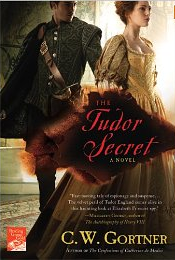
The Tudor SecretI have heard about C. W. Gortner before, but The Tudor Secret is the first book of his I have read. My overall impression is that the book reflects some knowledge of Tudor times and some research, but is generally on the light side, with a fairly predictable plot.

Brendan Prescott is a servant of the powerful Dudley family, a foundling who has been mistreated by the Dudleys all of his life. He is surprised when he is removed from the stables and given training as a body servant. He is dismayed when he is sent to court to wait on the cruel Robert Dudley.

He is almost immediately thrust into dangerous circumstances as he tries to help the Princess Elizabeth see her dying brother, King Edward. Edward’s regent Northumberland, Robert’s father, is trying to keep everyone away from the king.

Elizabeth is in contention for the throne against her half-sister Mary. But Northumberland is trying to manipulate his daughter-in-law, Lady Jane Grey, and his son Lord Guildford Dudley, onto the throne. Soon, Brendan finds himself spying for William Cecil to help Princess Elizabeth.

Although the Tudor era was a turbulent time, involving much intrigue and a lot of paranoia, I felt that some of the plots suggested in the book were absurd, such as Northumberland poisoning Edward so that he can put himself on the throne. I understand from reading one of the reviews on Amazon that this was an early book by Gortner and not up to his usual level, so perhaps I will try another.

Day 118: The Solitary House

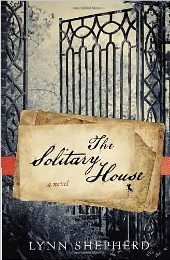
Cover for The Solitary HouseBest Book of the Week!

I had an ambivalent reaction to The Solitary House, which is sort of a riff on Bleak House. It is not exactly a retelling of Dickens’s book. Although some story lines are re-interpreted, most of the Dickens characters appear in the background of the novel. My ambivalence is because Bleak House is one of my favorite Dickens novels, and I have not been happy with some of the retellings of classics that have appeared lately, particularly those that seem to miss the point of the original works. I am also a little dismayed by what Shepherd has done to some of my favorite Dickens characters. However, I find I have to admire the masterful way Shepherd has worked the threads of Dickens’s novel into such a different story. On the whole, almost despite myself, I am giving this novel a big recommendation for its originality.

Charles Maddox is a former detective for the London police force who left under undesirable circumstances. He is hired by Edward Tulkinghorn, a mysterious solicitor who has an evil reputation. A client of Tulkinghorn’s has been receiving threatening letters, and Maddox’s assignment is to find out who is sending them. Charles descends into the squalor of London to discover the author of the notes, but when he turns the information over to Tulkinghorn, the author of the notes is brutally murdered.

Thinking that this is not a coincidence, Charles begins investigating Tulkinghorn himself, as well as his client, Julius Cremorne. In doing so, he comes upon evidence of a serial killer. He also runs up against Inspector Bucket, his former police supervisor.

Charles’s story is written in a jokey third-person omniscient narration that often addresses the reader directly and is interlarded with many references to Dickens and some quotes from Shakespeare. Imagine a style that is like a postmodern Dickens. This narration is interleaved with the first-person narrative of Hester, seemingly the same quiet, loving, capable Esther Somerset of Bleak House. It is not until the end of the novel that these two stories merge horribly together.

Ultimately, I am coming down on the side of strong admiration for this book. It is completely absorbing and inventive, well written and literate, and actually convincing as a twisted alternate vision of Bleak House minus the case of Jarndyce vs. Jarndyce. It made me want to return to Bleak House, which I have not read recently, and dig out all the references. It is a gothic novel that becomes a serious creepfest, and you know how I love those.

I see that Shepherd has also riffed on Mansfield Park. As much as I am dreading what she will do to my beloved Jane Austen, I think I’m going to have to read it.

Day 116: 22 Britannia Road

Cover for 22 Britannia RoadAlthough the subject matter of 22 Britannia Road should have been interesting, a major flaw of this novel by Amanda Hodgkinson is that I always feel removed from the actions and characters. This feeling of distance may be because we, the readers, are immediately thrust into their woes without first getting a chance to know them.

One minute they meet, the next minute they have a baby, the next he is off to war. The two main characters, Janusz and Sylvana, are natives of Poland before the invasion of the Nazis, but aside from knowing that, you wouldn’t believe that anything unusual is going on. Later, they are in Poland, fleeing, with the Nazis invading, but except for a few events, you wouldn’t know there was a war. It’s as though the author is unable to imagine what it might be like first to live in Poland when the war is building and worse to be there once the Nazis arrive.

The novel actually begins after the war, with Janusz waiting in England, where he has spent most of the war, for the arrival of Sylvana and their son Aurek from Poland. Later it tells the story of their meeting, courtship, marriage, and war through unconvincing flashbacks.

It also tells the story of their floundering marriage, which happens because they tell each other nothing. This post-war story is a little more realized than the story of their past.

I have some sympathy for Janusz at the beginning of the novel, when he is waiting for his family to arrive. He has obviously meticulously prepared for them and is hoping to give them a good life. But I think Sylvana is a stupid woman, who is cloyingly overprotective of Aurek. She is harboring a big secret, but I guessed it almost from the beginning.

Although I was mildly interested in the story of the novel, I felt it could have been done much better.

Day 111: The Black Tulip

Cover for The Black TulipThe Black Tulip does not feature the swashbuckling we have come to expect from the historical novels of Alexandre Dumas. Even though it begins with two innocent men being torn limb from limb by a mob, it is actually a romantic comedy about the mania for tulips in the 17th Century.

The two men are the uncles of an obsessed tulip grower, Cornelius van Baerle. Just before their deaths, they send him a message telling him to destroy some papers they’ve left with him, but he is too occupied with cultivating his black tulip bulbs to read it.

These bulbs are worth a lot of money, as the Horticultural Society is offering a huge prize for a black tulip. Cornelius himself is not interested in the money as much as the achievement of growing the tulip. However, a neighbor who covets the prize, Isaac Boxtel, betrays him to the authorities hoping to get a chance to steal his tulip when he is arrested.

Cornelius bequeathes his tulip to Rosa, the jailer’s daughter, when he thinks he will be executed. Although completely innocent of treason, he is sentenced to life in prison. The story continues with the attempts of Boxtel to steal his tulip, which Cornelius and Rosa are trying to grow in jail so that it can be delivered to the Horticultural Society. At the same time it is about the love that grows between Cornelius and Rosa.

The novel is funny, romantic, and well written. Although some historians currently believe that reports of tulip mania are exaggerated, this novel seems to accurately reflect what was earlier reported of this odd period of history. If you are interested in another look, try reading Deborah Moggach’s historical novel Tulip Fever or the Wikipedia entry on “tulip mania.” For a nonfiction account reflecting current ideas, try Anne Goldgar’s Tulipmania: Money, Knowledge, and Honor in the Dutch Golden Age, which I have not read, but is cited in the Wikipedia article.