Day 402: Dust and Shadow

Cover for Dust and ShadowIn Dust and Shadow: An Account of the Ripper Killings by Dr. John H. Watson, Lyndsay Faye combines a great deal of research into the Jack the Ripper killings in 1888 with a vast knowledge of Sherlock Holmes literature to offer an entertaining solution to the crimes. The novel begins nearly 50 years after the events, when Dr. Watson places his narrative of the murders into a safety deposit box on the eve of war.

Inspector Lestrade comes to consult Holmes after the second murder, when police begin to realize the two deaths may be linked. Holmes immediately begins pursuing his usual means of detection–inspecting the body and the scenes of the crimes, trying to find out where the victims were last sighted, questioning the victims’ friends–and he very quickly figures out that another murder is related. He even hires an alert young prostitute, Mary Ann Monk, to make her own enquiries and observations after she identifies the body of her friend, Mrs. Nichols. However, he is soon frustrated by his lack of progress. The only lead Holmes has come across is the story of an elusive sailor, being sought by a friend who thinks he may have been involved in the first murder, that of Mrs. Nichols.

Soon Holmes and Watson have something else to worry about, for a member of the press is printing details of the crimes unknown to but a few. He has been alleging that Holmes himself may be the murderer.

Faye’s novel is atmospheric and absorbing. Its greatest accomplishment, though, is in successfully capturing the narrative style of Doctor Watson, making us believe that this could be a Holmes story. Although I was about 100 pages ahead of Holmes in solving the murder (which would never happen in a real Holmes story), I still found the solution ingenious as well as the reason why the crimes are recorded in history as unsolved (when, of course, Holmes solved them). This novel is a very good first effort. I have Faye’s next book awaiting me in my pile.

Day 398: The Strange Fate of Kitty Easton

Cover for The Strange Fate of Kitty EastonIf you prefer a book to leap immediately into action, this is probably not the mystery for you. The second in a series, it starts slowly, with Speller taking the time to develop the setting and characters.

Laurence Bartram is a young man damaged by World War I, during which his wife and child died and he was injured. Laurence is an expert on church architecture, and he is happy to be summoned to the estate of Easton Deadall by his friend, William Bolitho. William wants him to look over  a small but unusual church, for which William is designing and installing a window.

Laurence is soon pulled into the affairs of the Eastons, a family that is haunted by the war, but moreso by the disappearance in 1911 of the young daughter of Digby Easton, the oldest of the three Easton brothers. Digby died during the war, but Kitty still obsesses her mother Lydia, an invalid who sometimes speaks of her as if she is alive.

The middle Easton son, Julian, has been doing his best with the estate, which Laurence finds beautiful but slightly crumbling, while Lydia’s sister Frances takes care of her. Laurence finds the subject of Kitty lurking behind every conversation and wonders if they will discover her body in the course of their renovations. Soon, the third Easton brother, Patrick, returns to Easton Deadall after an absence of years, first at Oxford and then on an archaeological dig in Greece. It becomes obvious that there is tension between him and Julian.

The family decides to make up a party to visit the Empire Exhibition. William, who was left wheelchair bound by the war, does not feel he can handle it, and Lydia is too ill, but the rest of the family goes. The expedition includes Eleanor, William’s wife, and Laurence. They also bring along David, the estate’s man of all work, and the teenage maid Maggie to help care for William and Eleanor’s young son Nicholas. At the exhibition, Maggie and Nicholas go missing, and although the others find Nicholas, Maggie is nowhere to be seen.

Distressed by Maggie’s disappearance, which can’t but echo the earlier one of Kitty, the family begins falling apart and secrets emerge, especially about the charismatic Digby and his relationships to his family and to his troops during the war. A few days after the disastrous outing, Laurence and David are clearing an area in the church to prepare for the installation of William’s window when they discover a trap door in the floor under the altar. When they open it, they find the body of a woman. The police are able to quickly ascertain that the body is of a woman too old to be Maggie, but then, who can it be? Could it even be Kitty, grown up and returned from wherever she has been?

Laurence does not exactly detect so much as look into a few things the others haven’t thought of, and he eventually unearths a tangle of secrets. Although the novel takes awhile to get going, I soon found myself unable to put it down. It slowly and skillfully builds to suspense. I found it well worth my patience.

Day 374: A Plague of Lies

Cover for A Plague of LiesA Plague of Lies is the third in the mystery series set in 17th century France and featuring Charles du Luc, a master of rhetoric at the Louis le Grand school in Paris.

Charles is dismayed when he is summoned to escort Père Jouvancy to the court at Versailles to present Madame de Maintenon with the gift of a holy relic. Madame is angry with the Jesuits because the King’s confessor, Père la Chaise, convinced the King not to give her the title of Queen, so the gift is an attempt to regain favor. Although Charles disapproves of what he sees as the Sun King’s constant self-glorification, he must escort Père Jouvancy, an old man who is just recovering from an illness that is raging through Paris.

On their way to Versailles, Charles and Jouvancy encounter Lieutenant-Général de la Reynie, head of the Paris police, whom Charles has assisted on occasion. La Reynie asks Charles to keep an eye on the Prince of Conti while he is there and to listen to what is said about him.

Once at court, though, Père Jouvancy has a relapse, and Charles comes close to witnessing the death of a much-disliked man, the Comte de Fleury. Apparently, he too was ill and running for the latrine when he slipped on the wet floor and fell down the stairs. The rumor is that he was writing a scandalous memoir, and poison is immediately mentioned. When the other members of Charles’ party fall ill, there are more rumors of poison, but all the men seem to just have food poisoning.

De Fleury does appear to have been poisoned, however, and Charles observes several people going in and out of his room, including the Duc du Maine, son of the King. Charles finds himself getting embroiled in the problems of the Duc’s sister, Mademoiselle de Rouen, who is soon to be engaged to the son of the King of Poland and is not happy about it. Charles also observes Conti behaving suspiciously. Next, a gardener is found drowned.

The novel presents us with a convoluted plot but also with a fascinating portrait of the court at Versailles. Rock’s knowledge of the period, even of how the places she describes would have appeared at that time, seems convincingly complete. Her novels are always absorbing.

Day 366: The Pale Blue Eye

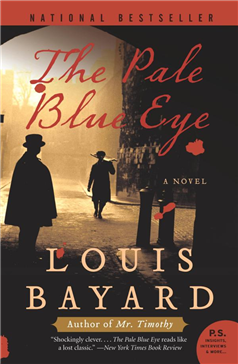
Cover for The Pale Blue EyeGus Landor, a retired New York police detective, is dying, and he writes the account of his last case in The Pale Blue Eye. Gus is a lonely widower who earlier moved up to the mountains near the Hudson Valley with his wife and daughter to help improve his lungs. But his wife died within a year, and his daughter left him soon after. So, Gus lives as a veritable hermit.

On an October morning in 1830, an officer from West Point fetches him. The body of a cadet named Fry was found hanged the night before, presumably a suicide, but during the night his body was stolen and later he was found with his heart removed. Superintendent Thayer and Commander Hitchcock wish to hire Landor to find who stole the heart. Landor is quick to figure out that Fry did not commit suicide but was murdered. A mysterious message clutched in his hand seems to indicate an assignation.

Landor soon realizes that his investigations on the reservation will be sorely hampered without the assistance of an inside man. So, he asks for the help of an unusual cadet he has met who is not in good favor with the academy–Cadet Edgar Allan Poe.

This is a clever novel with a macabre mystery that would have been completely to Poe’s taste. Just when we think everything is figured out, Bayard presents us with a twist. His portrait of the young Poe, bombastic, ridiculously romantic, and fearfully intelligent, is a great pleasure.

I would only fault the novel for a slow-paced middle section, and only because Landor doesn’t seem to be doing anything. Most of the plot is driven forward by Poe’s reports, which begin to dwell on his infatuation with a lovely young woman, Lea, the daughter of the post doctor, who unfortunately suffers from the “falling sickness,” or epilepsy.

Of course, Landor is doing something–he’s deciphering Fry’s diary–but since he doesn’t relate its revelations, his investigation seems to flag, and he barely seems to look into a second death, with a second missing heart. Otherwise, the novel is well written, with well-developed and interesting characters and a surprising ending.

Day 359: The Yard

Cover for The YardThe Yard contains elements that should have made it interesting to me, particularly the period, but it didn’t really grab me.

The novel takes place shortly after the failure of Scotland Yard to capture Jack the Ripper, and the police are dispirited, while the public has grown scornful of them. The body of Detective Little turns up in a trunk at Euston Square Station. Detective Inspector Walter Day is put in charge of the investigation to the surprise of everyone, as he is new to the force.

We are not left in ignorance of the identity of Little’s murderer, as he is watching the case from the sidelines. He didn’t intend to murder anyone, but Little discovered his secret. Soon another officer stumbles onto his secret and also must be killed.

Constable Hammersmith is assigned to the case, but he becomes embroiled in another incident. A thief breaking into a house finds the body of a boy stuck in the chimney and stops Hammersmith on the street to tell him about it. Directed by his superiors to concentrate on the more important case of Detective Little’s murder–the death of a chimney sweep’s boy not being considered a crime–Hammersmith continues to search for the sweep on his own time.

Another case is preoccupying Inspector Blacker. Some men have been found murdered with their beards newly shaven. Blacker thinks it is unlikely that two serial killers are loose in London at the same time, but Day and Dr. Kingsley, the coroner who is interested in new forensics research, do not agree.

This first series book sets the stage for all the recurring characters as well as attempts to recreate the chaos of the Yard. I feel it is spread a bit thin. The writing is capable rather than brilliant, although I encountered enough clichés in the first few pages to irritate me. A technique used several times of flashing back to explain something right in the middle of the action seems very disruptive and only serves to stall the flow.

Some unlikely events disturbed me as well. That two police officers would stumble onto the killer’s secret in the space of two days seems completely far-fetched. A minor incident where a family claims to have made a day trip to Birmingham seems equally absurd. I can’t imagine even in these days that a trip from London to Birmingham and back would be something anyone would want to do in one day, but back then the trains were surely slower. Such a trip may have been possible, but that the police officers receiving this information don’t challenge it seems absurd.

Almost despite myself I found myself beginning to like the major characters, but I still don’t think I’ll be picking up the second book anytime soon.

Day 320: The Malice of Fortune

Cover for The Malice of FortuneThe Malice of Fortune follows a current trend of mystery fiction to use actual historical people as detectives. In this case, the novel is set in 16th century Italy, and the historical detective is Niccolò Machiavelli, assisted at times by Leonardo da Vinci.

It is 1502 in the Papal States of Italy, and the infamous Pope Alexander VI, the former Rodrigo Borgia, has received word of his beloved son Juan, who was murdered years before. A woman was found butchered in Imola, and with her body was an amulet Juan always kept with him. The Pope summons the courtesan Damiata, whom he suspects of complicity in Juan’s death, and takes her little son hostage while he dispatches her to investigate.

In Imola, Damiata finds that someone has been murdering and butchering women and then leaving quarters of their bodies around the city. When she travels out to the scene of the latest discovery, she finds that Juan’s brother, the dangerous Duke Cesare (nicknamed Valentino) Borgia, has Leonardo da Vinci on the scene as his investigator. Da Vinci thinks that the killer is playing a game by constructing puzzles for him. At the scene some masked men provide an additional clue by fleeing the investigators.

Damiata also meets Niccolò Machiavelli, who is in town representing the city of Florence, which is afraid that Duke Valentino and his condottieri, or mercenaries, are planning to attack the city. Damiata suspects one of the three condottieri generals of being the murderer, but she does not know which one.

Machiavelli provides a different insight into the murderer. He has made a study of what he calls “the necessity” for each man–what drives him–and he begins trying to discover the murderer’s necessity. Machiavelli and Damiata team up to find the murderer.

This novel has interesting characters and situations, but at some point I felt as if the characters are chasing around too much with little result. Instead of building suspense, the plot seems unplanned and disorganized.

Michael Ennis is a historian, and the historical background is convincing and seems accurate. Compared to his previous novel about medieval Italy, The Duchess of Milan, a straight historical fiction novel about the powerful d’Este family, The Malice of Fortune is a little disappointing.

Day 313: Murder on the Eiffel Tower

Cover for Murder on the Eiffel TowerThis mystery set at the opening of the Eiffel Tower has a nice sense of history and is well written, but like mysteries written early in the genre (which it is not), it depends almost entirely upon determining opportunity. There is no indication of motive until the lengthy written confession at the end of the novel–standard early detective fiction nonsense–that is, charming in earlier fiction, but not so much now. This novel was published in 2009.

People begin being killed by “bee stings” on or near the Eiffel Tower the day before Buffalo Bill arrives in Paris for the opening of the 1889 World Exposition. Bookseller Victor Legris starts looking into these incidents after he notices that Kenji Mori, his father figure and business partner, met with more than one of the victims near the time they were killed. He also begins to fear that the woman to whom he is attracted, Russian illustrator Tasha Kherson, could be involved.

I found Victor to be silly, not very good at investigating, and prone to overlooking clues. Many secondary characters are only sketchily drawn and therefore difficult to keep straight. So for me, despite all its promise and its setting in an exciting period of time, Murder on the Eiffel Tower was not a success.

Day 305: The Dark Enquiry

Cover for The Dark EnquirySome elements of Deanna Raybourn’s Lady Julia Grey romantic mystery series sometimes get old, such as the debate between Lady Julia and her husband Brisbane about how involved she is allowed to get in his investigations. This debate begins The Dark Enquiry, and eventually Brisbane reluctantly agrees that she can be a partner in his investigations, but not before she discovers for herself that her own proper, conservative brother, Lord Belmont, is being blackmailed. As a government official, he should have known better than to get involved with a lady, but especially to send her love letters. The lady turns out to be working for a foreign government.

In following up her investigation into her brother’s difficulties, Lady Julia disguises herself as a man to go to the Ghost Club, where Madame Séraphine holds nightly séances. There she is discovered by Brisbane. As they sneak back into the club together later in the evening, they are just in time to see Madame Séraphine be murdered by poison.

This novel is peopled with Lady Julia’s eccentric family, but it also features blackmail, gypsies, and spies. Raybourn’s novels are lively, and the dialog is entertaining. If we can just get over the endless debate about Julia’s part in the investigations, the series will continue to be fun to read.

Day 294: Death on the Nevskii Prospekt

Cover for Death on the Nevskii ProspektGiven my interest in Russia and the time period, this novel should have been a slam-dunk for me, but I was disappointed. Lord Francis Powerscourt is asked to investigate the death of a British diplomat in Russia, who was discovered with his throat cut on a bridge across the Nevskii Prospekt. No one in the British government knows why the victim was in Russia, and the Russians, having reported his death, pretend that they know nothing about it.

Powerscourt’s investigations seem to be pointing to the victim having had a secret meeting with the Tsar. In addition, Powerscourt may be running up against the Russian secret police, the Okhrana.

The book begins with a completely unnecessary chapter or two devoted to efforts to try to persuade Lord Powerscourt’s wife to release him from his promise not to take any more investigations. In addition, the real circumstances of the death seem completely unlikely. Characterization was minimal, and the plot had several unlikely points.

Dickinson’s historical research is commented on in the blurbs, but there was little in the novel that anyone doing the most cursory reading about Tsarist Russia’s last days wouldn’t know.

Day 289: Birds of a Feather

Cover for Birds of a FeatherMaisie Dobbs is a “psychologist and investigator” solving cases in post World War I London. Birds of a Feather is the second book in the series by Jacqueline Winspear. Maisie’s background is unique, in that she is a former serving girl who was taken up by a mentor, educated, and trained in some unusual techniques to use in her investigations.

Maisie accepts the case of a wealthy owner of grocery stores, Joseph Waite, to find his daughter Charlotte, who is in her 30’s, and return her home. As Maisie investigates the case by locating Charlotte’s friends, they begin dying. At each crime scene, a white feather is left. White feathers were traditionally given to young men during World War I to shame them into enlisting, as they are a symbol of cowardice.

I read the first book in this series, Maisie Dobbs, and was not enthralled with it, so I only read this novel because it was chosen for my book club. I finally decided that I like the book a little, but it certainly has its flaws. Winspear is not very good at delineating Maisie’s character, I feel. Maisie also speaks surprisingly modern American English for a British woman in the 1930’s.

The biggest problem I have with Maisie, though, is that the unusual skills she has picked up to use in her investigations are far too New Agey to be convincing for a character in the 1930’s. It does not help my enjoyment of the novel, I fear, that I find many New Age ideas irritating.

In addition, it makes no sense to me at all that no one seems surprised to find the detective is a young woman. Even in P. D. James’ classic An Unsuitable Job for a Woman, written in 1972, characters express surprise to find a woman in that role. All-in-all, this makes too many anachronisms in the series to suit me.

Finally, I know this is a silly quibble, but I feel that Winspear spends too much time describing Maisie’s clothes.