Day 285: Full Dark House

Cover for Full Dark HouseThe back cover of this mystery calls it “mapcap” and “great fun.” I found it mildly amusing in a silly way.

John May arrives at work in the present time to find the place has been blown up, apparently with his partner Arthur Bryant inside. He investigates this incident while he thinks back to their first case together.

John joined Arthur during the Blitz in World War II working in the Peculiar Crimes Unit. Their case was that of a dancer at a theatre in Covent Garden who is drugged and then dragged into the elevator with her feet sticking out, so that when the elevator moves, her feet are cut off.

There are many gothic touches in this novel, which is not surprising because the author is apparently a writer of horror fiction. However, after references to phantoms, vampires, spiritualism, and so on, the murderer turns out to be human after all. I came away feeling that this book promises more, in the way of humor and the unusual, than it actually delivers.

Day 282: Speaking From Among the Bones

Cover for Speaking From Among the BonesEleven-year-old chemist and detective Flavia de Luce is back with her latest adventure in Speaking From Among the Bones. An expert in poisons and an accomplished snoop, Flavia has already solved four crimes before the ripe old age of twelve.

Having accompanied her sister Ophelia (Feely) to her organ practice one night, Flavia hears a flapping in the organ pipes that she thinks is a trapped bat. Feely is practicing for the Easter Sunday service, as Mr. Collicutt, the organist, has vanished.

The next morning when Flavia goes back to the church to get the bat out of the pipes (so that she can look at its blood under her microscope), she gets distracted into eavesdropping on a confrontation between the vicar and the bishop’s secretary over the unearthing and reburial of the bones of St. Tancred from his crypt in the church. The vicar has previously received permission to do this and now the bishop is trying to rescind it through a magistrate.

The vicar insists on going ahead, and the men open the sealed crypt enough so that Flavia can look into it. Inside the crypt is the body of Mr. Collicutt, with his head in an old gas mask.

Flavia’s investigations take her as usual all over the village and turn up all sorts of secrets, including a man hidden away in an old house, a secret passageway into St. Tancred’s crypt, and the whereabouts of a diamond that was buried with his body in the saint’s crozier. At the same time she worries about family problems, such as her sister’s impending marriage and the sale of the crumbling family mansion, Buckshaw, for back taxes.

As usual, Flavia herself is the most charming part of the series, as she plunges recklessly into and out of difficult situations, contemplates the structure of blood and the properties of ether, irritates her older sisters, and rides all over the village on her trusty bike Gladys. The novel is funny, the mystery absurd, the writing splendid, and Flavia always entertaining.

Day 279: The Serpent’s Tale

Cover for The Serpent's TaleIn the first of the Mistress of the Art of Death series (minor spoilers ahead), Vesuvia Adelia Rachel Ortese Aguilar, a medieval pathologist, solved a series of murders for the English King Henry II and fell in love with one of his soldiers, Rowley Picot. She declined his marriage proposal because he expected to be rewarded a baronetcy as a result of their success and she knew that as a baronet’s wife she would not be allowed to pursue her medical profession. As a more humble citizen she has a lot more freedom. So, they parted and, to his horror, he was made the Bishop of St. Albans.

In this second book, taking place almost two years later, Rowley fetches her for another mission. She is bubbling over with resentment because she has borne him a daughter, Ally, whom he has not acknowledged.

Rowley is on what he hopes is a preemptive mission. Using poison mushrooms, someone has attempted to murder Rosamund the Fair, Henry II’s mistress, and blame it on his queen, Eleanor of Aquitaine. In an effort to avoid civil war, Rowley wants Adelia to help him figure out who ordered the attempt before Henry hears of it.

But Adelia has bad news for him. The basket of mushrooms he brought to show her contains nightcaps, and Adelia explains that Rosamund may seem to have improved, but she is already dead.

In a frozen winter landscape, Adelia and Rowley travel first to a convent and then to the fantastic Wormwood Tower to investigate the crime, where Rosamund’s body lies protected by a labyrinth and an insane lady’s maid.

Franklin’s series is well written and carefully researched. Although she admits to taking a few liberties with historical characters in this book, for the most part it is historically based on Eleanor’s revolt against Henry in favor of her oldest son.

Franklin sets up a vivid backdrop in the icy English landscape, which plays more than an incidental part in the plot. In addition, she has the ability to make us care about Adelia and Ally, Rowley, Mansur, and Glytha, the main recurring characters. It is with sadness that I heard not long ago of Franklin’s death, and I regret that there are only four books in this series.

Day 275: A Dead Man in Athens

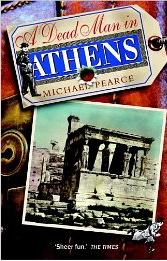
Cover for A Dead Man in AthensThe “Dead Man” series sounds interesting because of the exotic locales (Athens, Istanbul, Trieste, Tangier, Malta) and the time it is set (pre-World War I), but it proves a bit light for me. I like mysteries that are funny or have an edge, but my idea of humor doesn’t match that of many writers. This book was called “effortlessly funny,” but its humor escaped me. A Dead Man in Athens is the third in the series, and I still don’t know why the books are always named “dead man” here or there, except as possibly a suggestion of Anthony Burgess’s novel A Dead Man in Deptford. Otherwise, believe me, there is no comparison.

Sandor Seymour, a multi-lingual Scotland Yard detective, is sent out to Athens by the Foreign Office because someone has poisoned the cat of the Ottoman sultan living in exile there. The Foreign Office fears someone may be practicing for an attempt on the sultan.

Seymour soon believes that the poisoning may be simply domestic in nature, but the Foreign Office is sure it has something to do with war brewing in the Balkans. Then someone poisons the British engineer hired by the Greeks to take care of Blériot machines, early airplanes that the engineer feels could be useful to the Greeks for reconnaissance during the war.

The novel has many characters, but few are more than narrowly drawn. The mystery is not very complicated, and the absurdity of investigating the death of a cat doesn’t really carry the novel, as far as humor goes.

Day 271: The Abyssinian Proof

Cover for The Abyssinian ProofIn 19th century Istanbul, the magistrate Kamil Pasha  is assigned to find out who is stealing valuable relics throughout the city and selling them to London. He is instructed to find the relics and bring them back to where they belong. One of the relics is contained in a reliquary that has been guarded since the last days of the Byzantine Empire by a sect of Abyssinian descent called the Melisites. The relic is called the Proof of God.

Kamil is an upright and dedicated civil servant. While he is investigating, he learns about the history and beliefs of an odd group of people, the descendents of Abyssinian slaves who live in an abandoned cistern and are part of the city’s underworld.

In pursuit of the relic thieves and in investigation of some apparently related murders, we follow Kamil through the subterranean passages under Istanbul.

Kamil is also attracted to Elia, a refugee artist who lives in his sister’s house. Elia has suffered terribly, though, and is not really prepared to pursue more than friendship.

As with Barbara Nadel’s more modern Turkish mysteries, I find novels set in this exotic locale interesting, and the history presented in The Abyssinian Proof is fascinating. Sometimes, I wish that Kamil Pasha wasn’t quite such a serious man, however.

Day 264: The Ballad of Tom Dooley

Cover for The Ballad of Tom DooleySharyn McCrumb has written several series of light mysteries, some better than others. I have usually enjoyed her “ballad” series–atmospheric, sometimes ghostly mysteries set in Appalachia and each named after a traditional folk ballad. The Ballad of Tom Dooley, despite a background of historical research (because this folk ballad is based on a true case), is not her best, however.

According to McCrumb’s notes at the end of the novel, she got interested in the story after researching it for an article and decided that the prevailing theories of the crime are not satisfying. So, she reconstructed her theory of the crime in this book. As such, it is not so much a mystery as an explication.

Most people vaguely know the story, that Tom Dooley (actually Dula) met Laura Foster “on the mountain/stabbed her with [his] knife.” Another defendant, Ann Melton, was let go. But McCrumb says most people in Wilkes County, where the crime occurred, will tell you Ann did it. To McCrumb, knowing that Ann was Tom’s long-time married lover, Tom being guilty didn’t make sense.

The novel is narrated by two characters who were actually involved in the incident: Pauline Foster, who was Ann Melton’s cousin and servant girl; and Zebulon Vance, the ex-governor and senator of pre-Civil War North Carolina who defended Tom. Pauline is an interesting character–McCrumb depicts her as a sociopath who manipulates the others and wants revenge for Ann’s slights.

The biggest fault in the novel is the narration of Zebulon Vance. At first, I thought McCrumb’s intent was to depict him as a maundering old bore, possibly even senile, as his section is so repetitive and adds so little to the narrative. It is mostly about himself and has little to do with the story. But then I read that Vance’s career was one reason McCrumb wanted to do the story. Instead of adding to it, it detracts from and drags against the impetus of the plot.

The fact is that none of the characters are likable people, and the crime isn’t particularly interesting. From the author of some haunting stories, this novel is a disappointment. If McCrumb wanted to write about Vance, she may have done better to write a biography.

Day 249: The Physick Book of Deliverance Dane

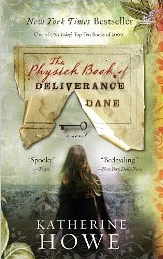
Cover for The Physick Book of Deliverance DaneBest Book of the Week!
Connie Goodwin has just passed her orals in history at Harvard and is one thesis away from her doctorate when her advisor, Manning Chilton, challenges her to find an undiscovered primary source on which to base some subject about Colonial America. She is almost immediately side-tracked in her research by a request from her mother to sort out her grandmother’s long-abandoned house in Marblehead and sell it to pay off back taxes.

Connie finds a very old, filthy house with a gate so overgrown with vines that it’s hard to find the house. Almost immediately she has a few odd glimpses, as if she can vividly picture her grandparents and other people in the house.

While sorting through the objects and papers in the house, she finds evidence of a woman named Deliverance Dane, who was found guilty of witchcraft in the Salem trials and left behind a “recipe” book, possibly of spells. Chilton immediately begins putting pressure on Connie to find the book, as it could provide the first evidence that people were actually practicing witchcraft at that time in Massachusetts. As Connie searches for the book, she makes some astonishing discoveries about her family and herself.

Back in the 17th century, Deliverance Dane, a wise woman or healer, is called to attend a child she cannot save. When the child dies, her father accuses Deliverance of satanism.

Some small things at the beginning of the novel irritated me. In laying the foundation of some basic history, I think Howe condescends to the reader a bit too much. For example, she finds occasion to tell us what a familiar is. Although many people may assume that all familiars are cats and find out differently from this novel, I would be surprised if people didn’t know what they were, if only from remembering their grade school lessons about the Salem witch trials. But perhaps I’m wrong.

There are also a couple of instances where Connie takes awhile to figure out something that she, as a graduate history student, should already know. For example, she doesn’t immediately know that “receipt” is another word for “recipe,” and then she has to explain this term to her professor, supposedly an expert in Colonial America. I am no historian or even generally interested in this period of history, but I knew immediately what the word meant. She does the same thing with figuring out that “Deliverance Dane,” mysterious words on a piece of paper, is someone’s name, as if in all her studies of the period she never encountered such an unusual name.

It is also very easy to see where the novel is going and who will turn out to be a villain. However, I still found it interesting enough to regard it as a strong first novel, especially if you enjoy the mixture of historical fiction and the supernatural. The characters are believable, and both story lines kept my attention. The historical portion seems solidly researched.

And I won’t mention the tomatoes, because it’s just too picky.

Day 240: A Murderous Procession

Cover for A Murderous ProcessionWhen I first started reading Ariana Franklin’s “Mistress of the Art of Death” series, I had mixed feelings about the premise, which is that a 12th century Jewish woman doctor is trapped in England because of her usefulness to Henry II and is in love with a bishop. However, these books are well written and show a great deal of knowledge of the time and place. Ultimately, I find the books interesting and the characters compelling.

Adelia Aguilar is a medieval forensic pathologist trained in Italy who is forced in England to pretend that her Moorish servant Mansur is the doctor and she is his interpreter, since no one would believe a woman could be a trained doctor. In A Murderous Procession, Adelia is living a retired life in the countryside with her daughter when she is ordered to accompany Henry II’s daughter Joanna to her marriage with the King of Sicily. Adelia must leave her own daughter with Queen Eleanor until she returns.

However, Adelia herself is being followed, by a vengeful madman whose bandit lover she killed in a previous book. Unfortunately, I read and reviewed these books out of order. The previous book is Grave Goods, I believe.

Adelia’s lover Rawley is also a member of the party, but he is required to leave periodically on missions of diplomacy. In his absence, the madman incites the entire party, particularly the church men, against Adelia and Mansur, blaming them for the procession’s many mishaps.

Franklin was only able to write a few books in this series before she died. A Murderous Procession is the last. She also wrote the excellent pre-World War II book set in Berlin, City of Shadows, which I reviewed a few months ago. Her death is a sad loss to the fans of good historical fiction.

Day 235: The Eloquence of Blood

Cover for The Eloquence of BloodIn the second of Judith Rock’s series, the Louis le Grand school run by the Jesuits is under financial hardship in this cold winter of 1686. On a visit to Monsieur Callot to ask for a contribution to the alms budget, rhetorician Charles du Luc meets a lovely young woman, Martine Mynette.

Martine’s mother Anne has recently died, and Martine is very concerned, because Henri Brion, a notary and Monsieur Callot’s nephew, has been unable to find a copy of Martine’s donation entre vifs. Because Martine is adopted, according to French law of the time she cannot inherit, so the only way her mother could leave her an inheritance is through this document. The copy usually hidden in the house is gone, and M. Brion is looking for his own copy.

When Charles relates this story to the school’s rector, Pére le Picart, the rector is dismayed because the Jesuit order was expecting the money through a bequest by Anne Mynette’s father. If a donation entre vifs exists, the school will not be entitled to the bequest. Another concern is that M. Brion is the same person who has supposedly been following up on the order’s claim. The rector sends Charles to the Brion’s house to find out what is going on.

Charles finds the area in disorder. Martine–a neighbor of the Brion’s, and Isabelle Brion’s best friend–has been murdered. No one has seen M. Brion. Isabelle is concerned because her father was trying to force her brother Gilles to marry Martine, which gives Gilles a motive for murder.

In addition to finding out about the bequest, Charles is assigned to follow the investigation into Martine’s murder. There are rumors on the street that the Jesuits murdered Martine for the money, and Paris seems to be entering one of its periodic convulsions against the Jesuit order.

As usual for the two books in this series, the historical details seem convincing and interesting. The novel is well written and keeps you involved. One very small caveat that I did not notice in the first book–Rock explains even the simplest French, which is annoying.

Day 231: I Am Half-Sick of Shadows

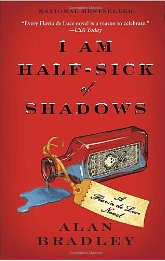
Cover for I Am Half-Sick of ShadowsAnother comic mystery starring the eleven-year-old sleuth Flavia de Luce, I Am Half-Sick of Shadows is the usual fun, even though the clues don’t add up until after the murderer is revealed.

Flavia’s father has rented out the house for Christmas to a film company in an effort to save the estate, since the family is so badly in debt. On Christmas Eve, the lead actors, Phyllis Wyvern and Desmond Duncan, perform a small benefit concert for the village of Bishop’s Lacey, after which everyone is snowed in by a blizzard. During the night, Wyvern is murdered, strangled to death with a length of film. This situation leaves the entire film crew and population of the village as potential suspects.

Although Flavia doesn’t know who the killer is, she becomes trapped on the roof where she has gone to shoot off fireworks and perform a scientific experiment. She has devised a super-sticky bird lime and has spread it all over the roof in an effort to capture Father Christmas, if he exists. Unfortunately, the murderer finds some reason to suspect that Flavia might be on his or her trail.