Day 208: The Quiet Twin

Cover for The Quiet TwinThe Quiet Twin by Dan Vyleta seems to start out as a standard mystery, but it turns out to be something else entirely. I was attracted to it because in reviews it was compared to Rear Window, one of my favorite movies.

In a 1939 Viennese neighborhood, there is a rumor of a serial killer. A man was murdered not far away, and someone has killed Professor Speckstein’s old dog in a similar manner.

The courtyard behind Dr. Beer’s more respectable apartment building is shared by some tenements occupied by poverty-stricken tenants. The view that some apartments have into others sets up the situation reminiscent of Rear Window.

Dr. Beer is called to treat Professor Speckstein’s niece Zuzka, a college student who suffers from periodic paralysis. Speckstein is a disgraced former college professor who was once accused of child molestation but has hung onto his social position by becoming a Nazi party informant. Dr. Beer, a student of Freud, diagnoses Zuzka with hysteria.

Zuzka is bored and sleepless, so she watches the courtyard from the window in the middle of the night. She has seen a man across the way washing off makeup and what appears to be blood, so she decides to investigate whether he is the killer.

Also living in the courtyard is a drunken man and his little girl Lieschen, whose body is badly deformed from an accident. Zuzka befriends Lieschen while Dr. Beer worries what may happen to her under the Nazis, having heard about some of their ideas.

A brutish police detective named Teuben appears to investigate the murders, but his actual plan is to pin them on some hapless person.

Although Vyleta has tried to depict the atmosphere among the common people of Vienna under the Nazis, I am not so sure he succeeds. Dr. Beer seems to be one of the few characters who is aware of any threat. An aura of dread persists, but it seems more dependent upon my knowledge of coming events than on any feeling from the novel, although the novel is certainly bleak. Perhaps because I read In the Garden of the Beasts only a few weeks before, I expected an atmosphere that was much more fraught with peril.
Day 206: Special Assignments: The Further Adventures of Erast Fandorin

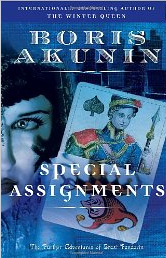
Cover for Special AssignmentsI have been following Boris Akunin’s Erast Fandorin series for several years. At first I liked Akunin’s shy, skinny, intellectual young hero. But then Fandorin transformed himself into a muscle-bound Putinesque superhero wannabe, so I lost most of my affection for him.

Set in Tsarist Russia, Special Assignments is actually two novelettes about Fandorin cases. The first, “Jack of Spades,” is a silly case where Fandorin is pursuing a clever con artist. It is supposed to be funny, I think, but I mostly missed the humor and found it ridiculously overcomplicated.

The second story I did not finish once I grasped where it was going. Called “The Decorator,” it is about Jack the Ripper moving his operations to Moscow. However, it becomes quickly obvious that Jack is supposed to be not only a woman but one who is murdering prostitutes because they are defiling their bodies. The whole idea was so abhorrent to me that I refused to read any more of it.

Day 171: Eye of the Red Tsar

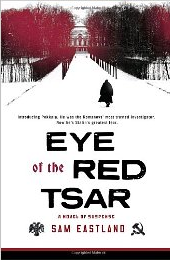
Cover for Eye of the Red TsarI had a strange reaction to Eye of the Red Tsar by Sam Eastland. I felt as if the author had researched the time and place without actually grasping anything about it. The novel is placed in post-revolutionary USSR with flashbacks to pre-revolutionary Russia. Tsar Nicholas II and Stalin are both characters in the book, in their different time periods, but you do not get any feeling that the author understands what kind of people they were or anything about the politics involved. Given my fascination with Russia, this novel would seem to be a great fit for me, but I have nothing but objections to it.

Pekkala, a Finnish soldier, is a prisoner in a labor camp in Siberia at the beginning of the novel. He was Nicholas II’s private investigator before the revolution, when he became known as The Emerald Eye. He remained completely faithful to the Romanovs, so when the family was captured by the Bolsheviks, he was exiled to Siberia. But at the beginning of the novel, he is released because Stalin wants him to find out exactly what happened the night the Tsar and his family were executed. Of course, this question has remained a mystery to the western world until recently, but I did not buy at all that Stalin and his predecessors would not have already known perfectly well what happened to the Romanovs.

My first objection is about how Stalin is characterized. The book takes place partly in 1929, when Stalin is only a few years away from his reign of terror. Yet he is depicted as quiet and thoughtful, not exactly true to the historical consensus. As a kind of extension of that thought, even though the book is about a time and place when everything is politicized, the novel provides no political context for the reader.

Another problem I have is with the narrative style. As Pekkala conducts his investigation, he remembers his past, in order. When I compare Eastland’s technique with that used in The Darkest Room, where characters have fleeting thoughts or disjointed memories that eventually add up to something, this novel seems incomparably clumsy in execution.

Finally (somewhat of a spoiler), I found it completely unbelievable, given the loyalty of the main character to the Romanovs, that he would willingly agree to work for Stalin at the end of the book. I forgive myself for revealing this turn of events, as it is easy to see it coming. Readers are told at the beginning of the book that Stalin is known as the Red Tsar. Obviously, since Pekkala was the Emerald Eye under the Nicholas, he will become the Eye of the Red Tsar under Stalin.

Day 167: City of Shadows

Cover for City of ShadowsAlthough I have read and liked books from Ariana Franklin’s “Mistress of the Art of Death” mystery series, I think that City of Shadows, a stand-alone thriller about a different period, is particularly good. On a side note, I am sorry to hear that Ariana Franklin has died, so we will never learn what her plans were for the characters in her series.

Esther Solomonova is a mysterious scarred woman who works for the phony Russian prince and nightclub owner Nick Potrovskov in 1920’s Berlin. However, the book begins a step before we get to Esther, when a woman is being chased through the streets of Berlin and dives into a canal to get away. Nick hears that this woman, Anna Anderson, is claiming to be Grand Duchess Anastasia of the murdered Romanov family, so he decides to take her under his wing in the hopes of getting a share of the Tsar’s fortune that has been left in England.

Anna is in an asylum, and the inmates claim that every six weeks a man lurks outside, trying to get a chance to murder her. After Nick removes her from the asylum, people begin dying. Only Detective Schmidt pays attention to Esther’s theory that someone is trying to kill Anna, since the only evidence is the testimony of insane people.

Franklin does a convincing job of mixing the true story of Anna Anderson with the completely fictional murder plot. She evokes a real sense of the chaotic, anarchic, starving Berlin in the time in which Hitler is coming to power.

Day 165: Alexandria

Cover for AlexandriaFor years I avidly collected all of Lindsey Davis’s Didius Falco mysteries. My passion has cooled a bit, as it usually does for series mysteries, but I still enjoy them enough to pick them up when I find them.

Marcus Didius Falco is a cynical, rascally, wisecracking “informer” during the Roman Empire of Vespasian. I have followed his path from the first book when he met Helena Justina, the fiery, unconventional daughter of a senator. Falco has had to work his way up from the plebeian rank and earn enough money so that he can legally be permitted to marry her.

In Alexandria, the 19th novel in this series, Falco and Helena Justina have been married for awhile when they travel to Alexandria with their two daughters, their adopted teenage daughter, and their mongrel dog for a vacation and visit to his uncle. Almost immediately upon arrival Falco is plunged into an investigation when his uncle’s dinner guest of the night before, Theon, the head of the famed library, is found dead, locked in his own office.

Of course, Falco has to figure out how Theon was murdered and why. He soon finds that several of the library’s scholars may want Theon’s job. Of course, people begin dropping like flies, including a philosophy student who is mauled by a crocodile. Falco begins to suspect that something else might be going on.

Davis’s books always involve a multitude of interesting, shifty characters and lots of dirty politics and other shenanigans, and Falco is always engaging and amusing. Davis does a convincing job of re-creating the ancient world in her books.

If you are interested in this series, I recommend that you start with the first book, Silver Pigs (recently renamed The Silver Pigs). Although the mysteries are stand-alone, developments in Falco’s personal life make it more enjoyable if you read this series in order.

Day 164: The Bone Garden

Cover for The Bone GardenThe Bone Garden is one of Tess Gerritsen’s Risoli and Isles series, but Isles only appears briefly, so it is more of a stand-alone mystery.

The novel takes place in two time periods. In the present day Julia Hamill has just purchased a 130-year-old house when she discovers an old skull in the overgrown garden. Medical examiner Maura Isles determines that the victim, a woman, was murdered long ago. Julia becomes fascinated with a box of newspaper clippings and letters that hold the key to the mystery.

In 1830’s Boston, Norris Marshall has joined the “resurrectionists,” grave robbers, in an effort to pay for his medical education. After a nurse and a doctor are murdered on the university hospital grounds, Norris finds he is a suspect. He seeks help from another student, Oliver Wendell Holmes.

I have only read a few Risoli and Isles books. I thought this one was passable, but I didn’t like it as well as others I have read. The attempt at 1830’s dialogue is awkward and painful to read, and in this case I didn’t see any reason to use a real historical person in the novel when a fictional one would have done just as well.

Day 136: The Séance

Cover for The SeanceThe Séance is a modern novel that is written like a Victorian gothic mystery. It features narrations by several different characters–a typical Victorian device that was used successfully in Wilkie Collins’s The Moonstone.

John Harwood’s novel is difficult to describe without going too far into the plot, because some important characters do not appear until later in the book. It begins with the story of Constance Langdon’s dreary childhood and young adulthood. Her mother has been depressed and nonfunctional since her sister died, and her father behaves as if he lives alone in the house. When Constance reaches the age of 11, her father withdraws her from school and abandons her and her mother to go live with his sister. Later, a disastrous experiment with spiritualism (very popular in Victorian times) in an attempt to help her mother results in her mother’s suicide.

Constance accepts her uncle’s invitation to live with him in order to avoid being thrust upon a father who doesn’t want her. But shortly after moving in with him, she finds she has inherited Wraxford Hall, an infamous house, old and crumbling, where two boys died; an old man mysteriously disappeared; and Magnus Wraxford was apparently murdered by his wife, Eleanor, who has also disappeared.

The next section of the novel is narrated by John Montague, a lawyer who visits Constance. He was involved in the experiment at Wraxford Hall that ended in the murder of Magnus Wraxford, and he tells the story of the experiment. This visit and Constance’s subsequent agreement to take part in a séance at Wraxford Hall lead us to Eleanor’s story, which is taken up by a diary that Eleanor wrote. Finally, we return to Constance. When she arrives at Wraxford Hall, she finds the experiment is to take place in a spooky gallery occupied by an odd-looking set of armor and a sarcophagus.

The novel is successfully creepy and mysterious. However, by the time of the séance I had figured out one character’s crucial secret identity, which made several other plot points clearer. Some readers may find it takes a long time to get to the crux of the novel, but I enjoyed the journey.

Day 118: The Solitary House

Cover for The Solitary HouseBest Book of the Week!

I had an ambivalent reaction to The Solitary House, which is sort of a riff on Bleak House. It is not exactly a retelling of Dickens’s book. Although some story lines are re-interpreted, most of the Dickens characters appear in the background of the novel. My ambivalence is because Bleak House is one of my favorite Dickens novels, and I have not been happy with some of the retellings of classics that have appeared lately, particularly those that seem to miss the point of the original works. I am also a little dismayed by what Shepherd has done to some of my favorite Dickens characters. However, I find I have to admire the masterful way Shepherd has worked the threads of Dickens’s novel into such a different story. On the whole, almost despite myself, I am giving this novel a big recommendation for its originality.

Charles Maddox is a former detective for the London police force who left under undesirable circumstances. He is hired by Edward Tulkinghorn, a mysterious solicitor who has an evil reputation. A client of Tulkinghorn’s has been receiving threatening letters, and Maddox’s assignment is to find out who is sending them. Charles descends into the squalor of London to discover the author of the notes, but when he turns the information over to Tulkinghorn, the author of the notes is brutally murdered.

Thinking that this is not a coincidence, Charles begins investigating Tulkinghorn himself, as well as his client, Julius Cremorne. In doing so, he comes upon evidence of a serial killer. He also runs up against Inspector Bucket, his former police supervisor.

Charles’s story is written in a jokey third-person omniscient narration that often addresses the reader directly and is interlarded with many references to Dickens and some quotes from Shakespeare. Imagine a style that is like a postmodern Dickens. This narration is interleaved with the first-person narrative of Hester, seemingly the same quiet, loving, capable Esther Somerset of Bleak House. It is not until the end of the novel that these two stories merge horribly together.

Ultimately, I am coming down on the side of strong admiration for this book. It is completely absorbing and inventive, well written and literate, and actually convincing as a twisted alternate vision of Bleak House minus the case of Jarndyce vs. Jarndyce. It made me want to return to Bleak House, which I have not read recently, and dig out all the references. It is a gothic novel that becomes a serious creepfest, and you know how I love those.

I see that Shepherd has also riffed on Mansfield Park. As much as I am dreading what she will do to my beloved Jane Austen, I think I’m going to have to read it.

Day 103: Dark Road to Darjeeling

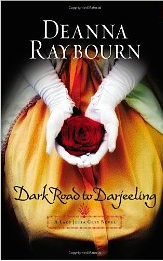
Cover for Dark Road to DarjeelingMy interest in the Lady Julia Grey series by Deanna Raybourn waxes and wanes. Although it is unusual for me to like books that mix mystery and romance, I usually enjoy reading this series, but I enjoy some books more than others. The books have followed the relationship of Lady Julia Grey and Nicolas Brisbane–who solves crimes for a living and whose breeding makes him an unsuitable mate for Julia–since they first met when her husband was murdered. Now, after several books following the ups and downs of their relationship as they solve crimes and get each other into and out of danger, they are married.

In Dark Road to Darjeeling, Lady Julia and Brisbane have been persuaded to interrupt their honeymoon in the Mediterranean by Julia’s sister Portia, who is worried about her friend Jane. In a previous novel, Jane left Portia to be married, and she is now a widow on a tea plantation near Darjeeling. Portia has asked Julia and Brisbane to investigate the possible murder of Jane’s husband. Jane herself is obsessed by her own pregnancy and the mysterious death of her husband Freddy, who may have been murdered for his inheritance.

The Brisbanes take along part of her eccentric family, Portia and brother Plum. Upon arriving at the plantation, they get to know the potential suspects, including Freddie’s aunt, his cousin Harry, several neighboring families, and the mysterious White Rajah.

I was unable to guess the murderer but figured out which family the murderer belonged to. Although this series sometimes resorts to the typical conflict between romantic co-investigators about the danger of the job, a conflict that I find extremely tedious, the dynamic between Julia and Brisbane still holds my attention. If you are interested in this series, I recommend that you start with the first book, Silent in the Grave.

Day 69: The Information Officer

Cover for The Information OfficerI really enjoyed Mark Mills’s book Amagansett from a few years ago and liked The Savage Garden. However, I did not find his third book, The Information Officer, as satisfying.

It is World War II during the siege of Malta. The British are trying to get their Spitfires to Malta to defend it, but in the meantime the strategic island is being heavily bombed. Major Max Chadwick’s job as information officer is to deliver updates to the local newspaper that are as positive as possible and figure out what is truth and what fiction.

Max’s good friend Freddy comes to him with information that someone is murdering Maltese dance hall girls, and there is evidence that the murderer is a British submariner. Freddy, a doctor, has already raised the problem with the high command and gotten nowhere, so Max decides to investigate. In the meantime, the murderer is plotting his moves.

The novel was interesting enough, with good descriptions of Malta and a fairly involving plot. However, I did not grow to care very much about the characters. I figured out the murderer, although not his motive, fairly easily.