Day 165: Alexandria

Cover for AlexandriaFor years I avidly collected all of Lindsey Davis’s Didius Falco mysteries. My passion has cooled a bit, as it usually does for series mysteries, but I still enjoy them enough to pick them up when I find them.

Marcus Didius Falco is a cynical, rascally, wisecracking “informer” during the Roman Empire of Vespasian. I have followed his path from the first book when he met Helena Justina, the fiery, unconventional daughter of a senator. Falco has had to work his way up from the plebeian rank and earn enough money so that he can legally be permitted to marry her.

In Alexandria, the 19th novel in this series, Falco and Helena Justina have been married for awhile when they travel to Alexandria with their two daughters, their adopted teenage daughter, and their mongrel dog for a vacation and visit to his uncle. Almost immediately upon arrival Falco is plunged into an investigation when his uncle’s dinner guest of the night before, Theon, the head of the famed library, is found dead, locked in his own office.

Of course, Falco has to figure out how Theon was murdered and why. He soon finds that several of the library’s scholars may want Theon’s job. Of course, people begin dropping like flies, including a philosophy student who is mauled by a crocodile. Falco begins to suspect that something else might be going on.

Davis’s books always involve a multitude of interesting, shifty characters and lots of dirty politics and other shenanigans, and Falco is always engaging and amusing. Davis does a convincing job of re-creating the ancient world in her books.

If you are interested in this series, I recommend that you start with the first book, Silver Pigs (recently renamed The Silver Pigs). Although the mysteries are stand-alone, developments in Falco’s personal life make it more enjoyable if you read this series in order.

Day 164: The Bone Garden

Cover for The Bone GardenThe Bone Garden is one of Tess Gerritsen’s Risoli and Isles series, but Isles only appears briefly, so it is more of a stand-alone mystery.

The novel takes place in two time periods. In the present day Julia Hamill has just purchased a 130-year-old house when she discovers an old skull in the overgrown garden. Medical examiner Maura Isles determines that the victim, a woman, was murdered long ago. Julia becomes fascinated with a box of newspaper clippings and letters that hold the key to the mystery.

In 1830’s Boston, Norris Marshall has joined the “resurrectionists,” grave robbers, in an effort to pay for his medical education. After a nurse and a doctor are murdered on the university hospital grounds, Norris finds he is a suspect. He seeks help from another student, Oliver Wendell Holmes.

I have only read a few Risoli and Isles books. I thought this one was passable, but I didn’t like it as well as others I have read. The attempt at 1830’s dialogue is awkward and painful to read, and in this case I didn’t see any reason to use a real historical person in the novel when a fictional one would have done just as well.

Day 136: The Séance

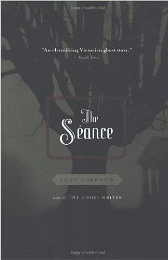
Cover for The SeanceThe Séance is a modern novel that is written like a Victorian gothic mystery. It features narrations by several different characters–a typical Victorian device that was used successfully in Wilkie Collins’s The Moonstone.

John Harwood’s novel is difficult to describe without going too far into the plot, because some important characters do not appear until later in the book. It begins with the story of Constance Langdon’s dreary childhood and young adulthood. Her mother has been depressed and nonfunctional since her sister died, and her father behaves as if he lives alone in the house. When Constance reaches the age of 11, her father withdraws her from school and abandons her and her mother to go live with his sister. Later, a disastrous experiment with spiritualism (very popular in Victorian times) in an attempt to help her mother results in her mother’s suicide.

Constance accepts her uncle’s invitation to live with him in order to avoid being thrust upon a father who doesn’t want her. But shortly after moving in with him, she finds she has inherited Wraxford Hall, an infamous house, old and crumbling, where two boys died; an old man mysteriously disappeared; and Magnus Wraxford was apparently murdered by his wife, Eleanor, who has also disappeared.

The next section of the novel is narrated by John Montague, a lawyer who visits Constance. He was involved in the experiment at Wraxford Hall that ended in the murder of Magnus Wraxford, and he tells the story of the experiment. This visit and Constance’s subsequent agreement to take part in a séance at Wraxford Hall lead us to Eleanor’s story, which is taken up by a diary that Eleanor wrote. Finally, we return to Constance. When she arrives at Wraxford Hall, she finds the experiment is to take place in a spooky gallery occupied by an odd-looking set of armor and a sarcophagus.

The novel is successfully creepy and mysterious. However, by the time of the séance I had figured out one character’s crucial secret identity, which made several other plot points clearer. Some readers may find it takes a long time to get to the crux of the novel, but I enjoyed the journey.

Day 118: The Solitary House

Cover for The Solitary HouseBest Book of the Week!

I had an ambivalent reaction to The Solitary House, which is sort of a riff on Bleak House. It is not exactly a retelling of Dickens’s book. Although some story lines are re-interpreted, most of the Dickens characters appear in the background of the novel. My ambivalence is because Bleak House is one of my favorite Dickens novels, and I have not been happy with some of the retellings of classics that have appeared lately, particularly those that seem to miss the point of the original works. I am also a little dismayed by what Shepherd has done to some of my favorite Dickens characters. However, I find I have to admire the masterful way Shepherd has worked the threads of Dickens’s novel into such a different story. On the whole, almost despite myself, I am giving this novel a big recommendation for its originality.

Charles Maddox is a former detective for the London police force who left under undesirable circumstances. He is hired by Edward Tulkinghorn, a mysterious solicitor who has an evil reputation. A client of Tulkinghorn’s has been receiving threatening letters, and Maddox’s assignment is to find out who is sending them. Charles descends into the squalor of London to discover the author of the notes, but when he turns the information over to Tulkinghorn, the author of the notes is brutally murdered.

Thinking that this is not a coincidence, Charles begins investigating Tulkinghorn himself, as well as his client, Julius Cremorne. In doing so, he comes upon evidence of a serial killer. He also runs up against Inspector Bucket, his former police supervisor.

Charles’s story is written in a jokey third-person omniscient narration that often addresses the reader directly and is interlarded with many references to Dickens and some quotes from Shakespeare. Imagine a style that is like a postmodern Dickens. This narration is interleaved with the first-person narrative of Hester, seemingly the same quiet, loving, capable Esther Somerset of Bleak House. It is not until the end of the novel that these two stories merge horribly together.

Ultimately, I am coming down on the side of strong admiration for this book. It is completely absorbing and inventive, well written and literate, and actually convincing as a twisted alternate vision of Bleak House minus the case of Jarndyce vs. Jarndyce. It made me want to return to Bleak House, which I have not read recently, and dig out all the references. It is a gothic novel that becomes a serious creepfest, and you know how I love those.

I see that Shepherd has also riffed on Mansfield Park. As much as I am dreading what she will do to my beloved Jane Austen, I think I’m going to have to read it.

Day 103: Dark Road to Darjeeling

Cover for Dark Road to DarjeelingMy interest in the Lady Julia Grey series by Deanna Raybourn waxes and wanes. Although it is unusual for me to like books that mix mystery and romance, I usually enjoy reading this series, but I enjoy some books more than others. The books have followed the relationship of Lady Julia Grey and Nicolas Brisbane–who solves crimes for a living and whose breeding makes him an unsuitable mate for Julia–since they first met when her husband was murdered. Now, after several books following the ups and downs of their relationship as they solve crimes and get each other into and out of danger, they are married.

In Dark Road to Darjeeling, Lady Julia and Brisbane have been persuaded to interrupt their honeymoon in the Mediterranean by Julia’s sister Portia, who is worried about her friend Jane. In a previous novel, Jane left Portia to be married, and she is now a widow on a tea plantation near Darjeeling. Portia has asked Julia and Brisbane to investigate the possible murder of Jane’s husband. Jane herself is obsessed by her own pregnancy and the mysterious death of her husband Freddy, who may have been murdered for his inheritance.

The Brisbanes take along part of her eccentric family, Portia and brother Plum. Upon arriving at the plantation, they get to know the potential suspects, including Freddie’s aunt, his cousin Harry, several neighboring families, and the mysterious White Rajah.

I was unable to guess the murderer but figured out which family the murderer belonged to. Although this series sometimes resorts to the typical conflict between romantic co-investigators about the danger of the job, a conflict that I find extremely tedious, the dynamic between Julia and Brisbane still holds my attention. If you are interested in this series, I recommend that you start with the first book, Silent in the Grave.

Day 69: The Information Officer

Cover for The Information OfficerI really enjoyed Mark Mills’s book Amagansett from a few years ago and liked The Savage Garden. However, I did not find his third book, The Information Officer, as satisfying.

It is World War II during the siege of Malta. The British are trying to get their Spitfires to Malta to defend it, but in the meantime the strategic island is being heavily bombed. Major Max Chadwick’s job as information officer is to deliver updates to the local newspaper that are as positive as possible and figure out what is truth and what fiction.

Max’s good friend Freddy comes to him with information that someone is murdering Maltese dance hall girls, and there is evidence that the murderer is a British submariner. Freddy, a doctor, has already raised the problem with the high command and gotten nowhere, so Max decides to investigate. In the meantime, the murderer is plotting his moves.

The novel was interesting enough, with good descriptions of Malta and a fairly involving plot. However, I did not grow to care very much about the characters. I figured out the murderer, although not his motive, fairly easily.

Day 58: Grave Goods

Cover for Grave GoodsBest Book of Week 12!

In the year 1154 a dying monk sees what he thinks is a vision of the burial of King Arthur after an earthquake at Glastonbury Abbey. He tells his nephew about it as he dies. Twenty years later when King Henry II is putting down a Welsh rebellion, the nephew, a Welsh bard, tells him the story hoping to save his own life. Henry sends a message to Glastonbury, which has just suffered a great fire, and the monks find a coffin buried in the described location that seems to contain the corpses of a man and a woman.

The penurious Henry would love to announce that they had found the bodies of Arthur and Guinever, because the resulting monies from pilgrimages would save him having to pay to rebuild the abbey. But how can he be sure someone won’t come to claim the bones belonging to his Uncle Tom and Aunt Gladys? By summoning his “mistress in the art of death,” Adelia Aguilar, he hopes to determine at least their antiquity.

Grave Goods is a novel in Ariana Franklin’s Mistress of the Art of Death series. Adelia Aguilar is a graduate of the School of Medicine in Salerno, at the time the only such facility that would accept women, and an expert on the causes of death. She arrived in England on a previous matter, but Henry has found her so valuable that he has never granted her a passport to leave the country. Since she is a woman, her word is not respected by most men, so she pretends she is a translator for her Arab servant Mansur, who pretends to be the doctor.

Henry’s soldiers find Adelia and take her away as she is travelling with her friend Lady Emma Wolvercote to Wells to claim Emma’s son’s property from his grandmother. But when she arrives in Glastonbury after meeting with Henry in Wales, Emma has disappeared. The monks give Adelia’s party an unfriendly greeting, and while she and Mansur are looking in a crypt to find samples to compare with the corpses, someone tries to bury them alive. Something is not right at the abbey, and Adelia is not best pleased to be saved by Rawley, the Bishop of St. Albans, her ex-lover.

I have been reading this series for awhile. At first, I wasn’t sure I bought the premise, but the books are rich with historical details and the forensics information available at the time, and Ariana is a likeable heroine. It’s not her or Rawley’s fault that he was made a bishop (he was a soldier when she met him), and the blending of romance and mystery works fairly well here, which is unusual. The romance is played down in favor of action and suspense. If you like a good historical mystery, you’ll probably enjoy these books.

Day 46: The Winter Thief

Cover for The Winter ThiefThe Winter Thief is the latest of Jenny White’s mysteries set in late 19th Century Istanbul about the investigations of the honest and hard-working Special Prosecutor Kamil Pasha.

It is a freezing cold, wintery holiday in Istanbul when Vera Arti visits an Armenian publisher to try to convince him to publish The Communist Manifesto in Armenian. Disappointed in her attempts, she doesn’t notice when someone follows her home. When her husband Gabriel returns abruptly to their apartment and tells her they must leave immediately, she argues that she must pack her things. He leaves her to get a carriage for them, but while he is gone, she is taken by the Sultan’s new secret police.

In another part of the city there has been a bank robbery and next door a massive explosion at a café followed by a fire where many people are injured or killed. Kamil Pasha is helping out at the scene when he finds evidence that his brother-in-law Huseiyn might be one of the victims.

Gabriel Arti’s mission is to open a socialist commune in Armenia, and to do that he arranged to purchase a shipment of illegal guns and robbed the bank. His fears for his wife lead him to seek the help of an enigmatic but powerful acquaintance of Kamil Pasha’s who helped him arrange the gun shipment. At the man’s suggestion, Gabriel departs for Trabzon and the commune, leaving the other man to try to find his wife.

Although the Ottoman empire has traditionally been one that tolerates people of different religions and race, tensions are rising. Vahid, a vicious, sadistic, conniving commander of the Sultan’s new secret police has a plot to gain more power by making the Sultan believe that the Armenians are a threat to the empire and then providing himself an opportunity to end the threat. Vahid believes that Huseiyn might have been having an affair with the woman he intended to marry, who died in the fire. In his efforts to find Huseiyn and wreak his vengeance, he runs up against Kamil Pasha and his sister, who is frantically trying to find her husband. The next thing he knows, Kamil Pasha has been framed for the murder of a young Armenian girl.

As we follow the adventures of all those people, as well as Gabriel, the members of the commune, and others, the book begins to feel too disorganized and diffuse. My interest flagged a little. However, the threads of the story all come back together when the Sultan dispatches Kamil Pasha to the wilds of Armenia with a small troop of soldiers to find out whether the new settlement is a band of Armenian revolutionaries or a harmless socialist commune.

Day 41: Death Comes to Pemberley

Cover for Death Comes to PemberleyDeath Comes to Pemberley is an unusual attempt by P.D. James, a mystery with Elizabeth and Mr. Darcy and their family and friends as characters. P.D. James is, of course, the queen of the mystery novel, but I had to admit to some disappointment with this effort.

On the night before the Darcy’s annual ball, the Darcys, his sister Georgina, the Binghams, Colonel Fitzwilliam, and a suitor of Georgina’s have just finished dinner when a coach careers into the yard containing Lydia Wickham, who says that someone is trying to murder her husband. As you will remember from Pride and Prejudice, Lydia would have been ruined by Wickham had not Darcy paid him to marry her, so the family has been at outs.

The men all go off to find Wickham bending over the body of his friend Major Denny. Although the evidence seems to suggest that Wickham has murdered Denny, he insists that after an argument he left the coach containing the three of them, on their way to crash the Darcy’s ball, and didn’t know what happened to Denny.

Although James is a little more successful at capturing the style and time of an Austen novel than other modern writers who have used the Darcys as characters, she spends no time on character development at all, leaving this to the readers’ knowledge of Pride and Prejudice. Yet, at the same time, she unnecessarily, considering the novel is supposed to take place six years later, has characters rehash the events of the original. Although I cannot recall the details, I also have a note that the novel was repetitive.

I have generally avoided reading the plethora of new books riffing on the reinterest in Austen, but I was looking forward to this one because James is usually so good. Although not at all a bad book, I feel that this was not one of her better efforts.

Day Four: The Rhetoric of Death

Cover for The Rhetoric of DeathOne of the many surprising things I learned from the historical mystery The Rhetoric of Death by Judith Rock is that an important part of the curriculum of 17th century rhetoric, as instructed by the Jesuits, was ballet. I don’t quite get the connection, but there it is. This novel, written by a historian whose dissertation is about the Louis le Grand in Paris, is full of interesting details about life in 17th century France.

Charles du Luc, a Jesuit maître of rhetoric, has had a position arranged by his cousin, the Bishop of Marseilles, at the famous Louis le Grand school. Du Luc isn’t really qualified to be employed by such an esteemed school, but the bishop wants to get him out of Provence because Charles has just finished helping smuggle his Huguenot cousin from there to Switzerland.

The school is two weeks away from its annual performance, an enormous, lengthy (some were as long as 12 hours) ballet and rhetoric production of The Labors of Hercules that will be attended by the king himself, and du Luc is assigned to assist with the dance rehearsals. On his first day, the distracted student who is to play Hercules runs off from the rehearsal and disappears. On the same day, his little brother is almost run down by a horse. Charles thinks these two events may be connected and is even more sure when the first boy is found strangled in a latrine.

At the same time Charles finds himself under suspicion from the authorities because he was the last person to see the first boy alive and was on the scene right after the second boy was almost run down. He is also facing hostility from a fellow member of the Jesuit school who takes an instant dislike to him, a member of the powerful De Guise family.

This novel does a good job of making the period come alive. Unfortunately, the mystery is not nearly as effective as the history. I figured out the motive and the person behind the murders on about page 50. Shortly thereafter I figured out who the actual murderer was. However, the test for me on a mystery, since I often figure out the solution, is whether I am still interested in reading it. In this case, I found the characters, story, and historical background interesting enough to finish.