Day 730: The Sea Captain’s Wife

Cover for The Sea Captain's WifeSince she was a little girl, Azuba has wanted to marry a sea captain and leave her home on the Bay of Fundy to live with him at sea. Although such arrangements are not usual, they are also not unheard of. She envisions a life of romance and adventure, traveling to the distant realms of the earth.

This is the life she plans with her suitor Nathaniel Bradstock, but once they are married, he changes his mind. Azuba is bored and discontented at home for years alone and feels he will be a stranger to their daughter Carrie. After a traumatic miscarriage, she decides to insist he take them with him on his next voyage.

In her loneliness, Azuba has befriended the young Reverend Walton. Just before Nathaniel is due to return, carelessness and misjudgment result in a scandal for the two of them. When Nathaniel learns about it, he decides she cannot be trusted home alone and makes immediate plans to leave instead of staying ashore awhile as planned, taking along Azuba and Carrie.

Azuba has got her way, but she is not happy. Aside from the misunderstanding with her husband, she has not realized the dangers and inconveniences of the voyage. To make matters worse, Nathaniel sees her and Carrie as more burdens among the many he must juggle as captain. The terrifying voyage around the Horn is the first in a series of mishaps that endanger them all.

I found this a fascinating book in its knowledge of sea lore and the ports of the time. The main characters are complex, the novel focused on Azuba and Nathaniel’s struggle to design the conditions of their marriage. I have one plot quibble when Mr. Walton reappears in Belgium, where he is studying to be a photographer. After booking Azuba and Carrie on a relatively safe journey home by steamship, Nathaniel suddenly decides to keep them with him. There is no explanation of this decision, and we don’t even see the scene where it is made. It seems awkward, as if Powning made the decision just to further the plot.

Finally, Nathaniel and Azuba don’t actually work out their conflict. Instead, the decision that resolves it is forced on Nathaniel. Still, I found this novel of absorbing interest. But one more quibble. Sometimes stopping to explain what Azuba or other female characters are wearing actually interferes with the story-telling.

Related Posts

Ahab’s Wife: or, The Star-Gazer

Galore

We, The Drowned

Day 726: The Other Daughter

Cover for The Other DaughterRachel Woodley has been working in France as a governess when she receives a telegram informing her that her mother is ill. Although she returns home immediately, the telegram was delayed, and she finds her mother dead, the funeral over, and the landlord giving her two weeks to vacate her home.

While she is going through her mother’s things, she finds a recent newspaper photo of the Earl of Ardmore with his daughter, Lady Olivia Standish. The Earl looks exactly like her father would have looked had he not died on a botanical expedition when she was four. But it’s not just a resemblance. He is the same man, with the same scar on his face.

Rachel goes to Oxford to see her Cousin David, who she’s sure would know the truth. David explains that her father was the second son and that he and her mother were forced to part after her father’s older brother died and her father became heir to the estate.

Rachel is furious to hear that her father left them, that she has been lied to, and that she is illegitimate. The thought of all the times she missed her father also makes her angry. She is expressing her displeasure when they are interrupted by Simon Montfort, Cousin David’s neighbor in rooms. He takes Rachel away to calm her down.

link to NetgalleyAlthough Simon is a social columnist for the Daily Yell, he promises to keep private what he has overheard. Soon, he is helping her get an opportunity to meet her father. After a makeover of a new haircut and his sister’s fashionable clothes, he lends her his mother’s apartment and presents her to young London society as the chic Vera Merton, his cousin. Rachel is not entirely sure of her own motives but is soon positive that Simon is doing this for his own purposes, especially when she learns her sister Olivia was once his fiancée.

This novel is sheer frivolity, set as it is in the 1920s among the wild young things. It is certainly a bit predictable—soon we guess Rachel will end up with either her sister’s current fiancé or her previous one. But it has lots of snappy dialogue and enough twists to keep things interesting. Although I’m not generally fond of this genre, I enjoyed The Other Daughter.

Related Posts

Lucky Us

Empire Girls

The Secret Keeper

Day 708: At the Water’s Edge

Cover for At the Water's EdgeMaddy, Ellis, and Hank make a riotous threesome as they party and caper their way through Philadelphia high society. It is World War II, but both Ellis and Hank are classified 4F. In any case, taking upon any adult responsibility doesn’t seem to be in their plans. Maddy and Ellis Hyde are married, but they live with Ellis’ parents. Hank has a girlfriend but has shown no interest in marrying Violet.

After a particularly drunken New Year’s Eve, Ellis’ father throws Ellis and Maddy out of the house to fend for themselves and cuts Ellis’ allowance. To get back into the good graces of Mr. Hyde, Ellis and Hank come up with a hare-brained scheme. Long ago, Mr. Hyde went to Loch Ness to look for the monster. He claimed to have found it and circulated photos. But they were revealed as fakes. Ellis thinks if they can find the monster and take legitimate pictures of it, he can revive the family name and make his family proud.

But getting to Scotland during wartime poses problems. Hank finally gets them on a freighter, but when their ship rescues some men whose vessel was torpedoed, Maddy begins to understand the horrors of war. Arriving at their destination, she is the only one of the three who seems to understand how ridiculous their presence as tourists is during this difficult time. The three know nothing of ration cards, air raids, or war casualties. And the men’s boorish attitude about the lack of conveniences at the inn doesn’t help.

Maddy settles in and gets to know the villagers, but she is soon disturbed by how much Ellis and Hank are drinking and how many of Maddy’s “nerve pills” Ellis takes. Maddy herself has only ever taken one.

link to NetgalleyAlthough dealing with another period and setting, Gruen is covering some of the same ground as in Water for Elephants. She clearly enjoys the wives in distress theme. Still, after I experienced an initial distaste for all three main characters, Maddy grew on me with her evolving sensitivity and efforts to help the villagers. I enjoyed this novel and think it makes a good light historical romance. Gruen periodically gives us details of the war and does a fair job of evoking the atmosphere of a small pub, where everyone nightly listens to the war news.

Related Posts

The Postmistress

Studio St.-Ex

Rules of Civility

Day 630: Amherst

Cover for AmherstAmherst combines the tale of two love stories, one actual and one fictional. The historical actual affair was between Emily Dickinson’s brother Austin and the much younger Mabel Loomis Todd. The modern fictional affair is between Alice Dickinson, working on a screenplay about the affair, and Nick Crocker, an older academic who gives her a place to stay in Amherst while she does her research. All of these people are married to others except Alice.

Emily Dickinson herself is a minor character in the 19th century story. Her brother and Todd used her house for their trysts—a known fact—and there is some debate about how much exposure Emily herself had to sex. Nicholson theorizes a woman listening at doors and a sort of free love attitude by everyone except Sue, Austin’s wife. I found it all a little sordid and probably unlikely.

All of this might be interesting to a reader of literature if Nicholson had spent any time with these characters before thrusting them into their love affairs. We don’t know any of them, so we don’t care about them (alas, too often my complaint lately).

Worse, to me, are the liberties or omissions at the end of the novel. Nicholson gives Todd full credit for her efforts to publish Dickinson’s poetry after her death, even having her spend hours convincing Thomas Wentworth Higginson of the value of Emily’s work. He doesn’t mention that Higginson was already very familiar with Dickinson’s poetry, having been in correspondence with her for 20 years before her death, as related in the excellent biography White Heat. (Although on the surface Nicholson seems unfamiliar with or ignores some of the content of the biography, he interestingly uses the phrase “white heat” to refer to the affair between Todd and Austin Dickinson.) Higginson was already convinced of the worth of Dickinson’s poetry—he just had doubts about how publishable it was. In fact, he almost certainly met Dickinson, which Todd never did.

The other historical fact Nicholson completely glosses over is the one the world of literature finds most shocking—that Todd and Higginson edited Dickinson’s poetry, changing capitalization and spelling but even rewriting some of the passages.

http://www.netgalley.comThe lovers are not really likable, in fact or fiction. Austin Dickinson actually consummated his affair with Todd while his wife was grieving the recent death of their young son. Mabel comes off everywhere as self-centered, and she fought with the Dickinson’s over Emily’s legacy as much as she ensured it.

The two modern lovers are just not interesting, really more of a footnote to the historical section, and I found Nick to be extremely manipulative. The novel also employs that overused trope of having Alice find out immediately in a way that is too crass to be believable that Nick has a reputation as a seducer. Note to minor characters: these warnings never work.

It’s hard to tell whether Nicholson meant these stories to be romantic, although he states in an interview that he is interested in exploring love. I did not find the stories romantic, either one of them. I also did not feel they particularly explored the theme of love. I was not at all drawn in by this novel, neither by the historical nor by the modern story.

Day 608: The Convenient Marriage

Cover for The Convenient MarriageThe Winwood sisters are in turmoil. Miss Winwood has gained a spectacular suitor in the Earl of Rule, who has finally decided to marry. He is wealthy, and his generous settlement will save the family from ruin. The only problem is that Miss Winwood is in love with Edward Heron, a mere army lieutenant and a second son with no fortune.

Young Horatia Winwood, not yet out of the schoolroom, thinks she has the solution. Rule wants to marry a Winwood, and it should not matter to him which one. So, she goes to his house and proposes herself as an alternative. She forthrightly points out her unfortunate eyebrows and her stammer and hopes that Rule won’t mind them. Rule is enchanted.

So, Horry gets married without realizing she has made a love match. Since Rule is afraid he may be too old for her, he treats her with a little too much care. She has told him she won’t interfere with him, so she says nothing when she learns about his mistress, Caroline Massey.

Rule has broken with Massey, though, who is jealous and angry. Crosby Drelincourt, Rule’s foppish heir, is eager to make trouble, as is Rule’s enemy, Robert Lethbridge.

Horry soon finds herself very popular. But her efforts to make Rule jealous and the plots of Rule’s enemies land her in trouble, and her scapegrace brother Pelham’s schemes to get her out of it only make things worse.

In Horry, Heyer has created another engaging and feisty heroine. Heyer is an expert on the Regency period, as well as the master of warm and funny romantic escapades, and The Convenient Marriage is one of her best.

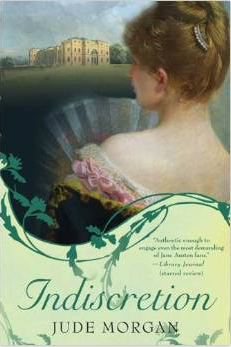
Day 576: Indiscretion

Cover for IndiscretionIn Regency London, Caroline Fortune and her ex-soldier father have been surviving at the edge of poverty for a long time. When her father reports that he has lost all his money in a bad investment, Caroline decides to look for work as a governess.

Soon, her father tells her he has found her a better situation, as companion to Mrs. Catling, the widow of her father’s former colonel. In his ebulliant way, he assumes Caroline could easily be left Mrs. Catling’s fortune. Caroline is not pleased with the situation, nor does she have any hopes of Mrs. Catling’s generosity, but seeing no other option, she takes the position. With no relatives other than her father to fall back on, as her mother’s relatives disowned her mother after her marriage, Caroline moves to Brighton to wait on Mrs. Catling.

Caroline soon learns that Mrs. Catling is demanding and petulant. She treats her servants harshly. When Mrs. Catling’s niece and nephew, the Downings, come to call, Caroline witnesses how her employer manipulates Matthew Downing with the promise of her fortune. Still, Caroline manages to get along with the Downings and Mrs. Catling fairly well, even receiving unwanted confidences from Matthew. However, her dependent position unexpectedly leaves her open to an insult from an unscrupulous man.

Re-opened contact with her relatives eventually removes her to an entirely new neighborhood and life, and she makes some new friends. After awhile, though, her experiences in Brighton return to haunt her.

I don’t often read romance novels and tend to stick to the older authors I love when I do. I have found no writer who can surpass Georgette Heyer in Regency romances. But a friend recommended this novel to me, and I found it quite entertaining. It does not seem simply a copy of Heyer as some other Regency novels have. The dialogue is witty. Once Caroline leaves Brighton she meets some endearing characters, and the plot is both complex and interesting. Caroline is an intelligent and engaging heroine. For some light, escapist reading, I recommend Indiscretion.

Day 433: Black Sheep

Cover for Black SheepI hadn’t read this Georgette Heyer novel in some years. Although it is not one of my absolute favorites, reading it is still a relaxing, amusing way to spend a few hours.

When Abigail Wendover is away from her home of Bath visiting her family, she hears disturbing rumors that her niece Fanny, an heiress, is being courted by a fortune hunter named Stacy Calverleigh. Returning home, she finds that her 17-year-old headstrong niece believes they are madly in love, and she is not ready to listen to arguments that Calverleigh, a much older man, has not behaved as he should. He has also worked his way into the good graces of Abigail’s foolish sister Selina.

Abigail encounters a man named Calverleigh in a hotel parlor, and she is shocked to find him neither of good looks nor address and much older than she is herself. He is further prone to uttering the most shocking remarks that unfortunately make her laugh. Soon Abigail finds that this Calverleigh is not Stacy but his uncle Miles, the black sheep of the family, who was sent away to India after a youthful scandal and has now returned. However, he is unwilling to interest himself in the situation between her niece and his nephew. He is only interested in Abigail herself.

Although Abigail knows she shouldn’t encourage his attentions and finds some of his views about family and duty shocking, he never fails to make her laugh. Soon she discovers that he is even more unsuitable a companion than she thought, for his youthful indiscretion was to run off with Fanny’s own mother, who later married Abigail’s older brother!

Abigail is one of Heyer’s more mature heroines, an intelligent, sensible woman with a sense of humor some of her relatives consider unfortunate. Of course, the journey out of the tangle her niece is in will be enjoyable and entertaining. Although this novel is not as funny as some of my favorites, it is always a pleasure to spend time with Heyer’s creations.

Day 397: Sylvester, or the Wicked Uncle

Cover for SylvesterOn occasion, I reread a few of Georgette Heyer’s Regency romances, which have been some of my favorite reading for many years. Just recently, I reread Sylvester, which in some editions is titled Sylvester, or the Wicked Uncle.

The extremely eligible bachelor Sylvester, Duke of Salford, has decided to take a wife. His only difficulty is in deciding which of five eligible girls to marry. When his beloved mama mentions that she and her best friend made a plan for their children to marry many years before, he decides to go inspect the girl, his godmother’s granddaughter, to see if he might like her. Although he is warm and thoughtful to those he cares for, since his twin brother’s death, he has been aloof to others and comes off as haughty.

Sylvester’s visit is disguised as a hunting party, but Phoebe Marlow is informed by her detestable stepmother that the duke is coming to make her an offer. Unfortunately, Phoebe has already met Sylvester and took such a dislike to him that she used him as the villain in a novel she wrote. That novel is going to be published, despite all expectation. Normally, she would not expect him to recognize himself in a silly gothic romance that pokes fun at various society figures, but for the mention of Sylvester’s very distinctive eyebrows.

Fearful of her stepmother’s pressure and not understanding that Sylvester has no intention of proposing, Phoebe talks her childhood friend Tom into escorting her to her grandmother’s house. However, an accident and a snowstorm strand her and Tom with Sylvester in a small country inn.

After Phoebe gets to know and like Sylvester, she is horrified to find out that he has a nephew, since in her silly romance his character is a wicked uncle who wants to steal his nephew’s fortune. Another horror lurks, because Phoebe’s book proves to be a smashing success, much read by society members, who are all trying to identify their friends. Since Phoebe has never brought herself to admit to Sylvester that she wrote a book, she soon fears that people will find out she is the author.

Heyer creates delightful, engaging characters and puts them into silly and unbelievable situations, which is part of the pleasure of reading her novels. They are very well written, with entertaining and sparkling dialogue and a complete understanding of the customs, dress, and speech of the period. If you decide to read Sylvester, get ready for some fun. Many of Heyer’s novels have been re-released in the past few years, so they should not be hard to find.

Day 353: Friday’s Child

Cover for Friday's ChildFriday’s Child is one of Georgette Heyer’s funniest Regency romances. Although some of her novels are a bit closer to being “serious” romances (that is, with the emphasis on the romance, but always with witty dialogue), this novel is endearing in its plethora of foolish characters.

Anthony Verelst, the Viscount Sheringham, is a wild young man who is extravagantly wasting his inheritance on gambling and women, but his estate is left so that he cannot touch the principal unless he marries. He has fancied himself in love with the current reigning beauty, Isabella Milbourne, but he is not tempted to matrimony until he becomes fed up with his mother and her brother, one of his trustees, whom he believes is milking his estate. He proposes to Isabella, plainly expecting an answer in the positive, but piqued by his lack of ceremony, she rebukes him for his dissipated lifestyle. In a rage, he storms off, vowing to marry the first female he meets.

As he is returning to London from his mother’s house in the country, he meets Hero Wantage, a very young lady who is an impoverished orphan and a neighbor. He thinks of her as a little sister, so he has no hesitation in relating the tale of his misfortunes. When he tells her of his vow, she answers, “Silly, that’s me!” So, the heedless viscount throws her up into his curricle and drives her off to London to get married. Since she has long worshipped the Viscount, or Sherry, as he is known to his friends, and has been mistreated by her Bagshot relatives, she is happy to go.

The couple is naturally headed for trouble, for Hero is completely naïve and badly brought up, with no idea of how to behave in society. The heedless Sherry seems to feel that he can go on about his business as always without paying much attention to her, so she begins befriending the wrong people and otherwise falling into scrapes.

This novel features an outstanding cast of secondary characters, especially Sherry’s close friends–Gil Ringwood, a thoughtful young man who vaguely feels there is something wrong with the way Sherry neglects his wife; Ferdy Fakenham, a silly but warm-hearted dunderhead reminiscent of Bertie Wooster; and George, Lord Wrotham, a hot-tempered gentleman who constantly challenges other men to duels and is madly in love with Isabella. As a side comment, I think it is a hallmark of a good Heyer novel that the characters who would be the heroine and hero in a typical romance novel (that is, Isabella and George) provide some of the humor in her own novels, especially the devastatingly handsome George, with his exaggeratedly romantic behavior.

Heyer is one of my favorites for light reading, and Friday’s Child makes me laugh out loud, particularly when Ferdy gets it into his head that he and Gil are being pursued by “that dashed Greek we learned about at Cambridge. Kept lurking about in corners,” in other words, Nemesis. The characters are funny, the dialogue is witty, and the plot is full of twists and turns.

Day 82: Cotillion

Cover for CotillionOne of my favorite authors if I want the lightest of reading material and a good laugh is Georgette Heyer. Although I am not a romance reader, for her meticulously researched and comic Regency romances I have to make an exception. Her period pieces are absolutely convincing, as she was an expert on Regency dress, deportment, and speech. In fact, she became such an expert on the period’s idioms that she once was able to successfully sue a plagiarizer by proving that the expression the other writer copied appeared only in some records to which she had been granted private access.

But Heyer was also an expert at creating charming comic characters and situations. Cotillion is one of my favorites of her books, and one of the silliest.

Kitty Charing is an impoverished orphan who has been raised in discomfort by her miserly old guardian, “Uncle” Matthew Penicuik. A great one for manipulating his putative heirs, Uncle Matthew announces that he will leave his entire fortune to Kitty, but only if she marries one of his four grandnephews. Then he invites them all to come calling. Priggish Reverend Hugh Rattney and doltish Lord Dolphinton arrive, and the married Lord Biddenden comes to represent his rakish brother Captain Claud Rattney, but dashing Captain Jack Westruther, whom Kitty has grown up hero-worshipping, does not make an appearance, as he is unwilling to be manipulated.

Kitty is furious that Jack doesn’t appear, but even more furious at being put in this position. She soundly rebukes all of her “cousins,” except Lord Dolphinton, who is too stupid to be responsible for his actions and has been compelled to come by his mama. But then Uncle Matthew announces that if Kitty refuses to marry one of her cousins, he will leave her with nothing. What is a spunky Heyer heroine to do but run off into a snowstorm with only a few possessions and an impractical plan to get a job as a house maid?

She arrives at the local inn to find her cousin Freddy Standen, who has absolutely no idea why he has been summoned. Freddy, not the brightest of bulbs but a kind-hearted young man, is perfectly wealthy in his own right and has no intention of getting married. When he meets Kitty at the inn, she talks him into pretending an engagement with her and inviting her to go up to London so she can acquire some “town polish,” buy some nice clothes, and (she hopes but doesn’t tell Freddy) enchant Jack into a proposal.

Freddy, an expert in deportment and fashion who can always be relied upon to accompany a young married woman to a dance or concert, is not really a lady’s man. When he and Kitty arrive in London to find his harassed mother attempting to care for a house full of children with mumps, he is dismayed to find he is left responsible for a naïve girl who tends to fall into difficulties and odd friendships.

The novel is crammed with comic characters, such as Kitty’s foolish governess “Fish,” who has a turn for quoting romantic poetry; Freddy’s frippery married sister Meg, who wears color combinations that shock him to the core and spends her time trying to avoid her mama-in-law; Camille, Kitty’s real French cousin, who is impersonating a lord; Lord Dolphinton, who is terrified of his mother but strictly charged by her to get Kitty to dump Freddy and marry him; and the silly doe-eyed Olivia, whom Kitty befriends but Jack is pursuing to be his mistress.