Review 2585: Literary Wives! The Constant Wife

Today is another review for the Literary Wives blogging club, in which we discuss the depiction of wives in fiction. If you have read the book, please participate by leaving comments on any of our blogs.

We also welcome another member to our group! Becky Chapman is a new member from Australia. You can see her bio on my Literary Wives page. Welcome, Becky!

Be sure to read the reviews and comments of the other wives!

My Review

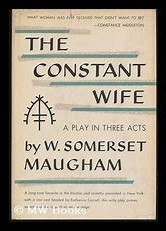
The Constant Wife is a play by Maugham, a social comedy that is reminiscent of one of Wilde’s. It is witty and reflects some interesting attitudes about marriage and faithfulness. It is set completely in Constance Middleton’s drawing room.

The play begins with the revelation that most of Constance’s friends and relatives think her husband John is being unfaithful with her best friend, Marie-Louise Durham. Constance’s sister Martha wants to tell her, but her mother, Mrs. Culver, does not. In any case, once the matter is hinted at, Constance refuses to hear and says she is sure John is faithful to her.

John and Marie-Louise are having an affair, though, and it turns out Constance knows. She has been maintaining the status quo, but when the truth comes out, it turns out she has some unusual ideas about marriage, especially for the time. At the same time, Bernard, a former suitor of Constance’s, returns from years in China.

The play is meant as a light diversion, I think, but its ending was probably considered pleasantly shocking at the time.

I try hard not to judge works out of their time, but although the script is undoubtedly witty, it reflects some attitudes that made me wince. Here’s one that seemed so strange it was funny. I’m not sure what early 20th century British people of a certain class thought feminism was, but in an early speech Mrs. Culver says she told a friend whose husband was unfaithful that it was her fault because she wasn’t attractive enough. (Ouch! But that idea was still around when I was growing up.) What made me laugh, although I don’t think it was meant to be funny, was that Constance in response asks her if she’s not “what they call a feminist.” Maybe it was meant to be funny. Hmm.

What does this book say about wives or about the experience of being a wife?

I think a discussion of this topic probably involves spoilers, which I try to avoid. But here goes.

This play comments in several ways about marriage and fidelity. First, there is the idea that it’s okay and expected for a man to cheat, expressed by Mrs. Culver. The corollary to that is that it is not okay for the wife. Martha does not agree. She thinks both should be faithful. Constance’s attitudes are more complex.

At first, Constance wants to maintain the status quo of her marriage by ignoring the situation. Then when she is forced to acknowledge her husband’s infidelity, she does and says some surprising things. She is very matter of fact about it and expresses the idea that they were lucky because they both fell out of love at the same time. John, more conventionally, affects to love her still.

Constance has been offered a place with a successful decorating business by her friend Barbara, which she originally turned down. Now, she decides to take it, eventually explaining that John’s rights over her have to do with him supporting her, so she wants to be independent. And a year later, there is more to come.

I’m not sure whether Maugham was making serious points about marriage and the relationships between the sexes or just trying to shock and be funny. The upshot of the play is what’s good for the goose is good for the gander—or the other way around.

There are still lots of implicit messages in the play:

  • That women are still property, based on their being supported by men. And Constance discounts running a house and caring for children as if it were nothing
  • That once love has calmed, marriage is basically a financial arrangement
  • That women are more interesting when they’re unobtainable than when they are present and faithful

These are the women’s attitudes, mind you (although I keep reminding myself that this play is written by a man). John isn’t that much heard from, except his cowardly request for Constance to break up with Marie-Louise for him and his conventional assertions that he still loves Constance.

Related Posts

All’s Well That Ends Well

The World’s Wife

Excellent Women

Review 2576: Moo

I have an uneven relationship with Jane Smiley. I have by no means read all her books, but I found some of them to be entertaining (The All-True Travels and Adventures of Lidie Newton and Horse Heaven) but her trilogy beginning with Some Luck to be over-rated. However, The Greenlanders was excellent, and I thought A Thousand Acres was one of the best books I ever read. Checking her oeuvre, I see now that I haven’t read any of her more recent books. This book is not one of the more recent.

Moo is set in the 1980s in Iowa in what used to be called an agricultural university (nicknamed “Moo U”). I believe the novel is supposed to be a satire. It starts with students, a boy named Bob whose job is to feed a pig as much as it can eat and take measurements, a project that seems only to be known about by the faculty member who is paying him, and four freshman girls, roommates.

But we don’t really get to know them, because then we meet a bunch of faculty members, administrators, and staff. The Spanish professor begins sleeping with the English professor. The Dean has decided, on almost no acquaintance, to marry the lunch lady. The provost seems to be entranced by money and about to make some sort of shady deal with the rich Texan who almost ruined the university’s reputation years ago. He’s seeing dollar signs in his eyes at a time when the college is cutting costs to the bone.

At page 120, I felt like I’d been introduced to about 50 people I only knew one or two things about and didn’t care. I assumed it was a satire, but nothing was funny, and it didn’t seem to be getting anywhere. So, sadly, this was a DNF for me.

Related Posts

A Thousand Acres

Horse Heaven

The Greenlanders

Review 2570: #1952 Club! Excellent Women

Entry #2 for the 1952 Club!

By “excellent women,” Pym seems to mean a type of English spinsters who occupy themselves with charity events and helping others, dress drably, and are taken for granted by men. That’s what Mildred Lathbury seems to think she is. She’s a clergyman’s daughter of limited means, mild-mannered and religious but observant of others’ characters while not wishing them any harm. In Excellent Women, she gets a surprising amount of attention from men, but then she’s always picking up after them.

Mildred lives upstairs of a vacant flat, and she’s curious about what her new neighbors will be like. She knows they’re named the Napiers by the sign at the doorbell. She meets Helena Napier on page 2, a young, stylish woman, and sees her around with a man, whom she assumes is her husband, Rockingham (known as Rocky). But he is not. He is Everard Bone, an anthropologist, and he and Helena, also an anthropologist, are writing a paper together. Rocky is off serving in Italy.

Mildred is good friends with Julian Malory, the vicar of her rather high church, and his sister Winifred. It is the expectation of several characters in the book that Julian will marry Mildred, but she doesn’t seem to expect it. Or does she? It’s hard to tell. Certainly, he is very friendly with her, but she thinks he is not the marrying kind.

Mildred meets Everard before she meets Rocky. Although he seems not to notice her at first, after a while he begins seeking her out. He is abrupt and serious, and she doesn’t think she likes him. Or does she? It’s hard to tell.

Once he shows up, Rocky is utterly charming and handsome. He is very friendly to Mildred and keeps popping up for tea. Mildred senses friction in the Napier home—well, she can hear them arguing. Rocky does all the cooking and cleaning in their home, because Helena is completely undomesticated. (She sounds like my kind of gal, even though she isn’t depicted particularly positively.) Mildred distrusts Rocky’s charm. She understands from Everard that Helena thinks she’s in love with him (Everard).

It being post-war London, it is still hard to find a place to live, so the Malorys decide to lease their upper floor. Soon, it is taken by Mrs. Gray, a beautiful clergyman’s widow. Mildred finds both Julian and Winifred transfixed by her, so she steers clear. It’s pretty evident what Mrs. Gray thinks Julian’s fate should be.

Mildred isn’t at all liberated. She is constantly cleaning up after men or doing ridiculously involved favors for Rocky and Helena, and all take her for granted. Yet, this is a lively, amusing social comedy. It is also a tale of the rapidly disappearing lives of upper- and middle-class English people.

Related Posts

The Camomile

Alice

My Brilliant Career

Review 2559: What Sheep Do in Iceland When Nobody’s Around

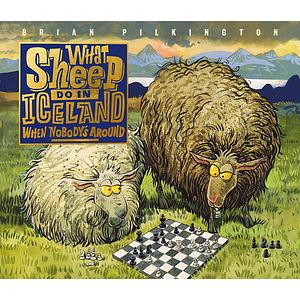
A friend of mine has family in Denmark, and she brought back this little novelty book that came from Iceland. It has great illustrations and is silly and funny, and very imaginative.

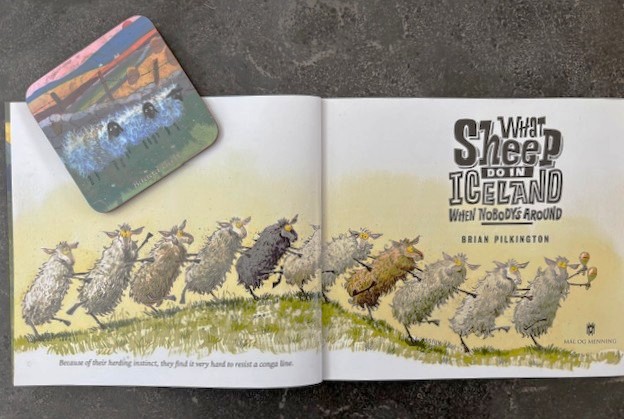
The tone of the book is set right away by the cover and title page. I took a photo of the title page, and here is its caption, in case it’s unreadable in the photo, “Because of their herding instinct, they find it very hard to resist a conga line.”

The book starts out with a more-or-less straightforward history of how sheep got to Iceland and of Icelandic sheep-keeping details, but then it just becomes silly and full of puns, with great illustrations. Perfect for a lighthearted quarter hour of reading.

I jumped into this book from a great pile of tomes I accumulated for my A Century of Books project. In fact, I interrupted my reading of Angle of Repose because I was so behind in my number of books read (I usually am reading at least 20 books ahead of my blog, and I was only in at about 13) that I wanted to dash something off and also relax. Angle of Repose is good but for some reason I kept getting distracted from it, so it took me more than a week—an unheard-of rate for fiction, even at 600+ pages.

The bad news about this book is that from the U. S. I ended up ordering it from Iceland! I assume my friend got it in Denmark, so maybe European readers will be able to find it. Anyway, it’s a hoot! I’m categorizing it as children’s literature, because I have no other suitable place for it, but I think it is probably just as funny for adults. Maybe even more so.

Related Posts

Moominsummer Madness

Summer Lightning

The Flying Books of Mr. Morris Lessmore

Review 2524: I Capture the Castle

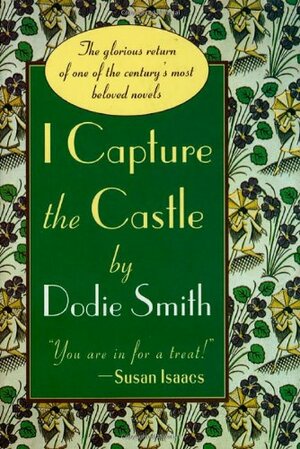
It was with delight that I noticed I Capture the Castle would help me with my Century of Books project, because I liked it so much when I read it years ago. It had an ending that was completely different from what I remembered, though, my memory having possibly been polluted by seeing a couple of TV versions of it.

Cassandra lives with her family in a house attached to a ruined castle. The house, which was purchased during the heights of her father’s success as a writer, is now woefully decrepit. Her father has not produced anything since his initial success, and the money ran out long ago. Now their clothes are shabby, and they can barely afford to eat. Rent hasn’t been paid for months, and they’ve sold all the good furniture.

There is exciting news, though. Their landlord having died, new occupants of the estate, which includes their home, have arrived. They are American brothers, Simon and Neil Cotton.

The brothers arrive when Cassandra is taking a bath in the kitchen. She keeps quiet and they go away, but they return so she has to announce herself. They take her for a child. Her sister Rose, who is beautiful, decides that she will marry Simon, the heir, no matter what, even though she hates his beard.

Cassandra likes both men at first but then overhears them talking about Rose, who has been behaving affectedly. With a little advice, Rose begins to act naturally, though, and soon she has accomplished her goal. She is engaged to Simon, although Neil seems to hate her. The only trouble is, Cassandra is in love with Simon.

This sounds like a straight love story, but it isn’t. There are lots of terrifically eccentric characters and subplots to go with them. There is the issue of whether their father will write again. And will Topaz, their stepmother, who sees herself as an artist’s muse, leave him for someone who is working? What can Cassandra do about Stephen Colley, a devastatingly handsome young man who lives with and basically supports the family and copies out poems to give to her?

This novel is charming. Its narrator mixes wit with naiveté and wisdom, and the novel is written in a sprightly, entertaining manner. It’s a lovely light read.

Related Posts

It Ends with Revelations

A Pink Front Door

The Weather at Tregulla

Review 2519: Murder after Christmas

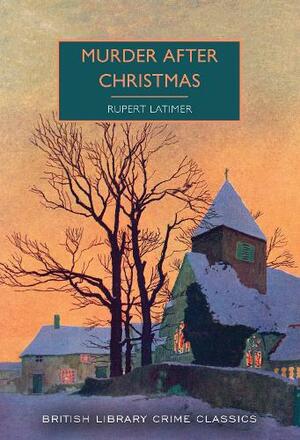
There’s nothing like a nice, cozy mystery to read at Christmas time. This one is so cozy, in fact, that you don’t want any of the characters to be murderers. And what better day to post the review of a book called Murder after Christmas than New Year’s Eve?

When Rhoda Redpath invites her eccentric, elderly, very wealthy stepfather to spend Christmas, none of the Redpaths expect him to come. After all, he has never come before. Uncle Willie is nearly 90 and has lived a rambunctious life, so there are lots of people who want to meet him. Thus, when he agrees to come, the Redpaths decide to throw a real blowout, a Christmas Tree on Boxing Day, and invite everyone.

Once he arrives, his behavior is a bit odd. He eats a lot, stuffing down loads of mince pies and chocolates even though it is wartime. He gets the order of his wives mixed up, and all the Christmas packages disappear. He also starts writing his memoirs, so they have to hire a secretary.

During the party, he is hardly to be seen except when he appears dressed as Santa to pass out the packages. Frank Redpath, the host, also appears as Santa, but having been upstaged by Uncle Willie, his appearance is a bust. Then the next morning, Uncle Willie is found frozen stiff out by the snowman, still in his Santa suit. Was it a natural death or did someone murder him? When everyone learns that his wife died on Christmas day, the timing becomes very important.

Uncle Willie is found to have laudanum in his system. Nevertheless, the coroner’s hearing finds the cause of death accidental, assuming the batty old man took an overdose. Inspector Culley isn’t quite sure, so when Frank and Rhoda Redpath ask him to stay and figure out what really happened, he agrees.

Inspector Culley’s clue collection involves lots of mince pies—sewn into a chair cushion, eaten before Christmas, eaten after Christmas, packages hung from the ceiling, chocolates hidden in the snowman, and a turkey in the wardrobe—among other things. The whole thing is ridiculous and hard to keep track of, so I just went along for the ride.

Lots of fun, this one. I’ll never look at mince pies the same again.

Related Posts

The Iron Clew

Who Killed Father Christmas?

Silent Nights

Review 2499: Novellas in November! Highland Fling

I read Highland Fling to fill a hole in my Century of Books project but found it also qualifies for Novellas in November!

The novel begins with Albert Gates, who almost on a whim, moves to Paris to become a painter. There, he at least seems serious about it and actually arranges a showing at a gallery in London before returning home to arrange his show.

Now the point of view shifts to that of Jane Dacre. She has been spending time with her married friends, Walter and Sally Monteath, who are having difficulty living on their incomes, Walter, a poet, apparently being unable to hold a job. The Monteaths are asked to travel to Scotland to host a house party at Dulloch Castle, Lord and Lady Craigdulloch having been called out of the country. They are not excited about it but agree thinking it will be a good way to save money. They invite Jane and Albert.

The rest is a no-holds-barred satire of country house parties, sporting people, Scottish customs, and surprisingly, the young people themselves. In Scotland, Albert comes off as an intellectual snob, his remarks rude and his likings absurd, his outfits unsuitable and ridiculous. (He reminded me of an obnoxious artist character in Angela Thirkell’s series, but try as I might, I cannot figure out which book he appears in. If anyone knows who I’m talking about, please tell me.)

Nevertheless, Jane falls in love with him and everything he says is wonderful. This plot point may be explained because Mitford herself fell in love with a young man on a similar Scottish visit, and they eventually split, possibly because he was gay.

This novel seemed a lot less polished than Mitford’s later ones, but it is her first. The caricatures are very broad, and the supposedly bright banter seemed puerile. However, there are some funny moments here, the description of Albert’s art being one of them.

Related Posts

The Pursuit of Love

Love in a Cold Climate

Pigeon Pie

Review 2481: Memorial

Benson is a young Black gay man living in Houston with his Japanese boyfriend Mike. When Mike’s mother is due to arrive for a visit for the first time in years, Mike tells Benson that his father is dying and he’s going to Osaka to be with him, leaving his mother with Benson, who has never met her before.

While Benson navigates the situation with Mitsuko, Mike’s mother, he also considers his relationship with Mike, which has been deteriorating lately. For his part, Mike must work through his resentment that his father deserted him and his mother when he was a teen. That, and Eiju’s general prickliness.

This novel explores the difficulties both men have had with their families and their relationships with each other. Each man also tentatively begins getting to know another gay young man.

Although this novel is supposed to be funny, the humor went right over my head. I found it perceptive and sometimes touching, although I am not a fan of explicit sex scenes. I read it for my James Tait Black project.

Related Posts

Real Life

Edinburgh

Murmur

Review 2448: Ferdydurke

I thought that Ferdydurke would be something different that I could read for the 1937 Club, but I couldn’t bring myself to finish it. When I returned to it, I still couldn’t make any headway. I didn’t finish it but read about 70 pages.

The unnamed narrator is turned from a middle-aged writer into a juvenile boy by an old schoolmaster and forced to go back to school. The sense of humor is juvenile, jokey, and forced, and I didn’t think it was funny. I quit reading during the mock introduction to a story (the first of two, apparently) that Gombrowitz chose to interrupt the flow of the novel. Not that the flow was very interesting.

Gombrowitz uses a Polish word, “pupa,” which means the butt or core of the body, to signify the concept of infantilization. He uses the word so often that I never wanted to hear it again.

This novel is supposed to be a masterful satire, but I couldn’t stand it.

Related Posts

The Finkler Question

Quichotte

The Broom of the System

Review 2341: #1937Club! Beginning with a Bash

I really enjoyed reading Alice Tilton’s The Iron Clew a few years ago for the 1947 Club so when I saw that Beginning with a Bash qualified for the 1937 Club, I was delighted. And this novel proved to be as much of a romp as the other.

This year, because I had so many previous reviews for books published in 1937, I did a separate posting. You can see that list here.

Beginning with a Bash is Tilton’s first book featuring Leonidas Witherall, the ex-teacher who looks just like William Shakespeare, so that his friends call him Bill. The novel begins with Martin Jones fleeing the police down a Boston street on a wintry day, clad inappropriately in flannels and carrying a set of golf clubs. He takes refuge in a used bookstore, where he finds Leonidas, his ex-teacher, as well as Dot, an old friend and new bookstore owner. There Martin explains that after he got his dream job at an anthropological society, $50,000 in bonds disappeared. (In a nod to Bookish Beck and what she calls book serendipity, this is the second book I’ve read in a month that involved stolen bonds.) Even after Martin was proved innocent, his boss John North fired him. He has lost his home, got accidentally mixed in with a demonstration by Communist sympathizers and got arrested again, and is a vagrant, so when someone snatched a lady’s purse, the police thought it was him.

Martin is hiding out in the bookstore when he discovers John North dead in the back, having been bashed over the head. The police naturally arrest Martin for murder. However, Leonidas notices that on that same morning two different customers came in looking for volume four of the same obscure book of sermons, and John North was one of them.

Leonidas decides that there’s nothing for it but that he and Dot must figure out who killed John North so that Martin can be set free. In no time at all, they have accumulated helpers in the form of North’s maid Gerty, her gangster boyfriend Freddy, and the indomitable widow of the governor, Agatha Jordan. They blithely engage in house breaking, vehicle theft, and even kidnapping while being chased around by other gangsters and hiding from the police. And let’s not forget that aside from stolen bonds, the story involves secret passageways, gun battles, and capture. All of this is told in a breezy style with lots of humor. It’s a totally improbable story but lots of fun.

Related Posts

The Iron Clew

The Circular Staircase

Partners in Crime