Day 743: Happy Returns

Cover for Happy ReturnsHappy Returns is one of Angela Thirkell’s books set in Barsetshire, the setting also of Anthony Trollope’s novels. Thirkell’s novels were written in the 1930’s-50’s and feature, in large part, pleasant and well-meaning characters, gentle romances, and problems bravely dealt with, particularly during and after the war.

Happy Returns is set in 1951 and 1952, just before and after Winston Churchill’s ascension to the office of Prime Minister. Much of the conversation at the beginning of the novel is about the government, called Them, the depredations its taxes have made to the neighborhood, and the characters’ hope that there will be an election that will bring Churchill into office.

The situation of Lady Lufton is one of the focuses of this novel. Her husband is recently dead at an early age, and she is struggling with grief and apathy. The family fortunes have suffered so from death taxes that she is forced to lease half her house to a tenant, Mr. MacFadyen of Amalgamated Vedge. She is concerned because her son, the young Lord Lufton, can’t afford to rent a better place when he goes up to London for Parliament and has to stay with a miserly relative, who does not feed him well in exchange for his ration card. Frankly, the gentle Lord Lufton fears he is too poor to marry.

Charles Belton is another important character. He has been engaged for a year to Clarissa Graham, but they show no sign of marrying. Clarissa has been behaving petulantly, so that Charles has begun to doubt that she wants to marry him. It takes his friend Eric Swan to notice that Clarissa is actually madly in love with Charles and fears he doesn’t love her back.

Swan, a schoolteacher, doesn’t seem very ambitious, but he is actually considering trying for a place at Oxford. But then he meets Grace Grantly and falls in love with her. At this time, fellows at Oxford couldn’t be married, so he decides to put his plans on hold and see what develops.

The whole neighborhood notices that Francis Brandon hasn’t been treating his nice wife Peggy very well lately. She, along with several other women in the novel, is very pregnant and despite her husband’s behavior keeps her good humor.

As an example of the flavor of this book, Lady Lufton and Lord Lufton are having a conversation when Mr. MacFadyen comes in. Mr. MacFadyen observes sympathetically that some of Lady Lufton’s comments are of the type to make a young man impatient, but Lord Lufton always replies gently and patiently.

Most of the characters in Happy Returns are nice people, except maybe the Bishop, who never actually appears. Throughout the entire novel, Mrs. Joram is planning a party but is waiting for the Bishop and his wife to depart for Madeira so she won’t have to invite them. The Bishop is apparently so disliked by many people that when he finally leaves for Madeira and his ship is overtaken by a storm, almost every character wishes for a shipwreck.

I enjoyed this novel with its depiction of the hardships of post-World War II Britain. My only problem with it was the plethora of characters, for I could not keep track of who they all were and what their relationships were. Probably someone following the series from the beginning would not have this problem. I have read several of the books, but that was a long time ago.

There are also quite a few cultural and literary references I didn’t get—and probably many jokes. For the tone of the novel, although it has touching moments, is one of humor, with many funny asides addressed directly to the reader about what will or will not be further explained. I think a fair comparison for someone who is not familiar with Thirkell’s work would be the novels of Nancy Mitford, although they are more obviously unrealistic and caricatured.

Related Posts

The Warden

The Pursuit of Love

Love in a Cold Climate

Day 719: To Rise Again at a Decent Hour

Cover for To Rise Again at a Decent HourThe descriptions I’ve read of this book in reviews and on the cover don’t really do a good job of conveying what it is like, and I’m afraid mine won’t be any better. Still, I’ll give it a try.

Paul O’Rourke is a rather neurotic New Yorker, a middle-aged dentist who loves the Red Sox. He wants to belong to something so badly that his desire has messed up his two most significant relationships. Each time, he has fallen madly for his girlfriend’s family—the first a close-knit Catholic family whom he offended by announcing he was an atheist, the second a close-knit Jewish family he tried to impress by his research into the Holocaust.

Paul feels he needs to engage more with life but instead engages less. He records and watches baseball games and eats take-out and does little else except worry about how little his patients floss. At least, that’s all he’s done since he and Connie, his office manager, broke up.

Although Paul texts, he does not use other Internet technology, so he is surprised when someone puts up a web site for his dental practice. He immediately contacts the designers of the site and asks them to take it down. Soon, someone is posting odd messages about a group called Ulm on the site and has also started a Facebook page and Twitter feed in his name.

Rather than simply working through a lawyer, Paul engages with this other “Paul” in long philosophical arguments by text. Soon Paul’s other self is trying to get him to visit his “homeland” in the Negev desert.

This novel creates a distinct personality in Paul as well as a fair amount of humor. I enjoyed it even though I thought many of the discussions were gratuitous and the plot a bit whacky.

Related Posts

Straight Man

Wife 22

Await Your Reply

Day 716: The Siege of Krishnapur

Cover for The Siege of KrishnapurThe Siege of Krishnapur, the second in J.G. Farrell’s trilogy about the British Empire, is a novel of ideas, full of the mordant humor and irony that characterizes the first book, Troubles. Farrell based his novel on the true-life 1857 siege of Lucknow, during which British residents held out for five months against attacks from Indian sepoys.

As author Pankaj Mishra explains in the introduction, this siege and similar incidents generated at the time a popular romantic genre of fiction, wherein two young English people meet in India just before the rebellion and bravely withstand privation to prevail in the end. In The Siege of Krishnapur, Farrell is among other things satirizing this genre.

George Fleury arrives in Calcutta with his sister Miriam just before news of the first sepoy rebellions. Like Farrell’s protagonist of Troubles, Fleury is an unformed young man, and worse, he tends to the pedantic. He is inclined to the romantic and likes to lecture about the supremacy of feelings and ideas over the new plethora of objects and inventions resulting from the current Industrial Revolution.

In Calcutta, Fleury and Miriam meet another brother and sister, Harry and Louise Dunstable, offspring of one of Krishnapur’s doctors. Harry is a young lieutenant, and Louise is thought to be the prettiest (English) girl in India. Fleury is taken by her, but she spends her time flirting with the young soldiers.

Once the young people reach Krishnapur, it is not long before the rumors of trouble turn into reality. The Collector, who is in charge of the district, has been paying attention, though. The others have been ridiculing him for surrounding the Residency with trenches and sending his wife home to England.

The Collector can’t quite comprehend why the natives would want to attack the British, who in his mind are bringing them the wonderful benefits of civilization. He himself attended the Great Exhibition and has filled his house with some of the marvels exhibited there, including electroplated busts of some of the great poets. (Shakespeare’s head turns out later to make a great cannonball; Keats’ does not.)

Once the British are under attack, there are thrilling yet funny descriptions of the fighting, bravely and innovatively conducted by Harry and the other soldiers, who have limited resources, and incompetently assisted by Fleury. Fleury is continually arming himself with some bulky and impractical weapon. Inside the Residency, the British begin by maintaining strict social levels and having tea parties. Once Fleury and Harry have rescued Lucy, a suicidal fallen woman, from her bungalow outside the compound, the other ladies are horrified at having to share quarters with her, even though they are sleeping on billiard tables.

Many vibrant characters inhabit this novel. The Padre is an Anglican clergyman who endlessly tries to convert his flock’s thoughts into more pious channels, haranging them even in the midst of battle. Dr. Dunstable is so incensed by the more modern treatments of his rival, Dr. McNab, that he challenges him to verbal debates and eventually gets himself killed trying to prove Dr. McNab is wrong about the cause and treatment of cholera. Even when Dr. Dunstable’s death proves Dr. McNab is right, the supposedly rational and enlightened British still somehow believe he is wrong. The Magistrate is so interested in phrenology that he shocks everyone by feeling the back of Lucy’s head to determine its amativeness and is slapped for it.

As conditions in the Residency deteriorate, the true nature of the British rulers of India emerges, petty, jingoistic, and chauvinistic, caring little for the natives, who do not appear much in the novel except as servants or attackers. In one revealing speech, an opium grower rejoices at how much money has been made by forcing the Indians to grow opium and then using it to addict the Chinese. In fact, it was just at this time that the 8th Earl of Elgin stopped to hear about the rebellion in northern India while he was on his way to China to force the Chinese emperor to admit British opium dealers.

The novel tells a great story, while still being full of wit and philosophy.

Related Posts

Troubles

Sea of Poppies

River of Smoke


Day 707: Don Quijote

Cover for Don QuijoteI know. This is not the spelling of “Quixote” most people are accustomed to seeing, but it is the one used in my Norton Critical Edition, translated by Burton Raffel. And a sprightly translation it is.

Don Quijote is the story of an old man who has studied the popular chivalric romances so much that they have addled his brain. He declares himself a knight errant and takes to the road seeking adventure. Accompanying him is a neighboring farmer, Sancho Panza, who he has convinced to come with him as his squire in exchange for a share in certain rewards. In particular, Sancho has his heart set on the governorship of an island.

Don Quijote doesn’t just look for adventure. In the first book, he hurls himself at every passer by, convincing himself that windmills are giants, a barber is a knight, an inn is a castle. Above all else, he worships his lady, the beautiful Dulcinea, whom he has never met but whom Sancho remembers as a muscular peasant girl.

Don Quijote is both a parody of the chivalric romances and a satire against the Spanish conquistadores. Its most important distinction is that it is considered the first modern novel. I found volume one to be amusing in a sort of slapstick style, as Don Quijote’s adventures always go wrong and end up with him and Sancho Panza being beaten up.

Volume two was a little too much of the same, though. In a bit of metafiction, Cervantes lists some of the things readers criticized from the first volume and then attempts to avoid them. So, for example, the two adventurers are not beaten up as often. However, both volumes contain long disquisitions on such topics as marriage, poetry, chivalry that don’t all translate well into modern times.

Finally, after Don Quijote had himself lowered into Montesino’s Cave to see its wonders and then fell asleep and dreamt a bunch of nonsense and never even saw the cave, I had to stop. Quijote was in the midst of recounting his ridiculous dream, which he took for reality, and it seemed to go on and on. I leafed ahead, looking for the end of it, never found the end, and finally lost patience. I fully believe, since apparently someone else published a book about our hero after the first volume came out, that Cervantes only brought Quijote back out on the road so that he could kill him off at the end.

Related Posts

People of the Book

The Black Tulip

Othello

Day 684: Ella Minnow Pea

Cover for Ella Minnow PeaEven though I enjoyed Mark Dunn’s unusual novel Under the Harrow, I avoided Ella Minnow Pea for some time because it sounded too gimmicky. When I finally read it, I found it mildly entertaining, but yes gimmicky, although I can see why it would amuse those with a different sense of humor than mine.

Ella Minnow Pea is a 17-year-old girl living on a fictional island off the coast of South Carolina that is not part of the United States. This island, called Nollop, is named after Nevin Nollop, the supposed author of “The quick brown fox jumped over the lazy dog.” Nollop is the island’s most eminent native son, and there is a cenotaph containing the sentence in the middle of Nollopton.

This epistolary novel opens with a letter from Ella to her cousin Tassie in Nollopville, in which she relates that the letter z fell off the cenotaph. Soon, the island council announces that the spirit of Nollop has used this way to send the message that the letter z must be removed from all island correspondence and speech. Violation of this statute is punished severely with a third occurrence resulting in banishment. The libraries are soon closed, because no books exist without the letter z. A rebellious youth is banished almost immediately. Conveniently, the procedures for running the government are destroyed, including those for recalling the council, because they contain the banned letter. People make mistakes and are punished or banished. The radio station eventually shuts down and the newspaper struggles, because it is too difficult to avoid the letter.

Then another letter falls, then another.

It is mildly amusing to see how the characters get around the problem of the disappearing letters in their correspondence. Of course, the novel is a statement about tyranny and freedom of expression.

Dunn’s latest novel Ibid, a novel written entirely in footnotes, has good reviews for its originality. Another gimmick, and I’m not sure I’ll try it. Dunn’s interests seem to lie in inventing isolated imaginary places where over-elaborate speech is common, along with made-up words, and where the government can’t be trusted.

Have you read Ibid? What did you think of it?

Related Posts

Under the Harrow

Good Omens: The Nice and Accurate Prophecies of Agnes Nutter, Witch

Brave New World


Day 680: As Chimney Sweepers Come to Dust

Cover for As Chimney SweepersAfter 12-year-old Flavia de Luce’s last adventures, she starts out this most recent novel in the series on her way to Toronto. She has been sent away to school, to Miss Bodycote’s Female Academy. Lest you worry that this will turn the series into a nonmagical version of Harry Potter, never fear.

Flavia has arrived by boat in the company of Dr. and Mrs. Rainsmith, an unlikable couple who are associated with the school. They drop her there late at night, and true to form, Flavia has discovered a corpse by morning.

Or rather, another of the boarding students by the name of Collingwood has. In an attempt to hide from the headmistress when she is out of her room at night, Collingwood crawls up the chimney in Flavia’s room, only to fall down again along with a desiccated body wrapped in a Union Jack.

Of course, Flavia is soon on the job, trying to identify the body. Several girls are rumored to have disappeared from the school. And then there is the mysterious death of Dr. Rainsmith’s first wife, even though she went overboard during a cruise, which makes the death a little harder to fit.

Although the series has taken a somewhat fantastical turn, with Flavia seemingly being groomed to be some sort of spy, she continues her inimitable self, naive enough to draw some pretty ridiculous conclusions from her evidence but smart enough to find the facts, and entirely neglectful of the school rules. I have to admit, though, that I miss Flavia’s village and the eccentric members of her family.

I’m sure I am not the only one to enjoy Flavia, an expert in chemistry who thrills over an electron microscope but still believes in Santa Claus, as we discovered a few volumes ago.

Related Posts

The Sweetness at the Bottom of the Pie

The Dead in Their Vaulted Arches

Speaking from Among the Bones


Day 667: Alias Grace

Cover for Alias GraceBest Book of the Week!
Most of what I have read by Margaret Atwood has been futuristic and dystopian, so I was quite surprised to find that Alias Grace is an apparently straightforward historical novel. But then, nothing with Atwood is exactly straightforward.

The novel is based on a notorious Canadian murder, in which two servants were found guilty of murdering their master and his paramour housekeeper. The man was hanged, but there continued to be debate about the extent of the guilt of the woman, Grace Marks.

The novel begins some years after the event, when Dr. Simon Jordan, studying new discoveries in the field of mental illness, is hired by a group trying to gain Grace a pardon. Grace has always claimed she cannot remember the crimes, and he hopes to revive her memory. He begins in a way meant to slyly nudge a modern sense of humor, by bringing her an apple followed by a series of root vegetables he hopes will remind her of a cellar, where the bodies were discovered.

Grace, who was very young at the time of the crime, eventually tells him what she can remember, beginning with her early life. She relates her story in a simple way, conveying the persona of a proper young girl.

Dr. Jordan appears as if he is going to be the hero of this novel, but he has his own obsessions and difficulties.

As Grace tells her story, we are drawn slowly in, waiting to learn what really happened. This novel is rich in detail and beautifully written, but it is also slyly humorous and dark.

Related Posts

Stone Mattress

Corrag

Burial Rites


Day 660: Straight Man

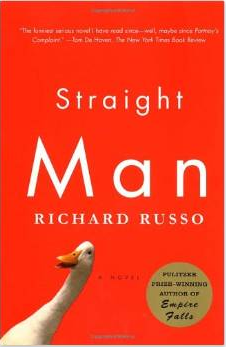
Cover for Straight ManSo far, I have enjoyed Empire Falls the most of Richard Russo’s novels, and Straight Man is at least also set in the rust belt, which he depicts so well. However, rather than being a depiction of small-town life, it is a rich spoof of academia. My husband, formerly the spouse of an academic, tells a joke, probably an old one, that the reason politics in academia is so vicious is that the stakes are so low. That these battles are being fought not on the campus of a great university but of an obscure college in a small Pennsylvania industrial town makes it more ironic.

William Henry Devereux, Jr., (Hank) sees himself as a bit of a rebel, although his rebelliousness mostly confines itself to snarky comments in faculty meetings and satiric opinion pieces on academic life in the local paper. He was once the author of a decently reviewed novel, but now he finds himself the interim head of the English department at a small Pennsylvania college.

Hank has been ignoring rumors that the college is to undergo stringent cuts on the grounds that the same rumors make the rounds every April. The faculty members in his department are constantly embattled, most recently over the job search for a new department head. Hank is better at enraging them than smoothing things over, and at the beginning of the novel suffers a wound to his nose when a professor hits him with her spiral notebook.

Maybe Hank wouldn’t have gotten himself into quite so much trouble, but his wife Lily is out of town on a job interview, and he is preoccupied by a possible kidney stone when he begins taking the rumors seriously. One of the reasons he has discounted them is that the college is breaking ground on an expensive new technology center and he can hardly believe they could claim financial problems requiring layoffs at the same time.

Such is the case, he finds, and with his department members all worried about their jobs, he chooses the groundbreaking ceremony to stage a protest, claiming he will kill a duck (which is in reality a goose) from the campus pond for every day he doesn’t get his budget. Soon he finds himself a minor media celebrity and a suspect of campus security when someone actually does kill a goose. In the meantime, his daughter’s marriage is imploding, he keeps imagining his wife is having an affair with the dean, his scholar father who years before deserted him and his mother for a graduate student is returning, and an attractive daughter of a colleague might be trying to seduce him. The events of this week force him to examine his relationship to his own life.

I found this novel both a bit over the top and amusing, as well as true. If I have a criticism, it is to wonder about some modern male authors’ fascination with bodily functions, and why they seem to think they’re funny. But I guess I can’t constrain this complaint to just novelists, because I’ve been staying away from comic movies for years for the same reason.

Related Posts

That Old Cape Cod Magic

Lucky Jim

The Bridge of Sighs

Day 657: The Fish Can Sing

Cover for The Fish Can SingÁlfgrímur is an orphan boy who has always known life in a simple turf cottage with his foster parents, Björn of Brekkukot, whom he calls Grandfather, and Grandmother. His grandfather lives a life of integrity, with no interest in ambition. Words are so important in their household, Álfgrímur explains, that they are only spoken to hide things.

Álfgrímur grows up with his only ambition to live in his grandparents’ cottage and fish for lumpfish with his grandfather. But his grandmother has other ideas, so when he is old enough, he goes reluctantly off to school.

Most of this novel is an account of everyday life at Brekkukot, peopled by the peculiar residents of the grandparents’ loft, some permanently there and others passing through. These people are all good but eccentric. For example, there is the Superintendent, whom Álfgrímur as a boy thinks is the superintendent of the entire city of Reykjavic but turns out to be in charge of the public toilets at the harbor.

Hanging on the wall of their neighbor Kristín’s cottage is the picture of a young man. When Álfgrímur asks about him, his grandparents answer “He was a nice little boy, that Georg,” Kristín’s son. But Georg is now Garðar Holm, a famous Icelandic opera singer. Garðar Holm seldom comes home. When he does and his patron schedules a concert, he never appears, but he does take an interest in Álfgrímur. Álfgrímur can sing and he wants to learn to sing “one true note.”

In this novel, Laxness is interested in exploring the tension between fame and obscurity, but he is also interested in the importance of morality and honest dealing. Serious as its intent is and primitive as are the characters’ surroundings, this is not at all a grim novel. It is told with a wry and ironic sense of humor and is full of colorful characters. With Laxness, you can be sure that there is plenty going on beneath the surface of things.

Related Posts

Independent People

Cod: A Biography of the Fish That Changed the World

The Beautiful Mystery

Day 649: The Death of Bees

Cover for The Death of BeesBest Book of the Week!
It may take some fortitude for readers to get past the foul language and bad behavior at the beginning of this novel. But I think most readers will feel it is worth it to have read this dark, funny, and ultimately touching little modern gothic novel.

Marnie and her younger sister Nelly find themselves with a problem. Their parents are dead, and they have already once experienced the joys of the foster care system. So, the two girls bury their mother Izzy in the back garden and hide their father Gene in the shed.

Izzy hung herself, but it is not altogether clear for quite some time what happened to Gene. The couple were terrible parents in any case, Izzy a self-obsessed, neglectful addict and Gene also an addict and molester of his own daughters. The two girls will do their best to take care of themselves until 15-year-old Marnie can do it legally.

Lennie, the old man next door, is a social outcast. After the death of his long-time partner, the lonely Lennie was once tempted by a male prostitute, only to be arrested and charged because the prostitute was a minor. Lennie doesn’t see that well anymore, so although he knew the man was young, he didn’t know how young and feels thoroughly ashamed. Despite his poor eyesight, Lennie is the only person who notices that the two girls are on their own. Soon, he is inviting them over and feeding them, happy to have someone to cook for.

The meat of the novel is the characters of these three. Marnie is brash, foul-mouthed, and smart. She is determined to protect her unworldly sister. But she is more vulnerable than she seems.

Nelly speaks like someone out of a Jane Austen novel and seems strangely clueless for a girl growing up in a tough Glaswegian neighborhood. She has a tendency to see only what she wants to.

Lennie misses his partner. He is meticulous but still ready to open his house to the two teenage girls.

Marnie’s world is populated with drug dealers, butch girlfriends and unreliable boyfriends, a best friend who was ready to run off with her father, and other difficult personalities. As Lennie’s dog Bobbie insists on digging up the bones in the garden and the girls evade questions about their parents, they both learn who they can love and depend upon.

Related Posts

NW

All the Birds, Singing

Mercy Snow