Day 1090: The Vicar of Wakefield

Cover for The Vicar of WakefieldI originally selected The Vicar of Wakefield for my Classics Club list because I was trying to choose a few works from different centuries. For the 18th century, I selected this novel and a few others.

Apparently, there is some debate among scholars about whether to take this novel straightforwardly as a sentimental work or to view it as a satire of sentimental novels. Since it reminds me of nothing so much as Candide, I take it as a satire. Even the title is confusing, since the vicar leaves Wakefield for another town early in the novel.

Reverend Primrose leads a comfortable life with his family as the Vicar of Wakefield. His own private fortune is enough that he has made over his salary to various charities. However, early in the novel, he loses his fortune when the merchant he has invested it with runs off. At that point, he leaves Wakefield and his considerable salary for a much smaller salary in another town. Why he does this instead of using his salary for himself is unclear.

Although the family is now poor, Primrose is determined that they can still live happily if they simplify their lives. However, some of his family are not willing to simplify, and their troubles are not over. His oldest boy, George, has had his engagement broken off by his fiancée’s father. And things even get worse. From here on, every decision they make turns out poorly, touching everyone in the family. In fact, though trusting and ready to see the good side of everyone, Primrose shows himself to be remarkably poor in judgment. The family is cheated, deceived, and persecuted by enemies. All the time, though, Primrose tries to see the good in every situation.

This short novel moves along nicely and has a charming though inconsistent narrator in Reverend Primrose. Its narrative is occasionally interrupted, though, by philosophizing and sermonizing, which I found tedious. Some of the plot twists and masquerades are easy to predict, but overall the novel is lively and a bit silly.

Related Posts

Robinson Crusoe

The Antiquary

The Necromancer

Day 1083: Everybody’s Fool

Cover for Everybody's FoolBest Book of the Week!
I don’t think I am the only one to be delighted when I learned that Richard Russo was returning to the familiar ground of North Bath, New York, and Sully, of Nobody’s Fool. Sully has been diagnosed with a heart condition and has less than two years to live unless he undergoes a procedure he’s been avoiding. This situation leads him to consider a little more deeply some fundamental questions.

Sully’s friend Rab has felt a change in their relationship since Sully came into money. They no longer work together, and Rab feels that Sully neglects him. Rab is ridiculously dependent on him.

Sully is concerned for Ruth, his long-time lover, and her daughter, Janey. Janey’s abusive ex-husband is back in town, fresh out of jail.

A major character of the novel is Douglas Raymer. Once the rookie who waved his gun at Sully for driving on the sidewalk, Raymer is now the chief of police.  He has always been obsessively self-conscious and unsure of himself. His self-esteem has not been improved by finding out on the day of his beloved wife Becka’s death that she was leaving him for someone else. The problem is, he doesn’t know who, but he has found the remote for someone else’s garage door under the seat of Becka’s car.

Raymer is already considering quitting his job when he begins one of the worst days of his life. While attending the funeral of a judge, he passes out from the heat and falls into the grave. Later he realizes that he must have dropped the remote, which he planned to use to find Becka’s lover, in the grave.

Russo is great at creating flawed but lovable and believable characters, and he specializes in settings of beaten-down working class towns in the rust belt. He also doesn’t flinch from pushing his characters to the heights of absurdity, in a sort of tongue-in-cheek style. Sometimes he goes too far with this, but other times it works perfectly to produce a serio-comic effect. This is one of those times. Empire Falls remains my favorite Russo novel, but this one is right up there.

Related Posts

Empire Falls

Bridge of Sighs

Straight Man

Day 1076: Money to Burn

Cover for Money to BurnIt may be difficult to find a book by Elizabeth Cadell these days (it was when I wrote this, but I find now that someone is republishing them), but if you want something that is totally light and fluffy, a gentle, amusing romance with funny characters and a hint of a mystery, you can do no better than this author, whose heyday was in the 1950’s-70’s. Money to Burn features the vague young lord Raymond Trysting and his sister Auriol, their Canadian cousin Leigh Anderson, and three eccentric aunts.

When Leigh comes to the village of Cammertree to visit, he finds all of his relatives impoverished and Raymond and Auriol living in primitive circumstances. The odd old aunts are obsessed by their own interests and Auriol is disorganized and incompetent in the housekeeping department. She only knows how to cook eggs. Raymond is mild-mannered and seemingly lazy, but he has a shadow hanging over him. Trysting Mansion, the family seat, has just burnt down, and no one knows what happened to the £13,000 of insurance money the family received. Raymond and Auriol’s father has recently died and with him the secret of the money. And whatever happened to the historic family silver, which has also disappeared?

Leigh finds himself attracted to the beautiful Auriol, but the family problems are almost too difficult to contemplate. And Auriol has already rejected three suitors, so there’s no telling if she will accept Leigh.

With lots of fun, amusing dialog, and eccentric characters, Cadell’s books offer a refreshing change of pace.

Related Posts

Friday’s Child

Pigeon Pie

The Diary of a Provincial Lady

Day 1062: Today Will Be Different

Cover for Today Will Be DifferentI so much enjoyed Where’d You Go, Bernadette that I was really looking forward to Today Will Be Different. That said, this novel bears many of the same characteristics as the previous one while lacking its originality of expression.

Like Bernadette, Eleanor Flood is also a once-successful professional who is now leading a depressed life as a Seattle housewife and mother. At one time she lived in New York and was the animation director for a successful cartoon series. After the series was cancelled, she agreed to move to Seattle for ten years for her husband’s career as a hand surgeon and sports team doctor. She has been depressed because of her alienation from her sister, Ivy.

The morning of the story, she wakes up determined to do better. Soon she notices that her husband, Joe, is behaving oddly. She thinks she has a lunch appointment with an annoying friend only to realize it’s with a man she once fired from her show. And her eight-year-old son Timby is faking illness to get out of school.

When Eleanor takes Timby to Joe’s office, she finds that he has told his employees the family is on vacation. Where is Joe and what is he up to?

One of my issues with this novel is how most of Eleanor’s problems get solved in one day. Of course, this novel is meant to be light and funny, so something like that has to happen. I guess it’s more my problem with a whole genre of fiction. Still, I felt sympathy with Eleanor and liked most of the characters. I missed the zingers about Seattle from Bernadette, which I understood even though I have only been there a few times. Instead, Semple replaces this kind of thing with Eleanor blaming herself for her New York sense of superiority.

So, a middling review for this one.

Related Posts

Where’d You Go, Bernadette

To Rise Again at a Decent Hour

The Interestings

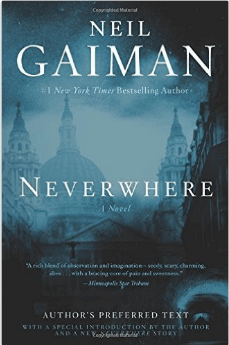
Day 917: Neverwhere

Cover for NeverwhereI haven’t read any Neil Gaiman except a book about a witch that he wrote with Terry Pratchett. That one was very silly, but I thought I should read some more Gaiman since he is so popular. I should maybe mention that fantasy is not usually my genre, with notable exceptions.

Richard Mayhew is happy with his life. He is a successful young investment counselor and is engaged to a beautiful but demanding woman. One night when they are on the way out for an important dinner with his fiancée’s boss, he finds an injured girl lying on the sidewalk. The girl is filthy, and Richard’s fiancée wants him to call an ambulance and leave her there. But Richard picks her up and takes her to his apartment.

We have already met the girl, being chased by two villains named Mr. Croup and Mr. Vandemar through dirty dark tunnels. When the two men come to Richard’s apartment looking for the girl, he says she is not there.

The girl’s name is Door, and she asks Richard if he will go somewhere for her and fetch the Marquis de Carabas. Doing this favor takes him to a strange world underneath London. Richard returns Door to the Marquis, but once she is gone, he realizes he can’t return to his own world. When he tries to, people can’t see him. He finds he has no job, no fiancée, and his flat is in the midst of being let to someone else. He returns to the other world to get help from Door.

Door is the daughter of Lord Portico, a family famous for opening things. Recently, her entire family was slaughtered by Croup and Vandemar, and she wants to find out who ordered it and why. When she returns home to find her father’s diary, it tells her to go to Islington, a legendary angel. Richard finds himself accompanying Door, the Marquis, and Door’s bodyguard Hunter on a dangerous quest through this alternate world that makes its home in the London underground, with characters whose names play on the names of underground stations.

At times this novel seems quite juvenile. In fact, partway through I started trying to figure out if it was intended for adults at all. This is because the humor often seems to be aimed at 14-year-old boys, for example, a villain who is constantly eating live slugs and pigeons. But the Introduction states that it is meant for adults, to do for them what books like the Chronicles of Narnia did for Gaiman as a child.

For this adult, anyway, it fails. I was mildly sympathetic to Richard’s plight, but the book doesn’t do enough with the characters to get us more interested in them. And I wasn’t enamored of Gaiman’s vision of a filthy, mud-filled underworld of strange beings.

Related Posts

Good Omens: The Nice and Accurate Prophecies of Agnes Nutter, Witch

The Night Circus

The Summer Tree

Day 892: Wild Strawberries

Cover for Wild StrawberriesThis title does not refer to the Ingmar Bergman film but to the second (or third, depending on where you look) Barsetshire novel by Angela Thirkell. Unlike the others I’ve reviewed lately, Wild Strawberries was written before World War II. It is a delightful and gentle comedy with a romantic triangle.

Wild Strawberries is about a summer with the Leslies. Lady Emily is universally adored, a vague woman always leaving a trail of her possessions behind. She is also a managing type whose attempts to arrange things that are already decided repeatedly throw the family into chaos. The novel opens with a hilarious scene in which the family is late for service and disrupts the sermon while Lady Emily tries to tell everyone where to sit. Lady Emily is the mother whose passing is much lamented in Enter Sir Robert, which I reviewed a few months ago.

And if I am not mistaken, Agnes, a daughter of the house, is the same Lady Graham who is a major character in Enter Sir Robert, and as in that novel, Robert is continually referred to but not present. Agnes is a young mother with three children, kind but silly, and entirely obsessed with the children.

Other members of the household are Mr. Leslie, gruff but kind, sons John and David, and grandson Martin. Martin is the son of the Leslies’ deceased oldest son. John is a widower who has been mourning his wife Gay. David is a charming but selfish playboy.

The Leslies have invited Mary Preston to spend the summer with them while her mother recuperates at a spa on the Continent. Mary is Agnes’s niece by marriage, and her affections play a major part in the plot. She is a young, naive girl who is immediately charmed by David. John, on the other hand, falls in love with her when he hears her singing. We find ourselves rooting for John, but in Thirkell’s novels, the characters we like best are not always successful in love.

Providing humor are a visit from Mr. Holt, a toady to the upper class and expert on gardens, who invites himself to visit the Leslies, and the establishment at the vicarage of a French family. Seventeen-year-old Martin gets himself embroiled in a demonstration to restore the French monarchy, and Mr. Holt finds himself rewarded for his gate-crashing by being entertained by Agnes and her children.

This is a delightful novel with sympathetic and engaging characters and a great deal of humor. I enjoyed it very much.

I have to say that my Moyer Bell edition (not the one pictured above) was riddled with typographical errors, including a chapter that literally ended in the middle of a word, to be completed after the next chapter title. I just picked this up at a used bookstore, but next time I buy Thirkell, I will look for a Virago edition.

Related Posts

Enter Sir Robert

Miss Bunting

Happy Returns

Day 883: Salmon Fishing in the Yemen

Cover for Salmon Fishing in the YemenI enjoyed the movie Salmon Fishing in the Yemen, a light romantic comedy, so I picked up the novel. Although most of the same elements are there, the novel is a bit darker and more satirical, the emphasis on government idiocy.

Dr. Alfred Jones is a scientist for the National Centre for Fisheries Excellence. He loves his work but is taken aback when he receives a letter about assisting with a project to establish salmon in the Yemen, to be sponsored by a wealthy sheik. Fred thinks the idea is scientifically absurd and ignores it.

But government officials in the prime minister’s office get wind of the project and see it as a possible source of good publicity about the relationship between the U.K. and the Middle East. The outcome is that Fred is ordered to follow through on the project.

Fred is pleasantly surprised at the apparent competence of the project manager, Harriet Chetwode-Talbot, but it is when he meets the sheik that he begins to have an interest in the project. The sheik is a devoted fisherman who has an outlandish but possibly feasible plan for his project.

Fred’s marriage isn’t going smoothly. His no-nonsense wife Mary has accepted a temporary posting to Geneva without consulting him. She is far better paid than he is and is dismissive in her attitudes toward his career, even when a political shift toward the project gets him fired and he is taken on by Harriet’s company at a lot higher salary.

Harriet also has some personal problems. Her fiancé Robert has been posted somewhere in the Middle East, and she is no longer receiving his letters. Nor can she get any information about him from the Marines.

This novel is epistolary, told completely in emails, Fred’s diary entries, letters, transcripts of interviews, and newspaper articles. It is occasionally funny, almost ridiculously satirical, and a little bit sweet. However, if you are hoping for the movie ending, you will be disappointed, because in the movies, the boy always has to get the girl, especially if he’s played by Ewan McGregor. In fiction, things can be more complicated.

Related Posts

To Rise Again at a Decent Hour

The Descendants

Major Pettigrew’s Last Stand

Day 876: The Diary of a Provincial Lady

Cover for Diary of a Provincial LadyBest Book of the Week!
The Diary of a Provincial Lady was popular again quite a few years ago, but I didn’t read it then. Now that I have read it, I wish I’d read it earlier.

Considering that I have little in common with a 1930’s suburban upper-class English housewife and mother struggling with servant problems, I found this novel very funny.

The novel begins with a visit from Lady B., for whom the narrator’s husband Robert works as a land agent. Lady B. is in turn patronizing and demanding, first nearly sitting on the indoor bulbs, then questioning where the narrator got them and telling her where she should have got them, then telling her it’s too late to plant them anyway. The bulbs appear throughout the novel as a running joke. They get moved to the basement and then to the attic, are over-watered and under-watered, get stepped on by Robert when he is bringing down the suitcases, and are nibbled by mice. What they don’t do is bloom.

The house is made lively by a constant stream of visitors, including Our Vicar’s Wife, who always must be getting along but stays another hour. Another less pleasing visitor is the hearty Miss Pankerton, who barges her way into invitations and thinks nothing of bringing along an extra three people and two dogs on what was supposed to be a family picnic.

The narrator has two lively children—Robin, who makes frequent visits from prep school, and Vicky, who is at  home with a very French governess, Mademoiselle. I had to break out Google Translate for Mademoiselle, who continually manages to insult her employer and persists in being overly dramatic.

The narrator’s husband is taciturn except when complaining about expenses or the condition of the house, but he never denies her and is often kind. Many paragraphs, though, end with “Robert said nothing,” which begins to be very funny after a while. In fact, there is a lot that Robert finds nothing to say about. Meanwhile, the poor narrator is constantly scrambling for money, hocking her grandmother’s jewels and so on, to be able to keep up a decent appearance.

To some extent Delafield is depicting types but they also seem like real people, very funny real people. Delafield’s sense of humor is dry. Particularly amusing are her memos to herself and her queries. For example, after arguing with the children about washing up for tea:

(Mem: Have sometimes considered—though idly—writing letter to The Times to find out if any recorded instances exist of parents and children whose views on this subject coincide. Topic of far wider appeal than many of those so exhaustively dealt with.)

All I can say is, I can’t tell you how many times a page I chuckled, or just plain laughed out loud.

Related Posts

Where’d You Go, Bernadette?

Love in a Cold Climate

The Pursuit of Love

Day 828: Sex and Stravinsky

Cover for Sex and StravinskySex and Stravinsky is about two families that live far apart from each other but eventually meet. Caroline and Josh live in England with their daughter Zoe, while Hattie and Herman live in South Africa with their daughter Cat.

Caroline is Australian, tall, beautiful, and vastly capable. All her life she has been striving to please her mother, who continues to favor her other daughter Janet. Caroline leaves Australia to study in England and eventually marries Josh, a small, mild-mannered theatre academic. They struggle financially for their first few years. They are just able to afford their own house when Caroline’s mother moves to England without warning. She demands that they buy her a house and give her an allowance, and they seem unable to resist her commands. So, they continue struggling, living in a bus even though they have two professional salaries.

Hattie was Josh’s girlfriend until she met Herman. She was a ballerina despite the lack of support from her family. But when she married Herman, she started teaching and began writing a series of children’s books about a girl who wants to dance. Herman, a wealthy businessman, is away on business most of the time, and Hattie’s teenage daughter Cat treats her with contempt.

Caroline and Josh’s daughter Zoe has always wanted to learn ballet, and she adores the ballet series written by Hattie, who was Josh’s first love. But Caroline thinks Zoe is being silly about wanting to dance, even though Josh’s career deals heavily with ballet. Caroline says that in any case they can’t afford ballet lessons.

When Josh goes to a conference in South Africa, he reconnects with Hattie. Caroline finds out something shocking about her mother that sends her flying to South Africa to find Josh; Hattie finds out her lodger has a secret identity.

Trapido’s novels are witty and engaging. I always love them. They are sparkling with amusing dialogue, they have likable and not so likable characters, but ones that seem to be real people. Trapido continues to be one of my favorite writers.

Related Posts

Brother of the More Famous Jack

The Travelling Hornplayer

The Weird Sisters

Day 778: This Is Your Life, Harriet Chance!

Cover for This Is Your Life, Harriet ChanceA few years ago, I read Jonathan Evison’s West of Here. This Is Your Life, Harriet Chance! is nothing like it. It’s a somewhat whimsically told story of the whole of one woman’s difficult life.

Harriet Chance is a widow nearing 80 whose husband died a few months before from Alzheimer’s. She gets a call from a cruise company telling her that her husband booked a cruise to Alaska for two. At first, she has no intention of going, but then she decides to take her best friend, Mildred.

Her friends and family are a little concerned, because she claims she is being haunted by her husband, Bernard. Harriet is a little worried that they want her to enter the retirement community where Mildred lives. She loves her home and doesn’t want to leave. Besides, Bernard is haunting her.

When Mildred’s son arrives to pick Harriet up for the cruise, she learns that Mildred isn’t coming after all. Instead, Dwight gives her a letter to open on the ship. Harriet isn’t going to like what it says.

link to NetgalleyTold in a way that is supposed to remind us of the old TV show, “This Is Your Life,” the novel skips backward and forward to scenes from Harriet’s ordinary-seeming but painful life. This narrative technique is anchored by the story of the cruise, which is told linearly.

I found this novel touching, although in some ways the narrative style creates distance from the story. It’s a serious story told as if it’s a comedy, with bumbling, repentant Bernard as a chorus in ghost form.

Related Posts

West of Here

A Heartbreaking Work of Staggering Genius

Sweet Caress