Day 492: The Life and Times of the Thunderbolt Kid

Cover for The Life and Times of the Thunderbolt KidThe Life and Times of the Thunderbolt Kid is billed as a memoir, but it is even more a collection of information and odd facts about 1950’s America, each chapter headed by a strange newspaper clipping from the time. This book is one of nostalgia similar to the work of Jean Shepherd, the humorist whose works centered on a slightly earlier time and author of the books that spawned A Christmas Story.

The memoirs bear many similarities to Shepherd’s, possibly because of the similarities in the imaginations and predilections of young boys, although Bryson’s continue on into the 1960’s and lose a lot of their innocence as the boys become obsessed with gaining glimpses of naked women and stealing beer. I’m guessing that a lot of the humor, with its emphasis on body functions and pranks, would be more amusing to men than to women.

Still, I found the book mildly funny. It turns out that I am roughly one month older than Bill Bryson, so I can vividly remember many of the things that Bryson relates as curiosities, clambering under our desks for the absurd air raid drills, for example, or going to view model air-raid shelters. Bryson grew up in Des Moines, a much bigger town than my own, so his memories are a little more urban than mine.

One place where my memory differs from his is in his repeated assertions that the Russians would never bomb Des Moines. When I was in the seventh grade, I distinctly remember being forced to watch an “educational” film during which we were informed that our town was among the top three bombing targets in the country (which is, of course, absurd, but we believed it). My subsequent informal research (occasionally asking people) has lead me to believe that every school child in America was told the same thing.

Readers Bryson’s age can take a brief look back through time in an afternoon of light reading. Younger readers might be surprised at some of the tidbits Bryson has uncovered, but they were no surprise to me.


Day 481: St. Lucy’s Home for Girls Raised by Wolves

Cover for St. Lucy'sDifficulties of youth and adolescence are the themes of Karen Russell’s unusual collection of short stories. Many of them are set in the Florida Everglades among bizarre and tacky theme parks or tourist destinations, where children sled through the sand on crab shells or visit enormous conches.

The first story, “Ava Wrestles the Alligator,” provides an introduction to the two sisters who are more fully developed in Russell’s later novel Swamplandia! Abandoned momentarily at their Everglades theme park home, Ava has a murky encounter with the Bird Man and tries to rescue her sister Osceola from her ghost lover. That story is expanded in the novel, which I really enjoyed.

Although certainly all are unusual, some of the stories are more bizarre than others. In “from Children’s Reminiscences of the Westward Migration,” a 19th century family makes a difficult crossing west, their wagon pulled by their father, the Minotaur. In the title story, human children of werewolves are sent away to be raised by nuns so that they can have a better life than their parents.

Russell’s stories are at once peculiar and oddly touching, full of young misfits who are even more out of place than all adolescents think they are. At times funny, such as the descriptions of the wolf-girls’ canine behavior when trying to adjust to their new school, the stories all reverberate with longing. Russell’s writing is brilliantly fierce and original, sparked by her own peculiar vision.

A few of the stories felt to me as if the author was just trying to think of the strangest ideas possible, and she almost lost me in “Lady Yeti and the Palace of Artificial Snows.” But ultimately, I enjoyed the stories, although I prefer the more developed characters and plot of Swamplandia!

Day 477: The Fault in Our Stars

Cover for The Fault in Our StarsBest Book of the Week!
It seems as if I have read more books lately from which I do not get a sense of the characters’ personalities. I don’t feel as if they could be real people but just projections of the author’s plot. But that is not the case with The Fault in Our Stars, which creates for us some unforgettable personalities.

Hazel Lancaster is a sixteen-year-old with thyroid cancer that has spread to her lungs. Unlike the other kids in the support group her mom has talked her into attending, she doesn’t have any hope of survival. She just wants to live as long as she can. At the group, she meets Augustus Waters, a seventeen-year-old ex-basketball player who has lost one leg to osteosarcoma but has a generally good prognosis.

Hazel is witty, smart, and well read. She is obsessed with a novel called An Imperial Affliction by Peter Van Houten, which is about a young girl suffering from a fatal illness, and literally ends in the middle of a sentence. As she and Augustus discuss their favorite books, Hazel explains that she just wants to know what happened to everyone else in the novel. Augustus decides to use his wish from the Genie Foundation to take Hazel to Amsterdam, where she can meet Peter Van Houten and find out what happened after the novel ended.

This novel is about teenagers falling in love, and rarely has fiction depicted two more appealing people. My one very small criticism is that they are scarily smart and funny, in intelligence reminding me more of Salinger’s Glass family than of normal kids. But Green has got the juvenile speech patterns down.

Frightfully well written, touching, funny, and ultimately sad, this novel has much to offer teens, young adults, and adults. Hazel and Augustus are affectingly human, and even Hazel’s parents, those cumbersome quantities so often ignored or eliminated in children’s or young adult fiction (note, for example, how much we see of Bella’s father in Twilight), are deftly characterized by their affectionate jokey interactions with Hazel.

Again, I feel that my capabilities are stretched here in my inability to adequately express how good this novel is. When I first started reading it, I was afraid of manipulation, as there seem to be a lot of “affliction of the month” children’s books out there right now, but that feeling left me almost immediately.

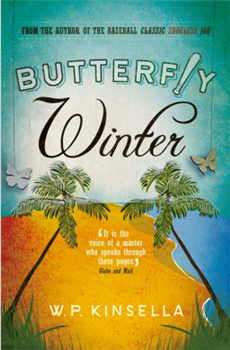
Day 431: Butterfly Winter

Cover for Butterfly WinterI have to start right out by saying that Butterfly Winter was a poor choice for me. W. P. Kinsella is beloved by many, and I know that people are excited that this is his first novel in fifteen years. However, I should have known better than to select a book by the “master of magical realism,” as one reviewer put it, because I have a problem with magical realism. It is a very tough sell for me. I have to be fully bought into the realism before I can accept the magic. In the case of this novel, though, I don’t even think it can be called magical realism, because the realism was left out.

This novel is about baseball. That shouldn’t be a problem, although I am not a sports fan. I was willing to be wooed by The Art of Fielding into at least grasping that it can be pretty fantastic. But Kinsella doesn’t try to convince us of that. He just posits that it is wonderful and magical and obviously thinks everyone should agree with him.

I think I could have dealt with either of these two issues, but the first chapter of this novel, where the Gringo Journalist is trying to interview the Wizard, and the Wizard refuses to answer his questions but goes off on a bunch of tangents, is the most annoying piece of writing I have ever read. The novel picks up a little in the second chapter when it changes to a narrative style and picks up again every time it returns to that style, but unfortunately the irritating voice from the first chapter is the novel’s primary narrator. The tone of the novel is arch, to me a little forced, and the humor unsubtle.

http://www.netgalley.comNow to the story. Julio and Esteban Pimenthal are twins who play baseball in their mother’s womb (a wince-inducing image). One of them is born with cleats on, and the other with a baseball glove. (I think it is safe to say that only a man would have thought of that.) They are inhabitants of Courteguay, a fictional country wedged between Haiti and the Dominican Republic where magic is commonplace. (Silly me, when I read “magical Caribbean island” in the blurb, I was thinking scenery and beauty.) When Julio and Esteban are ten years old, they travel to the United States to play pro ball. But first we hear about the Wizard and how he came to the island in the late 19th century and introduced baseball to it.

I have to admit, I did not finish this book. I’m sure that many will think it delightful, but I found the narrative style too annoying to continue. This novel was the wrong one for me to choose to become acquainted with Kinsella.

Day 397: Sylvester, or the Wicked Uncle

Cover for SylvesterOn occasion, I reread a few of Georgette Heyer’s Regency romances, which have been some of my favorite reading for many years. Just recently, I reread Sylvester, which in some editions is titled Sylvester, or the Wicked Uncle.

The extremely eligible bachelor Sylvester, Duke of Salford, has decided to take a wife. His only difficulty is in deciding which of five eligible girls to marry. When his beloved mama mentions that she and her best friend made a plan for their children to marry many years before, he decides to go inspect the girl, his godmother’s granddaughter, to see if he might like her. Although he is warm and thoughtful to those he cares for, since his twin brother’s death, he has been aloof to others and comes off as haughty.

Sylvester’s visit is disguised as a hunting party, but Phoebe Marlow is informed by her detestable stepmother that the duke is coming to make her an offer. Unfortunately, Phoebe has already met Sylvester and took such a dislike to him that she used him as the villain in a novel she wrote. That novel is going to be published, despite all expectation. Normally, she would not expect him to recognize himself in a silly gothic romance that pokes fun at various society figures, but for the mention of Sylvester’s very distinctive eyebrows.

Fearful of her stepmother’s pressure and not understanding that Sylvester has no intention of proposing, Phoebe talks her childhood friend Tom into escorting her to her grandmother’s house. However, an accident and a snowstorm strand her and Tom with Sylvester in a small country inn.

After Phoebe gets to know and like Sylvester, she is horrified to find out that he has a nephew, since in her silly romance his character is a wicked uncle who wants to steal his nephew’s fortune. Another horror lurks, because Phoebe’s book proves to be a smashing success, much read by society members, who are all trying to identify their friends. Since Phoebe has never brought herself to admit to Sylvester that she wrote a book, she soon fears that people will find out she is the author.

Heyer creates delightful, engaging characters and puts them into silly and unbelievable situations, which is part of the pleasure of reading her novels. They are very well written, with entertaining and sparkling dialogue and a complete understanding of the customs, dress, and speech of the period. If you decide to read Sylvester, get ready for some fun. Many of Heyer’s novels have been re-released in the past few years, so they should not be hard to find.

Day 396: Back to Bologna

Cover for Back to BolognaThe Aurelio Zen series begins as fairly traditional mysteries featuring the bemused Italian detective. Gradually, they become more and more comic. In Back to Bologna, Dibdin presents us with more of a spoof than a mystery novel.

Zen is not feeling his normal self. He is just recovering from a stomach operation, and he is also coping with troubles with his girlfriend, Gemma. She is leaving for Bologna to meet her son when Zen is also recalled to duty and sent to Bologna to solve the murder of a football team owner.

The victim is Lorenzo Curti, a millionaire entrepreneur who was found dead in his Audi, stabbed by a Parmesan cheese knife. Zen actually has little desire to investigate. His main reason for coming to Bologna is to keep an eye on Gemma.

A ridiculous situation is created by a celebrity cook-off between local semiotics professor Edgardo Ugo and the singing TV chef Romano Rinaldi, or Lo Chef. Ugo has suggested in a newspaper article that Lo Chef can’t cook, which has sparked a rivalry and this competition. Gemma gets tickets to the cook-off, and Zen ends up being arrested after Ugo is shot in the wake of the comic event.

Dibdin presents us with a large cast of characters, including a rich student of Ugo’s who is an “ultra” football fan, the student’s illegal immigrant girlfriend “Princess Flavia of Ruritania,” and the worst private detective imaginable. Despite the large number of characters, the solution is not at all difficult to guess. 

Zen does very little detecting as we watch a series of incredible mishaps result in the murderer being delivered right at Zen’s feet. Although I found this novel mildly amusing, my interest in this series has been winding down, and I think this is a good place to stop.

Day 376: Where’d You Go, Bernadette

whered-you-go-bernadetteDespite the cover, Where’d You Go, Bernadette is not chick lit; however, it is a great beach read, and summer is almost over (except if you live in Texas, like I do)! This novel is quite a romp. It has a zany, ridiculous plot and is full of little jibes at such things as suburban mothers who are overly involved in their children’s schools, Microsoft, and Seattle.

Bee loves her mother, who is creative and funny, but Bernadette has managed to alienate the other mothers at Bee’s school. She is slightly agoraphobic, so she stays home most of the time and does not volunteer at school, and she has hired a virtual personal assistant to help her run errands, even though Bee’s father doesn’t approve. Bee’s father Elgie is a computer genius who is practically worshipped at Microsoft and is seldom at home.

Bee’s parents have promised her that if she gets perfect grades, she can have any gift she wants. She picks a trip for the entire family to Antarctica over Christmas. To Bernadette, the idea of such a trip is intimidating, but she thinks Bee deserves it, so she begins ordering supplies online and getting Manjula, her online personal assistant, to take care of travel arrangements.

However, Bernadette’s dispute with a neighbor (and school mom enemy) about blackberry brambles creates complications that are both appalling and hilarious. When Elgie gets drawn in, he misunderstands what is going on because of his ignorance of home events. Crisis ensues, and Bernadette disappears on the eve of the trip.

Elgie is convinced that Bernadette had a breakdown, but Bee refuses to give up on her mother. She decides to try to figure out what happened the last few weeks before her mother disappeared.

My description does nothing to convey how cheeky, inventive, and funny this novel is. It is told in an epistolary style through emails from Bernadette to Manjula, emails between plotting mothers who hate Bernadette, emails between Elgie and his administrative assistant, and Bee’s record of her search for her mother. Bee and Bernadette are appealing, even while Bernadette is going a little crazy. If I have one little quibble, it’s that I don’t believe the personality change that one character undergoes. Still, if you want something light and lots of fun, this is the book for you. I have to thank my friend Gunjan for this recommendation.

Day 353: Friday’s Child

Cover for Friday's ChildFriday’s Child is one of Georgette Heyer’s funniest Regency romances. Although some of her novels are a bit closer to being “serious” romances (that is, with the emphasis on the romance, but always with witty dialogue), this novel is endearing in its plethora of foolish characters.

Anthony Verelst, the Viscount Sheringham, is a wild young man who is extravagantly wasting his inheritance on gambling and women, but his estate is left so that he cannot touch the principal unless he marries. He has fancied himself in love with the current reigning beauty, Isabella Milbourne, but he is not tempted to matrimony until he becomes fed up with his mother and her brother, one of his trustees, whom he believes is milking his estate. He proposes to Isabella, plainly expecting an answer in the positive, but piqued by his lack of ceremony, she rebukes him for his dissipated lifestyle. In a rage, he storms off, vowing to marry the first female he meets.

As he is returning to London from his mother’s house in the country, he meets Hero Wantage, a very young lady who is an impoverished orphan and a neighbor. He thinks of her as a little sister, so he has no hesitation in relating the tale of his misfortunes. When he tells her of his vow, she answers, “Silly, that’s me!” So, the heedless viscount throws her up into his curricle and drives her off to London to get married. Since she has long worshipped the Viscount, or Sherry, as he is known to his friends, and has been mistreated by her Bagshot relatives, she is happy to go.

The couple is naturally headed for trouble, for Hero is completely naïve and badly brought up, with no idea of how to behave in society. The heedless Sherry seems to feel that he can go on about his business as always without paying much attention to her, so she begins befriending the wrong people and otherwise falling into scrapes.

This novel features an outstanding cast of secondary characters, especially Sherry’s close friends–Gil Ringwood, a thoughtful young man who vaguely feels there is something wrong with the way Sherry neglects his wife; Ferdy Fakenham, a silly but warm-hearted dunderhead reminiscent of Bertie Wooster; and George, Lord Wrotham, a hot-tempered gentleman who constantly challenges other men to duels and is madly in love with Isabella. As a side comment, I think it is a hallmark of a good Heyer novel that the characters who would be the heroine and hero in a typical romance novel (that is, Isabella and George) provide some of the humor in her own novels, especially the devastatingly handsome George, with his exaggeratedly romantic behavior.

Heyer is one of my favorites for light reading, and Friday’s Child makes me laugh out loud, particularly when Ferdy gets it into his head that he and Gil are being pursued by “that dashed Greek we learned about at Cambridge. Kept lurking about in corners,” in other words, Nemesis. The characters are funny, the dialogue is witty, and the plot is full of twists and turns.

Day 333: Pigeon Pie

Cover for Pigeon PieThis exceedingly silly book about Britain just before World War II has its amusing moments. Although it is not one of Mitford’s best, it still made me laugh out loud at times. The novel spoofs British high society, spy stories, and religious cults.

The heroine is Lady Sophia Garfield, a stupid, frivolous society matron who lives happily, mutually ignoring her husband, who admires Hitler. As events move toward war, she begins to suspect she has a nest of German spies in her home. Although no one believes her, she eventually manages to foil them.

One of the funniest moments for me has to do with Lady Sophia’s chief social rival, whom she distinctly remembers as the ordinary school girl Baby Bagg but who goes around pretending to be a Russian princess, Olga Golgothsky. Inclined to the theatrical, Olga frequently makes remarks about what would happen to her if she went to Russia–she says she would be handed over to the peasants to do what they please. Our heroine reflects on what Russian peasants must be like, thinking that if she were handed over to British peasants to do what they please, they would put her in the best bedroom and give her a cup of tea.

Day 315: Beyond Black

Cover for Beyond BlackI have liked almost everything I have read by Hilary Mantel but could not finish Beyond Black. It is supposed to be extremely black humor, which I usually enjoy, and the idea is certainly an entertaining one, but somehow I felt it went too far, at least for me.

Alison is a medium who travels the rounds of the psychic “fayres.” She actually does see and hear the dead. Alison meets Colette, an event planner, who she hires as her personal assistant. Soon, the two women are sharing a house in a suburban wasteland, where apparently all hell breaks loose. (I did not get this far in the novel.)

Mantel’s skewering of the “fayres” is amusing. Another clever idea in the novel is that the dead are a bunch of seedy characters obsessed with trivial things, just as are many people in life. However, after awhile the sheer bulk of the trivialities becomes overwhelming.

Alison’s spirit guide, Morris, instead of being the traditional Indian chief or swami, is the ghost of an actual hoodlum Alison knew when she was young. I could deal with the spirits constantly talking about minutia, but Morris was incredibly repulsive and disgusting. With the mundanity going over the top combined with my disgust at Morris, I stopped reading.